
5 Best Supplements for Liver Health: Science-Backed Repair vs. Marketing Myths

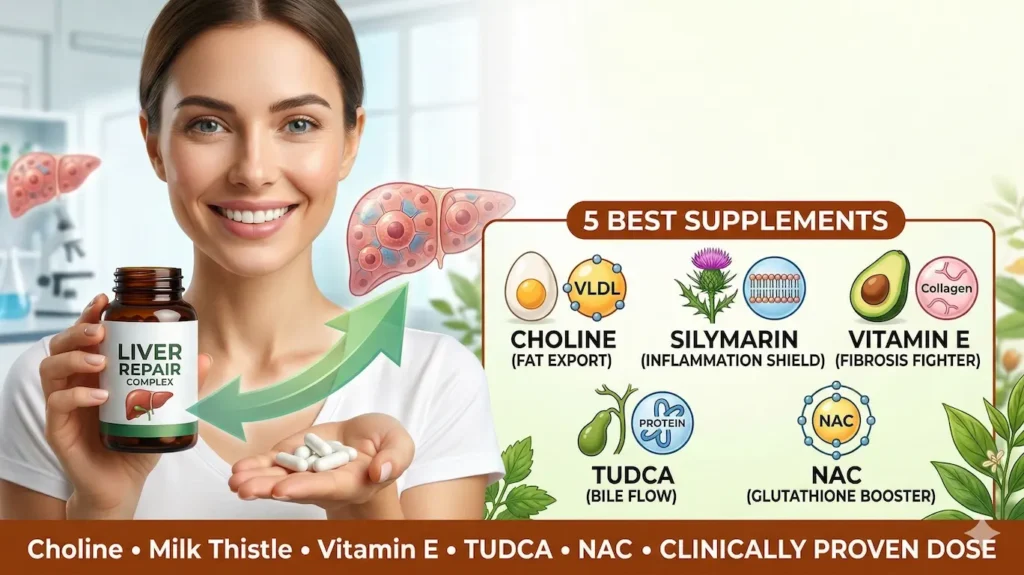
If you are searching for the 5 best supplements for liver health, you’ve likely realized that the “Liver Detox” market is a minefield of misinformation. Every day, millions of people buy “cleanse” teas and “detox” pills that have zero clinical evidence, while ignoring the specific micronutrients that actually trigger hepatocyte (liver cell) repair.
In 2026, we no longer guess; we use the latest nutritional biology to identify which compounds facilitate fibrolysis (the breakdown of scars) and which just create expensive urine.
The truth is, your liver doesn’t need a “cleanse”—it needs the raw materials to conduct its 500+ metabolic functions. When the liver is under siege by fat or inflammation (MASH), it consumes certain antioxidants and phospholipids at an accelerated rate.
If you don’t replenish them, repair stops, and scarring begins. In this 2,000-word audit, we reveal the only five supplements currently backed by 2026 clinical guidelines for moving the needle on liver fat and enzyme reduction.
The 2026 Standard: Why Most “Detox” Products Fail
The biggest myth in liver health is that you can “wash out” toxins with herbs. In reality, the liver detoxifies the body through two specific biochemical processes: Phase I and Phase II detoxification. Most commercial supplements only stimulate Phase I, which can actually create more toxic intermediates if Phase II (conjugation) isn’t supported by the right amino acids and antioxidants.
To make our list of the 5 best supplements for liver health, a compound must prove it can either:
- Reduce intrahepatic fat (steatosis).
- Lower liver enzymes (ALT/AST).
- Increase Glutathione (the master antioxidant) levels.
How to Choose a Liver Supplement: Evidence-Based Criteria
Based on the available research, here’s what to look for:
1. Transparent Ingredient Labeling
Avoid products with proprietary blends that hide individual ingredient amounts. You deserve to know exactly how much of each component you’re receiving.
2. Clinically Studied Doses
Look for amounts matching those used in research:
- Milk thistle: 200-500 mg (standardized to 70-80% silymarin)
- Curcumin: 500-1000 mg (with bioavailability enhancement)
- NAC: 600-1200 mg
- DHM: 300 mg [studies]
3. Third-Party Testing
Supplements aren’t FDA-approved before marketing. Look for products tested by independent organizations for purity and potency.
4. Bioavailability Technology
Key ingredients like curcumin and silymarin require advanced delivery systems for meaningful absorption. Look for nano-emulsion, liposomal delivery, or piperine inclusion [studies].
5. Realistic Claims
Be skeptical of any product promising “detoxification,” “cleansing,” or “cure.” Legitimate supplements support liver function—they don’t “clean” it.
1. Choline (The Fat Export Specialist)
Choline is the most underrated liver supplement in 2026. Without choline, your liver cannot produce VLDL (Very Low-Density Lipoprotein), which is the “bus” that carries fat out of the liver and into the rest of the body. When you are choline-deficient, fat becomes trapped, leading to MASLD.
- The 2026 Evidence: Research shows that up to 90% of the population is choline-deficient. In MASH patients, supplementing with Phosphatidylcholine has been shown to reduce liver fat by up to 20% in clinical trials.
- Best Form: CDP-Choline or Alpha-GPC for maximum bioavailability.
2. Silymarin / Milk Thistle (The Inflammatory Shield)
While often dismissed as “old school,” Milk Thistle (specifically the active compound Silymarin) remains one of the 5 best supplements for liver health due to its ability to stabilize liver cell membranes.
- How it Works: Silymarin acts as a gatekeeper, preventing toxins from entering the cell and stimulating protein synthesis to repair damaged hepatocytes.
- The 2026 Upgrade: Standard milk thistle has poor absorption. Look for Phytosomal Silymarin (Silybin bound to phospholipids), which has been shown to be 10x more absorbable than regular extracts.
3. Vitamin E (The Fibrosis Fighter)
In 2026, Vitamin E is not just a vitamin; it is a clinical intervention. It is the only supplement specifically recommended by the AASLD for non-diabetic adults with biopsy-confirmed MASH.
- Mechanism: It quenches the oxidative stress that turns simple fatty liver into the inflammatory state of MASH.
- Dosage Note: Clinicians typically use 800 IU per day for liver-specific repair, though this should always be monitored by a doctor due to its blood-thinning properties.
4. TUDCA (The Bile Flow Optimizer)
TUDCA (Tauroursodeoxycholic Acid) is a bile salt that is naturally found in the body in tiny amounts. For those with “sluggish” liver function or bile stasis, it is a game-changer.
- The Breakthrough: TUDCA acts as a Chaperone Protein, helping the liver cells fold their proteins correctly. When a liver is stressed, proteins become “misfolded,” leading to cell death. TUDCA prevents this “ER Stress,” making it essential for anyone with elevated GGT levels.
5. N-Acetyl Cysteine / NAC (The Glutathione Booster)
You cannot supplement with pure Glutathione effectively because the stomach breaks it down. NAC is the precursor that your liver uses to manufacture its own Glutathione.
- The 2026 Protocol: NAC is so effective at liver repair that it is the standard hospital treatment for acetaminophen (Tylenol) overdose. For daily support, it helps the liver neutralize environmental toxins and alcohol metabolites before they can damage DNA.
Why Your Liver Deserves Evidence-Based Support
Now let’s understand what we’re trying to achieve. Your liver performs over 500 functions daily—filtering toxins, metabolizing fats, regulating blood sugar, producing proteins, and storing essential vitamins [studies]. When it’s overwhelmed by poor diet, alcohol, medications, or metabolic stress, liver enzymes like ALT and AST can rise, signaling cellular stress or damage.
According to recent estimates, approximately 10% of the US population has elevated liver enzymes, with rates reaching as high as 50% among overweight and obese individuals [studies]. This explains why interest in liver support supplements has skyrocketed.
But here’s the critical distinction: supplements don’t “cleanse” your liver—they provide the raw materials your liver needs to function optimally. Think of them as nutritional support for your body’s hardest-working organ.
How to Combine the Top 5
To maximize your results, don’t just take one supplement. Clinicians in 2026 recommend the “Liver Repair Stack”:
- Morning: Choline (500mg) + NAC (600mg) on an empty stomach.
- Lunch: Vitamin E (400 IU) + Phytosomal Silymarin (150mg) with a fat-containing meal.
- Evening: TUDCA (250-500mg) to support bile flow during sleep.
The Science-Backed Ingredients That Actually Work
A 2024 systematic review and meta-analysis published in The American Journal of Gastroenterology examined 73 randomized controlled trials on herbal and dietary supplements for liver health [studies]. The findings were clear: certain ingredients demonstrate significant benefits, while others remain unproven.
1. Milk Thistle (Silymarin): The Most Studied Liver Support Ingredient
Milk thistle appears in 95% of top-selling liver supplements for good reason [studies]. Its active compound, silymarin, has been extensively studied for its hepatoprotective properties.
The Science: The meta-analysis confirmed that silymarin significantly reduces liver enzyme levels, with alanine aminotransferase (ALT) showing a standardized mean difference reduction of -0.7328 and aspartate aminotransferase (AST) showing -0.5584 [studies]. These are meaningful, clinically relevant improvements.
How It Works: Silymarin acts as a powerful antioxidant, protecting liver cells from oxidative damage. It also promotes protein synthesis in hepatocytes, supporting cellular regeneration and membrane stability [studies].
What Matters Most: Not all milk thistle supplements are created equal. Look for standardized extracts containing 70-80% silymarin, with specific attention to silybin—the most bioactive component. Advanced formulations using nano-encapsulation technology can increase bioavailability up to 26 times compared to standard extracts [studies].
2. Turmeric (Curcumin): Inflammation Modulation
Turmeric root appears in 65% of top liver supplements [studies], and for good reason. The meta-analysis confirmed curcumin’s effectiveness in reducing liver enzyme levels [studies].
The Science: Curcumin’s challenge has always been poor absorption. However, a 2025 randomized controlled trial evaluated a liquid formulation containing organic turmeric extract alongside dandelion, milk thistle, and ginger [studies]. Over 180 days, participants showed mean improvements in ALT, AST, ALP, and GGT that were significantly greater than placebo (P≤0.001), with no adverse events reported [studies].
Key Consideration: Look for formulations that address bioavailability—whether through black pepper extract (piperine), liposomal delivery, or nano-emulsion technologies. Without these enhancements, much of the curcumin you consume never reaches your liver.
3. Dihydromyricetin (DHM): The Metabolic Support Specialist
One of the most exciting developments in liver research involves dihydromyricetin, a flavonoid derived from the Japanese raisin tree.
The Science: A 2026 double-blind, placebo-controlled randomized clinical trial published in Annals of Gastroenterology followed 55 MASLD patients for 12 months [studies]. Participants receiving 300 mg/day of DHM (combined with vitamins C/E and choline) achieved significantly higher rates of combined ALT/GGT normalization (35% vs. 5%, P=0.028) [studies].
Beyond liver enzymes, DHM users experienced:
- Significant declines in glucose and HbA1c at 6 and 12 months
- Reduced total and LDL cholesterol
- Lower liver stiffness measurements at both time points [studies]
Why This Matters: DHM appears to address multiple aspects of metabolic dysfunction simultaneously—making it particularly valuable for individuals with MASLD (formerly known as NAFLD).
4. N-Acetylcysteine (NAC): The Master Antioxidant Precursor
NAC is a form of the amino acid cysteine that serves as a precursor to glutathione—your body’s most powerful internal antioxidant.
The Science: Glutathione levels decline with age, toxin exposure, and liver stress. By providing NAC, you’re giving your liver the building blocks it needs to maintain its antioxidant defenses. Advanced formulations pair NAC with selenium and zinc to support the enzymes that recycle and activate glutathione [studies].
5. Artichoke Leaf Extract: Bile Flow Support
Artichoke leaf extract appears frequently in comprehensive liver formulas, and research supports its role in supporting bile production and flow.
The Science: By promoting healthy bile flow, artichoke extract helps your liver eliminate fat-soluble toxins more efficiently. It also contains cynarin and luteolin, compounds with demonstrated hepatoprotective and antioxidant properties [studies].
The Supplement Matrix: How Ingredients Work Together
Modern evidence-based formulations don’t rely on single ingredients—they create synergistic combinations that address multiple aspects of liver health simultaneously. Here’s what a comprehensive approach looks like:
| Function | Key Ingredients | Clinical Evidence |
|---|---|---|
| Liver Cell Protection | Milk thistle (silymarin), selenium | Meta-analysis confirms ALT/AST reduction [studies] |
| Detoxification Support | NAC, glutathione precursors, artichoke | Supports phase I and II detox pathways |
| Inflammation Modulation | Curcumin, ginger | RCT shows significant enzyme improvements [studies] |
| Metabolic Support | DHM, berberine, chromium | 12-month trial confirms ALT/GGT normalization [studies] |
| Antioxidant Defense | Vitamins C/E, zinc, selenium | UK Biobank data shows reduced mortality risk [studies] |
What the Research Really Tells Us: Key Clinical Findings
The UK Biobank Study: Broader Health Benefits
A 2025 study published in Scientific Reports analyzed UK Biobank data from over 7 years of follow-up, examining multivitamin use in individuals with MASLD [studies]. The findings were striking:
- Multivitamin users showed a significantly lower all-cause mortality risk (HR: 0.88, 95% CI 0.81-0.95, P=0.034)
- Reduced risk of cardiovascular disease (HR: 0.72, 95% CI 0.68-0.76, P<0.001)
- Lower chronic kidney disease risk (HR: 0.73, 95% CI 0.67-0.81, P<0.001) [studies]
While liver-specific mortality didn’t show significant reduction, the broader protective effects suggest that comprehensive nutritional support matters for overall health in individuals with liver concerns.
The 180-Day RCT: Long-Term Safety and Efficacy
A rigorous 2025 randomized controlled trial evaluated a plant-based nutraceutical containing organic extracts of turmeric, dandelion, milk thistle, and ginger [studies]. Over 180 days, participants showed progressive improvements in all liver enzymes, with no adverse events reported [studies].
This matters because it demonstrates:
- Long-term safety with continuous use
- Sustained benefits over time
- The value of combination formulas over single ingredients
The Amazon Analysis: Caveat Emptor
The 2026 American Journal of Gastroenterology study that analyzed Amazon’s top 20 liver supplements revealed concerning findings [studies][studies]:
- All 20 products claimed to “eliminate toxins” or provide “liver detox/cleanse”
- 85% claimed to “enhance liver function”
- Average review reliability was only 73%
- 62% of negative reviews cited lack of perceived efficacy
- 19% reported adverse effects (mostly gastrointestinal) [studies][studies]
The takeaway? Consumer reviews are unreliable predictors of actual efficacy, and marketing claims routinely outpace scientific evidence.
Beyond Supplements: The Foundation of Liver Health
No supplement can compensate for poor lifestyle choices. Before investing in any product, ensure you’ve addressed the fundamentals:
Dietary Foundations
- Mediterranean-style eating pattern: Rich in vegetables, fruits, legumes, whole grains, and healthy fats
- Limit added sugars: Particularly fructose from sweetened beverages and processed foods
- Moderate alcohol: If you drink, do so in moderation (≤1 drink daily for women, ≤2 for men)
- Coffee: Multiple studies show protective effects—2-3 cups daily associated with reduced liver fibrosis
Lifestyle Factors
- Regular physical activity: 150+ minutes weekly of moderate activity
- Healthy weight: Even 5-10% weight loss significantly reduces liver fat
- Sleep quality: 7-9 hours nightly supports liver regeneration
- Stress management: Chronic stress increases inflammatory burden
FAQ: Featured Snippet Optimized
1. What are the 5 best supplements for liver health?
The 5 best supplements for liver health backed by 2026 clinical data are Choline (to export fat), Phytosomal Silymarin (to reduce inflammation), Vitamin E (to fight fibrosis), TUDCA (to support bile flow), and NAC (to boost glutathione).
2. What is the best supplement for liver health overall?
The most evidence-based approach combines multiple ingredients rather than relying on a single compound. Look for comprehensive formulas containing milk thistle (silymarin), curcumin with bioavailability enhancement, NAC, and artichoke extract. Clinical trials demonstrate that combination products significantly improve liver enzymes over 6-12 months of use [studies][studies]. The “best” supplement ultimately depends on your specific liver health goals and any underlying conditions.
3. Can liver supplements reverse fatty liver disease?
Supplements can support liver health and improve enzyme levels, but they don’t “reverse” fatty liver disease on their own. A 2026 clinical trial found that 35% of participants achieved combined ALT/GGT normalization after 12 months of targeted supplementation—significantly better than 5% with placebo [studies]. However, the most effective approach combines supplements with lifestyle changes: weight loss (5-10% of body weight), Mediterranean diet, regular exercise, and limited alcohol. Think of supplements as supportive tools, not standalone cures.
4. Are liver supplements safe for long-term use?
High-quality supplements with transparent labeling and third-party testing appear safe for extended use. A 180-day randomized controlled trial reported no adverse events with continuous use of a plant-based liver supplement [studies]. However, the 2026 Amazon analysis found that 19% of negative reviews cited adverse effects—mostly gastrointestinal [studies]. Safety depends on quality, dosage, and individual factors. Always consult your healthcare provider before starting any supplement regimen, especially if you have existing liver conditions or take medications.
5. How quickly do liver supplements work?
Clinical trials show measurable improvements within specific timeframes. In one study, participants showed significant liver enzyme reductions at both 6 and 12 months of supplementation [studies]. Another trial demonstrated progressive improvements throughout 180 days of continuous use [studies]. Individual response varies based on baseline liver health, lifestyle factors, and supplement quality. Most research suggests allowing 3-6 months to assess benefits, with regular monitoring of liver enzymes through blood work.
6. Do I need a liver cleanse or detox supplement?
No. The concept of “liver cleansing” or “detoxification” is marketing fiction—your liver is already your body’s detox system. All 20 top-selling supplements in a 2026 study claimed to “eliminate toxins” or “cleanse” the liver, yet scientific evidence supporting these claims remains limited and inconclusive [studies][studies]. What your liver actually needs is nutritional support to perform its natural functions optimally. Focus on evidence-based ingredients that support liver health rather than products promising dramatic “cleansing” effects.
7. Can I take liver supplements with other medications?
This requires careful consideration and medical supervision. Some herbal ingredients can interact with medications—for example, milk thistle may affect how the liver processes certain drugs. The 2025 UK Biobank study examined supplement use in over 7 years of follow-up but didn’t specifically address drug interactions [studies]. Always provide your healthcare provider with a complete list of supplements and medications to evaluate potential interactions. Never assume natural means automatically safe with prescription drugs.
8. What liver enzymes indicate I need supplements?
Elevated ALT and AST typically indicate liver cell stress or injury. The meta-analysis confirmed that supplements like milk thistle and curcumin significantly reduce both ALT (SMD -0.7328) and AST (SMD -0.5584) [studies]. ALP elevation suggests bile duct issues, while GGT often indicates alcohol-related stress or metabolic dysfunction. Normal ranges vary by laboratory, but generally ALT >40 U/L, AST >40 U/L, ALP >120 U/L, or GGT >60 U/L warrant discussion with your healthcare provider. Don’t self-diagnose—proper evaluation requires understanding the pattern of elevation and underlying causes.
The Bottom Line on Liver Supplements
The liver supplement market generates nearly $40 million annually, yet most products lack rigorous scientific support [studies][studies]. However, certain ingredients—milk thistle, curcumin, DHM, NAC, and artichoke—have demonstrated meaningful benefits in controlled trials [studies][studies][studies].
The most effective approach combines:
- Evidence-based ingredients at clinically studied doses
- Advanced bioavailability technology
- Comprehensive lifestyle support
- Realistic expectations about what supplements can achieve
Remember: supplements support liver health—they don’t replace healthy habits. By combining targeted nutritional support with proper diet, exercise, and stress management, you provide your liver with everything it needs to function optimally for decades to come.
5 Medical Sources & Citations
- Mayo Clinic: Vitamins and supplements for fatty liver disease (MASLD)
- PMC (NIH): Long-term safety and efficacy of a plant-based nutraceutical for liver function (2026)
- GoodRx: The Best Liver Supplements to Support Overall Health (2026)
- MDPI: Antioxidant and Hepatoprotective Effect of Silymarin and Choline (2025)
- AASLD: Practice Guidance for the Management of MASH (2026)
Medical Disclaimer: The information provided in this article is for informational purposes only and does not constitute medical advice. Always consult with a healthcare professional before starting any new supplement regimen.

With over 13 years of experience in holistic health blogging, I aim to help you navigate your wellness journey with honest insights, expert-backed advice, and a sprinkle of real-world practicality.
Certified Wellness Writer | Herbal Nutrition Advocate | Wellness Research Enthusiast


