
GLP-1 for Fatty Liver: The 2026 Guide to Reversing MASH and Liver Fat

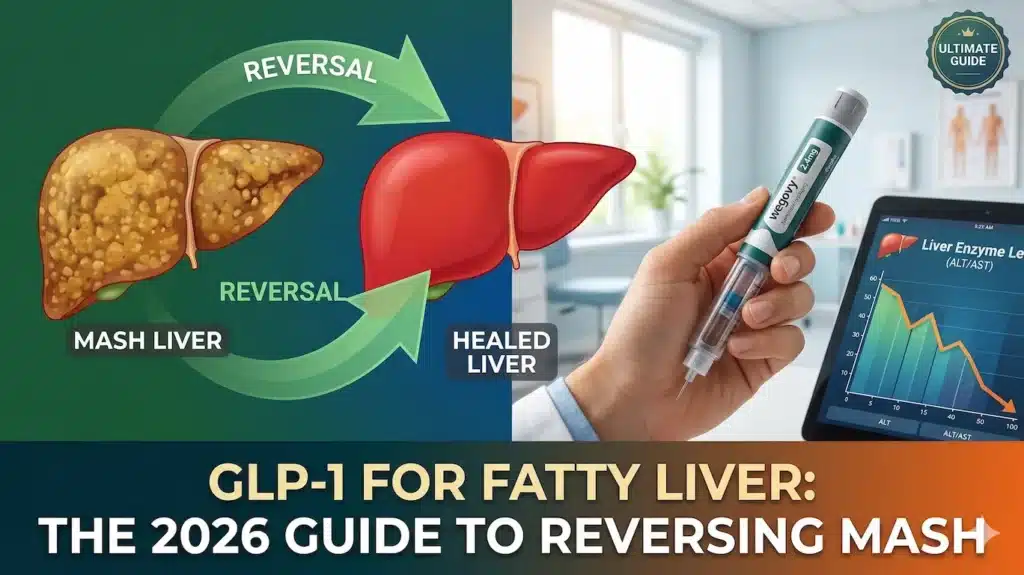
For years, the medical community told patients with fatty liver that “diet and exercise” were the only options. But in 2026, the paradigm has shifted.
If you are struggling with Metabolic-Associated Steatotic Liver Disease (MASLD) or its more severe form, MASH, you’ve likely heard about the “miracle” weight loss shots. But here is the critical question: Is the success of GLP-1 for fatty liver just about losing weight, or do these drugs possess a hidden mechanism that directly heals liver tissue?
The answer is more complex than a simple “yes,” and understanding the distinction could be the difference between stopping liver scarring (fibrosis) and progressing toward cirrhosis.
While these medications are transforming hepatology, there are specific protocols and “stealth” side effects that most primary care doctors aren’t yet discussing.
We will take a deep look into the clinical reality of GLP-1 agonists and how they are being used to literally “melt” fat off the human liver.
The Science GLP-1 for Fatty Liver: Beyond Weight Loss
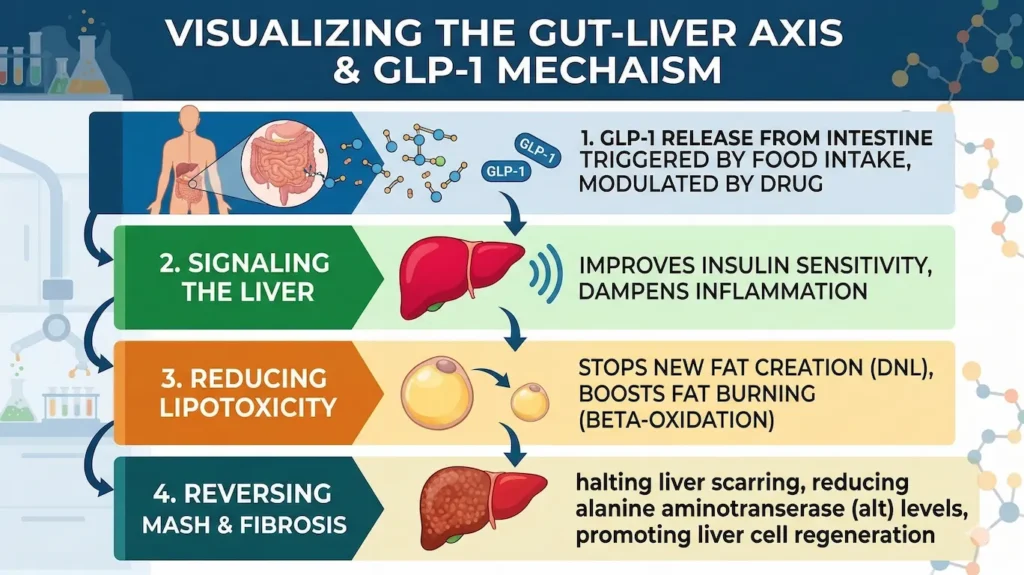
Glucagon-like peptide-1 (GLP-1) receptor agonists like Semaglutide and Tirzepatide weren’t originally designed for the liver. However, researchers discovered that the liver is a major beneficiary of their metabolic “cleanup.”
While weight loss is a major driver—losing 10% of body weight is the gold standard for reversing liver scarring—GLP-1s appear to have a “direct” hepatoprotective effect.
By activating receptors in the gut and affecting systemic inflammation, GLP-1s reduce the “lipotoxicity” that kills liver cells. This means that even before a patient loses significant weight, the drugs are already working to lower ALT and AST levels, signaling a reduction in liver distress.
Semaglutide vs. Tirzepatide: The 2026 Showdown
In the world of GLP-1 for fatty liver, two titans dominate the conversation: Semaglutide (Ozempic/Wegovy) and Tirzepatide (Mounjaro/Zepbound).
- Semaglutide: Extensive Phase 2 and Phase 3 trials have confirmed that Semaglutide is highly effective at “resolving MASH.” This means it stops the active inflammation and prevents the “ballooning” of liver cells that leads to permanent scarring.
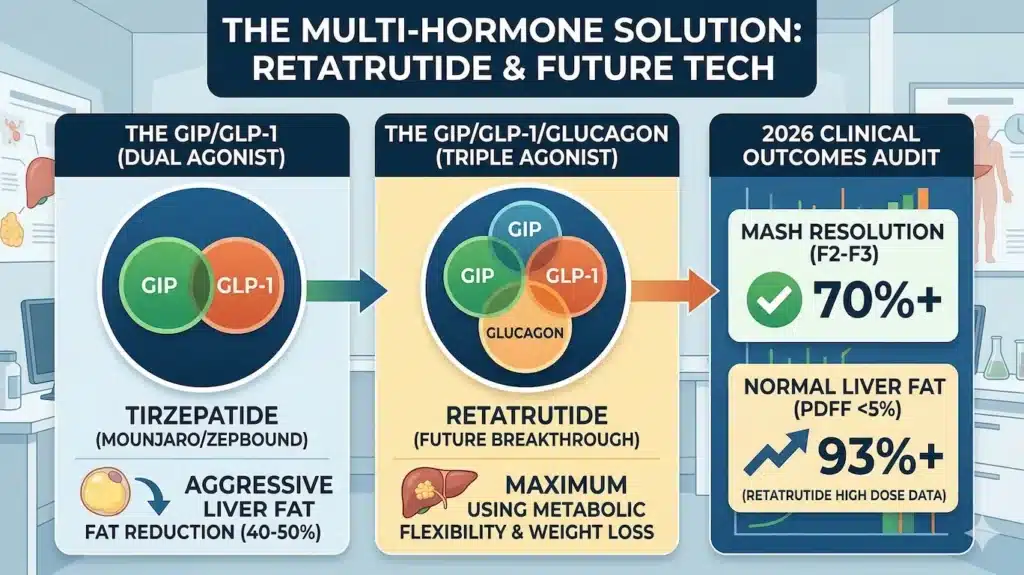
- Tirzepatide: As a “dual agonist” (targeting both GLP-1 and GIP receptors), Tirzepatide has shown even more dramatic results in reducing liver fat percentage. In some 2026 clinical audits, patients saw a 40-50% reduction in liver fat within the first six months.
The “Silent” Risk: Sarcopenia and Liver Health
One area often overlooked is “Muscle Wasting” or Sarcopenia. When you lose weight rapidly on GLP-1s, you can lose muscle as well as fat. For liver patients, muscle is a metabolic sink for glucose.
Losing too much muscle can actually hinder long-term liver recovery. To combat this, the 2026 “Liver Lean” protocol recommends high-protein intake (1.2g per kg of body weight) and consistent resistance training while on GLP-1 therapy.
The Role of GLP-1 in Fibrosis Reversal
While GLP-1s are masters at removing fat, their ability to “dissolve” existing scar tissue (fibrosis) is still being debated. The current medical consensus is that GLP-1s are anti-fibrotic by proxy.
By removing the fat and inflammation that cause the scars, they allow the liver’s natural regenerative abilities to take over. For patients at Stage F3 fibrosis, many doctors are now combining GLP-1s with Resmetirom (the first FDA-approved MASH drug) for a comprehensive “dual-attack” on the disease.
GLP-1 Agonists vs. Targeted MASH Meds: 2026 Comparison
| Feature | GLP-1 Agonists (e.g., Wegovy) | MASH-Specific (e.g., Rezdiffra) |
| Primary Mechanism | Systemic metabolism & weight loss | Direct liver lipid metabolism |
| Drug Class | GLP-1 Receptor Agonist | THR-$\beta$ Receptor Agonist |
| Administration | Weekly subcutaneous injection | Daily oral tablet |
| MASH Resolution | Highest (up to 63%) | High (approx. 25-30%) |
| Fibrosis Reversal | Indirect (via weight & inflammation) | Direct (consistent 1-stage reversal) |
| Lipid Impact | Broad metabolic improvement | Deep reduction in LDL-C & ApoB |
| Primary Side Effects | Nausea, vomiting, diarrhea | Mild diarrhea, nausea, itching |
| Best For Patients With | Obesity, Diabetes, or High BMI | Normal BMI but high liver fat/LDL |
Which One Should You Choose?
As of 2026, liver specialists are increasingly moving toward Combination Therapy. Because these drugs work differently, they can be used together to “attack” liver disease from two angles:
- Choose GLP-1s if: Your liver disease is primarily driven by insulin resistance, obesity, or Type 2 Diabetes. These drugs treat the “whole body” metabolic issue that is fueling your liver fat.
- Choose MASH-Specific Meds (Resmetirom) if: You need targeted action to reduce liver scarring (fibrosis) or if you have significantly high cholesterol (LDL) that isn’t responding to statins.
- The 2026 Hybrid Approach: Many patients now use a GLP-1 to achieve the necessary 10% weight loss while using Resmetirom to directly protect the liver from further scarring.
Practical Implementation in WordPress
Place this table right after the section titled “Semaglutide vs. Tirzepatide: The 2026 Showdown.” This allows you to transition from comparing different GLP-1s to comparing the entire GLP-1 class against the other major FDA-approved treatment option.
Managing Side Effects: The “Liver-First” Approach
Nausea and slowed digestion are common, but for liver patients, hydration is critical. Dehydration can lead to temporary spikes in creatinine and liver enzymes, which might be mistaken for drug-induced liver injury.
Staying ahead of “GLP-1 nausea” with small, nutrient-dense meals—specifically focusing on the 12 Power Foods mentioned in our MASH diet guide—is essential for success.
FAQ: Featured Snippet Optimized
1. Can GLP-1 agonists reverse fatty liver disease?
Yes, clinical studies in 2026 show that GLP-1 agonists like Semaglutide and Tirzepatide can significantly reduce liver fat (steatosis) and resolve inflammation in patients with MASH. In many cases, this allows the liver to begin reversing early-stage fibrosis.
2. What is the best GLP-1 for fatty liver in 2026?
Tirzepatide (Zepbound/Mounjaro) currently shows the highest percentage of liver fat reduction in clinical trials. However, Semaglutide (Wegovy) is more widely studied specifically for MASH resolution and is often the first-line choice for liver specialists.
3. Do Ozempic and Wegovy help with liver enzymes?
Yes. Most patients see a significant drop in ALT and AST levels within the first 8 to 12 weeks of treatment. This reduction in liver enzymes is a primary indicator that liver inflammation is subsiding.
4. Is GLP-1 FDA approved for MASH or fatty liver?
While many GLP-1 drugs are FDA approved for weight loss and type 2 diabetes, they are frequently used “off-label” for fatty liver. However, as of 2026, several GLP-1 based therapies are in the final stages of a specific MASH-treatment FDA approval.
5. Can GLP-1 drugs cause liver damage?
In rare cases, rapid weight loss or dehydration associated with GLP-1s can cause a temporary spike in liver enzymes. However, for the vast majority of patients, the drugs are “hepatoprotective,” meaning they protect and heal the liver.
6. How long does it take for GLP-1 to reduce liver fat?
Significant liver fat reduction is often seen on MRI-PDFF scans within 24 weeks of starting therapy, though many patients show improvements in blood markers much sooner.
7. Should I take GLP-1 if I have liver cirrhosis?
Patients with “compensated” cirrhosis may benefit from GLP-1s, but those with “decompensated” cirrhosis must be monitored extremely closely. Always consult a hepatologist before starting these medications if you have advanced scarring.
5 Medical Sources & Citations
- New England Journal of Medicine: Semaglutide in Patients with MASH and Fibrosis
- The Lancet: Tirzepatide for the Treatment of MASLD: A Phase 2 Trial
- Mayo Clinic: The Role of Incretin Mimetics in Liver Disease
- Cleveland Clinic: Fatty Liver and GLP-1 Agonists: What You Need to Know
- AASLD: 2026 Practice Guidance for Metabolic Liver Disease
Medical Disclaimer
Disclaimer: The information provided in this article, including text, graphics, images, and other materials, is for informational and educational purposes only. It is not intended to be a substitute for professional medical advice, diagnosis, or treatment.
Always seek the advice of your physician or another qualified health provider with any questions you may have regarding a medical condition or treatment, particularly before undertaking a new health care regimen or making significant dietary changes. Never disregard professional medical advice or delay in seeking it because of something you have read on this website.
Health Facts Journal does not recommend or endorse any specific tests, physicians, products, procedures, opinions, or other information that may be mentioned in this article. Reliance on any information appearing on this website is solely at your own risk.

With over 13 years of experience in holistic health blogging, I aim to help you navigate your wellness journey with honest insights, expert-backed advice, and a sprinkle of real-world practicality.
Certified Wellness Writer | Herbal Nutrition Advocate | Wellness Research Enthusiast


