
The Complete GLP-1 Medication Guide: Everything You Need to Know
If you’ve heard the buzz around Ozempic, Wegovy, or Mounjaro and wondered what all the excitement is about — you’re not alone. GLP-1 medication has become one of the most talked-about topics in modern medicine, and for good reason.
These drugs are reshaping how we treat obesity, type 2 diabetes, and even heart disease. But with so many options, changing insurance rules, and a pipeline full of new therapies, it can be hard to know where to start.
This GLP-1 Medication Guide breaks it all down — clearly, honestly, and completely.
Key Takeaways: GLP-1 Medication Guide 🔑
- 11 FDA-approved GLP-1 medications are currently available, with several more expected to gain approval in 2026 [3]
- Oral GLP-1 options are expanding rapidly — the Wegovy pill launched in January 2026, joining Rybelsus as the only two FDA-approved oral choices [3]
- Insurance coverage is becoming more fragmented, with Medi-Cal eliminating weight-loss-only GLP-1 coverage for most adults starting January 2026 [1]
- GLP-1 indications are expanding beyond diabetes and obesity to include cardiovascular disease and more [2]
- The WHO issued its first global GLP-1 guideline in December 2025, signaling worldwide recognition of these medicines [7]
What Is a GLP-1 Medication and How Does It Work?
GLP-1 stands for glucagon-like peptide-1. It’s a natural hormone your gut releases after you eat. It tells your pancreas to release insulin, signals your brain that you’re full, and slows digestion. GLP-1 receptor agonists (GLP-1 RAs) are drugs that mimic this hormone — and they do it very effectively.
Here’s what GLP-1 drugs do in your body:
- 🍽️ Reduce appetite by signaling fullness to the brain
- 💉 Lower blood sugar by stimulating insulin release
- 🐢 Slow gastric emptying so you feel full longer
- ❤️ Protect the heart — a benefit that’s still being studied and expanded
“GLP-1 receptor agonists represent one of the most significant advances in metabolic medicine in decades.”
As of 2026, there are 11 FDA-approved GLP-1 medications, most of which are injectable, though oral options are now growing [3].
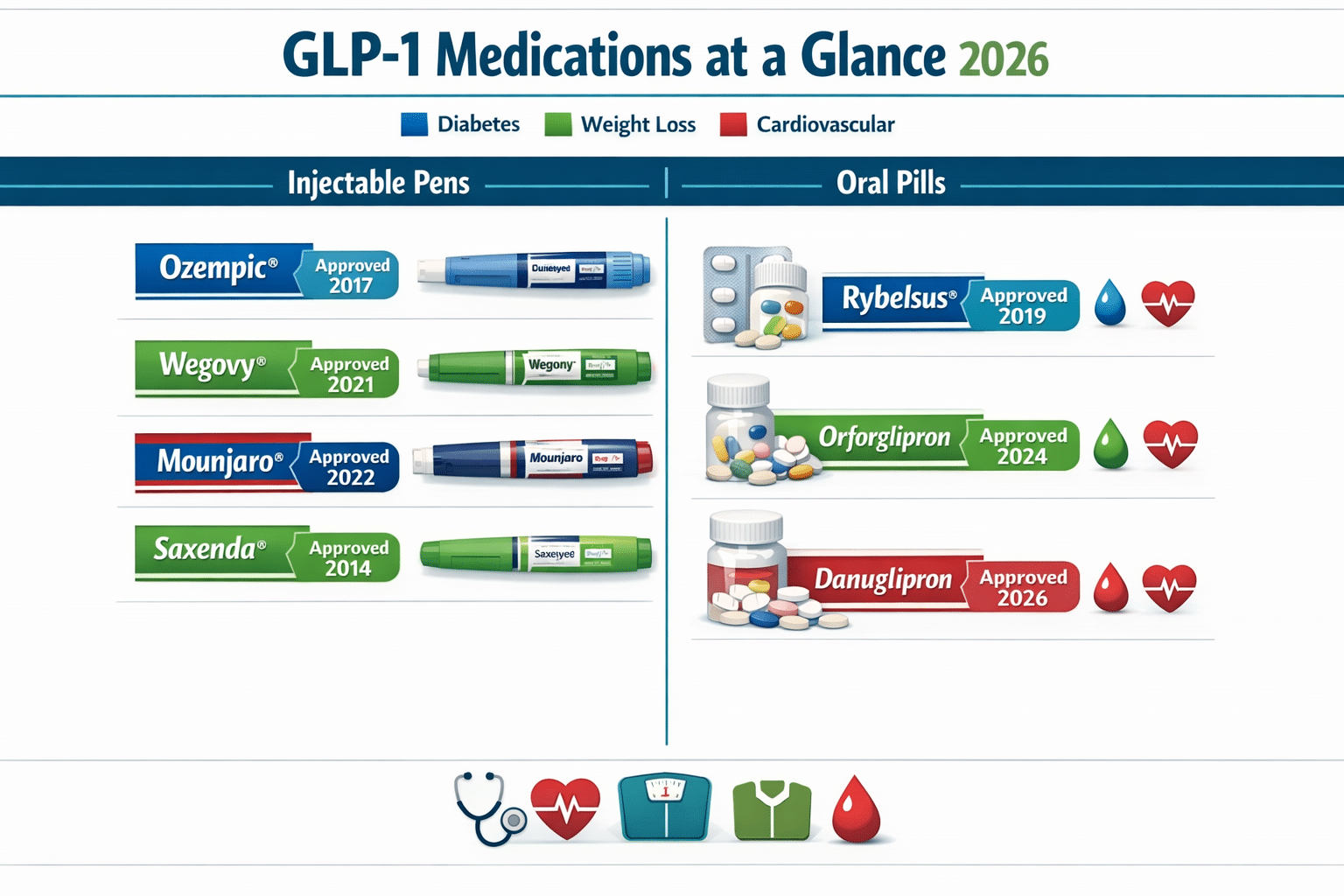
A Complete Guide to GLP-1 Medication Options Available Today
Injectable GLP-1 Medications
Most GLP-1 drugs are given as injections — either daily or weekly. Here’s a quick overview:
| Brand Name | Generic Name | Approved For | Frequency |
|---|---|---|---|
| Ozempic | Semaglutide | Type 2 diabetes | Weekly |
| Wegovy | Semaglutide | Weight loss (obesity) | Weekly |
| Mounjaro | Tirzepatide | Type 2 diabetes, cardiovascular | Weekly |
| Zepbound | Tirzepatide | Weight loss (obesity) | Weekly |
| Trulicity | Dulaglutide | Type 2 diabetes | Weekly |
| Victoza | Liraglutide | Type 2 diabetes | Daily |
| Saxenda | Liraglutide | Weight loss (obesity) | Daily |
| Byetta | Exenatide | Type 2 diabetes | Twice daily |
| Bydureon | Exenatide ER | Type 2 diabetes | Weekly |
💡 Note: Mounjaro (tirzepatide) is technically a dual GIP/GLP-1 receptor agonist, meaning it targets two hormones instead of one — which may explain its impressive results.
Mounjaro also recently received FDA approval to reduce the risk of major adverse cardiovascular events (MACE) in patients with type 2 diabetes, expanding its use well beyond weight loss [2].
Oral GLP-1 Medication Options
This is where things get exciting in 2026. Oral GLP-1 options are finally here:
- Rybelsus (semaglutide 3 mg, 7 mg, 14 mg) — FDA-approved for type 2 diabetes; the first oral GLP-1 on the market
- Wegovy pill (semaglutide 25 mg) — officially launched in January 2026, making it the first oral GLP-1 approved specifically for weight loss [3]
Many patients prefer pills over injections. The arrival of the Wegovy pill could be a game-changer for people who have avoided treatment due to needle anxiety.
What’s Coming Soon: The GLP-1 Pipeline 🔭
The pipeline for new GLP-1 drugs is packed. Here’s what to watch for in 2026 [2]:
| Drug | Developer | Type | Expected FDA Decision |
| Orforglipron | Eli Lilly | Oral, once-daily, non-peptide | Q2 2026 |
| Oral Ozempic tablets | Novo Nordisk | Oral ($1.5$ mg, $4$ mg, $9$ mg) | Q2 2026 |
| Oral Mounjaro | Eli Lilly | Oral tirzepatide | Mid-2026 |
| CagriSema | Novo Nordisk | Injectable combo (cagrilintide + semaglutide) | December 2026 |
And the higher-dose Wegovy 7.2 mg injection is also pending FDA approval in Q1 2026. Clinical trial data shows patients in this group lost nearly 19% of their starting body weight, with those completing the full treatment duration achieving close to 21% weight loss [3]. Those are remarkable numbers.
GLP-1 Medication Coverage, Costs, and Access in 2026
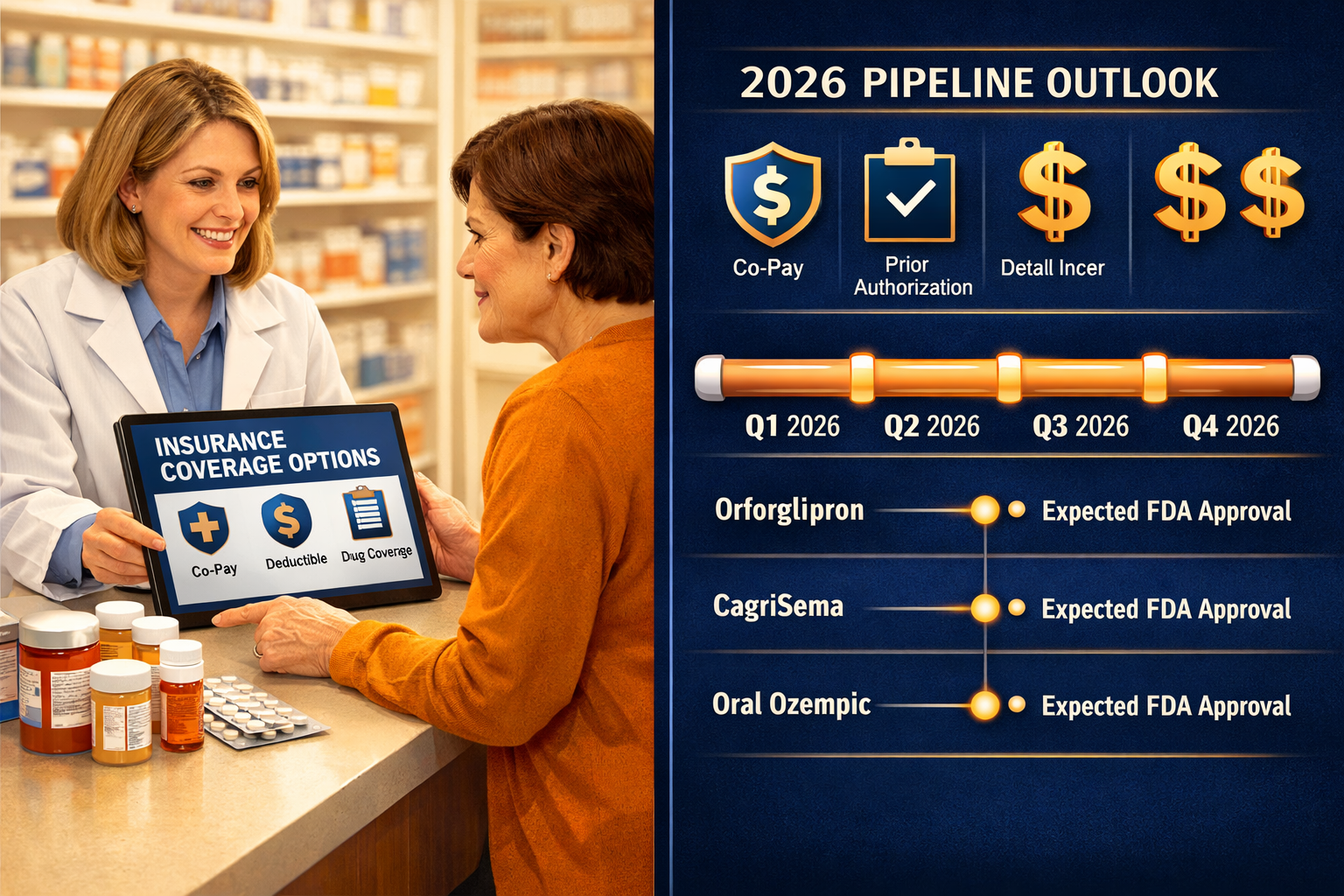
The Insurance Landscape Is Shifting
One of the biggest challenges with GLP-1 therapy right now is paying for it. These drugs can cost $800–$1,500 per month without coverage. And the insurance picture is getting more complicated.
Medi-Cal (California Medicaid) made a major change on January 1, 2026: it eliminated GLP-1 coverage for weight loss alone. This affects drugs like Wegovy, Zepbound, and Saxenda when prescribed only for obesity. However [1]:
- These drugs remain covered when prescribed for approved medical conditions like type 2 diabetes, cardiovascular disease, or metabolic dysfunction-associated steatohepatitis (MASH)
- The seven other GLP-1 drugs (Ozempic, Rybelsus, Mounjaro, Victoza, Byetta, Bydureon, Trulicity) also lost weight-loss-only coverage but stay covered for diabetes and other approved indications
- Medi-Cal members under age 21 are protected — federal EPSDT requirements allow them to continue receiving GLP-1 drugs for weight loss with prior authorization [1]
⚠️ Important: If you’re on Medi-Cal and currently using a GLP-1 drug for weight loss, talk to your doctor right away about whether your diagnosis qualifies for continued coverage.
Employer Insurance: A Mixed Picture
Across the country, employer insurance coverage for GLP-1 drugs is going in different directions. Some employers are adding coverage for weight loss, while others are cutting it to manage costs. The trend reflects a complex balancing act between employee health and budget pressures [3].
Alternative Ways to Access GLP-1 Drugs
Don’t have insurance coverage? You still have options:
- 💊 GoodRx coupons — can significantly reduce out-of-pocket costs at many pharmacies [3]
- 🖥️ Direct-to-consumer telehealth platforms — companies offering GLP-1 prescriptions online with transparent pricing
- 🏥 Manufacturer savings programs — Novo Nordisk and Eli Lilly both offer patient assistance programs
Direct-to-consumer programs are reshaping how patients access GLP-1 therapy, providing real alternatives to traditional insurance pathways [3].
Expanding Indications: GLP-1 Is About More Than Weight Loss
When GLP-1 drugs first arrived, they were all about blood sugar control. Then came weight loss. Now, in 2026, the list of approved and emerging uses is growing fast.
Current and emerging GLP-1 indications include:
- ✅ Type 2 diabetes (original indication)
- ✅ Obesity / chronic weight management
- ✅ Cardiovascular risk reduction (Ozempic, Mounjaro)
- ✅ Metabolic dysfunction-associated steatohepatitis (MASH)
- 🔜 Peripheral artery disease
- 🔜 Certain types of heart failure
The expansion into heart failure and peripheral artery disease represents a major leap — moving GLP-1 drugs from metabolic medicine into broader cardiovascular care [3].
In December 2025, the World Health Organization released its first-ever global guideline on the use of GLP-1 medicines for obesity — a landmark moment that signals international recognition of these drugs as a serious public health tool [7]. The WHO has committed to updating this guidance regularly as new evidence emerges.
Common Side Effects and Safety Considerations
GLP-1 drugs are generally well-tolerated, but they do come with side effects — especially when you first start or increase your dose.
Most common side effects:
- Nausea (most frequent, especially early on)
- Vomiting
- Diarrhea or constipation
- Stomach pain
Less common but serious risks to discuss with your doctor:
- Pancreatitis
- Gallbladder problems
- Thyroid tumors (rare; noted in animal studies with some GLP-1 drugs)
- Muscle loss (often managed with adequate protein intake and resistance exercise)
Most side effects improve over time. Starting at a low dose and gradually increasing — called dose titration — is the standard approach to minimize discomfort.
How to Talk to Your Doctor About GLP-1 Therapy
If you’re considering a GLP-1 medication, here’s how to make the most of your appointment:
- Be specific about your goals — weight loss, blood sugar control, or both?
- Share your full medical history — especially any history of pancreatitis, thyroid cancer, or kidney disease
- Ask about coverage first — have your doctor’s office check your insurance benefits before prescribing
- Discuss injection vs. oral options — especially if needle anxiety is a concern
- Set realistic expectations — GLP-1 drugs work best alongside healthy eating and physical activity
Conclusion: Your Next Steps With GLP-1 Medication
GLP-1 medication has moved from a niche diabetes treatment to a cornerstone of modern metabolic and cardiovascular medicine — and 2026 is shaping up to be its biggest year yet. With new oral options launching, higher-dose injections showing impressive results, and indications expanding into heart disease and beyond, there’s never been more reason to understand these drugs.
Here’s what to do right now:
- ✅ Talk to your doctor about whether a GLP-1 drug is right for your specific health goals
- ✅ Check your insurance coverage — especially if you’re on Medi-Cal or your employer plan recently changed its policy
- ✅ Explore cost-saving options like GoodRx or manufacturer assistance programs if coverage is limited
- ✅ Stay informed — new drugs and indications are being approved throughout 2026, and your options may expand soon
- ✅ Ask about oral formulations if injections have been a barrier for you
The GLP-1 revolution is real. With the right information and the right medical team, you can navigate it confidently.
References
[1] GLP-1 Changes (Medi-Cal) – https://medi-calrx.dhcs.ca.gov/cms/medicalrx/static-assets/documents/member/GLP1_Changes.pdf
[2] GLP-1 Pipeline Update February 2026 – https://www.primetherapeutics.com/glp-1-pipeline-update-february-2026
[3] GLP-1 Trends – https://www.goodrx.com/classes/glp-1-agonists/glp-1-trends
[4] GLP-1 Pills for Weight Loss Are Here: How Will They Change Obesity Care – https://www.aamc.org/news/glp-1-pills-weight-loss-are-here-how-will-they-change-obesity-care
[5] 2026 Oral GLP-1 Medication Options: A Complete Guide – https://www.tryshed.com/blog/post/2026-oral-glp-1-medication-options-a-complete-guide
[6] GLP-1 Considerations for 2026: Your Questions Answered – https://www.mercer.com/en-us/insights/us-health-news/glp-1-considerations-for-2026-your-questions-answered/
[7] WHO Issues Global Guideline on the Use of GLP-1 Medicines in Treating Obesity (December 2025) – https://www.who.int/news/item/01-12-2025-who-issues-global-guideline-on-the-use-of-glp-1-medicines-in-treating-obesity

With over 13 years of experience in holistic health blogging, I aim to help you navigate your wellness journey with honest insights, expert-backed advice, and a sprinkle of real-world practicality.
Certified Wellness Writer | Herbal Nutrition Advocate | Wellness Research Enthusiast


