
How to Stop Food Noise: 7 Science-Backed Strategies That Actually Work

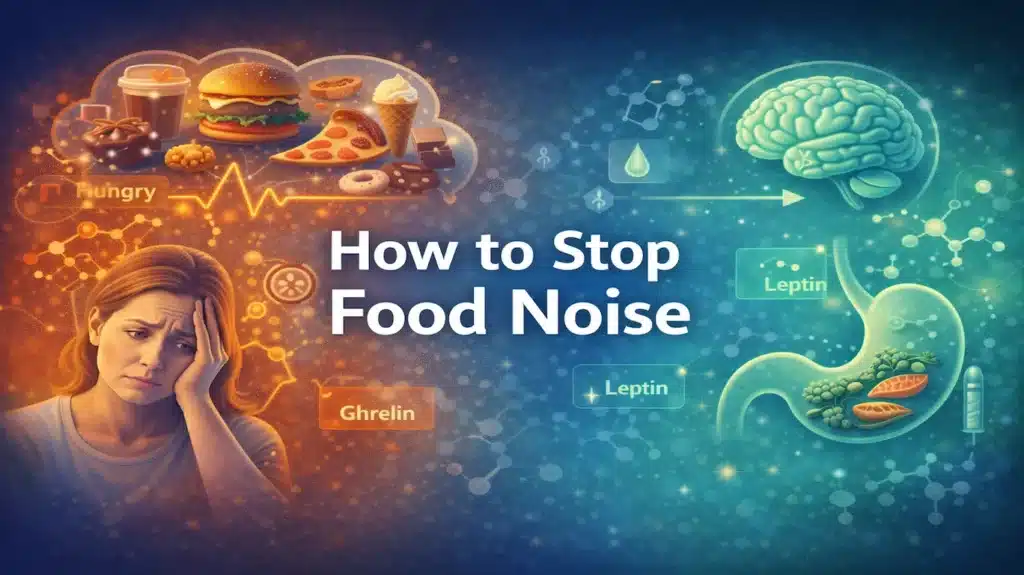
You ate a satisfying meal 20 minutes ago. You’re physically full. Yet your brain is already wandering: What’s for dessert? Should I have eaten less? Maybe I can sneak a snack later.
If this internal monologue sounds familiar, you’re experiencing what researchers and doctors now call “food noise”—and learning how to stop food noise might be the most important health decision you make this year.
Food noise isn’t simply thinking about food. It’s the constant, intrusive, often exhausting stream of food-related thoughts that plays on loop in your mind, regardless of whether you’re hungry . It’s planning your next meal while eating the current one. It’s obsessing over what you “should” or “shouldn’t” eat. It’s the mental negotiation with yourself about whether you “deserve” that snack.
For millions of people, this chatter never stops. And here’s the critical truth most articles won’t tell you: Food noise isn’t a character flaw or a failure of willpower. It’s biology. And because it’s biological, it can be fixed.
This guide walks you through exactly how to stop food noise—from immediate lifestyle adjustments to understanding when medical intervention like GLP-1 medications might be the solution your body needs.
What Is Food Noise, Really?
Before learning how to stop food noise, you need to understand what it is. Food noise is defined as “persistent thoughts about food that are perceived by the individual as being unwanted and/or dysphoric and may cause harm to the individual, including social, mental, or physical problems” .
Think of it as background static in your brain focused entirely on food. It makes it hard to focus, relax, or even enjoy meals because your mind is already onto the next eating occasion .
Food noise can look like:
- Constantly planning your next meal while eating the current one
- Grazing all day because food thoughts won’t stop
- Obsessing over what you just ate, even when physically full
- Feeling distracted by food during work or social situations
- Waking up thinking about food
Crucially, food noise is different from physical hunger. Physical hunger builds gradually, happens 4-5 hours after a meal, and any food sounds good. Food noise appears suddenly, craves specific foods (usually sugar, salt, or fat), and continues even when you’re full .
👉 Find affordable options: [Cheapest GLP-1 Without Insurance (Updated 2026)]
The Root Causes: Why Your Brain Won’t Shut Up About Food
To effectively learn how to stop food noise, you must understand what’s driving it. Multiple factors contribute to food noise, and most people have more than one.
Biological Factors
Your body has a built-in system for managing hunger and fullness. It includes areas of the brain that respond to physical hunger, emotional triggers, and decision-making around food . When this system is out of balance, food noise gets louder.
Key hormones involved:
- Ghrelin (The Hunger Hormone): Increases when you’re stressed or haven’t eaten. High ghrelin equals more food noise.
- Leptin (The Fullness Hormone): Tells your brain you’re full. In leptin resistance, that signal never lands, keeping food noise on even after eating .
- GLP-1 (The Satiety Signal): Slows digestion and signals fullness. Low GLP-1 or GLP-1 resistance means your brain never gets the “stop eating” message .
- Dopamine (The Reward Chemical): Tied to pleasure. Some research suggests that medications like semaglutide may reduce food noise by calming overactive dopamine pathways .
- Cortisol (The Stress Hormone): Drives cravings for comfort foods. Chronic stress keeps it elevated, increasing food noise .
Dietary Triggers
What you eat directly impacts food noise volume.
Restrictive dieting is a major culprit. When you severely restrict calories or eliminate entire food groups, your brain interprets this as a threat to survival. Food noise increases as your brain’s way of pushing you to eat more .
Processed foods high in fat, salt, or sugar light up the pleasure center in your brain, creating a dopamine rush that’s short-lived—and then the food noise starts again, creating a vicious cycle .
Environmental Triggers
Food noise isn’t just internal. It’s triggered by what’s around you:
- Food ads on TV or social media
- Smelling food cooking (like walking past a restaurant)
- Boredom or lack of mental focus
- Stress and worry
Researchers call this “cue reactivity”—your brain’s heightened sensitivity to food triggers in your environment .
Lifestyle Factors
Even non-food habits affect food noise:
- Lack of sleep raises ghrelin and lowers leptin. Even one poor night of sleep can increase cravings .
- Inactivity affects insulin sensitivity and stress hormones.
- Eating with distractions (TV, phone) reduces meal satisfaction and can increase impulsive eating .
👉 Compare medications: [Best GLP-1 for Appetite Suppression (Ranked)]
How to Stop Food Noise: 7 Proven Strategies
Now that you understand what drives food noise, here are seven science-backed ways to stop it. These range from immediate behavioral changes to medical intervention—because different bodies need different solutions.
Strategy 1: Eat Enough, and Eat Regularly
It sounds counterintuitive: to stop thinking about food, you need to eat more. But biologically, it makes perfect sense.
Your brain is wired for survival. If you’re skipping meals, dieting aggressively, or simply not eating enough, your brain perceives a food shortage. It responds by cranking up the volume on food noise to push you to eat .
How to apply it: Eat every 3 to 4 hours. Set a timer if needed. This reassures your brain that food is available and helps reduce obsessive thoughts .
Strategy 2: Ditch Restrictive Dieting
Unless you have a medical condition requiring a specific diet, stay flexible with your eating. When you label foods as “off-limits,” you actually increase your preoccupation with them .
Your brain doesn’t know you’re dieting on purpose. It views food restrictions as a threat to survival, which increases intrusive thoughts about the very foods you’re trying to avoid .
How to apply it: Give yourself unconditional permission to eat. Work on including nourishing foods without excluding the foods you enjoy. For most people, this alone significantly reduces food noise.
Strategy 3: Balance Your Plate for Satiety
What you eat matters as much as when you eat. Meals that lack protein, fiber, or healthy fats leave you biologically unsatisfied, which keeps food noise running.
Protein is the most satiating macronutrient. It increases GLP-1 naturally and reduces ghrelin. Fiber slows digestion and stabilizes blood sugar. Healthy fats support hormone function and fullness .
How to apply it: Build meals around protein (eggs, chicken, fish, tofu, beans), fiber (vegetables, fruits, whole grains), and healthy fats (avocado, olive oil, nuts, seeds). This combination keeps blood sugar stable and food noise quiet.
Strategy 4: Track Your Triggers
Food noise isn’t random. It follows patterns. Maybe it spikes when you’re stressed at work. Maybe it hits hardest at night when you’re bored. Maybe certain environments or social situations turn up the volume .
How to apply it: For one week, jot down when food noise feels loudest and what was happening right before. Were you stressed? Tired? Bored? Did you skip a meal? Once you identify patterns, you can address the root cause instead of just fighting the thoughts .
Strategy 5: Manage Stress and Prioritize Sleep
Stress and sleep deprivation directly increase food noise by messing with your hunger hormones. Cortisol drives cravings for comfort foods. Lack of sleep raises ghrelin and lowers leptin .
How to apply it: Build stress management into your day—even 5-10 minutes of walking, deep breathing, or journaling helps. For sleep, aim for consistency: same bedtime and wake time, dark cool room, no screens before bed .
Strategy 6: Practice Mindful Eating
Many of us eat on autopilot—scrolling phones, watching TV, working through lunch. When you’re not present during meals, your brain doesn’t fully register the eating experience, which can trigger food noise sooner .
How to apply it: Try eating one meal a day without distractions. Notice the taste, texture, and smell of your food. Pay attention to how your body feels as you eat. This helps your brain register satisfaction, which reduces later cravings .
Strategy 7: Consider GLP-1 Medication (When Appropriate)
For some people, lifestyle strategies alone aren’t enough to stop food noise—and that’s not their fault. It’s biology.
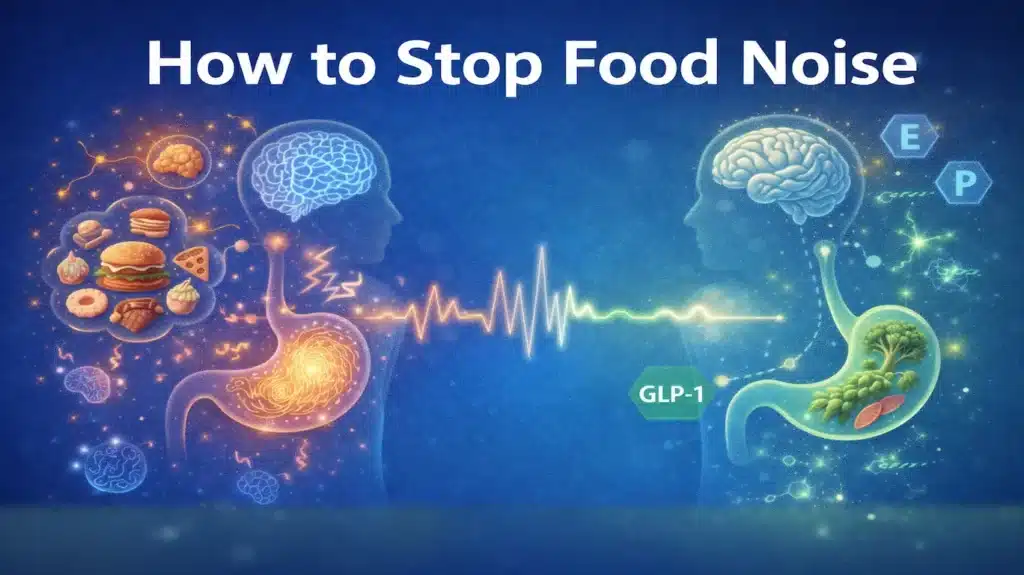
GLP-1 receptor agonists (like semaglutide, the active ingredient in Wegovy and Ozempic) work by mimicking the hormone that signals fullness to your brain. They slow stomach emptying, reduce hunger cues, and importantly for food noise, they appear to calm the brain’s reward pathways .
Recent research confirms this effect. A 2025 study presented at the European Association for the Study of Diabetes found that after starting semaglutide, the number of people reporting constant food thoughts throughout the day dropped by 46%. Before treatment, 62% of participants experienced constant food noise. While on medication, only 16% did .
Beyond reducing food noise, 64% of respondents reported improved mental health, 76% developed healthier lifestyles, and 80% developed healthier habits .
Important caveats: GLP-1s aren’t right for everyone. They can cause side effects like nausea, constipation, or diarrhea. They’re not recommended for anyone with a history of eating disorders. And they work best when combined with the lifestyle strategies above, not as a standalone solution .
When to Seek Professional Help
If food noise is interfering with your sleep, work, relationships, or ability to enjoy life, it’s time to get support .
Talk to your primary care provider, a registered dietitian who specializes in eating disorders or emotional eating, or a mental health professional. They can help you determine whether lifestyle changes are enough or whether GLP-1 medication might be appropriate for your situation .
“You don’t need a clinical diagnosis to get help. If food is occupying your mind too much, it matters” .
Ready to Finally Stop the Food Noise?
If you’ve tried lifestyle changes and the noise won’t stop, your biology may need additional support. GLP-1 medications have helped thousands of people quiet the mental chatter and regain control.
👉 New to GLP-1? Start here: [Complete Beginner’s Guide to GLP-1 Injections]
Frequently Asked Questions
1. What’s the difference between food noise and normal hunger?
Normal hunger builds gradually, happens when you haven’t eaten in several hours, and is satisfied by a variety of foods. Food noise appears suddenly (often right after eating), fixates on specific foods (usually sugar, salt, or fat), and doesn’t stop even when you’re physically full. Hunger is physical; food noise is neurological .
2. Can you stop food noise without medication?
Yes, absolutely. Many people successfully reduce food noise through lifestyle strategies: eating regular meals, balancing plates with protein and fiber, managing stress, prioritizing sleep, and identifying personal triggers. However, for some people with underlying metabolic dysfunction, medication may be necessary to achieve the same result—and that’s okay .
3. How quickly do GLP-1s stop food noise?
Many patients report significant reduction in food noise within the first 24-48 hours of their first dose—often before any weight loss occurs. This rapid effect suggests GLP-1s work directly on brain receptors involved in appetite and reward, not just through physical fullness .
4. Does dieting make food noise worse?
Yes, restrictive dieting is one of the most common triggers for food noise. When you severely restrict calories or eliminate foods, your brain perceives a survival threat and increases intrusive food thoughts to push you to eat. The more foods you label as “off-limits,” the more you tend to think about them .
5. Is food noise a sign of an eating disorder?
Food noise can be a symptom of disordered eating, particularly if it’s accompanied by guilt, shame, or loss of control around food. It’s common in conditions like binge eating disorder and bulimia. If food noise is causing distress or interfering with your life, talk to a healthcare provider or mental health professional .
6. Why is food noise louder at night?
Nighttime food noise often results from a combination of factors: inadequate eating during the day (leading to biological hunger), stress from the day catching up with you, boredom, and habit. Additionally, the endocannabinoid system (involved in reward and appetite) shows natural circadian variation that may increase reward-seeking in the evening .
7. Will food noise come back if I stop GLP-1 medication?
For most people, yes. Food noise returns when medication stops because the underlying metabolic tendency (low GLP-1 production or sensitivity) is still present. Obesity and metabolic dysfunction are chronic conditions; GLP-1 therapy is typically considered long-term treatment, similar to blood pressure or cholesterol medication .
Medical References
- Piedmont Healthcare. Making Food Less Important in Your Life. 2018. Available at: https://piedmonthealthcare.com/making-food-less-important-in-your-life/
- Healthline. What Is ‘Food Noise’ and How Do You Quiet or Stop It? 2025. Available at: https://www.healthline.com/health/weight-loss/food-noise-tips
- Hayashi D, et al. What is food noise? A conceptual model of food cue reactivity. Nutr Diabetes. 2023. Available at: https://pmc.ncbi.nlm.nih.gov/articles/PMC10674813/
- Chao A, et al. Food cravings mediate the relationship between chronic stress and body mass index. 2015. Available at: https://pmc.ncbi.nlm.nih.gov/articles/PMC6186388/
- Women’s Health. How To Stop Food Noise Naturally: 5 Habits To Start Now, According To Doctors. 2025. Available at: https://www.womenshealthmag.com/weight-loss/a63957280/how-to-stop-food-noise-naturally/
- Northwell Health. How to Stop Food Noise (Without The Meds). 2025. Available at: https://thewell.northwell.edu/obesity/how-to-stop-food-noise
- Henry Ford Health. How To Combat Food Noise. 2025. Available at: https://www.henryford.com/blog/2025/04/how-to-combat-food-noise
- Papatriantafyllou E, et al. Sleep deprivation: Effects on weight loss and weight loss maintenance. Nutrients. 2022. Available at: https://pmc.ncbi.nlm.nih.gov/articles/PMC9031614/
- Patient Care Online. Semaglutide Quells “Food Noise,” Improves Mental Health Among Adults on Treatment for Obesity and Overweight. 2025. Available at: https://www.patientcareonline.com/view/semaglutide-quells-food-noise-improves-mental-health-among-adults-on-treatment-for-obesity-and-overweight
- Noom. How to stop food noise naturally: Expert tips for calming the chatter. 2025. Available at: https://www.noom.dev/blog/weight-management/how-to-stop-food-noise-naturally/
Medical Disclaimer
The information contained on this website is for informational and educational purposes only. It is not intended as medical advice, nor is it a substitute for professional medical advice, diagnosis, or treatment. Always seek the advice of your physician or another qualified health provider with any questions you may have regarding a medical condition or treatment before starting a new medication, changing your diet, or beginning a fitness program.

With over 13 years of experience in holistic health blogging, I aim to help you navigate your wellness journey with honest insights, expert-backed advice, and a sprinkle of real-world practicality.
Certified Wellness Writer | Herbal Nutrition Advocate | Wellness Research Enthusiast


