
How to Store Compounded Semaglutide at Home

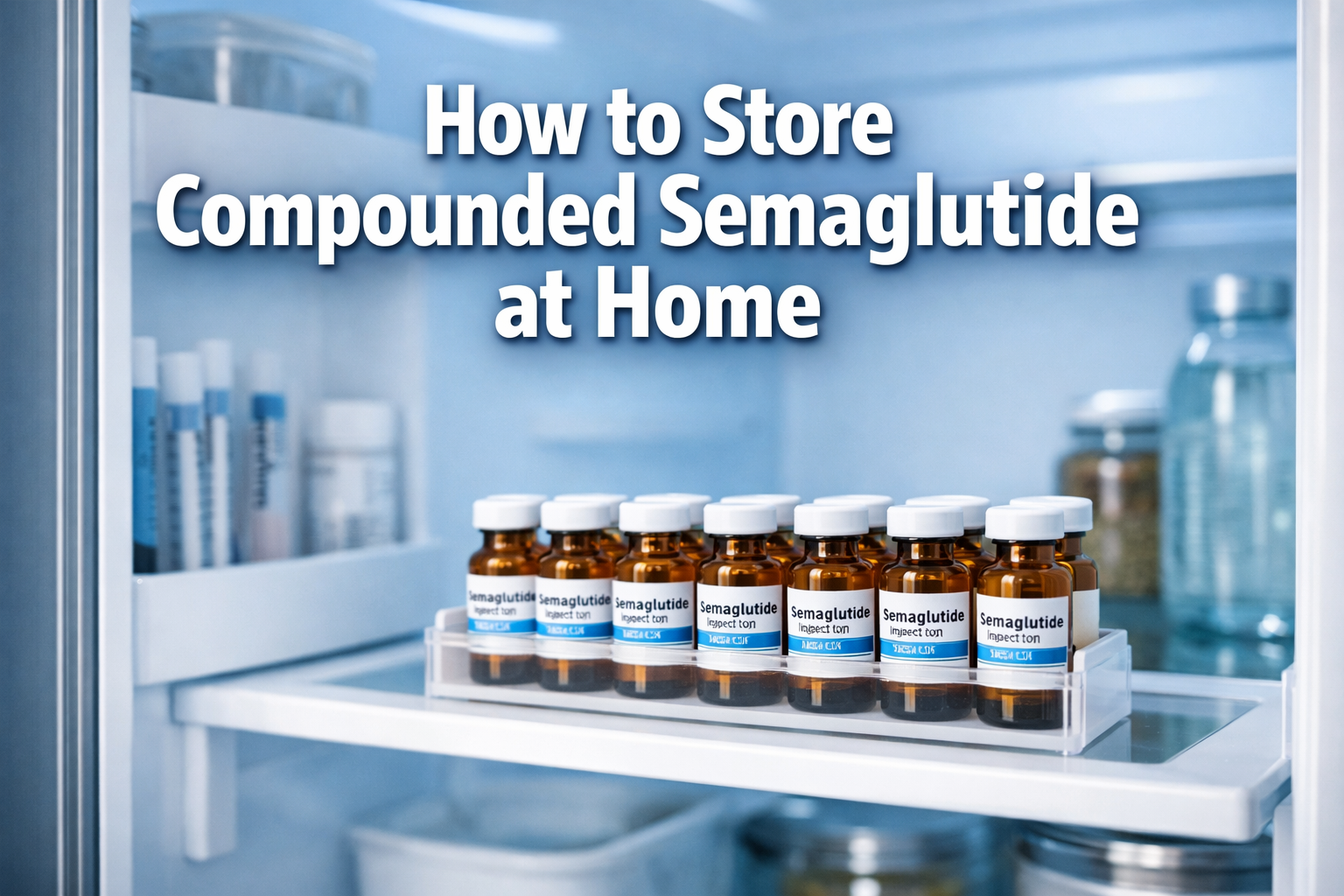
Quick Answer: Store compounded semaglutide in the main compartment of your refrigerator at 36°F to 46°F (2°C to 8°C). Never freeze it, never leave it on the fridge door, and always check the beyond-use date (BUD) on your pharmacy label. Most compounded vials remain stable for 14 to 120 days refrigerated, depending on your pharmacy’s formulation and stability testing.
Key Takeaways
- ✅ Refrigerate immediately at 36–46°F (2–8°C) in the main compartment, not the door [1][2]
- ❌ Never freeze compounded semaglutide — freezing breaks down the peptide structure [1][4]
- 📅 Beyond-use date (BUD) ranges from 14 days to 120 days depending on the compounding pharmacy [4]
- ⏱️ Post-opening window is often 30 days — confirm with your specific pharmacy [2]
- 🌡️ Brief room-temperature exposure (a few minutes for injection) is fine; hours-long exposure is not [2]
- 📦 Keep it in original amber or opaque containers to block light degradation [2][4]
- 🚫 Avoid bathrooms, cars, and windowsills — heat, humidity, and light all accelerate breakdown [5][7]
- 🔍 Compounded semaglutide degrades faster than brand-name Ozempic or Wegovy — treat it accordingly [1][4]
- 📞 Call your pharmacy if you suspect temperature exposure or notice cloudiness or particles [2]
Why Knowing How to Store Compounded Semaglutide at Home Actually Matters
Most people starting compounded semaglutide focus entirely on the dosing schedule. That’s understandable — but improper storage is one of the most common and costly mistakes patients make. A degraded vial doesn’t just waste money. It can mean weeks of ineffective treatment while you wait for a replacement.
Compounded semaglutide is a peptide-based GLP-1 receptor agonist. Peptides are fragile molecules. Unlike a standard antibiotic capsule, they break down when exposed to the wrong temperature, light, or repeated freeze-thaw cycles. The result is a medication that looks completely normal but has lost a significant portion of its potency [1][4].
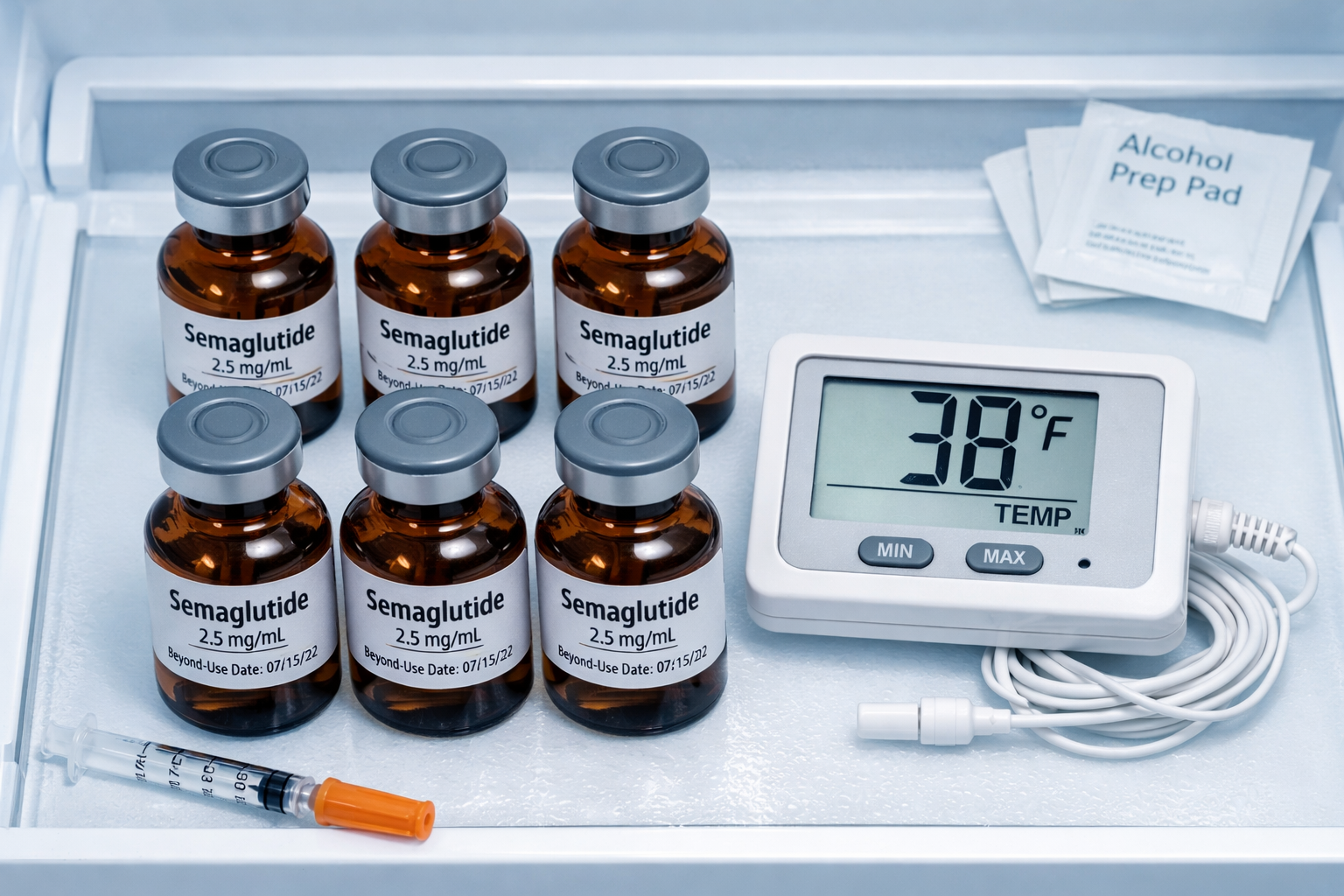
If you’re using compounded semaglutide to manage weight — and you’re doing it because it’s significantly more affordable than brand-name Wegovy or Ozempic — protecting that investment with correct storage is non-negotiable. For context on costs, see our breakdown of semaglutide cost in 2026: monthly prices with and without insurance.
What Temperature Does Compounded Semaglutide Need?
Compounded semaglutide must be refrigerated at 2°C to 8°C (36°F to 46°F) at all times when not in use. This is the single most important storage rule, and it applies whether your vial is unopened or already in use [1][2][4].
Here’s what that means in practice:
- Set your refrigerator between 37°F and 40°F — the sweet spot that keeps semaglutide stable without risking accidental freezing
- Use an inexpensive refrigerator thermometer to verify the actual temperature, not just the dial setting [5][7]
- If your fridge runs cold near the back or freezer wall, keep the vial toward the front-center of a middle shelf
💡 Quick rule: If your milk freezes occasionally, your semaglutide is at risk too. A $10 fridge thermometer is worth it.
What happens if it freezes? Freezing disrupts the peptide’s molecular structure. Even one freeze-thaw cycle can reduce potency in ways that aren’t visible to the naked eye [1][4]. A frozen-then-thawed vial may look perfectly clear but deliver a fraction of the intended dose.
What about room temperature? Short exposure during injection — a few minutes — is acceptable and won’t harm the medication [2]. Some specific compounded formulations may be stable at room temperature up to 25°C (77°F) for up to 60 days, but this varies by pharmacy and formulation [1]. Never assume your vial has this property unless your pharmacy explicitly states it in writing.
Where Exactly in the Fridge Should You Store It?
Place your compounded semaglutide on a middle shelf in the main compartment of the refrigerator — never on the door. This single placement decision matters more than most people realize [2].
| Location | Why It’s a Problem | The Clinical Risk |
| Fridge Door | Temperature swings 5–10°F with every opening. | Accelerates peptide degradation and loss of potency [2]. |
| Back of Fridge | High risk of being near the freezer cooling element. | Accidental Freezing: Frozen peptides must be discarded [4]. |
| Crisper Drawer | High humidity and often the coldest zone in the unit. | Inconsistent cooling can lead to crystallization. |
| Medicine Cabinet | Heat and steam from showers destroy proteins. | High moisture levels rapidly break down the formula [5][7]. |
| Car Glove Box | Extreme, uncontrolled heat and cold fluctuations. | Never Appropriate: Can ruin a 30-day supply in hours [7]. |
| ✅ Middle Shelf | Stable, consistent 36°F – 46°F temperature. | Correct Placement: Maximizes shelf life and efficacy [2]. |
Keep the vial in its original amber or opaque container. These containers block UV and visible light, which can degrade semaglutide even inside a refrigerator when the door opens [2][4]. If your vial came in a clear container, wrap it loosely in aluminum foil or store it in a small opaque bag.
How Long Does Compounded Semaglutide Last? (Beyond-Use Dates Explained)
The beyond-use date (BUD) on your pharmacy label is the authoritative expiration date for your compounded semaglutide — and it varies widely between pharmacies. Do not use the medication past this date, regardless of how it looks [2][4].
BUD ranges depend on how rigorously the compounding pharmacy conducts stability testing:
- 14–28 days: Pharmacies using conservative, less rigorous testing protocols
- Up to 90–120 days: Pharmacies with formal stability testing programs [4]
After opening, the window may be shorter. Many compounded preparations should be used within 30 days of first use to reduce contamination risk from repeated needle insertion [2]. Your pharmacy’s label or patient instructions will specify this — if they don’t, call and ask directly.
For comparison, FDA-approved Ozempic can remain stable at room temperature for up to 56 days after first use, and Wegovy for up to 28 days [4]. Compounded versions typically require stricter cold-chain adherence and have shorter usable windows — so plan your refill timing accordingly.
📅 Action step: Write your opening date on the vial with a permanent marker the moment you first use it. This makes tracking the 30-day window effortless.
If you’re comparing different semaglutide options and want to understand which formulations are most practical for home use, our expert-vetted ranking of the best semaglutide for fat loss covers the leading compounded and brand-name options side by side.
The 3 Most Affordable GLP 1 Semaglutide Without Insurance “TrumpRX (2026 Ranked)
🥇 #1 Best Overall: Zepbound (Triple-Action Option)
🥇 Best Overall (9.9/10)
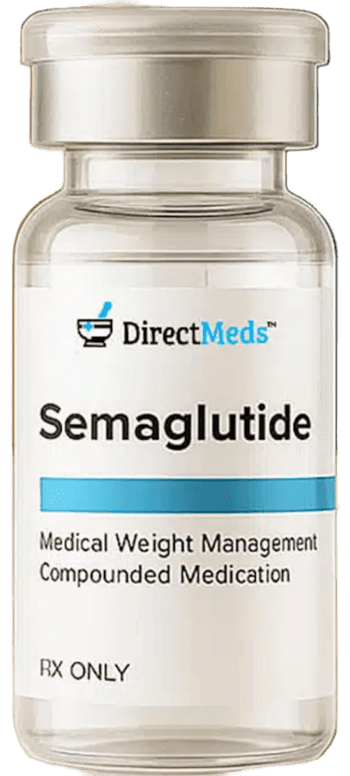
DirectMeds GLP1 provides a budget-friendly alternative to Ozempic/Wegovy while maintaining strong appetite control and weekly fat loss results. Everything is included—from telehealth visits to medication shipping—making it ideal for people wanting premium results at the lowest cost.
DirectMeds is a LegitScript-certified telehealth platform that connects patients with licensed U.S. physicians who evaluate whether compounded GLP-1 medications are clinically appropriate.
It is one of the most established providers in this space and is particularly well-suited to patients who want high-touch clinical oversight without paying brand-name prices.
How it works: Complete a secure online health intake form. A licensed medical provider reviews your profile and determines eligibility. If approved, your prescription is sent to a certified U.S. compounding pharmacy and medication is shipped directly to your door. All-inclusive pricing covers medical consultation, medication, and 24/7 support — no surprise charges.
◉ Clinical Note: DirectMeds’ LegitScript certification is a meaningful differentiator in this market. It requires compliance with pharmacy laws, prescription standards, and advertising guidelines — reducing the risk of receiving substandard compounded medications. For patients new to telehealth GLP-1 programs, this certification provides a meaningful layer of accountability. — Dr. Sarah Jenkins, Co-Author
🎯 Ideal for: Patients who want an established, verified provider with strong clinical support and are comfortable paying slightly more than the absolute floor price for greater peace of mind.
🥈#2 Best for Long-Term Cost Certainty: MyStart GLP-1
🥈 Silver Standard — Best Flat-Rate Pricing
- Rating: ⭐️⭐️⭐️⭐️⭐️ – (9.9/10) High Potency GLP1
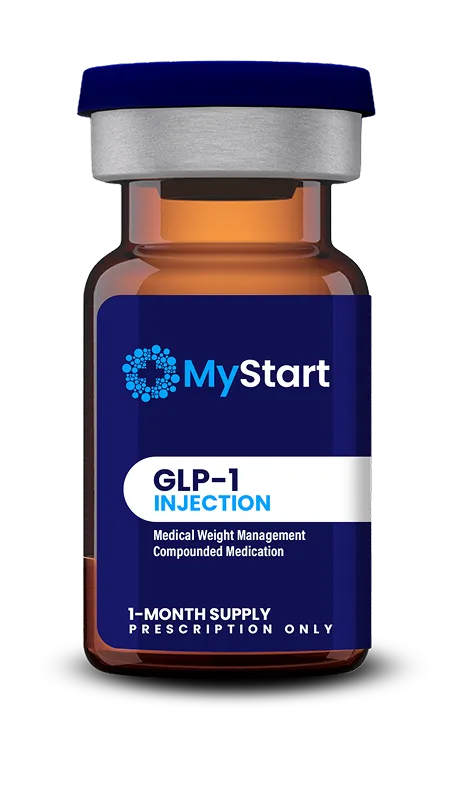
MyStart GLP-1 offers a smooth, beginner-friendly GLP-1 program using FDA-backed medications and simple weekly injections or tablets. Great for people wanting easy onboarding, rapid fat loss, and physician oversight—without the high price of traditional clinics.
MyStart GLP-1 uses a unique flat-rate membership model where your medication cost is fixed regardless of how high your therapeutic dose increases over time. For patients who will be on GLP-1 therapy for 12 months or more, this pricing structure can save $600 to $1,800 annually compared to platforms that charge progressively more as doses escalate.
How it works: Pay a monthly membership ($79) plus a flat medication fee (e.g., $175 for compounded semaglutide). The combined total stays fixed at $254 per month from starter dose through maximum maintenance dose. Medical consultation, all medication, dedicated care team access, and nutritional coaching are included.
◉ Clinical Note: The flat-rate model is financially sound for long-term GLP-1 use. GLP-1 therapy is most effective when sustained for 12+ months, and avoiding dose-related price increases removes a common reason patients discontinue treatment early. The included nutritional coaching adds meaningful clinical value, as sustainable weight loss requires both medication and lifestyle change. — Dr. Sarah Jenkins, Co-Author
🎯 Ideal for: Patients committed to long-term treatment (12+ months) who want price certainty as doses increase, and who value behavioral coaching as part of their program.
Best for: People who want a more advanced GLP-1 approach at a reduced price. 👉 SKIP THE WAITLIST. START FOR $199
Thousands of people are losing weight with MyStart GLP-1 medications. People like you are transforming their lives, feeling better, and looking their best with the help of GLP-1 (Dual-Action Option) medications.
🥉 #3 Best for Absolute Lowest Entry Cost: MEDVi GLP-1
🥉 Bronze Standard — Lowest Entry Price
- Rating: ⭐️⭐️⭐️⭐️⭐️ – (9.9/10) Excellent
MEDVi GLP-1 delivers fast, medical-grade weight loss with doctor-guided dosing and personalized coaching. Patients report losing 1–3 lbs per week with steady appetite control and reduced cravings. Qualify in minutes and access 600+ U.S. doctors with no membership fees.
MEDVi offers the most accessible entry price point in the compounded GLP-1 market, with starter doses beginning as low as $99 per month and a published price-match guarantee.
The platform provides both injectable and oral compounded GLP-1 options, giving prescribers flexibility to match the medication form to the patient. Clinical follow-up is primarily quarterly rather than monthly, which keeps costs lower but means less frequent dose adjustment guidance than the two options above.
How it works: Complete an online consultation. If qualified, your prescription is sent to a partner compounding pharmacy and medication is shipped to you within 48 hours. Customer support is available, and clinical check-ins are typically quarterly. No membership fees are charged on top of medication pricing.
◉ Clinical Note: MEDVi is a legitimate, cost-effective option for budget-focused patients who have researched compounded medications and are comfortable with less frequent clinical contact. Always ask your provider which specific compounding pharmacy fulfills your prescription — a reputable 503A or 503B state-licensed pharmacy is non-negotiable for safety. — Dr. Sarah Jenkins, Co-Author
🎯 Ideal for: Budget-focused patients who have done their research on compounded GLP-1 medications, are comfortable managing more of their own care independently, and want the lowest possible entry price with a price-match guarantee.
The Most Common Home Storage Mistakes (And How to Avoid Them)
Most storage errors fall into three categories: wrong temperature, wrong location, and ignoring the BUD. Each one can silently reduce the effectiveness of your treatment [2][5][7].
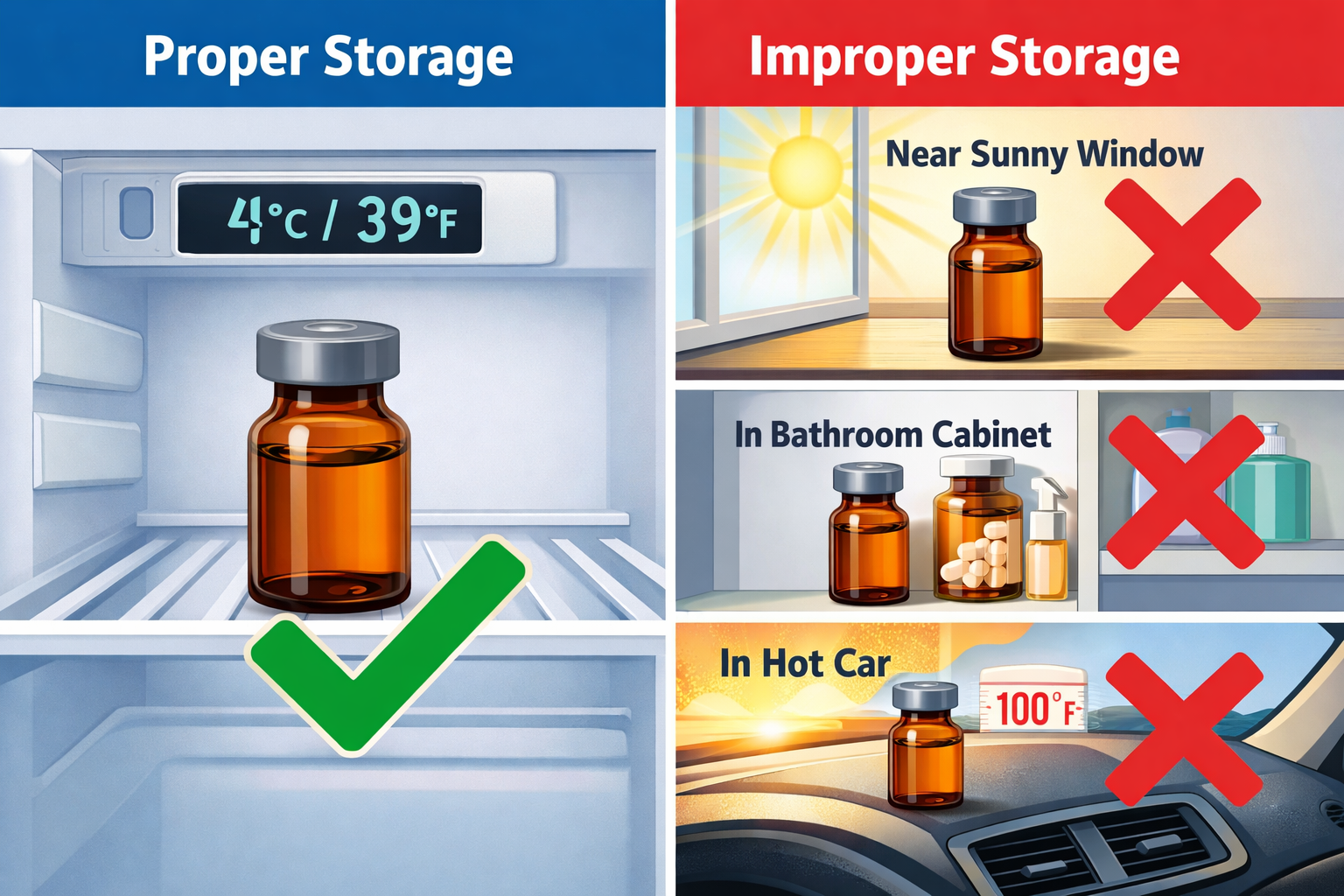
Mistake 1: Storing on the fridge door This is the most frequent error. Door temperatures fluctuate every time you open the refrigerator. Over days and weeks, this repeated cycling degrades the peptide [2].
Mistake 2: Letting it sit out too long before injecting Taking the vial out 30–60 minutes before injection to “warm it up” is a common habit borrowed from insulin users. With compounded semaglutide, extended room-temperature exposure is riskier. A few minutes is fine; anything measured in hours warrants a call to your pharmacy [2].
Mistake 3: Storing in the bathroom Bathrooms combine two enemies of peptide stability: heat and humidity. Even if your bathroom feels cool, steam from showers creates moisture that can compromise vials over time [5][7].
Mistake 4: Ignoring cloudiness or particles A properly stored compounded semaglutide solution should be clear and colorless or very slightly yellow. If you notice cloudiness, visible particles, or discoloration, do not use it — contact your pharmacy immediately [6].
Mistake 5: Traveling without a cooler If you’re traveling, compounded semaglutide needs to stay cold. Use an insulated travel case with an ice pack. Most pharmacies can advise on travel-specific storage for your formulation [7].
How to Store Compounded Semaglutide at Home During Travel or Power Outages
During travel, use an insulated medication cooler with a gel ice pack to maintain 36–46°F. During a power outage, an unopened refrigerator will typically hold safe temperatures for 4 hours — check with your pharmacy if the outage extends beyond that.
Practical steps for travel:
- Invest in a medical-grade insulated case — options like the FRIO wallet or similar insulin travel coolers work well for semaglutide vials
- Use gel ice packs, not loose ice — loose ice can cause freezing if the vial contacts it directly
- Keep the vial in its opaque container during transport to protect from light
- Never check medication in luggage on flights — cargo holds can freeze
- Carry a copy of your prescription in case you need to replace a vial at your destination
For power outages lasting more than 4 hours, the safest approach is to contact your pharmacy. They can advise whether the vial is still usable based on the estimated temperature exposure [2][5].
How to Store Compounded Semaglutide at Home: Step-by-Step Checklist
Follow this checklist from the moment your compounded semaglutide arrives to ensure every dose delivers full potency.
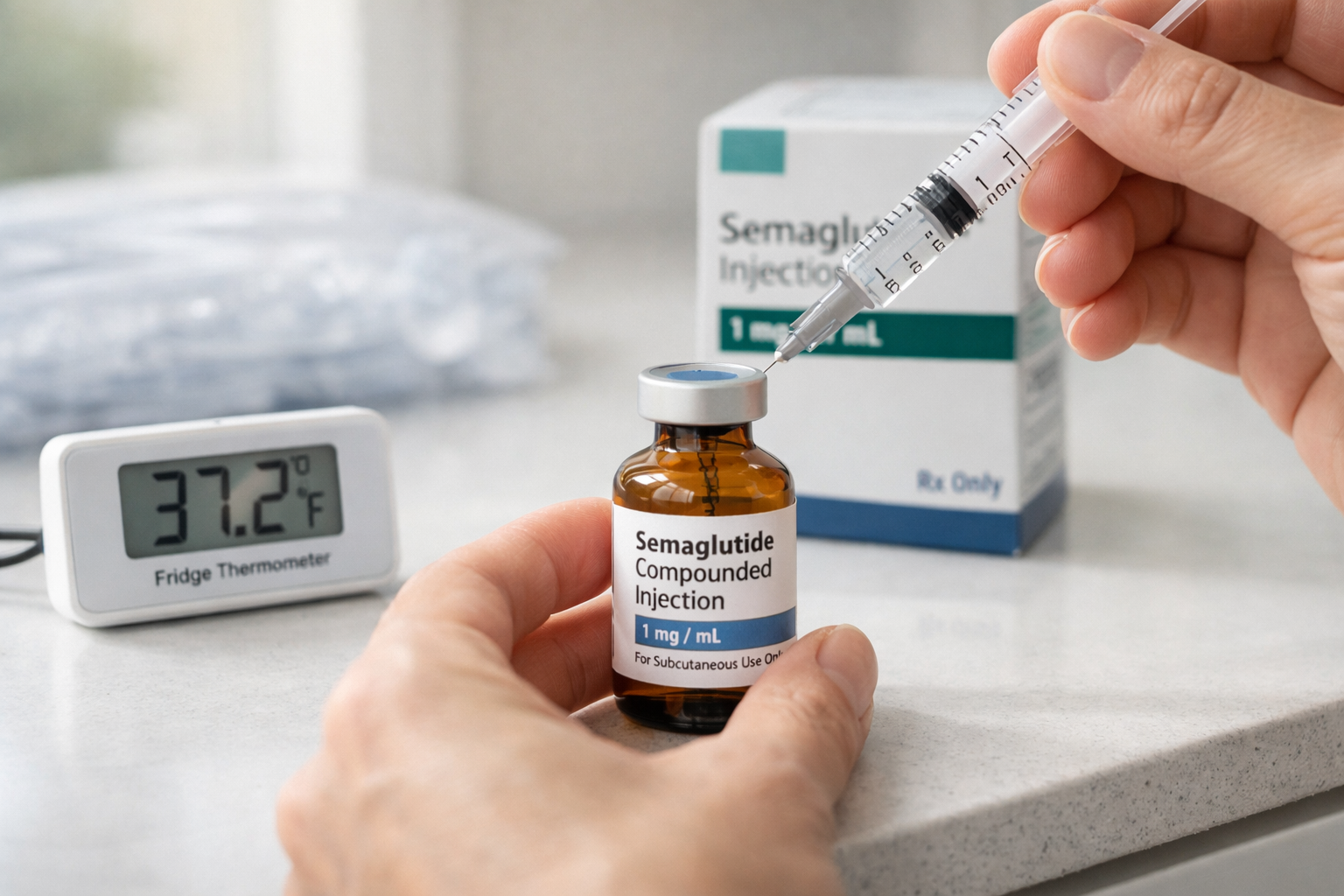
Upon Arrival:
- Place vial in refrigerator within 30 minutes of receiving it
- Store on a middle shelf, front-center — not the door
- Confirm fridge temperature is 36–46°F with a thermometer
- Note the beyond-use date from the pharmacy label
- Keep in original amber/opaque container
Before Each Injection:
- Remove vial from fridge
- Allow 2–3 minutes to reach comfortable injection temperature (no longer than needed)
- Inspect for cloudiness, particles, or discoloration — if present, do not use
- Return vial to refrigerator immediately after drawing your dose
Ongoing:
- Write your opening date on the vial
- Track the 30-day post-opening window (or your pharmacy’s specified window)
- Schedule your next refill before the BUD — don’t wait until the last day
- Never store in bathroom, car, or near heat sources
Understanding your dosing schedule is just as important as storage. See our guide on semaglutide dosage insights for effective treatment to make sure you’re getting the most from each vial.
Compounded vs. Brand-Name Semaglutide: Does Storage Differ?
Yes — compounded semaglutide generally requires stricter storage adherence than FDA-approved versions like Ozempic or Wegovy. This is because brand-name formulations undergo extensive manufacturer stability testing, while compounded versions rely on pharmacy-specific protocols that vary considerably [1][4][6].
| Feature | Compounded Semaglutide | Ozempic (FDA-Approved) | Wegovy (FDA-Approved) |
| Refrigeration Required | Yes, Always [1] | Yes, until first use [9] | Yes, until first use [9] |
| Room Temp After Opening | Varies (Check Pharmacy Label) | Up to 56 Days [4] | Up to 28 Days [4] |
| Beyond-Use Date (BUD) | 14 – 120 Days [4] | Manufacturer-set Exp. | Manufacturer-set Exp. |
| Freeze Risk | High Sensitivity [1][4] | High Sensitivity | High Sensitivity |
| Light Sensitivity | High — Use Opaque Containers | Moderate | Moderate |
The shorter and more variable stability windows of compounded versions make home storage knowledge more critical. If you’re still deciding between options, our comparison of the best semaglutide weight loss medications in 2026 can help you weigh cost versus convenience factors.
For those managing costs without insurance, compounded semaglutide is often the most accessible path. Learn more about semaglutide without insurance: costs and savings strategies.
FAQ: Storing Compounded Semaglutide at Home
Q: Can I store compounded semaglutide on the fridge door? No. Door storage exposes the vial to temperature swings of 5–10°F every time the refrigerator opens. Use a middle shelf in the main compartment [2].
Q: What happens if my compounded semaglutide freezes? Freezing damages the peptide’s molecular structure and reduces potency. Even one freeze-thaw cycle can compromise the medication. Do not use a frozen-then-thawed vial without consulting your pharmacy [1][4].
Q: How long can compounded semaglutide sit out at room temperature? A few minutes during injection preparation is fine. Extended exposure — anything measured in hours — should prompt a call to your dispensing pharmacy [2].
Q: Does compounded semaglutide expire faster than Ozempic or Wegovy? Generally yes. Compounded versions have BUDs of 14–120 days depending on the pharmacy, while FDA-approved versions have manufacturer-set expiration dates and longer post-opening stability windows [4][6].
Q: How do I know if my compounded semaglutide has gone bad? Look for cloudiness, visible particles, or discoloration. A good vial should be clear and colorless or very slightly yellow. If anything looks off, contact your pharmacy before using it [6].
Q: Can I travel with compounded semaglutide? Yes, with proper precautions. Use an insulated medical cooler with gel ice packs. Keep the vial in its opaque container and carry it in your carry-on luggage, not checked bags [7].
Q: What is a beyond-use date and why does it differ from an expiration date? A beyond-use date (BUD) is assigned by the compounding pharmacy based on their stability testing. It’s the date after which the medication should not be used. It differs from a manufacturer’s expiration date because compounded medications don’t go through the same standardized testing process [4].
Q: Should I let the vial warm up before injecting? You can remove it from the fridge a few minutes before injecting to reduce injection site discomfort, but do not leave it out for extended periods. Two to three minutes is typically sufficient [2].
Q: What if I accidentally left my vial out overnight? Contact your pharmacy immediately. Depending on the room temperature and formulation, the medication may or may not still be usable — don’t guess [2].
Q: Can I store compounded semaglutide in a bathroom medicine cabinet? No. Bathrooms have high humidity and temperature fluctuations from showers that are harmful to peptide stability [5][7].
Conclusion: Protect Your Investment, Protect Your Results
Knowing how to store compounded semaglutide at home correctly is not complicated — but it does require consistency. The core rules are simple: refrigerate at 36–46°F, use a middle shelf, keep it in its original opaque container, never freeze it, and respect the beyond-use date your pharmacy assigns.
Where most people go wrong is in the small habits — leaving the vial on the counter a bit too long, defaulting to the fridge door out of convenience, or ignoring a BUD that’s approaching. Each of these small errors adds up to reduced potency and wasted money.
Your immediate action steps:
- Check your refrigerator temperature today with a thermometer
- Move your vial to a middle shelf if it’s currently on the door
- Write today’s date on your vial if it’s already open
- Call your pharmacy to confirm your specific BUD and post-opening window
- Set a calendar reminder for your next refill — at least one week before the BUD
If you’re still exploring your options for compounded semaglutide or comparing it to other GLP-1 medications, our guide on types of GLP-1 medications including semaglutide and tirzepatide is a practical next step. And if you want to see real patient outcomes before committing, our semaglutide reviews covering real results and side effects gives you an unfiltered look at what to expect.
Stored correctly, compounded semaglutide is a powerful, affordable tool for meaningful weight loss. Don’t let a preventable storage mistake stand between you and your results.
References
[1] How To Store Compounded Semaglutide – [1]
[2] How Long Does Compounded Semaglutide Last In The Fridge – [2]
[3] Can You Freeze Semaglutide – [3]
[4] Semaglutide Storage – [4]
[5] Semaglutide Vial Duration Understanding Shelf Life And Usage – [5]
[6] Semaglutide Storage – [6]
[7] Tips For Storing And Refrigerating Semaglutide – [7]
[8] Does Semaglutide Need To Be Refrigerated – [8]
[9] GLP-1 RAs Storage and Stability – [9]

With over 13 years of experience in holistic health blogging, I aim to help you navigate your wellness journey with honest insights, expert-backed advice, and a sprinkle of real-world practicality.
Certified Wellness Writer | Herbal Nutrition Advocate | Wellness Research Enthusiast


