
Max Force

Last updated: August 14, 2026
Quick Answer: Max force is the single highest force output a muscle, limb, or object can produce in one effort, measured in Newtons (N) or pounds-force (lbf). In sport science and strength training, it serves as the gold-standard benchmark for raw muscular strength. You measure it with a force plate, hand dynamometer, or calculated from a one-rep maximum (1RM) lift. Improving max force directly raises athletic performance, injury resilience, and long-term functional capacity.
Key Takeaways
- Max force is the peak force value recorded during a single maximal effort, distinct from average force or power output.
- The standard formula is F = ma (force equals mass times acceleration), but in practice, 1RM testing or dynamometry gives more reliable real-world numbers.
- Max force differs from explosive power: power combines force and velocity, while max force is purely about peak output regardless of speed.
- Force plates and hand dynamometers are the most accurate tools; 1RM estimation formulas are a practical alternative for beginners.
- Athletes in strength sports (powerlifting, Olympic lifting) prioritize max force, while team-sport athletes balance it with rate of force development (RFD).
- Common testing mistakes include inadequate warm-up, inconsistent body position, and testing too frequently without recovery.
- Beginners should establish a baseline before any structured max force training and retest every 4 to 6 weeks.
- Max force training (heavy compound lifts at 85-95% 1RM) produces measurable neural and structural adaptations within 6 to 8 weeks.
What Is Max Force?
Max force is the highest force value a system can generate at any single point in time during a movement or contraction. In human performance, it refers to the greatest muscular force output a person can produce against a resistance, measured during a maximal voluntary contraction.
This concept applies across multiple domains: physics, biomechanics, sport science, and engineering. In everyday health and fitness language, max force is essentially your body’s ceiling for raw strength output. Understanding it matters because it sets the upper limit for everything else, including speed, power, and injury resistance.
The term also appears in several product and brand contexts. OxiClean markets a Max Force stain-removal line [5], and there are male-enhancement supplements using the Max Force branding [6]. The professional pest-control industry uses Maxforce as a product family name for bait gels and granules [7][8]. This guide focuses on the performance and physics meaning, which is the dominant search intent for the term in 2026.
Max Force Definition in Physics
In physics, max force is the maximum value of force (F) exerted by or on an object, expressed in Newtons (N) in the SI system. Force itself is defined by Newton’s second law: F = ma, where m is mass in kilograms and a is acceleration in meters per second squared.
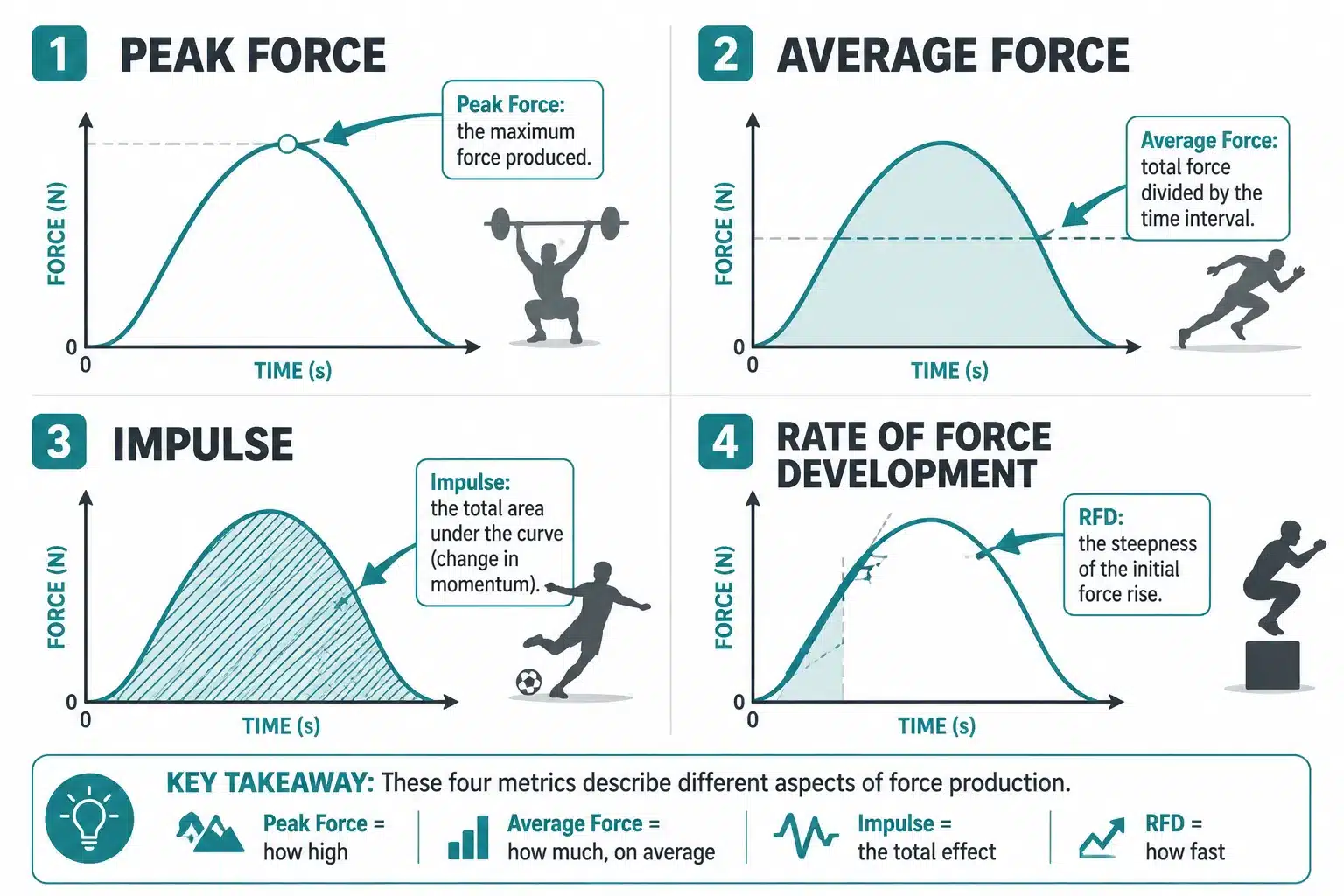
Max force becomes relevant when force is not constant over time, which is almost always the case in biological movement. A force-time curve plotted during a jump, throw, or lift shows a rising and falling profile. The peak of that curve is the max force value.
Key physics terms related to max force:
- Peak force: The single highest point on a force-time curve.
- Average force: The mean force across the entire movement duration.
- Impulse: Force multiplied by time (F x t), representing the total mechanical effect.
- Rate of force development (RFD): How quickly force rises toward its peak, measured in N/s.
Understanding the difference between these values prevents a very common error: confusing a high average force with a high max force. An athlete can produce a large impulse with moderate max force by extending the time of force application, which is a completely different physical strategy.
How Do You Calculate Max Force?
Max force can be calculated directly from Newton’s second law or estimated from performance tests. The approach you choose depends on your equipment and context.
Method 1: Direct calculation (physics problems)
F_max = m x a_max
For example, if a 100 kg barbell accelerates at 2 m/s² at the peak of a lift, the max force at that instant is approximately 980 N (gravitational load) plus 200 N (acceleration force), giving roughly 1,180 N.
Method 2: 1RM-based estimation
In practical training, the most common method is the one-repetition maximum (1RM) test. The 1RM represents the load at which max force approximately equals the gravitational force on the bar (since velocity approaches zero at the sticking point). Several validated estimation formulas exist:
- Epley formula: 1RM = weight x (1 + reps/30)
- Brzycki formula: 1RM = weight / (1.0278 – 0.0278 x reps)
These are estimates. For reps above 10, accuracy drops meaningfully, so keep test sets to 3 to 5 reps for better precision.
Method 3: Force plate or dynamometer measurement
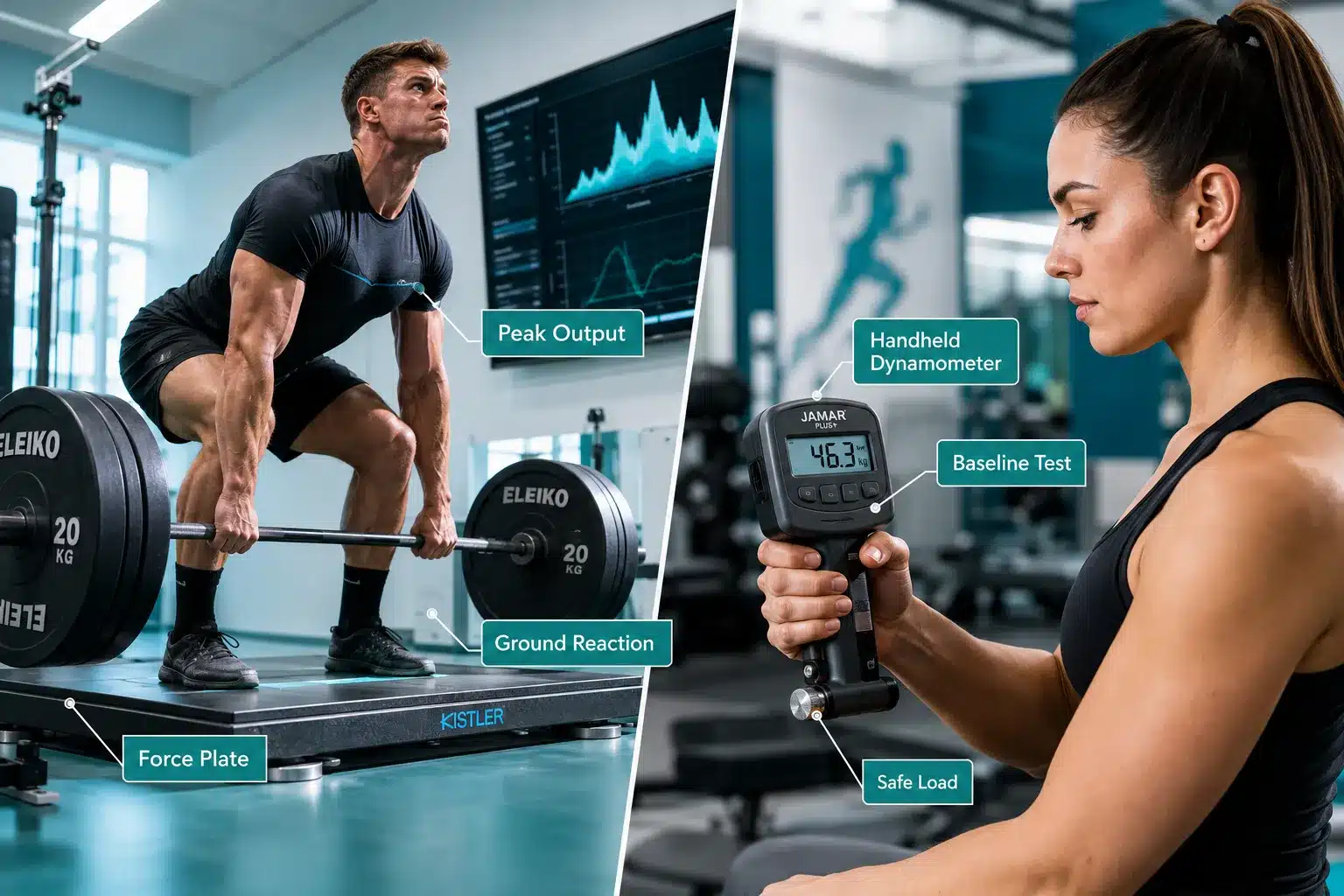
This is the most accurate method. A force plate records ground reaction force in real time, capturing the true peak value during a jump, squat, or isometric pull. A hand dynamometer measures grip or limb max force directly.
Max Force vs Average Force
Max force and average force measure different things and should never be used interchangeably. Max force is the single highest point on a force-time curve. Average force is the total impulse divided by the movement duration.
Why the distinction matters:
- A slow, grinding squat may produce a lower max force than a fast, explosive squat with the same load, because the acceleration component adds to peak force.
- Two athletes can produce identical average force during a sprint but have very different max force profiles, which affects their acceleration capacity.
- Rehabilitation protocols often target average force (sustained load tolerance), while performance training targets max force and RFD.
| Metric | Definition | Best Use |
|---|---|---|
| Max Force | Highest single force value on the curve | Strength benchmarking, power sports |
| Average Force | Mean force across the movement | Endurance, rehab, sustained effort |
| Impulse | Force x time (area under curve) | Jump height, throwing velocity |
| RFD | Rate force rises toward peak | Reactive sports, sprint starts |
Max Force vs Explosive Power
Max force and explosive power are related but distinct qualities. Max force is about the ceiling of force production. Explosive power combines force and velocity: Power = Force x Velocity.
An athlete with very high max force but slow contraction speed may have lower power output than an athlete with moderate max force and high movement velocity. This is why powerlifters and Olympic weightlifters train differently despite both working with heavy loads.
Choose max force training if:
- Your sport demands absolute strength (powerlifting, wrestling, rugby scrums).
- You are in an early training phase building a strength foundation.
- Your force-velocity curve shows a clear deficit at the high-force end.
Choose explosive power training if:
- Your sport demands speed-strength (sprinting, jumping, throwing).
- Your max force is already well-developed relative to your body weight.
- You need to convert existing strength into faster movement.
For most general health and wellness goals, a 12-week home workout plan that blends both qualities produces the best functional outcomes.
Max Force in Different Sports
Max force requirements vary significantly by sport. Understanding the specific demands helps athletes and coaches prioritize training correctly.
Strength sports (powerlifting, Olympic weightlifting): Max force is the primary performance determinant. Elite male powerlifters produce squat forces exceeding 3,000 N in competition conditions.
Team sports (rugby, American football): Max force in the lower body correlates with sprint speed and tackle dominance. Linemen require high absolute max force; backs prioritize RFD.
Racket and throwing sports: Shoulder and wrist max force predict serve velocity and throwing distance, but the relationship is mediated by technique and RFD.
Endurance sports (cycling, rowing): Max force matters less than sustained average force and force economy. However, a higher max force ceiling reduces the relative effort of any given sub-maximal workload.
Martial arts and combat sports: Grip max force, hip extension force, and rotational force are key predictors of grappling and striking performance.
Sport-specific max force norms exist in the peer-reviewed literature, but they vary by weight class, age, and competitive level. Use them as directional benchmarks rather than absolute standards.
Max Force Training Benefits
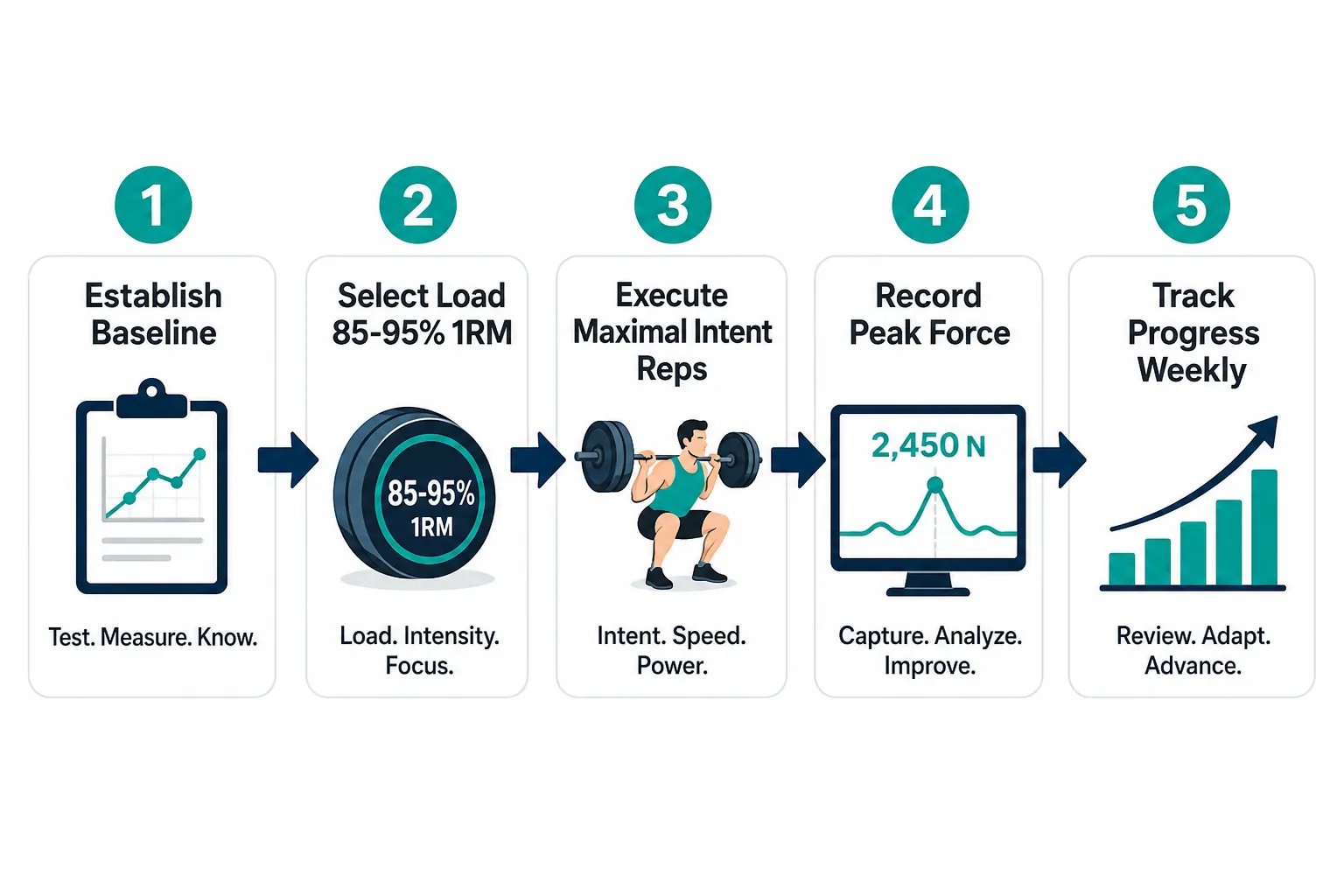
Max force training, defined as lifting at 85 to 95 percent of 1RM for low repetitions (1 to 5), produces specific adaptations that differ from moderate-load hypertrophy training.
Documented benefits:
- Neural drive improvements: Heavy loads recruit high-threshold motor units that lighter training cannot access, improving the nervous system’s ability to generate peak force on demand.
- Tendon stiffness: High-force loading increases tendon stiffness, which improves force transmission and reduces injury risk at the musculotendinous junction.
- Bone mineral density: Mechanical loading above a threshold stimulus drives bone remodeling, which is particularly relevant for adults over 40.
- Functional strength transfer: Max force improvements transfer to daily tasks like carrying, lifting, and postural stability more directly than isolated machine training.
- Hormonal response: Heavy compound lifts produce acute elevations in anabolic hormones, supporting muscle protein synthesis.
For men concerned about overall vitality alongside physical performance, it is worth noting that strength training interacts with hormonal health. Some readers also explore best male stamina supplements as a complementary strategy, though training itself remains the primary driver.
How to Measure Max Force: Equipment and Methods
Measuring max force accurately requires the right tool matched to the context. Three main categories of equipment are used in 2026.
1. Force plates
Force plates measure ground reaction force in real time during dynamic movements (jumps, squats, sprints) or isometric contractions. They are the gold standard in sport science labs but cost several thousand dollars for research-grade units. Consumer-grade options have improved significantly and are now accessible for well-funded training facilities.
2. Hand dynamometers
A hand dynamometer measures grip strength or the force output of a specific limb segment. They are affordable (typically $30 to $300 for clinical-grade units), portable, and validated against force plate measures for grip and isometric assessments. They are the most practical tool for general health screening.
3. Linear position transducers (LPTs)
LPTs attach to a barbell and measure bar velocity and position throughout a lift. Combined with known load, they calculate force at every point in the movement, including the peak. This is the most practical method for tracking max force in a training environment without a force plate.
4. 1RM testing (indirect)
A properly conducted 1RM test is a valid and reliable indirect measure of max force for most compound exercises. It requires a thorough warm-up, 3 to 5 progressively heavier attempts, and consistent technique across tests.
Max Force Dynamometer: What It Is and When to Use It
A max force dynamometer is any handheld or fixed device that measures peak force output during a maximal contraction. The term is used both generically (any dynamometer used to test max force) and as a product category name by several manufacturers.
When to use a dynamometer:
- Baseline fitness screening in clinical or occupational health settings.
- Tracking rehabilitation progress after injury.
- Comparing bilateral strength symmetry (left vs right limb).
- Field testing when a force plate is unavailable.
Grip dynamometry is the most researched application. Grip strength measured by dynamometer is a validated predictor of all-cause mortality, cardiovascular risk, and functional decline in aging populations, according to data published in The Lancet (Leong et al., 2015). This makes it one of the most cost-effective health screening tools available.
Common mistake: Testing grip strength with the elbow bent at 90 degrees is the standardized position. Testing with a fully extended or fully flexed elbow produces systematically lower values and makes longitudinal comparisons invalid.
When Should You Test Max Force?
Test max force at the right time in your training cycle to get valid data and avoid injury. Testing too frequently, or at the wrong point in a training block, produces unreliable results and unnecessary fatigue.
Recommended testing windows:
- Baseline: Before starting any new training program.
- Post-adaptation block: After 4 to 6 weeks of structured training, when neural and structural adaptations have had time to consolidate.
- Pre-competition: 7 to 10 days before a competition, during a deload phase when fatigue is low.
- Return to sport: After injury, to confirm readiness for full training loads.
Do not test max force:
- Within 48 hours of a heavy training session.
- During a high-volume accumulation phase when systemic fatigue is elevated.
- When experiencing joint pain, illness, or significant sleep deprivation.
Common Mistakes in Max Force Testing
Even experienced athletes make errors that invalidate max force tests or increase injury risk. Here are the most frequent problems and how to fix them.
1. Insufficient warm-up
A max force test requires progressive neural activation. Jumping straight to near-maximal loads without a structured warm-up underestimates true max force by 5 to 15 percent (estimate based on standard warm-up protocols in sport science literature) and significantly increases injury risk.
Fix: Use a pyramid warm-up, working from 50% to 70% to 85% of estimated max before the test attempt.
2. Inconsistent body position
Small changes in grip width, stance, or joint angle alter the mechanical advantage and produce different force readings. This makes test-to-test comparisons meaningless.
Fix: Standardize and document body position for every test. Photograph or video the setup.
3. Testing too frequently
Max force testing is itself a high-intensity stimulus. Testing weekly creates cumulative fatigue that suppresses performance and masks real progress.
Fix: Test every 4 to 6 weeks at minimum.
4. Using estimated 1RM formulas beyond their valid range
Epley and Brzycki formulas are validated for sets of 1 to 10 reps. Using them to estimate 1RM from a 15-rep set introduces large errors.
Fix: Keep test sets to 3 to 5 reps for best accuracy.
5. Ignoring daily readiness
Max force fluctuates with sleep, hydration, and stress. A single test on a bad day is not a reliable measure of true capacity.
Fix: Use rolling averages across 2 to 3 tests, or use a readiness protocol (e.g., a sub-maximal velocity check) before committing to a max test.
Max Force for Beginners: Where to Start
Beginners should not start with formal max force testing. The priority in the first 8 to 12 weeks of training is learning movement patterns, building connective tissue tolerance, and developing consistent technique.
Beginner progression:
- Spend 6 to 8 weeks on technique-focused training at 60 to 75% of estimated 1RM.
- Conduct a first 1RM estimate test after this foundation period using a 5-rep set and an estimation formula.
- Use that estimated 1RM to set training loads for the next block.
- Retest at week 12 to measure progress.
Beginners gain max force rapidly in the first 3 to 6 months, primarily through neural adaptations rather than muscle hypertrophy. This means visible muscle size changes may lag behind strength gains, which is normal and expected.
For beginners who are also managing weight alongside strength goals, understanding options like RX medications for weight loss can be relevant context, since body composition affects relative strength benchmarks.
Max Force vs Strength Training: Are They the Same?
Max force training is a specific subset of strength training, not a synonym for it. Strength training is a broad category that includes hypertrophy work (moderate loads, higher reps), endurance strength (light loads, high reps), and max force development (heavy loads, low reps).
Max force training specifically:
- Loads: 85 to 95% of 1RM
- Reps per set: 1 to 5
- Primary adaptation: Neural (motor unit recruitment, rate coding, inter-muscular coordination)
- Secondary adaptation: Tendon stiffness, myofibrillar density
General strength training:
- Loads: 60 to 85% of 1RM
- Reps per set: 6 to 12
- Primary adaptation: Hypertrophy (muscle cross-sectional area)
- Secondary adaptation: Some neural improvement
Both approaches improve max force over time, but max force-specific training does so more efficiently for athletes who already have a solid hypertrophy base. For general health and wellness, a blend of both is optimal.
Frequently Asked Questions
What is the difference between max force and 1RM?
The 1RM is the maximum load you can lift once with proper technique. Max force is the peak force value produced during that lift, which includes both the gravitational load and the acceleration component. They are closely related but not identical numbers.
Can max force be improved without heavy lifting?
Yes, to a degree. Isometric training at long muscle lengths, plyometrics, and contrast training all improve max force. However, for most people, progressive heavy loading remains the most efficient method.
How does age affect max force?
Max force peaks in the late 20s to mid-30s and declines gradually thereafter, with steeper declines after age 60 if training is not maintained. Consistent resistance training significantly slows this decline.
Is max force testing safe for older adults?
Yes, when properly supervised and preceded by an adequate warm-up. Grip dynamometry and isometric tests are very low-risk. Dynamic 1RM testing in older adults should be approached conservatively, with estimated 1RM from multi-rep sets preferred over true single-rep maxes.
What is a good max force for grip strength?
Normative values vary by age, sex, and body size. As a general benchmark, a grip strength below 26 kg in men or below 16 kg in women (measured by dynamometer) is associated with increased health risk in middle-aged adults, according to data from the PURE study (Leong et al., 2015).
How often should I do max force training?
Most athletes benefit from 1 to 2 max force-focused sessions per week per movement pattern, with at least 48 to 72 hours of recovery between sessions targeting the same muscle groups.
Does max force training make you bulky?
No. Max force training at very low reps (1 to 3) with long rest periods produces primarily neural adaptations with minimal hypertrophy. Athletes who want strength without significant size gain often prefer this rep range.
What equipment do I need to start max force training at home?
A barbell, weight plates, a squat rack, and a floor scale to estimate body weight relative to load. A hand dynamometer ($30 to $100) is a useful addition for tracking grip strength. A force plate is ideal but not necessary for most people.
Is max force the same as maximum voluntary contraction (MVC)?
MVC is the isometric equivalent of max force: the highest force produced during a maximal isometric contraction. They measure the same underlying capacity but in different movement conditions.
Can max force training help with fat loss?
Indirectly. Higher max force correlates with greater muscle mass, which raises resting metabolic rate. Heavy training also produces a significant post-exercise oxygen consumption (EPOC) effect. For direct weight management support, some people also explore options like GLP-1 telehealth providers alongside their training.
What is the Maxforce pest control product?
Maxforce is a brand of professional pest-control bait products, including Maxforce Complete granular insect bait [8] and Maxforce Fleet Ant Bait Gel [7]. These are unrelated to the fitness concept of max force but frequently appear in the same search results.
What is Maxx Force at Six Flags?
Maxx Force is a steel launch roller coaster at Six Flags Great America in Gurnee, Illinois [2][4]. It holds records for launch speed and vertical loop height. It is a separate concept from the physics or fitness meaning of max force, though the name causes frequent search confusion.
Conclusion
Max force is one of the most fundamental metrics in human performance and physics, yet it is consistently misunderstood, undertested, and undertrained by the general fitness population. The key insight from this guide is straightforward: max force is your strength ceiling, and raising that ceiling improves nearly every other physical quality, from power and speed to injury resilience and long-term health.
Actionable next steps for 2026:
- Establish your baseline. Use a 5-rep set and an estimation formula to calculate your current 1RM for at least one lower-body and one upper-body compound movement. Record it today.
- Get a hand dynamometer. Grip strength is a validated health marker and takes 60 seconds to test. Track it monthly.
- Add one max force session per week. Pick one compound lift and work at 85 to 90% of your estimated 1RM for 3 to 5 sets of 2 to 3 reps. Prioritize technique over load.
- Retest in 6 weeks. Compare your new 1RM estimate to your baseline. Expect a 5 to 15% improvement in the first training block.
- Distinguish max force from power. Once your strength foundation is solid, add explosive work to convert max force into functional athletic power.
Whether you are a competitive athlete, a health-conscious adult, or someone returning to training after a break, understanding and systematically developing your max force is one of the highest-return investments you can make in your physical health.
References
[1] Maxforce – https://www.maxforce.com/
[2] Maxx Force – https://www.sixflags.com/greatamerica/attractions/maxx-force
[3] Max Force Com.lovable – https://www.trustpilot.com/review/max-force-com.lovable.app
[4] Maxx Force – https://en.wikipedia.org/wiki/Maxx_Force
[5] Products – https://www.oxiclean.com/en/products
[6] Max Force Power Male Enhancement – https://finance.yahoo.com/news/max-force-power-male-enhancement-235000478.html
[7] Maxforce Fleet Ant Bait Gel – https://www.epestcontrol.com/pest-products/1490-maxforce-fleet-ant-bait-gel.html
[8] Maxforce Complete G I B Label – https://www.biisc.org/wp-content/uploads/Maxforce_Complete_G_I_B_Label.pdf


