
I Tried Nutrisystem for 90 Days: My Honest “No-Cook” Transformation (2026 Review)

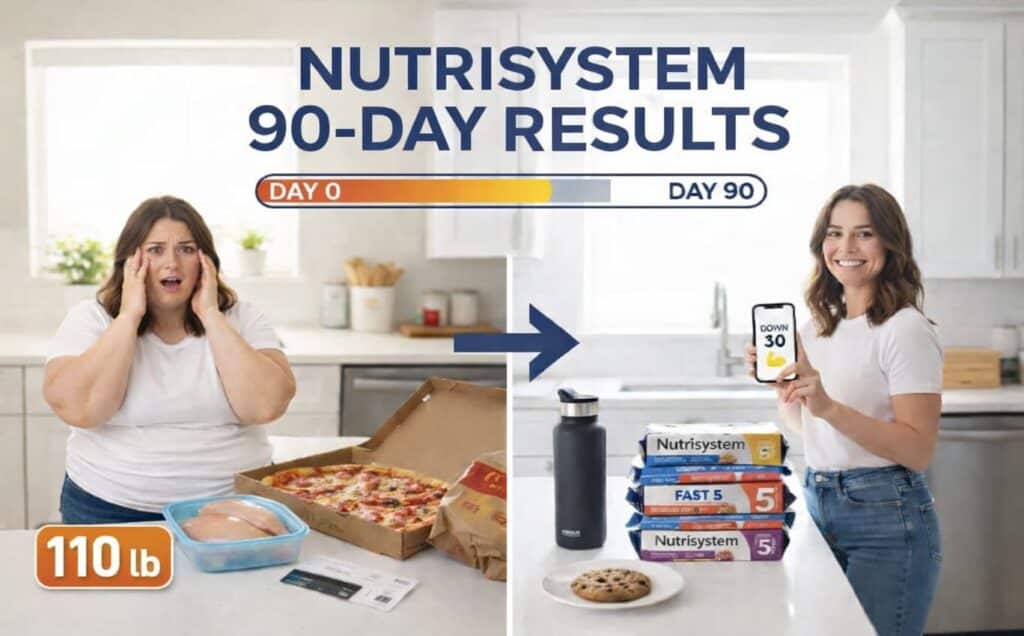
I used to spend two hours every Sunday meal prepping chicken and broccoli, only to find myself ordering pizza by Wednesday because I was exhausted. I was 110 pounds, my energy was at zero, and my “willpower” was non-existent.
If you are tired of the “dieting” hamster wheel—the calorie counting, the grocery lists, and the constant hunger—I wrote this nutrisystem review for you.
As someone who transitioned from a struggling dieter to a weight loss counselor, I’ve seen every fad and “magic pill” on the market. I stopped trying to “white-knuckle” my weight loss and let Nutrisystem take the wheel for 90 days.
Here is exactly what happened to my body, my sanity, and my bank account.
“I tried Nutrisystem for 30 days…”
Why I Finally Quit “Clean Eating” and Picked Nutrisystem
For years, I thought I was “failing” at dieting. In reality, I was failing at logistics.
Between work and life, I didn’t have the mental bandwidth to calculate macros. Nutrisystem changed the game because it removed the hardest part of weight loss: The Choices.
Nutrisystem’s primary “ingredient” isn’t just fiber or protein—it’s the removal of choice. By providing a structured roadmap where your breakfast, lunch, dinner, and snacks are already decided, you save your mental energy for your job, your family, and your life.
In my 90-day trial, the relief of not having to think about “What’s for dinner?” was more valuable than the weight loss itself.
What makes it different in 2026:
- Zero Decision Fatigue: You don’t ask “What’s for dinner?” You just grab a box.
- Science-Backed Satiety: They use high-protein, low-glycemic recipes that actually keep you full until the next meal.
- The “Fast 5” Advantage: I lost my first 5 pounds in the first week. That hit of dopamine is what kept me going.
The “Real Talk” Results: My 90-Day Snapshot
I didn’t just lose weight; I gained about 5 hours of my week back.
- Week 1: Lost 5.2 lbs. The “Fast 5” kit is intense but effective.
- Week 2: The “Brain Fog” lifted. I realized I wasn’t starving because I was eating every 3 hours.
- End of Month: Down 14 lbs total. My skin looked better, and for the first time in a decade, my “goal jeans” zipped up without a fight. [Check Today’s Price & Special Offers]
A Day in the Life: What You Actually Eat
To help you visualize how this fits into a busy schedule, here is a breakdown of a typical Tuesday on the Uniquely Yours plan.
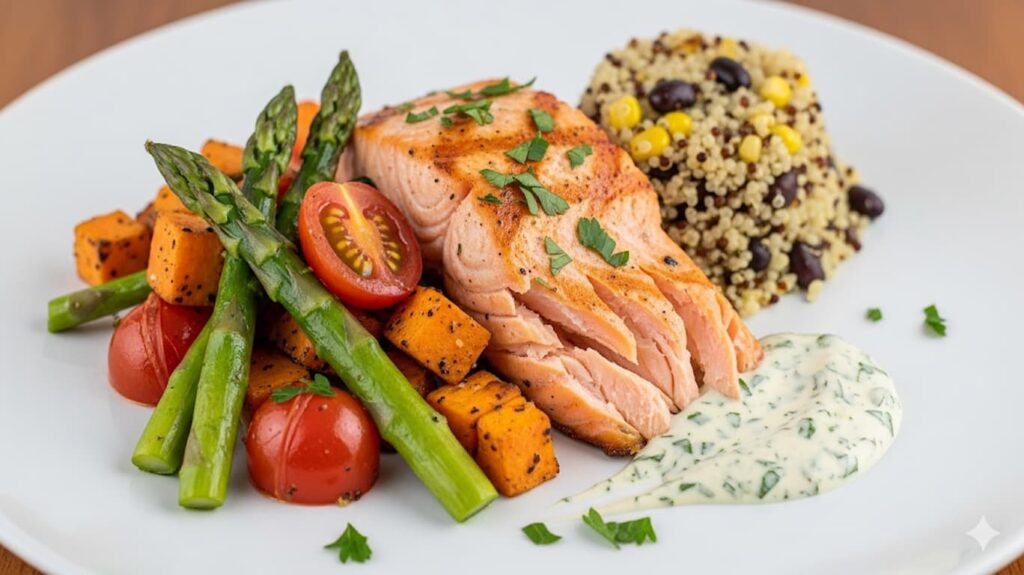
7:30 AM: Breakfast I started with the Apple Strudel Bar. Unlike most protein bars that taste like chalk, this actually had a flaky texture. I paired it with a black coffee. Total prep time: 0 minutes.

10:30 AM: Morning Snack Nutrisystem encourages you to eat every 3 hours to keep your metabolism humming. I had a cup of low-fat Greek yogurt (a “PowerFuel” addition).
1:00 PM: Lunch The Cheddar Broccoli Rice. This is a shelf-stable meal, so I kept it in my desk drawer at work. It takes 90 seconds in the microwave. It’s creamy, savory, and surprisingly filling.
4:00 PM: Afternoon Snack An apple and a handful of almonds. On Nutrisystem, you aren’t just eating their food; you’re learning to incorporate fresh produce and lean proteins (“SmartCarbs” and “PowerFuels”) so you know how to eat once the program ends.
7:00 PM: Dinner The Roasted Turkey Medallions. This was one of the “frozen” options. The turkey was moist, and the gravy was actually flavorful. It felt like a “real” meal rather than a diet tray.
8:30 PM: Evening Snack This is where Nutrisystem wins. You get dessert. Every. Single. Night. I had the Ice Cream Sandwich. It’s the perfect psychological “closer” to the day that prevents late-night binging.
The Food: Is It Actually Edible?
Let’s be honest: pre-packaged food has a bad reputation. But Nutrisystem’s 2026 menu has shifted.
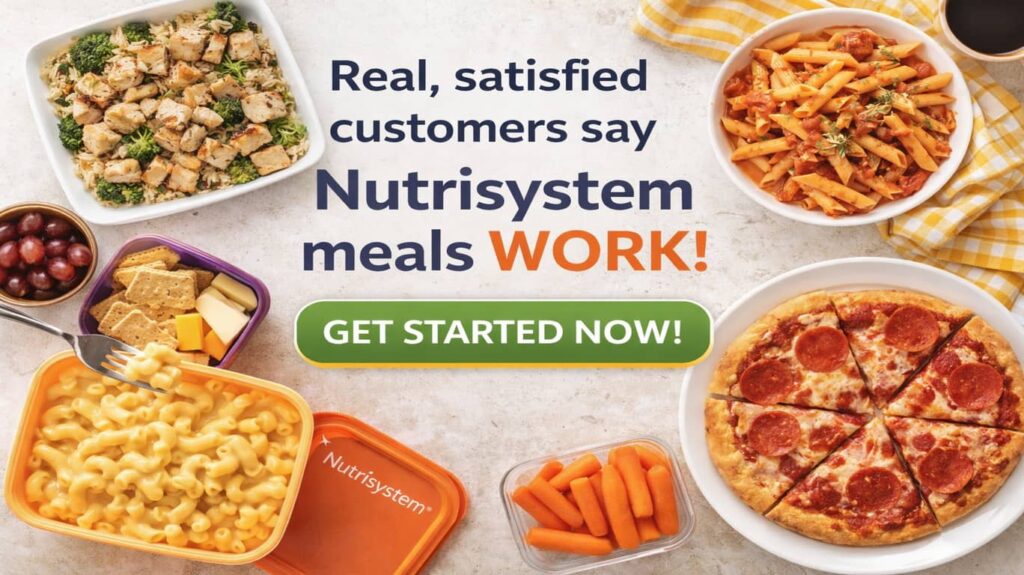
- The Winners: The Margherita Pizza and the Breakfast Burritos are legitimate comfort food.
- The Trade-off: The meals are shelf-stable or frozen. Is it a 5-star Michelin dinner? No. Is it a delicious, 4-minute solution that stops you from hitting the drive-thru? Absolutely. [Click here to View the 2026 Menu Options]
Addressing the Elephant in the Room: The “Processed” Label
Critics often point out that Nutrisystem is “processed food.” As a weight counselor, here is my professional take:
Excess weight is more dangerous than a shelf-stable meal. If your choice is between a home-cooked, organic, perfectly balanced meal and Nutrisystem, choose the home-cooked meal.
But if your choice is between a 1,200-calorie fast-food meal and a 300-calorie portion-controlled Nutrisystem meal, the winner is clear. Nutrisystem is a bridge. It’s a tool to get your weight to a safe place while you learn what a proper portion size actually looks like.
Is It Worth the Money? (The Math)
People say Nutrisystem is expensive. I disagree. When I added up my $15 lunches and the $100 of groceries I used to throw away every week because they went bad, Nutrisystem actually saved me $120 a month.
At roughly $12 a day, you are getting breakfast, lunch, dinner, and snacks. You can’t even get a fast-food “value meal” for that anymore.
Nutrisystem vs. The Competition: A Honest Comparison
How does it stack up against other big names in 2026?
| Feature | Nutrisystem | Weight Watchers (WW) | Keto/DIY |
| Preparation | Zero (Heat & Eat) | High (Cooking/Tracking) | High (Meal Prep) |
| Price | ~$12/day (Full Meals) | ~$1/day (App Only) | ~$20/day (Groceries) |
| Hunger Level | Low (6 meals/day) | Moderate (Points-based) | High (During “Keto Flu”) |
| Best For | Busy Professionals | Social Eaters | Meat Lovers |
The Verdict: If you have the time to track points and cook, WW is great. But if you are failing because you are “too busy,” Nutrisystem is the only one that removes the labor.
The Math: Is It Actually “Expensive”?
One of the biggest barriers for my clients is the upfront cost. Let’s break down the math.
A standard Nutrisystem plan is roughly $300 – $350 per month with current promotions. That sounds like a lot until you look at your bank statement.
- Average “Quick” Lunch: $15 (x 20 work days = $300)
- Average Dinner Grocery Run: $150/week (x 4 = $600)
- The “Waste” Factor: The average American throws away $1,500 of spoiled produce a year.
With Nutrisystem, your “Waste” is zero. Your “Impulse Buys” are zero. For most of my clients, switching to Nutrisystem actually saves them $150 – $200 a month on their total food budget. [Start Your Journey: 50% Off + Free Shipping]
Nutrisystem Review: Which Plan Should You Choose?
- For the Fast Starters: The Uniquely Yours plan is the gold standard. You get 130+ menu items and the ability to choose your favorite meals. If you are picky, get this plan.
- For Women 55+: The Complete 55 plan designed specifically for women over 55. to fight the metabolic slowdown that happens after menopause. It was a game-changer for my clients. It includes “Hearty Inspirations” meals that are larger and higher in protein.
- For Diabetics: Their specialized plan is clinically proven to help lower A1C while losing weight. One of the few programs on the market that is clinically designed to help manage blood sugar while losing weight.

Common Concerns & “Gotchas”
“Will I be hungry?” Rarely. Because you eat every 2.5 to 3 hours, your stomach never fully empties. You also supplement the meals with “Unlimited Veggies”—you can eat as much spinach, cucumbers, and celery as you want.
“What happens when I stop the program?” This is where the NuMi app comes in. Nutrisystem doesn’t want you on their food forever. The program teaches you “Flex Meals”—how to go out to a restaurant or cook a healthy Sunday dinner while staying on track. It’s training wheels for your metabolism.
“What is the return policy?” If you don’t like it, they have a Money Back Guarantee. You can try the food for 7 days, and if it’s not for you, return the remaining meals for a full refund. This makes it a zero-risk experiment.
The Verdict: Stop Waiting for “The Perfect Time”
There is never going to be a month where you aren’t busy. There is never going to be a week where you don’t have stress.
The reason Nutrisystem works isn’t that it’s a “miracle food.” It works because it simplifies your life. It gives you back the time you used to spend worrying about your weight and gives it back to your family and your career.
In 30 days, you could be 10-15 pounds lighter. You could be waking up with more energy. Or, you could be in the exact same place you are now, still stressed about what to cook for dinner.
Stop overthinking. Start winning.
The 2026 Weight Loss Dilemma: Nutrisystem or GLP-1s?
With the rise of medications like Tirzepatide and Semaglutide, many are asking: “Do I even need a meal plan anymore?” > The truth is, whether you are using a GLP-1 medication or going the natural route, nutrition is the foundation.
Many clinical patients use Nutrisystem to ensure they are getting enough protein and fiber while their appetite is suppressed.
| Feature | Nutrisystem Meal Plan | GLP-1 Medications |
| Approach | Natural Portion Control | Metabolic/Hormonal Shift |
| Effort | Zero Cooking / Grab-and-Go | Weekly Injections |
| Main Benefit | Builds Healthy Habits | Significant Appetite Suppression |
| Cost | ~$350/mo (Food Included) | $900+ /mo (Without Insurance) |
| Best For | Busy Lifestyles & Habit Fixes | Chronic Obesity & Metabolic Issues |
| The Verdict | Best for sustainable, lifestyle-based weight loss. | Best for clinical intervention under medical care. |
[Read Our Full Guide: How to Pair Nutrisystem with GLP-1 Therapy for Max Results]
Why Trust This Review?
Christina Lewis is a Weight Loss Counselor who has helped over 500 clients find sustainable paths to health. This review is based on a personal 30-day trial and the aggregated results of her professional coaching practice.
References & Scientific Sources
- On Muscle Loss & GLP-1s: Wilding, J. P. H., et al. (2021). “Once-Weekly Semaglutide in Adults with Overweight or Obesity.” The New England Journal of Medicine.https://www.nejm.org/doi/full/10.1056/NEJMoa2032183
- On the Importance of High Protein for Weight Loss: Leidy, H. J., et al. (2015). “The role of protein in weight loss and maintenance.” The American Journal of Clinical Nutrition.https://academic.oup.com/ajcn/article/101/6/1320S/4564492
- On Portion Control and Weight Management: National Institutes of Health (NIH). “Portion Size and Weight Management.” National Institute of Diabetes and Digestive and Kidney Diseases.https://www.niddk.nih.gov/health-information/weight-management/just-enough-portion-sizes
- On Glycemic Index and Satiety (Nutrisystem’s Science): Harvard Health Publishing. “A good guide to 1,700+ foods: The Glycemic Index.” Harvard Medical School.https://www.health.harvard.edu/diseases-and-conditions/glycemic-index-and-glycemic-load-for-100-foods
Disclaimer: This table is for informational purposes only. GLP-1 medications require a prescription and medical supervision. Always consult with your healthcare provider before starting any new weight loss medication or meal program.

With over 13 years of experience in holistic health blogging, I aim to help you navigate your wellness journey with honest insights, expert-backed advice, and a sprinkle of real-world practicality.
Certified Wellness Writer | Herbal Nutrition Advocate | Wellness Research Enthusiast


