
Semaglutide vs Saxenda Cost: Which Is More Affordable?


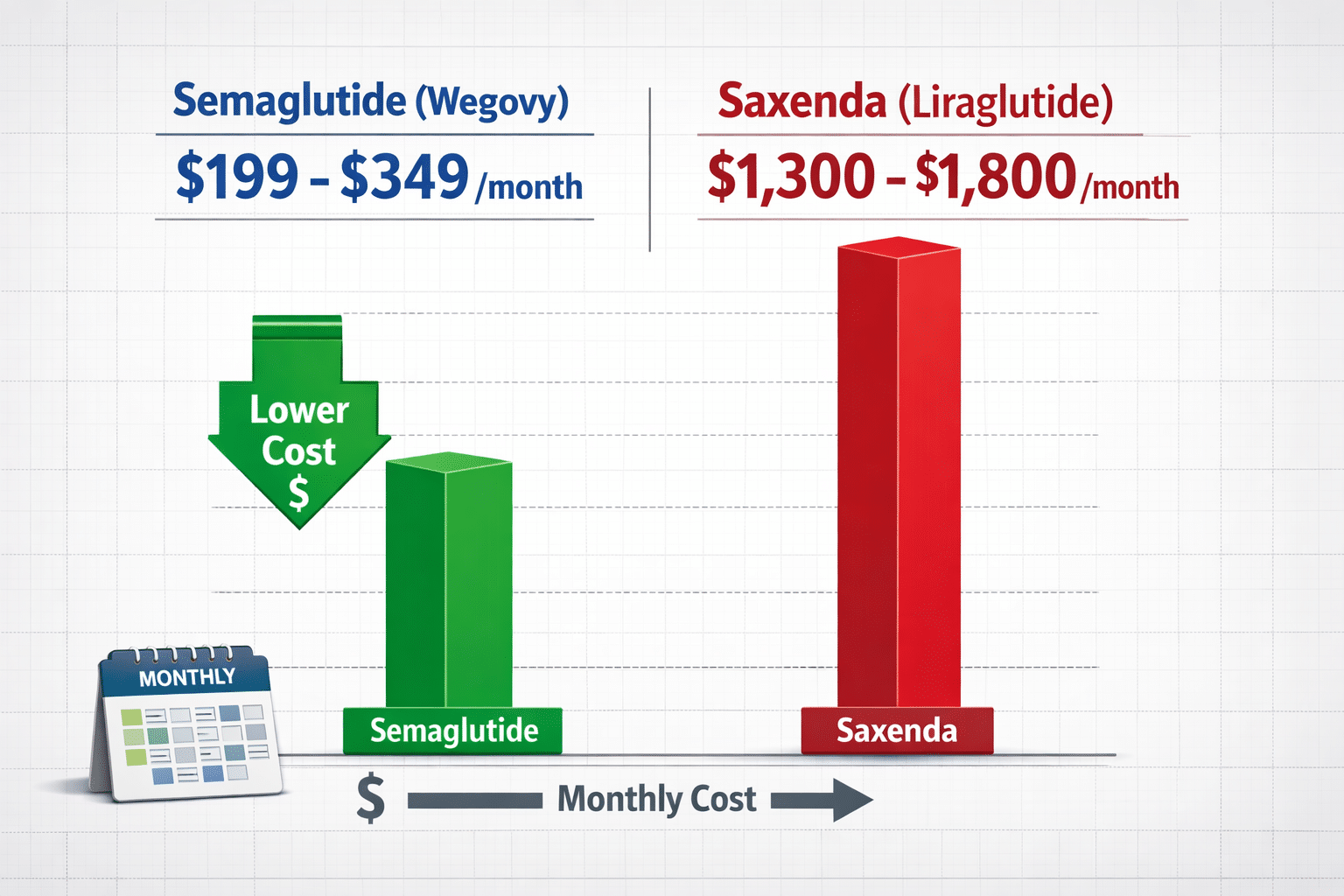
Quick Answer: Semaglutide is significantly more affordable than Saxenda for most people. Brand-name Saxenda (liraglutide) costs $1,300–$1,800 per month without insurance, while Wegovy (semaglutide injection) starts at $199/month for the first two months through GoodRx, then $349/month.
Generic liraglutide has entered the market but still runs $370–$1,300/month depending on the pharmacy. For uninsured patients, semaglutide wins on price by a wide margin.
Key Takeaways
- 💉 Saxenda costs $1,300–$1,800/month at full list price without insurance, making it the most expensive GLP-1 weight loss option currently available [1]
- 💊 Wegovy (semaglutide injection) costs $199/month for the first two months via GoodRx, then $349/month — far cheaper than Saxenda [5]
- 📋 Generic liraglutide (the active ingredient in Saxenda) launched in August 2025 and ranges from $370–$1,300/month, with prices still dropping [1][2]
- 🏥 With commercial insurance, both drugs can drop to $25–$60/month through manufacturer savings cards
- 📅 Saxenda requires daily injections vs. Wegovy’s once-weekly shot — meaning more supply used, more cost over time [2]
- 💡 Oral semaglutide (Wegovy pill) starts at $149/month for lower doses, making it the most affordable injectable-alternative option [4]
- ⚠️ Hidden costs — doctor visits and lab work — add $50–$100+ per month to either medication [2]
- 🔍 Medicare Part D does not cover Saxenda for weight loss, and Medicaid coverage varies by state [1][9]
- ✅ Bottom line: Semaglutide beats Saxenda on cost in almost every scenario, and it also shows stronger average weight loss results in clinical comparisons
What Is the Real Semaglutide vs Saxenda Cost Difference?
Semaglutide is dramatically cheaper than Saxenda at list price, and the gap widens when you factor in dosing frequency. Saxenda’s full retail price sits at $1,300–$1,800 per month for a 30-day supply at the full 3 mg dose without insurance [1]. Wegovy (semaglutide injection) runs $199/month for the first two fills through GoodRx, then settles at $349/month [5].
That’s a potential savings of $1,000+ per month by choosing semaglutide over brand-name Saxenda.
Here’s a direct side-by-side breakdown:
| Medication | Active Ingredient | Monthly Cost (No Insurance) | Injection Frequency |
|---|---|---|---|
| Saxenda (brand) | Liraglutide | $1,300–$1,800 [1] | Daily |
| Generic Liraglutide | Liraglutide | $370–$1,300 [2] | Daily |
| Wegovy (injection) | Semaglutide | $199–$349 [5] | Weekly |
| Wegovy (pill) | Semaglutide | $149–$299 [4] | Daily (oral) |
| Ozempic (off-label) | Semaglutide | $900–$1,200 [6] | Weekly |
Choose semaglutide if: You’re paying out of pocket and want the most affordable GLP-1 weight loss option. Consider generic liraglutide if: You’ve already been stable on Saxenda and want to reduce costs without switching drug classes.
💬 “The price difference between Saxenda and semaglutide is not marginal — it’s the difference between a car payment and a utility bill.”
For a full breakdown of semaglutide pricing across all formats, see our Semaglutide Cost 2026: Monthly Prices With and Without Insurance guide.
The 3 Most Affordable Options: Detailed Reviews
1. DirectMeds — Best Overall Value at $99–$149/Month
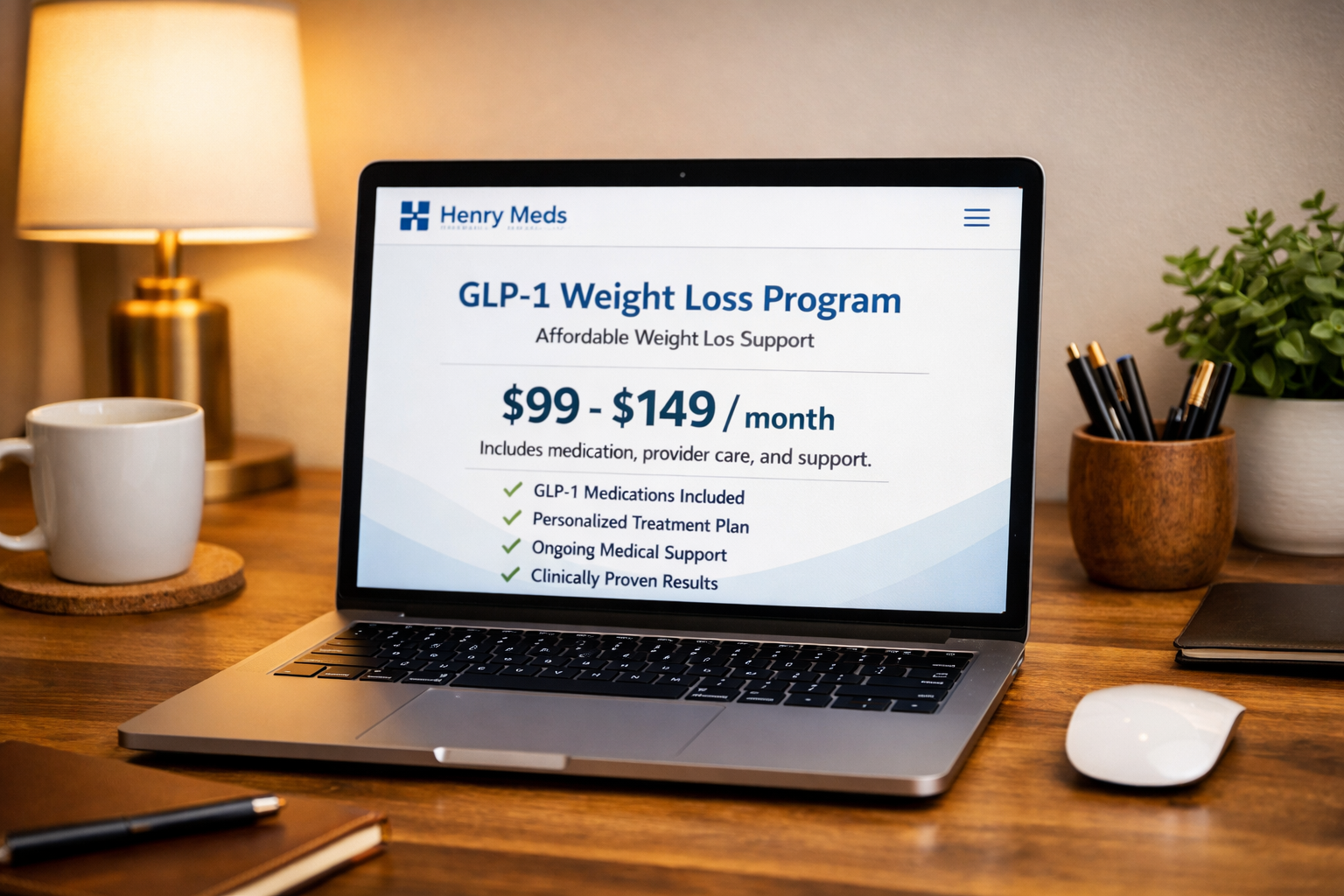
Henry Meds is one of the most affordable telehealth platforms offering GLP-1 medications, with monthly costs starting at $99 for compounded semaglutide. That price includes the medication, the telehealth consultation, and ongoing provider support — which makes it a genuinely strong value compared to paying separately for a doctor’s visit plus a pharmacy.
How it works: You complete an online intake form, a licensed provider reviews your health history, and if you qualify, your compounded semaglutide (or tirzepatide, depending on availability) is shipped directly to your door. The whole process typically takes a few days.
What you get for the price:
- Compounded semaglutide or tirzepatide (dose depends on your plan)
- Telehealth provider consultation included
- Ongoing messaging with your care team
- Medication shipped to your home
Who qualifies: Generally, adults with a BMI of 30+ or a BMI of 27+ with a weight-related condition (like high blood pressure or type 2 diabetes).
✅ Pros
- Lowest starting price among major telehealth GLP-1 providers
- Consultation and medication bundled — no surprise fees
- Easy online process, no in-person visit required
- Ships directly to your home
- Ongoing provider access included
❌ Cons
- Compounded semaglutide is not the same as FDA-approved Ozempic or Wegovy (different manufacturing process)
- Availability of tirzepatide may vary by state
- Not ideal if you specifically need brand-name medication
- No in-person care component
Best for: People who want the lowest possible monthly cost for a GLP-1 program and are comfortable with compounded medication from a licensed pharmacy.
Bottom line: At $99–$149/month with everything included, Henry Meds is hard to beat on price. If your main barrier to starting a GLP-1 is cost, this is the first place to look.
2. GobyMeds — Straightforward Access at $119/Month

GobyMeds offers compounded semaglutide at a flat $119/month, which puts it in the same budget tier as Henry Meds. The platform is designed to be simple: minimal friction, clear pricing, and a straightforward path from intake to prescription.
How it works: Similar to other telehealth GLP-1 platforms — you fill out a health questionnaire, a licensed provider reviews it, and if you qualify, medication is shipped to you. GobyMeds emphasizes transparent pricing with no hidden fees.
What you get:
- Compounded semaglutide (injectable)
- Telehealth provider review
- Home delivery
- Flat monthly pricing — no tiered plans to navigate
Who qualifies MyStart GLP-1: Adults with obesity or overweight with a qualifying health condition, similar to other GLP-1 telehealth platforms.
✅ Pros
- Flat, transparent pricing at $119/month
- No complicated plan tiers
- Telehealth consultation included
- Simple, fast online process
- Home delivery included
❌ Cons
- Newer platform with less established track record than some competitors
- Compounded medication (not FDA-approved finished product)
- May have limited availability in some states
- Fewer add-on support features compared to larger platforms
Best for: People who want a no-fuss, affordable GLP-1 option and don’t need a lot of hand-holding or extra program features.
Bottom line: GobyMeds is a solid pick if you want simplicity and low cost in one package. The flat $119/month pricing is refreshingly clear compared to platforms that bury costs in fine print.
3. Generic Liraglutide (Victoza/Saxenda Authorized Generic)
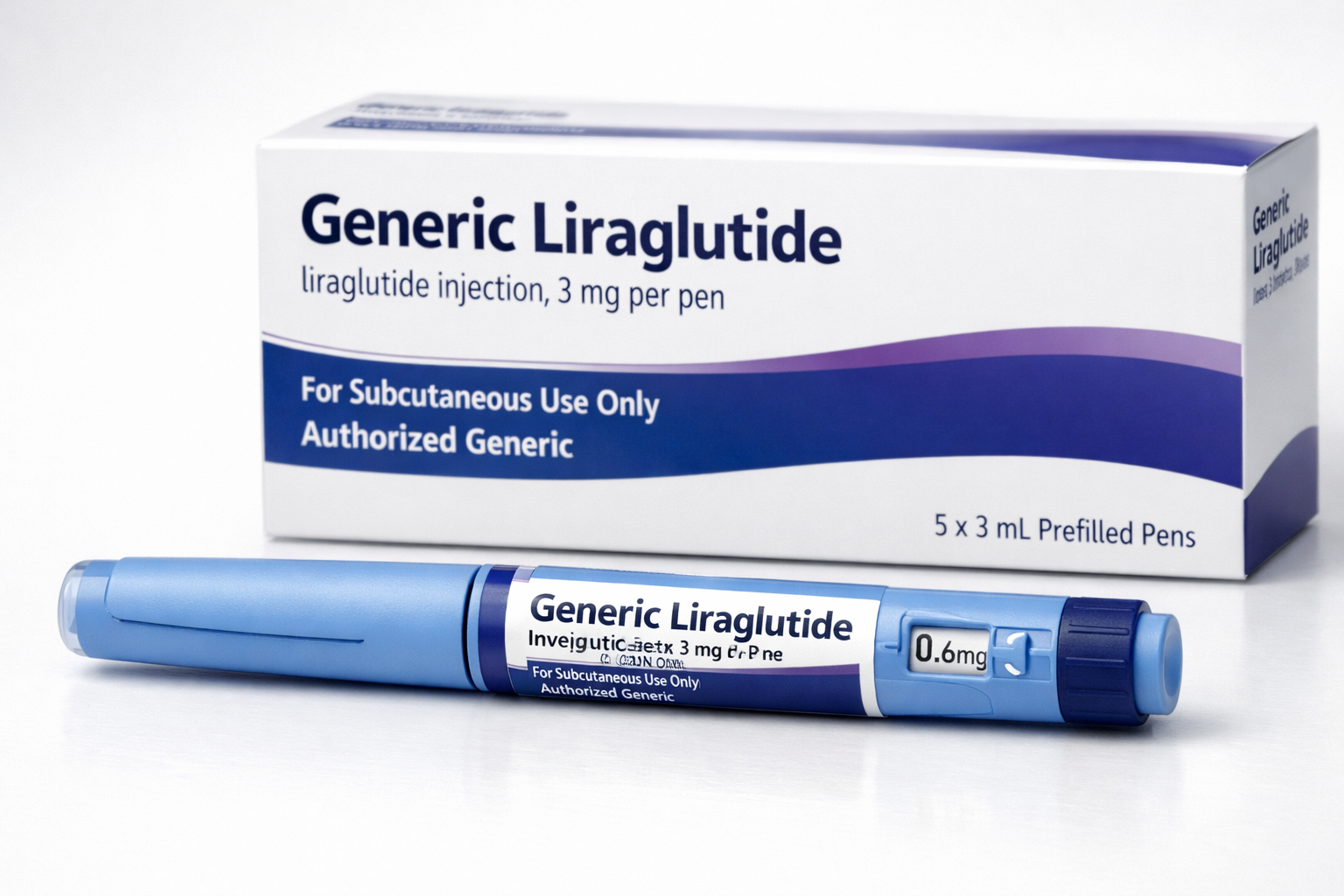
Generic liraglutide is the authorized generic version of Victoza (diabetes) and Saxenda (weight loss), which are older GLP-1 medications that have been around since 2010 and 2014, respectively. Liraglutide is a daily injectable (compared to weekly semaglutide), and it’s generally considered less potent for weight loss than semaglutide or tirzepatide — but it’s a legitimate FDA-approved option.
Why it’s on this list: With GoodRx coupons or discount pharmacy programs, generic liraglutide can sometimes be found at lower price points than brand-name semaglutide options. However, pricing varies significantly by pharmacy and location, so you’ll need to check current GoodRx prices in your area.
Important context: Generic liraglutide is an FDA-approved medication — not a compounded product. That’s a meaningful distinction for people who want the regulatory assurance of an approved drug. The trade-off is that it’s a daily injection rather than weekly, and clinical data suggests semaglutide produces greater average weight loss.
What you get:
- FDA-approved liraglutide (authorized generic)
- Available at retail pharmacies with a prescription
- GoodRx or similar discount programs can reduce cost
- Daily injectable pen
✅ Pros
- FDA-approved finished drug product (not compounded)
- Available at standard pharmacies (CVS, Walgreens, etc.)
- Authorized generic may be more affordable than brand-name
- Established long-term safety data
- No telehealth subscription required if you already have a prescriber
❌ Cons
- Daily injection (not weekly like semaglutide)
- Generally produces less weight loss than semaglutide or tirzepatide on average
- Pricing without insurance can still be high — check GoodRx before assuming it’s affordable in your area
- Requires a separate prescription from a doctor (not bundled with a telehealth platform)
- Not as widely discussed or promoted, so finding current pricing requires research
Best for: People who specifically want an FDA-approved GLP-1 (not compounded), already have a prescriber, and are willing to do a daily injection in exchange for potentially lower cost.
Why Is Saxenda So Much More Expensive Than Semaglutide?
Saxenda costs more primarily because liraglutide (its active ingredient) requires daily injections, consuming more product per month than semaglutide’s once-weekly format. More vials, more pens, more manufacturing cost — all passed on to you [2].
There’s also a competitive dynamic at play. Novo Nordisk makes both Saxenda and Wegovy. With Wegovy showing stronger weight loss outcomes in head-to-head data, Saxenda has lost market share. Rather than aggressively cutting prices, Novo Nordisk has let generic liraglutide absorb the cost-sensitive segment while keeping Saxenda’s brand premium intact [1].
Key cost drivers for Saxenda:
- Daily dosing = 30 injections per month vs. 4 for Wegovy
- No generic competition until August 2025 (Teva’s launch) [1]
- Brand-name pricing maintained despite newer, cheaper alternatives
- Less insurance coverage for weight loss compared to diabetes indications
Key cost drivers for semaglutide (Wegovy):
- Weekly dosing = lower supply volume per month
- GoodRx and manufacturer programs actively discount it [5]
- Compounded semaglutide options exist (though FDA oversight applies — verify your provider)
- Strong clinical data supports broader insurance coverage pushes
To understand all the types of GLP-1 medications and how they compare, read our guide on Types of GLP-1 Meds: Semaglutide, Tirzepatide & More.
Does Insurance Make Semaglutide vs Saxenda Cost Equal?
With the right commercial insurance plan, both drugs can cost as little as $25–$60/month — which nearly closes the price gap. But getting there is not guaranteed, and the path differs for each medication.
With commercial insurance:
- Saxenda: NovoCare Savings Card can reduce cost to $25/month for eligible patients [1]
- Wegovy: Novo Nordisk’s savings program also offers significant reductions for commercially insured patients
- Both require a BMI of 30+ (or 27+ with a weight-related condition) for coverage approval
Without insurance — the gap is massive:
- Saxenda: $1,300–$1,800/month [1]
- Wegovy: $199–$349/month [5]
- Generic liraglutide: $370–$1,300/month [2]
Medicare and Medicaid realities:
- Medicare Part D does not cover Saxenda for weight loss [1]
- Medicaid GLP-1 coverage varies significantly by state — some states cover weight loss indications, others do not [9]
- The Inflation Reduction Act and ongoing policy debates may shift this, but as of 2026, coverage gaps remain
Common mistake: Many patients assume their insurance covers weight loss drugs automatically. Always call your plan’s pharmacy benefits line and ask specifically about “obesity pharmacotherapy” coverage before filling your first prescription.
If your insurer denies coverage, our guide on How to Appeal Insurance Denial for Semaglutide walks through the step-by-step process.
What Are the Hidden Costs Neither Drug Advertises?
Both semaglutide and Saxenda carry additional costs beyond the sticker price of the medication itself. These hidden expenses add $50–$100+ per month on average [2].
What you’ll likely pay beyond the drug cost:
- Initial consultation: $150–$300 for a prescribing provider visit (in-person or telehealth)
- Follow-up visits: Every 3–6 months, typically $75–$200 per visit
- Lab work: Metabolic panels, thyroid screening, A1C — roughly $100–$200 every few months [2]
- Syringes/supplies: Usually included with pen devices, but worth confirming
- Telehealth subscription fees: Some online GLP-1 programs charge $30–$50/month for platform access on top of medication cost
Edge case to watch: Some telehealth platforms advertise low medication prices but charge mandatory monthly “membership” or “care coordination” fees. Always ask for the all-in monthly cost before committing.
For the most affordable all-in GLP-1 programs available in 2026, see our ranking of Most Affordable GLP-1 Without Insurance: From $199/mo.
Is Generic Liraglutide a Cheaper Alternative to Both?
Generic liraglutide is cheaper than brand-name Saxenda but still more expensive than semaglutide in most cases. Teva’s generic launched in August 2025 at a wholesale acquisition cost of approximately $1,165/month [1]. Other generics range from $370–$1,300/month depending on the pharmacy, with prices expected to keep falling as more manufacturers enter the market post-February 2026 [2].
Generic liraglutide makes sense if:
- You’ve been stable on Saxenda and want to cut costs without switching to a new drug class
- Your insurance specifically covers liraglutide but not semaglutide
- You’ve had side effects with semaglutide and need to stay on a liraglutide-based option
Generic liraglutide does NOT make sense if:
- You’re starting fresh and have no prior GLP-1 history — semaglutide is cheaper and shows stronger weight loss outcomes in most comparisons
- You’re uninsured and cost is the primary driver

How Do Semaglutide and Saxenda Compare on Weight Loss Results Per Dollar?
Semaglutide delivers better weight loss outcomes per dollar spent, based on available clinical data. In the STEP 8 trial, semaglutide 2.4 mg produced approximately 15.8% average body weight reduction compared to roughly 6.4% for liraglutide 3 mg over 68 weeks. [3]
When you combine that with semaglutide’s lower monthly cost, the value calculation is clear: you’re paying less and losing more weight on average.
Cost-per-pound-lost estimate (rough calculation for illustration):
Assuming a 200 lb person over 12 months:
- Wegovy (semaglutide): ~31.6 lbs lost / ~$3,500 total cost = roughly $111 per pound lost
- Saxenda: ~12.8 lbs lost / ~$15,000+ total cost = roughly $1,172 per pound lost
Note: These are illustrative estimates based on trial averages. Individual results vary based on diet, activity, adherence, and starting weight.
If you want to compare semaglutide against another newer GLP-1, our Semaglutide vs Tirzepatide: Which Wins for Weight Loss? breakdown covers the full picture.
What Are the Most Affordable Ways to Get Semaglutide in 2026?
The cheapest legitimate paths to semaglutide in 2026 are GoodRx-discounted Wegovy, telehealth programs offering compounded semaglutide, and manufacturer savings programs for commercially insured patients.
Ranked from lowest to highest cost (no insurance):
- Wegovy pill (oral semaglutide): $149/month for lower doses via GoodRx [4]
- Wegovy injection (first 2 fills): $199/month via GoodRx [5]
- Compounded semaglutide through licensed telehealth: Varies, often $150–$250/month (verify FDA compliance and provider credentials)
- Wegovy injection (ongoing): $349/month [5]
- Ozempic (off-label for weight loss): $900–$1,200/month [6]
Steps to minimize your semaglutide cost:
- Check GoodRx before filling any prescription
- Apply for Novo Nordisk’s savings program if you have commercial insurance
- Compare telehealth platforms — pricing and included services vary widely
- Ask your provider about lower-dose options if you’re early in treatment
- Avoid platforms with hidden membership fees
For a vetted list of providers, see our guide to the 6 Best Semaglutide Without Insurance Cost Options in 2026.
Semaglutide vs Saxenda Cost: Which Should You Actually Choose?
For the vast majority of people seeking affordable GLP-1 weight loss treatment in 2026, semaglutide is the better choice on both cost and outcomes. Saxenda’s only real advantage is familiarity for patients already stabilized on it and, in some cases, specific insurance formulary placement.
Choose semaglutide (Wegovy) if:
- You’re uninsured or underinsured
- You’re starting GLP-1 treatment for the first time
- You want once-weekly dosing for better adherence
- Cost per pound lost matters to you
Consider staying on Saxenda/liraglutide if:
- You’ve been on it for 12+ months with good results and tolerance
- Your insurance covers Saxenda but not Wegovy
- You’ve had adverse reactions to semaglutide specifically
Consider tirzepatide (Zepbound) if:
- You want the strongest available weight loss outcomes and cost is secondary
- Zepbound vials at ~$299/month fit your budget [4]
For a broader look at all affordable GLP-1 programs, our 7 Best Affordable GLP-1 Weight Loss Programs 2026 guide covers every major option currently available in the US.
Frequently Asked Questions
Q: Is semaglutide cheaper than Saxenda every month? Yes, in almost every scenario. Wegovy (semaglutide injection) costs $199–$349/month without insurance. Saxenda costs $1,300–$1,800/month at full price. Even with generic liraglutide at $370+/month, semaglutide is typically cheaper [1][5].
Q: Does insurance cover both Saxenda and Wegovy for weight loss? Commercial insurance may cover both, but coverage is not guaranteed and varies by plan. With the NovoCare Savings Card, commercially insured patients can access Saxenda for as low as $25/month. Medicare Part D does not cover Saxenda for weight loss. Medicaid coverage depends on your state [1][9].
Q: Is generic Saxenda (liraglutide) available in 2026? Yes. Teva launched a generic liraglutide in August 2025. As of early 2026, generic liraglutide ranges from $370–$1,300/month depending on the pharmacy, with prices expected to continue dropping [1][2].
Q: Can I switch from Saxenda to semaglutide to save money? Yes, with your doctor’s guidance. Switching is medically straightforward since both are GLP-1 receptor agonists. Your provider will typically start you at a low semaglutide dose and titrate up. The cost savings can be substantial — potentially $1,000+ per month.
Q: What is the cheapest semaglutide option available right now? The Wegovy pill (oral semaglutide) at $149/month for lower doses through GoodRx is currently the lowest-cost branded semaglutide option [4]. Compounded semaglutide through telehealth providers may be cheaper, but verify the provider’s licensing and FDA compliance before purchasing.
Q: Does Saxenda work better than semaglutide for weight loss? No. Clinical trial data consistently shows semaglutide produces greater average weight loss than liraglutide. The STEP 8 trial found semaglutide 2.4 mg outperformed liraglutide 3 mg significantly in head-to-head comparison [3].
Q: Are there any situations where Saxenda is the better financial choice? Yes — if your insurance specifically covers Saxenda but not Wegovy, and the savings card brings your cost to $25/month, Saxenda can be cost-competitive. Always check your specific formulary before assuming semaglutide is cheaper with your plan.
Q: What hidden costs should I budget for with either drug? Budget an extra $50–$100/month for provider visits (every 3–6 months) and lab work. Some telehealth platforms also charge monthly membership fees on top of medication costs [2].
Conclusion
The semaglutide vs Saxenda cost comparison is not close for most people paying out of pocket. Saxenda’s $1,300–$1,800/month price tag is simply not competitive against Wegovy’s $199–$349/month range — and semaglutide also delivers stronger average weight loss outcomes. Even generic liraglutide, while cheaper than brand Saxenda, still costs more than branded Wegovy in most pharmacies.
Your actionable next steps:
- Check GoodRx today for current Wegovy pricing at pharmacies near you
- Call your insurance plan and ask specifically about obesity pharmacotherapy coverage for both semaglutide and liraglutide
- Apply for manufacturer savings cards (NovoCare for Saxenda, Novo Nordisk’s Wegovy savings program) if you have commercial insurance
- Compare telehealth platforms — pricing, included services, and medication formats vary widely
- Talk to your doctor about switching from Saxenda to semaglutide if cost is a barrier to staying on treatment
The best GLP-1 medication is the one you can actually afford to stay on consistently. For most people in 2026, that medication is semaglutide.
References
[1] Saxenda Shortage Update What Patients Need To Know In 2026 – [1]
[2] Saxenda Cost Without Insurance – [2]
[3] Saxenda – [3]
[4] Ozempic Alternatives – [4]
[5] GLP-1 Drugs Cost And Savings – [5]
[6] Ozempic Vs Saxenda – [6]
[9] Medicaid Coverage Of And Spending On GLP-1s – [9]
Medical Disclaimer: The information on Healthfactsjournal.com is for educational and informational purposes only and is not intended as medical advice. These statements have not been evaluated by the FDA. Always seek the advice of a qualified healthcare provider regarding any medical condition or treatment. Never disregard professional medical advice or delay seeking it because of something you have read on this website.

With over 13 years of experience in holistic health blogging, I aim to help you navigate your wellness journey with honest insights, expert-backed advice, and a sprinkle of real-world practicality.
Certified Wellness Writer | Herbal Nutrition Advocate | Wellness Research Enthusiast


