
Prescriptions Filled: The Complete 2026 Guide to Getting Your Medication Fast and Affordably
{“cover”:”Professional landscape format (1536×1024) hero image with bold text overlay: ‘Prescriptions Filled: The Complete Guide’ in extra large 72pt white bold sans-serif font with deep shadow effect, centered upper-third composition. Background shows a modern pharmacy counter with rows of prescription bottles, a pharmacist in white coat reviewing paperwork, warm clinical lighting with blue and white color palette. High contrast, magazine cover editorial quality, clean professional aesthetic.”,”content”:[“Detailed landscape format (1536×1024) showing a close-up overhead shot of a patient’s hands holding a new prescription paper at a pharmacy counter, with a pharmacist typing into a computer system, prescription bottles and a clipboard visible, soft clinical lighting, blue and white tones, photorealistic editorial style, focus on the first-time prescription filling process.”,”Wide-angle landscape format (1536×1024) showing a split-screen comparison infographic: left side depicts a brand-name medication box with a high price tag, right side shows a generic white bottle with a lower price tag, bold text labels ‘Brand vs Generic’, clean white background with teal and orange accent colors, flat design infographic style, professional medical editorial quality.”,”Landscape format (1536×1024) showing a person sitting at a kitchen table using a smartphone prescription management app, pill organizer and medication bottles arranged neatly nearby, warm home lighting, over-the-shoulder perspective, soft focus background, modern lifestyle photography style, conveying convenience and medication management at home.”,”Landscape format (1536×1024) showing a GLP-1 semaglutide injection pen alongside a telehealth consultation screen on a laptop, a weight loss progress chart visible on screen, clean white desk surface, medical blue and green color accents, professional product photography style, conveying affordable telehealth prescription access and weight management medication.”]
Last updated: June 2, 2026
Quick Answer: Getting prescriptions filled in the U.S. is straightforward once you know the steps, but costs, insurance gaps, and pharmacy availability can create real barriers. In 2026, Americans filled nearly 5 billion retail prescriptions annually, yet millions still struggle with affordability and access. This guide covers everything from your first fill to managing GLP-1 medications like semaglutide through telehealth platforms, so you spend less time confused and more time treated.
Key Takeaways
- Approximately 4.98 billion retail prescriptions were filled in the U.S. in 2025, a number that continues to climb in 2026 [1]
- You do not need insurance to get a prescription filled; cash-pay and discount programs exist and are expanding
- Generic medications can cost 80-85% less than brand-name equivalents and are equally effective for most conditions
- GLP-1 medications like semaglutide and tirzepatide are among the fastest-growing prescription categories, with telehealth platforms making access easier
- Mail-order pharmacies can reduce costs significantly for maintenance medications
- Republican lawmakers in 2026 proposed legislation to allow cash-pay drug purchases to count toward insurance deductibles [6]
- DirectMeds GLP1 Semaglutide is currently one of the most affordable telehealth options for GLP-1 prescriptions
- AI tools are beginning to assist with prescription verification, reducing errors at the pharmacy level [9]

How Do I Get a Prescription Filled for the First Time?
Getting your first prescription filled requires three things: a valid prescription from a licensed provider, a pharmacy of your choice, and a form of payment. The process typically takes 15 to 45 minutes at a walk-in pharmacy, or 1 to 3 business days through mail-order.
Here is the basic process step by step:
- Get a prescription from your doctor, urgent care provider, or a telehealth platform
- Choose a pharmacy (retail, mail-order, or compounding pharmacy)
- Submit the prescription either in person, by fax from your provider, or electronically
- Provide your insurance card or confirm you are paying cash
- Wait for processing and pick up or receive your medication
Common mistake: Many first-time patients assume the prescription is automatically sent to their preferred pharmacy. Always confirm with your provider which pharmacy they are sending it to, or request a paper copy to bring yourself.
For GLP-1 medications specifically, telehealth providers like DirectMeds GLP1 Semaglutide handle the entire process online, from the medical consultation to the prescription and delivery. This is especially useful for semaglutide and tirzepatide, where traditional pharmacy stock can be inconsistent.
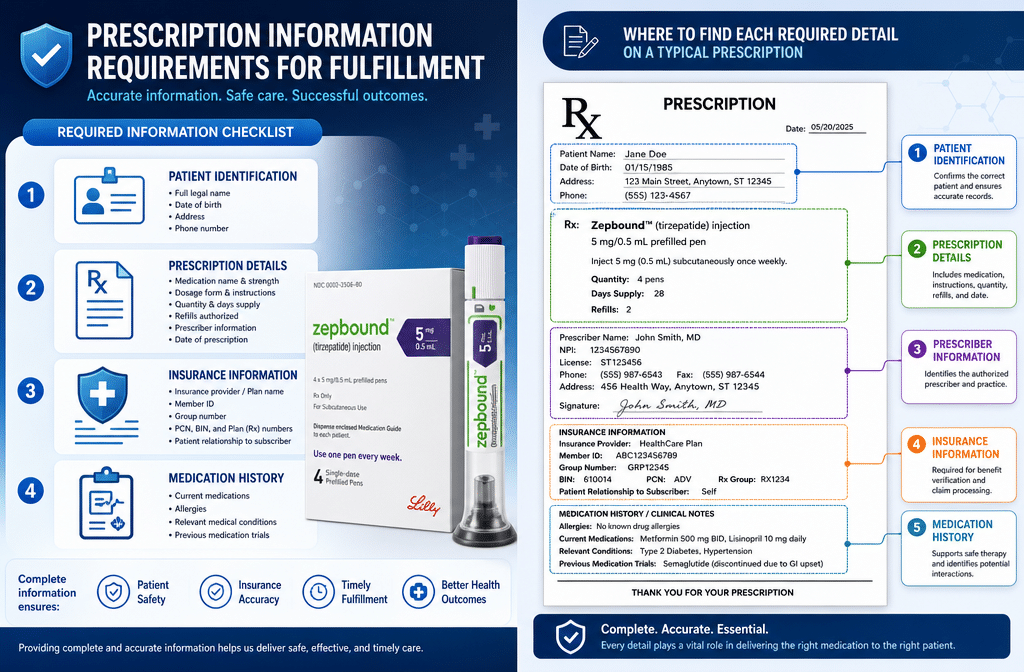
What Information Do I Need to Fill a Prescription?
You need your full legal name, date of birth, address, and insurance information (if applicable). The pharmacy also needs the prescription itself, which must include the drug name, dosage, quantity, prescriber’s name, and their DEA number for controlled substances.
What to bring to the pharmacy:
- Government-issued photo ID
- Insurance card (or Medicare/Medicaid card)
- Prescription paper or confirmation that your provider sent it electronically
- Payment method
- Any known drug allergies (for new patient profiles)
If you are filling a prescription through a telehealth platform, the provider typically sends everything electronically. You may only need to confirm your shipping address and payment details.
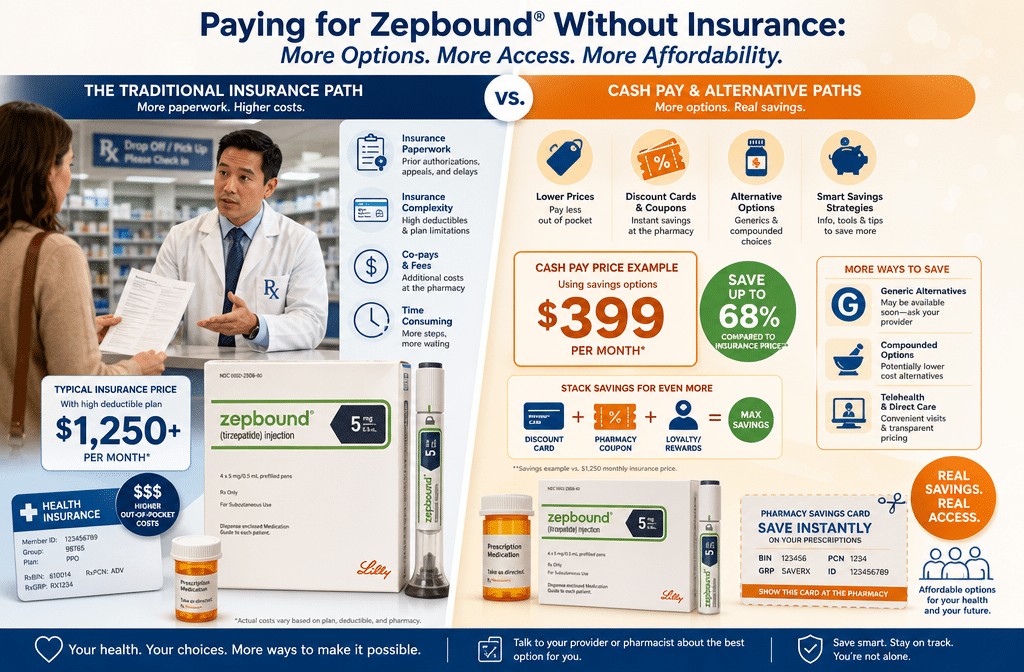
Can I Get a Prescription Filled Without Insurance?
Yes, you can absolutely get prescriptions filled without insurance. Uninsured patients can use GoodRx coupons, manufacturer discount programs, cash-pay telehealth platforms, or government programs like the 340B Drug Pricing Program.
In April 2026, Republican lawmakers proposed a bill that would allow prescription drug purchases made through cash-pay platforms to count toward patients’ insurance deductibles [6]. This signals a growing recognition that cash-pay is a legitimate and increasingly preferred route for many Americans.
Affordable options without insurance:
- GoodRx and similar coupon apps: Can reduce generic drug costs by 40-80% at participating pharmacies. See our breakdown of GoodRx Ozempic pricing for a real-world example.
- Manufacturer savings programs: Eli Lilly and Novo Nordisk offer savings cards for Zepbound and Wegovy respectively
- Telehealth cash-pay platforms: Services like DirectMeds GLP1 Semaglutide offer bundled pricing that includes consultation, prescription, and medication
- Compounding pharmacies: For GLP-1 medications, compounding pharmacies can provide semaglutide at significantly lower prices than brand-name versions
If you are specifically looking for affordable GLP-1 access, our full cost breakdown of compounded semaglutide and tirzepatide is worth reading before you commit to any provider.
Start your affordable GLP-1 prescription today with DirectMeds
How Long Does It Take to Fill a Prescription?
Most retail pharmacies fill standard prescriptions within 15 to 60 minutes. Controlled substances, specialty medications, and compounded drugs can take longer, sometimes 24 to 72 hours or more.
Typical fill times by pharmacy type:
| Pharmacy Type | Typical Fill Time |
|---|---|
| Retail pharmacy (in stock) | 15 to 60 minutes |
| Retail pharmacy (order needed) | 1 to 3 business days |
| Mail-order pharmacy | 3 to 7 business days |
| Compounding pharmacy | 2 to 5 business days |
| Telehealth with delivery | 3 to 7 business days |
Edge case: GLP-1 medications like semaglutide and tirzepatide have faced supply constraints. If your local pharmacy is out of stock, telehealth platforms that partner directly with compounding pharmacies often have more reliable availability. Learn more about how compounded semaglutide differs from Ozempic to understand your options.
Can I Get a Prescription Filled at Any Pharmacy?
In most cases, yes. A valid prescription from a licensed U.S. provider can be filled at any licensed pharmacy in the same state, and most states allow transfers between pharmacies for non-controlled substances.
Exceptions to know:
- Controlled substances (Schedule II drugs like Adderall or opioids) have stricter rules and may not be transferable between pharmacies
- Specialty medications may only be dispensed through specific specialty pharmacies approved by the manufacturer or insurer
- Compounded medications must be filled at a licensed compounding pharmacy. See our guide on how to verify a legitimate compounding pharmacy before ordering
CVS Health held approximately 46.55% of retail prescription market share in 2025, making it the single largest pharmacy chain in the U.S. [2]. That said, independent pharmacies and mail-order services often offer competitive or lower pricing, especially for uninsured patients.
What Is the Difference Between a Brand-Name and Generic Prescription?

Generic medications contain the same active ingredient, dosage, and route of administration as their brand-name counterparts. The FDA requires generics to be bioequivalent, meaning they work the same way in your body. The primary difference is cost.
Brand vs. Generic at a glance:
- Brand-name: Developed by the original manufacturer, protected by patent, significantly more expensive
- Generic: Produced after patent expiration, approved by the FDA for bioequivalence, typically 80-85% cheaper
- Compounded: Custom-made at a compounding pharmacy, not FDA-approved as a finished product, but the active ingredient may be FDA-approved
For GLP-1 medications, there are currently no FDA-approved generics for semaglutide or tirzepatide. However, compounded versions using the same active ingredients are available through licensed compounding pharmacies, which is exactly what platforms like DirectMeds GLP1 Semaglutide provide at a fraction of the brand-name cost.
Our full article on GLP-1 medications for weight loss and diabetes explains the clinical evidence behind these drugs in more detail.
How Much Does It Cost to Fill a Prescription?
Prescription costs vary widely based on the drug, your insurance status, and where you fill it. With insurance, copays typically range from $0 to $50 for generics and $50 to $200 or more for brand-name drugs. Without insurance, prices can range from under $10 for common generics to over $1,000 per month for specialty medications.
Real-world GLP-1 cost examples in 2026:
| Medication | Brand Retail Price | With Telehealth/Compounding |
|---|---|---|
| Wegovy (semaglutide) | $1,300-$1,500/month | $200-$400/month |
| Ozempic (semaglutide) | $900-$1,100/month | $200-$400/month |
| Zepbound (tirzepatide) | $1,000-$1,200/month | $250-$450/month |
| DirectMeds GLP1 Semaglutide | N/A | Starting under $200/month |
For a detailed month-by-month cost comparison, see our GLP-1 price per month breakdown for 2026.
Get the most affordable semaglutide prescription through DirectMeds
What If My Pharmacy Does Not Have My Medication in Stock?
If your pharmacy is out of stock, you have several options: ask them to order it (usually 1 to 3 days), transfer the prescription to another pharmacy, or ask your prescriber for a therapeutic alternative.
Steps to take when your medication is unavailable:
- Ask the pharmacist when they expect restock and whether they can order it for you
- Call nearby pharmacies to check stock before transferring
- Contact your prescriber to ask about equivalent alternatives
- Consider a mail-order or telehealth pharmacy that maintains its own supply chain
This is particularly relevant for GLP-1 medications, which have experienced ongoing demand surges. Telehealth platforms that work with compounding pharmacies tend to have more consistent supply, making them a practical backup for patients who cannot reliably find Ozempic or Wegovy at retail locations.
Can Someone Else Pick Up My Prescription for Me?
Yes. Most pharmacies allow a designated person to pick up a prescription on your behalf, as long as they can provide your name, date of birth, and in some cases, the last four digits of your Social Security number.
What the authorized person typically needs:
- Your full name and date of birth
- Their own photo ID
- Knowledge of your address or insurance on file (some pharmacies require this)
For controlled substances, rules are stricter. Some states require the patient to be present, or the authorized person must provide written authorization. Always call your pharmacy ahead to confirm their specific policy.
What Are Common Mistakes People Make When Getting Prescriptions Filled?
The most common mistakes are waiting too long to request refills, not checking for generic alternatives, and failing to compare prices across pharmacies. A 2024 study introduced an AI-based system called “Rx Strategist” specifically to reduce prescription verification errors, which remain a measurable problem in retail pharmacy settings [9].
Top mistakes to avoid:
- Waiting until you run out before requesting a refill, especially for maintenance medications
- Assuming your insurance covers it without verifying the formulary
- Not asking about generics when a brand-name is prescribed
- Skipping price comparison between pharmacies, which can vary by hundreds of dollars for the same drug
- Ignoring telehealth options for medications like GLP-1s, where direct-to-patient platforms can cut costs dramatically
- Not confirming the prescription was sent to your pharmacy before driving there
Are There Apps That Help Manage Prescriptions?
Yes. Several apps help patients track refills, compare prices, and manage multiple prescriptions. GoodRx, Blink Health, and NowRx are among the most widely used. Many pharmacy chains also have their own apps with refill reminders and price alerts.
Useful prescription management tools:
- GoodRx: Price comparison and coupons across thousands of pharmacies
- Blink Health: Prepay for prescriptions online at locked-in prices
- Amazon Pharmacy: Transparent pricing with Prime discounts
- CVS, Walgreens, Rite Aid apps: Refill management, pickup notifications, and auto-refill enrollment
- Telehealth platform apps: Services like DirectMeds manage your GLP-1 prescription, dosing schedule, and refills in one place
AI is also entering this space. Research published in 2024 showed that large language model-based systems can assist pharmacists in catching prescription errors before dispensing, improving patient safety outcomes [9].
What Should I Do If I Am Having Trouble Affording My Prescription?
Start by asking your pharmacist for the generic version, then check GoodRx or similar coupon platforms. If the medication is still unaffordable, contact the manufacturer directly about patient assistance programs, or explore telehealth platforms that offer bundled pricing.
Affordability options ranked by ease of access:
- Ask for the generic equivalent at the counter
- Use a coupon app like GoodRx before paying
- Check the manufacturer’s official savings program
- Ask your doctor about therapeutic alternatives
- Use a cash-pay telehealth platform for bundled pricing
- Apply for state pharmaceutical assistance programs
- Look into the 340B Drug Pricing Program if you qualify
For GLP-1 medications specifically, the most practical route for uninsured or underinsured patients in 2026 is a telehealth platform like DirectMeds GLP1 Semaglutide, which bundles the consultation, prescription, and compounded medication into one transparent monthly price.
Check current DirectMeds GLP1 pricing and start your consultation
Can I Get a Prescription Filled If I Am Out of Refills?
No, a pharmacy cannot dispense a prescription once the authorized refills are exhausted. You will need to contact your prescriber for a new prescription or a refill authorization. Some states allow pharmacists to dispense a limited emergency supply for certain chronic medications.
What to do when refills run out:
- Contact your prescriber’s office for a refill authorization (allow 2 to 3 business days)
- Ask the pharmacist if an emergency supply is permitted under your state’s laws
- Schedule a telehealth visit for faster turnaround if your doctor is unavailable
- For GLP-1 medications, telehealth platforms often include ongoing prescriber support as part of the subscription, eliminating this problem entirely
How Do Mail-Order Pharmacies Work for Prescriptions?
Mail-order pharmacies allow you to submit prescriptions online or by mail and receive medications at home, typically in 3 to 7 business days. They often offer 90-day supplies at a lower per-unit cost than 30-day retail fills, making them cost-effective for maintenance medications.
How the process works:
- Get a prescription from your provider (many now send directly to mail-order pharmacies)
- Create an account with the mail-order service and enter your insurance or payment info
- Submit or confirm the prescription
- Receive your medication by mail, usually in discreet packaging
- Set up auto-refill to avoid running out
For GLP-1 medications, telehealth platforms that include a compounding pharmacy component function similarly to mail-order but with the added benefit of an embedded prescriber relationship. This means your dosage can be adjusted, your prescription renewed, and your medication shipped without separate appointments.
Why DirectMeds GLP1 Semaglutide Stands Out for Affordable GLP-1 Access
For anyone researching GLP-1 medications in 2026, cost and access are the two biggest barriers. Brand-name Wegovy and Ozempic remain out of reach for most uninsured patients, and even insured patients face prior authorization hurdles.
DirectMeds GLP1 Semaglutide addresses both problems directly. The platform offers:
- Bundled pricing that includes the medical consultation, prescription, and compounded semaglutide
- Licensed U.S. prescribers who handle the GLP-1 consultation online
- Compounded semaglutide sourced from licensed U.S. compounding pharmacies
- Home delivery so you never have to chase down a retail pharmacy for stock
- Ongoing support for dosage adjustments without additional consultation fees
The DirectMeds GLP1 reviews from verified users consistently highlight the pricing transparency and ease of the process as the top reasons for choosing this platform over traditional pharmacy routes.
If you have been considering semaglutide for weight loss but have been put off by the cost of brand-name options, this is the most practical starting point available in 2026.
Start your DirectMeds GLP1 Semaglutide consultation today
Frequently Asked Questions
How many prescriptions are filled in the U.S. each year?
Approximately 4.98 billion retail prescriptions were filled in the U.S. in 2025, and that number continues to grow in 2026 [1]. This makes the U.S. one of the highest per-capita prescription markets in the world.
What is the fastest way to get a prescription filled?
The fastest option is an electronic prescription sent directly to a retail pharmacy with the medication in stock. Most retail pharmacies can fill standard prescriptions within 15 to 60 minutes of receiving an e-prescription.
Can I transfer my prescription to a different pharmacy?
Yes, for most non-controlled medications. Call the new pharmacy with your current pharmacy’s information and they will handle the transfer. Controlled substances (Schedule II) cannot be transferred and require a new prescription.
Is compounded semaglutide the same as Ozempic?
Compounded semaglutide contains the same active ingredient as Ozempic but is not FDA-approved as a finished drug product. It is made at licensed compounding pharmacies and is typically used when brand-name versions are unavailable or unaffordable. Read more about how compounded semaglutide differs from Ozempic.
Do I need a prescription for semaglutide or tirzepatide?
Yes. Both semaglutide and tirzepatide are FDA-approved prescription medications. You need a valid prescription from a licensed provider. Telehealth platforms like DirectMeds GLP1 Semaglutide include the prescriber consultation as part of the service.
What happens if I miss a dose of my GLP-1 medication?
For weekly injectable GLP-1 medications like semaglutide, if you miss a dose and your next scheduled dose is more than 2 days away, take the missed dose as soon as you remember. If it is within 2 days of your next dose, skip the missed dose. Always follow your prescriber’s specific instructions.
Can I use GoodRx for GLP-1 medications?
GoodRx can reduce the cost of brand-name GLP-1 medications at retail pharmacies, but savings are often limited for these high-cost drugs. For the most significant savings, a telehealth platform offering compounded semaglutide is typically more cost-effective. See our GoodRx Ozempic pricing guide for current numbers.
Are mail-order pharmacies safe?
Yes, provided they are licensed by your state board of pharmacy and accredited by NABP (National Association of Boards of Pharmacy). Always verify accreditation before ordering medications by mail.
What is a pharmacy benefit manager (PBM) and how does it affect my prescription cost?
A PBM is a third-party administrator that manages prescription drug benefits for insurance companies. PBMs negotiate drug prices with manufacturers and determine which drugs are covered. In 2026, state laws attempting to regulate PBMs faced federal court challenges, which may affect how much negotiating power patients have through their insurance [5].
How do I store compounded semaglutide at home?
Compounded semaglutide typically requires refrigeration. Our detailed guide on how to store compounded semaglutide at home covers temperature requirements, travel tips, and what to do if your medication is accidentally left unrefrigerated.
What if I am prescribed a medication that is not on my insurance formulary?
Ask your prescriber to submit a prior authorization request, or request a therapeutic alternative that is covered. You can also pay cash and use a coupon platform, or switch to a telehealth provider that offers cash-pay bundled pricing.
Are there non-opioid alternatives for pain management now available by prescription?
Yes. In January 2025, the FDA approved Journavx, the first novel non-opioid painkiller in over 20 years, giving prescribers a new option for patients who need pain relief without opioid risk. Meanwhile, the CDC has reported a consistent decline in opioid dispensing rates from retail pharmacies between 2019 and 2024 [3].
Conclusion
Getting prescriptions filled in 2026 is more flexible than most people realize. You do not need insurance, you do not have to pay brand-name prices, and you do not have to wait in line at a retail pharmacy. The system has real gaps, but there are concrete ways around each one.
Your actionable next steps:
- If you are uninsured, start with GoodRx or a cash-pay telehealth platform before assuming a medication is unaffordable
- Always ask for the generic version unless there is a clinical reason for the brand-name
- For GLP-1 medications, compare compounded options against brand-name retail prices before committing
- Set up auto-refill or use a prescription management app to avoid running out of maintenance medications
- If you are interested in semaglutide for weight loss, DirectMeds GLP1 Semaglutide is the most straightforward and affordable entry point available right now
The prescription landscape is shifting fast, with new legislation, AI-assisted verification, and direct-to-consumer platforms changing how Americans access medications. Staying informed means you pay less and wait less.
Get started with DirectMeds GLP1 Semaglutide today
References
[1] Total Number of Retail Prescriptions Filled Annually in the US – Statista
[2] CVS Caremark’s Share of Retail Prescriptions Filled in the US – Statista
[3] US Opioid Dispensing Rate Maps – CDC
[4] Drug Ads Face New Scrutiny at FDA and on Capitol Hill – Axios, 2026
[5] States’ PBM Laws Falter in Courts – Axios, 2026
[6] GOP Cash-Pay Drug Deductible Proposal – Axios, 2026
[9] Rx Strategist: AI System for Prescription Verification – arXiv, 2024


