
5 Best Medication to Shrink Prostate Gland in 2026
Last updated: July 23, 2026
Quick Answer
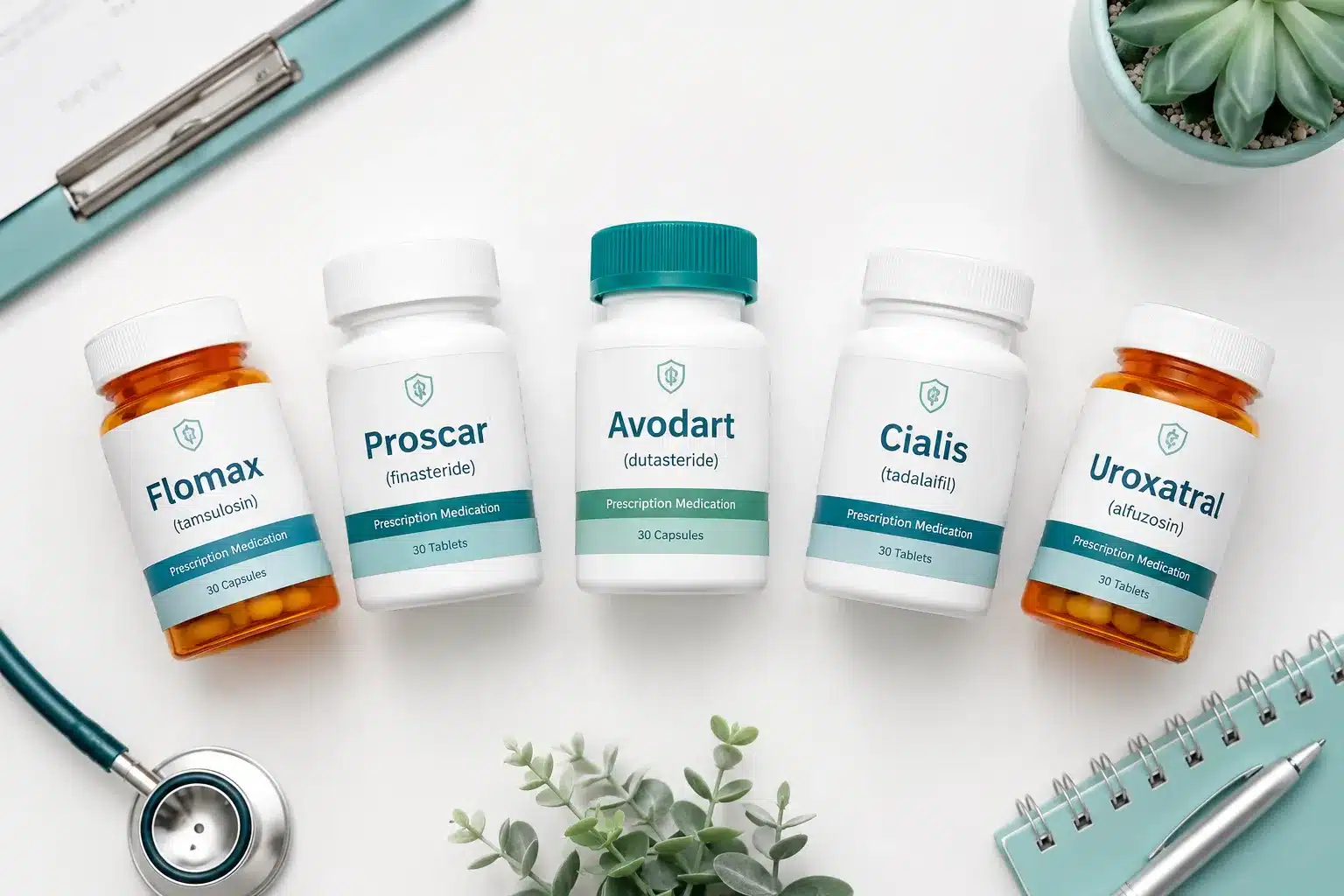
The 5 best medications to shrink the prostate gland are finasteride (Proscar), dutasteride (Avodart), tamsulosin (Flomax), tadalafil (Cialis), and combination therapy using both an alpha blocker and a 5-alpha reductase inhibitor. Of these, finasteride and dutasteride are the only two that actually reduce prostate size. The others relieve symptoms by relaxing muscles but do not shrink the gland itself.
Key Takeaways
- Finasteride and dutasteride are the only FDA-approved oral medications proven to physically shrink an enlarged prostate, typically reducing gland size by 20-30% over 6-12 months [1]
- Alpha blockers like tamsulosin work faster (within days to weeks) but relax muscles rather than shrink tissue [1]
- Combination therapy (alpha blocker plus 5-alpha reductase inhibitor) is the most effective approach for men with larger prostates and moderate-to-severe symptoms [2]
- Tadalafil (Cialis) is FDA-approved for BPH symptoms and works well for men who also experience erectile dysfunction [3]
- Most prostate medications cause some degree of sexual side effects, including reduced libido, ejaculation changes, or erectile dysfunction [1]
- Medications can take 3-6 months before delivering full symptom relief; do not stop early if results seem slow [1]
- Men with mild symptoms may qualify for watchful waiting rather than immediate medication [6]
- Natural approaches and supplements like saw palmetto have limited clinical evidence for actual prostate shrinkage
- Always verify your diagnosis with a urologist before starting any prostate medication
What Medications Actually Shrink the Prostate Gland
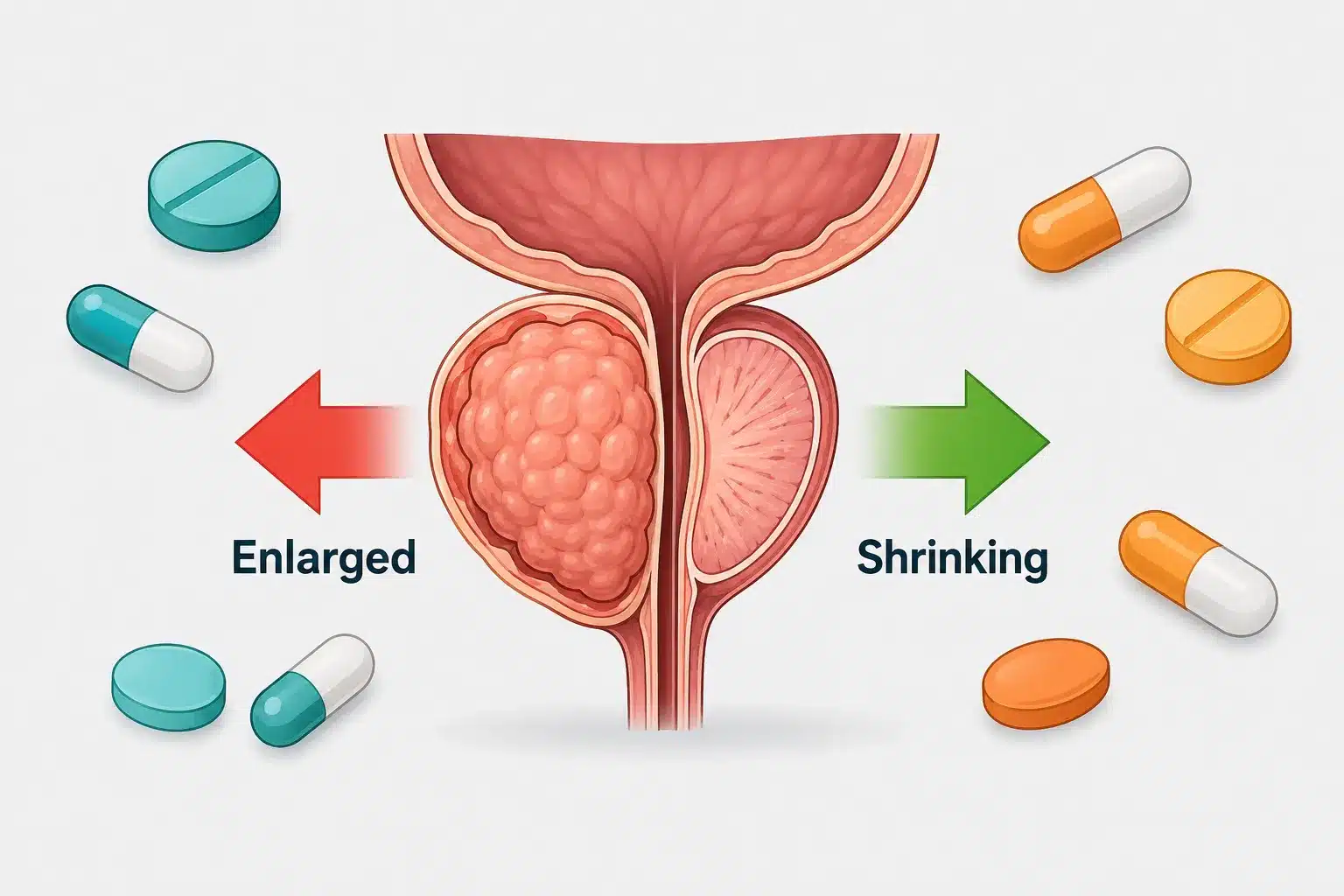
Only two drug classes physically reduce prostate size: 5-alpha reductase inhibitors (5-ARIs) and, to a lesser degree, some combination regimens. Alpha blockers and PDE5 inhibitors improve urinary symptoms but do not reduce the gland’s physical volume.
Understanding this distinction matters. Many men start tamsulosin expecting their prostate to shrink, then feel frustrated when scans show no size change. The medication is working as intended, it’s just doing a different job.
Here is a breakdown of the 5 best medications to shrink the prostate gland or manage benign prostatic hyperplasia (BPH) symptoms in 2026:
1. Finasteride (Proscar), Best for Long-Term Prostate Reduction
Finasteride is a 5-alpha reductase inhibitor that blocks the conversion of testosterone to dihydrotestosterone (DHT), the hormone primarily responsible for prostate growth. Clinical studies show it can reduce prostate volume by approximately 20-30% over 6-12 months [1].
Standard dose: 5 mg daily Time to effect: 3-6 months for meaningful size reduction Best for: Men with prostate volumes above 30-40 mL, or those at risk of disease progression
Pros:
- Physically reduces prostate size
- Reduces long-term risk of acute urinary retention
- Generic versions are affordable (often $10-$30/month with GoodRx)
- Also used at 1 mg dose (Propecia) for hair loss, so it’s well-studied
Cons:
- Slow onset, patience is required
- Sexual side effects in roughly 5-8% of users (decreased libido, erectile dysfunction)
- Must continue indefinitely; prostate regrows when stopped [1]
2. Dutasteride (Avodart), Most Comprehensive DHT Blockade
Dutasteride blocks both type 1 and type 2 forms of the 5-alpha reductase enzyme, compared to finasteride which only blocks type 2. This dual blockade produces a more complete reduction in DHT levels and may shrink the prostate slightly more than finasteride in some patients [2].
Standard dose: 0.5 mg daily Time to effect: 3-6 months Best for: Men with very large prostates or those who had an incomplete response to finasteride
Pros:
- More thorough DHT suppression than finasteride
- Reduces risk of BPH progression and need for surgery
- Once-daily dosing
Cons:
- Similar sexual side effects to finasteride
- Slightly higher cost than generic finasteride
- Long half-life means side effects can persist weeks after stopping
3. Tamsulosin (Flomax), Fastest Symptom Relief
Tamsulosin is an alpha-1 blocker that relaxes the smooth muscle in the prostate and bladder neck, improving urine flow within days. It does not shrink the prostate but is often the first medication prescribed because it works quickly [1].
Standard dose: 0.4 mg daily (taken 30 minutes after a meal) Time to effect: 1-2 weeks for noticeable symptom improvement Best for: Men who need fast relief from urinary symptoms, especially those with smaller prostates
Pros:
- Fast-acting
- Well-tolerated in most men
- Widely available as a low-cost generic
Cons:
- Does not reduce prostate size
- Can cause dizziness, especially when standing up quickly
- Retrograde ejaculation (semen goes backward into the bladder) in 10-18% of users [1]
- Requires caution before cataract surgery (floppy iris syndrome)
4. Tadalafil (Cialis), Best for Men with BPH and ED
Tadalafil, a PDE5 inhibitor best known for treating erectile dysfunction, received FDA approval for BPH symptom management. It relaxes smooth muscle in the prostate and bladder, improving urinary flow [3].
Standard dose: 5 mg daily for BPH Time to effect: 2-4 weeks Best for: Men dealing with both BPH symptoms and erectile dysfunction
Pros:
- Addresses two conditions with one pill
- Daily low-dose is well-tolerated
- No retrograde ejaculation risk (unlike tamsulosin)
Cons:
- Does not shrink the prostate
- Not ideal if you take nitrates (serious blood pressure drop risk)
- More expensive than tamsulosin without insurance
If you’re managing both BPH and ED, see our guide on fast-acting ED medication options for men in 2026 for a broader comparison.
5. Combination Therapy (Alpha Blocker + 5-ARI), Most Effective Overall
For men with moderate-to-severe BPH and larger prostates, combining an alpha blocker (like tamsulosin) with a 5-ARI (like dutasteride or finasteride) outperforms either drug alone. The landmark CombAT trial showed that combination therapy with dutasteride and tamsulosin was significantly more effective at reducing symptom scores and preventing disease progression than either agent alone [2].
Best for: Men with prostate volumes over 40 mL, high PSA levels, or significant symptom burden Downside: Higher cost, more side effects, and more pills to manage
Finasteride vs. Tamsulosin: Which Is Better for You
Finasteride shrinks the prostate over months; tamsulosin relieves symptoms within days but does not change prostate size. The right choice depends on your prostate size, symptom severity, and how quickly you need relief.
Here is a practical decision framework:
| Situation | Better Choice |
|---|---|
| Need fast urinary symptom relief | Tamsulosin |
| Large prostate (>40 mL), want to reduce size | Finasteride or dutasteride |
| Both BPH and erectile dysfunction | Tadalafil |
| Severe symptoms, large prostate | Combination therapy |
| Mild symptoms, small prostate | Watchful waiting or tamsulosin |
Common mistake: Men with small prostates are sometimes prescribed finasteride, which provides little benefit if the gland is not significantly enlarged. 5-ARIs work best when prostate volume is above 30-40 mL [1].
What Is the Difference Between Alpha Blockers and 5-Alpha Reductase Inhibitors
Alpha blockers relax the muscles around the prostate and bladder neck to improve urine flow. 5-alpha reductase inhibitors block the hormone that causes prostate cells to grow, physically reducing gland size over time.
Think of it this way: alpha blockers open the door wider without changing the door frame. 5-ARIs actually make the door frame smaller.
Alpha blockers include:
- Tamsulosin (Flomax)
- Alfuzosin (Uroxatral)
- Silodosin (Rapaflo)
- Doxazosin (Cardura)
5-alpha reductase inhibitors include:
- Finasteride (Proscar)
- Dutasteride (Avodart)
Alpha blockers work within days to weeks. 5-ARIs require 3-6 months before meaningful results appear [1]. If you stop a 5-ARI, the prostate gradually returns to its original size, so these medications are typically long-term commitments.

How Long Does It Take for Prostate Medication to Work
Alpha blockers like tamsulosin typically improve urinary symptoms within 1-2 weeks. 5-alpha reductase inhibitors like finasteride take 3-6 months to show meaningful prostate shrinkage, with maximum benefit often seen at 12 months [1].
This timeline difference is one of the most important things to understand before starting treatment. Many men stop finasteride at 6-8 weeks because they feel no change, not realizing the medication needs more time.
What to expect by drug class:
- Tamsulosin/alpha blockers: Noticeable flow improvement in 1-2 weeks; full effect by 4-6 weeks
- Finasteride/dutasteride: Modest improvement by 3 months; significant prostate volume reduction by 6-12 months [1]
- Tadalafil: Urinary symptom improvement in 2-4 weeks
- Combination therapy: Alpha blocker provides early relief while 5-ARI produces long-term size reduction
How to know if prostate medication is working:
- Urine stream feels stronger or more consistent
- Fewer nighttime bathroom trips (nocturia)
- Less urgency and straining
- PSA levels decrease by roughly 50% with finasteride or dutasteride (this is expected and not a cause for concern) [1]
- Your urologist confirms reduced prostate volume on ultrasound at follow-up
If symptoms have not improved after 3-4 months on an alpha blocker, or after 12 months on a 5-ARI, discuss reassessment with your doctor.
Prostate Medication Side Effects You Should Know About
Every prostate medication carries a side effect profile. Sexual side effects are the most common reason men stop treatment, and they vary significantly by drug class [1].
Alpha Blocker Side Effects (Tamsulosin, Alfuzosin, Silodosin)
- Dizziness and lightheadedness (orthostatic hypotension)
- Retrograde ejaculation (most common with silodosin and tamsulosin)
- Nasal congestion
- Floppy iris syndrome during cataract surgery, tell your eye surgeon before any procedure
5-ARI Side Effects (Finasteride, Dutasteride)
- Decreased libido (5-8% of users)
- Erectile dysfunction
- Reduced ejaculate volume
- Breast tenderness or enlargement (gynecomastia) in rare cases
- Depression (reported in post-market surveillance; discuss with your doctor)
Tadalafil Side Effects
- Headache
- Flushing
- Back pain
- Dangerous blood pressure drop if combined with nitrates
Important: Sexual side effects from 5-ARIs are reversible in most men after stopping the medication, though some men report persistent effects. This is a known and debated topic in urology, discuss it honestly with your prescriber before starting [1].
Prostate Medication and Sexual Dysfunction
Both 5-ARIs and alpha blockers can affect sexual function, but in different ways. Finasteride and dutasteride reduce libido and can cause erectile dysfunction by lowering DHT. Tamsulosin causes retrograde ejaculation in roughly 10-18% of men, which affects fertility but not the sensation of orgasm [1].
Tadalafil is the exception, it is the only prostate medication that may actually improve erectile function while treating BPH symptoms [3]. For men who are sexually active and concerned about these effects, this is worth discussing with a urologist.
For more on managing erectile dysfunction alongside prostate conditions, see our guide on the latest treatment options for erectile dysfunction in 2026.
Who Should Not Take Prostate Medication
Not every man with BPH symptoms is a good candidate for medication. Certain conditions, drug interactions, and individual risk factors make some medications inappropriate or require careful monitoring.
Do not take alpha blockers if you:
- Already take PDE5 inhibitors (risk of severe blood pressure drop, though tadalafil at 5 mg daily for BPH is specifically studied and approved)
- Have a history of orthostatic hypotension
- Are scheduled for cataract surgery (inform your ophthalmologist)
Do not take 5-ARIs if you:
- Are a woman of childbearing age (finasteride is teratogenic, it can cause birth defects; pregnant women should not even handle crushed tablets)
- Have a known allergy to these compounds
- Have not had a baseline PSA test (5-ARIs lower PSA, which can mask prostate cancer detection) [1]
Use tadalafil with caution if you:
- Take nitrates (nitroglycerin, isosorbide mononitrate), the combination can cause life-threatening hypotension
- Have severe kidney or liver disease
Watchful waiting may be better if you:
- Have mild symptoms (AUA symptom score below 7)
- Are concerned about sexual side effects
- Have a small prostate with no signs of progression [6]
Does Saw Palmetto Actually Shrink the Prostate
Saw palmetto does not have strong clinical evidence for shrinking the prostate. Multiple well-designed randomized controlled trials, including a large NIH-funded study, found that saw palmetto was no more effective than placebo for reducing prostate size or improving urinary symptoms.
This is a common question because saw palmetto is widely marketed and sold as a “natural” prostate remedy. Some earlier, smaller studies suggested modest benefits, but the larger and more rigorous trials have not confirmed those findings.
What the evidence shows:
- A 2011 NEJM study (STEP trial) found no significant difference between saw palmetto and placebo at doses up to three times the standard amount
- Some men report subjective symptom improvement, which may reflect a placebo effect or natural symptom fluctuation
- Saw palmetto is generally safe but is not a substitute for prescription medication in men with moderate-to-severe BPH
Bottom line: If your symptoms are mild and you prefer to avoid prescription drugs, saw palmetto is unlikely to cause harm, but do not rely on it if your symptoms are significant or progressing. Talk to your doctor about evidence-based options.
For a broader look at natural approaches, see our guide on how to shrink a swollen prostate with treatments that work.
Can You Shrink the Prostate Without Medication
Yes, in some cases. Minimally invasive procedures, lifestyle changes, and surgical options can reduce prostate size or relieve symptoms without daily oral medication. However, for most men with moderate-to-severe BPH, medication remains the first-line treatment.
Non-medication options include:
Minimally invasive procedures:
- UroLift: Small implants lift and hold enlarged prostate tissue away from the urethra. Does not remove tissue but relieves obstruction. Preserves sexual function better than many surgical options [3]
- Rezum therapy: Uses steam to destroy excess prostate cells. Studies show meaningful prostate volume reduction and symptom improvement within 3 months [3]
- Prostatic artery embolization (PAE): An interventional radiology procedure that reduces blood supply to the prostate, causing it to shrink. Less invasive than surgery
Surgical options:
- TURP (Transurethral Resection of the Prostate): The gold-standard surgery, effective in 85-90% of men. Removes prostate tissue directly [3]
- Laser procedures (HoLEP, GreenLight): Similar outcomes to TURP with potentially fewer side effects
Lifestyle changes that help manage symptoms [5]:
- Reduce fluid intake in the 2 hours before bedtime
- Limit caffeine and alcohol (both irritate the bladder)
- Regular moderate exercise
- Avoid medications that worsen symptoms (decongestants, antihistamines)
- Bladder training techniques
Lifestyle changes alone will not shrink the prostate, but they can significantly reduce symptom burden and may delay the need for medication or surgery.
You can also read our guide on how to shrink the prostate naturally for a full breakdown of evidence-based non-drug approaches.
Prostate Medication Cost and Insurance Coverage
Generic finasteride costs approximately $10-$30 per month with discount programs like GoodRx. Tamsulosin generics run $5-$20 per month. Brand-name versions and dutasteride are more expensive, ranging from $50-$150+ per month without insurance.
Here is a realistic cost breakdown for the 5 best medications to shrink the prostate gland:
| Medication | Generic Available | Estimated Monthly Cost (GoodRx) | Brand Name Cost |
|---|---|---|---|
| Finasteride 5 mg | Yes | $10-$30 | Proscar: $80-$150 |
| Dutasteride 0.5 mg | Yes | $20-$50 | Avodart: $100-$200 |
| Tamsulosin 0.4 mg | Yes | $5-$20 | Flomax: $80-$120 |
| Tadalafil 5 mg | Yes | $15-$40 | Cialis: $300-$400 |
| Combination (generic) | Yes | $25-$60 | Jalyn: $200-$300 |
Prices are estimates based on average GoodRx data as of mid-2026. Actual costs vary by pharmacy and location.
Insurance coverage: Most Medicare Part D plans and commercial insurance plans cover generic finasteride and tamsulosin, often at Tier 1 or Tier 2 copay levels. Dutasteride and brand-name drugs may require prior authorization. Tadalafil for BPH may be covered differently than tadalafil for ED, check your specific plan.
Tips to reduce cost:
- Ask your doctor to prescribe the generic version specifically
- Use GoodRx, RxSaver, or NeedyMeds discount cards at the pharmacy
- Check manufacturer patient assistance programs for brand-name drugs
- Consider mail-order pharmacy for 90-day supplies (often 20-30% cheaper)
Can You Stop Taking Prostate Medication Once You Start
Stopping prostate medication is possible, but the consequences depend on which drug you are taking. Alpha blockers can generally be stopped without long-term effects, though symptoms will return. Stopping 5-ARIs causes the prostate to gradually regrow to its pre-treatment size within 6-12 months [1].
This is one of the most important conversations to have with your urologist before starting treatment. Many men do not realize that 5-ARIs are typically a lifelong commitment.
What happens when you stop each medication:
- Tamsulosin/alpha blockers: Urinary symptoms return within days to weeks. No permanent change to prostate size. Safe to stop under doctor guidance.
- Finasteride/dutasteride: Prostate gradually regrows. PSA levels return to pre-treatment levels. Symptom relief fades over 6-12 months [1].
- Tadalafil: Symptoms return. No lasting structural change.
- Combination therapy: Losing the 5-ARI component means losing the size reduction over time.
When stopping may be appropriate:
- Intolerable side effects (especially sexual dysfunction)
- Prostate cancer diagnosis requiring different treatment
- Successful minimally invasive procedure that reduces medication need
- Shared decision-making with your urologist based on symptom monitoring
Never stop a 5-ARI abruptly without telling your doctor, because PSA levels will rise and could affect cancer screening interpretation.
Best Prostate Medication for Enlarged Prostate: How to Choose
The best medication for an enlarged prostate depends on your prostate size, symptom severity, PSA level, sexual health priorities, and whether you have other conditions like erectile dysfunction. There is no single “best” option for every man.

Use this framework to guide the conversation with your doctor:
Choose tamsulosin if:
- You need fast symptom relief
- Your prostate is smaller (under 30-40 mL)
- You want to avoid the sexual side effects of 5-ARIs
- You are not planning cataract surgery soon
Choose finasteride or dutasteride if:
- Your prostate is significantly enlarged (above 40 mL)
- Your PSA is elevated (suggesting larger gland)
- You want to reduce long-term risk of surgery or urinary retention
- You are willing to wait 6+ months for full effect
Choose tadalafil if:
- You also have erectile dysfunction
- You want to avoid retrograde ejaculation
- You are comfortable with daily PDE5 inhibitor use
Choose combination therapy if:
- You have moderate-to-severe symptoms
- Your prostate is large
- Your urologist recommends it based on your AUA symptom score and prostate volume
Consider watchful waiting if:
- Your symptoms are mild (AUA score under 7)
- BPH is not significantly affecting your quality of life
- You want to avoid medication side effects [6]
For men also managing erectile dysfunction alongside BPH, our guide on best impotence medications in 2026 covers treatment options that address both conditions.
FAQ: 5 Best Medication to Shrink Prostate Gland
Q: What is the most effective medication to actually shrink the prostate? Finasteride and dutasteride are the only oral medications proven to physically reduce prostate size. Dutasteride may produce slightly greater shrinkage due to its dual-enzyme blockade, but both are effective for men with enlarged prostates above 30-40 mL.
Q: Can tamsulosin shrink the prostate? No. Tamsulosin relaxes the muscles around the prostate and bladder neck but does not reduce prostate tissue volume. It improves urinary flow without changing gland size.
Q: How long should I take finasteride before deciding if it works? Give finasteride at least 6 months before evaluating effectiveness. Maximum prostate volume reduction typically occurs at 12 months. Stopping earlier is one of the most common reasons men incorrectly conclude the medication does not work [1].
Q: Is dutasteride better than finasteride for BPH? Dutasteride blocks both type 1 and type 2 5-alpha reductase enzymes, producing more complete DHT suppression. Some studies show slightly greater prostate volume reduction with dutasteride. The side effect profiles are similar. Your doctor may prefer one based on cost, insurance coverage, and your specific situation [2].
Q: Can I take tamsulosin and finasteride together? Yes. Combination therapy with both drugs is an established and guideline-supported approach for men with larger prostates and significant symptoms. The tamsulosin provides early symptom relief while finasteride works on long-term size reduction [2].
Q: What prostate medication has the fewest sexual side effects? Tadalafil (Cialis) at 5 mg daily is the only prostate medication that may improve rather than worsen erectile function. Alpha blockers like alfuzosin have a lower rate of retrograde ejaculation compared to tamsulosin or silodosin [1].
Q: Does prostate medication affect PSA test results? Yes. Finasteride and dutasteride lower PSA levels by approximately 50% after 6-12 months of use. Your doctor should account for this when interpreting PSA tests for prostate cancer screening. Always tell your doctor you are taking a 5-ARI before any PSA test [1].
Q: At what prostate size should I start medication? Guidelines generally recommend medication when the prostate exceeds 30-40 mL and symptoms are moderate-to-severe (AUA symptom score above 7-8). Men with smaller prostates and mild symptoms may do well with watchful waiting [6].
Q: Is there an over-the-counter medication that shrinks the prostate? No FDA-approved over-the-counter medication shrinks the prostate. Supplements like saw palmetto, beta-sitosterol, and pygeum are sold OTC but lack strong clinical evidence for prostate volume reduction. Prescription medications are required for proven results.
Q: How much does prostate medication cost per month? Generic tamsulosin costs $5-$20 per month. Generic finasteride runs $10-$30 per month. Dutasteride generics are $20-$50 per month. Most insurance plans cover the generics, and discount cards like GoodRx can reduce out-of-pocket costs significantly.
Q: Can lifestyle changes replace prostate medication? Lifestyle changes (reducing evening fluids, limiting caffeine and alcohol, exercising regularly) can meaningfully reduce symptom severity but will not shrink the prostate or replace medication in men with moderate-to-severe BPH [5].
Q: What happens if BPH goes untreated? Untreated BPH can progress to acute urinary retention (a medical emergency), bladder damage, urinary tract infections, and kidney problems. Men with mild symptoms can be monitored, but those with moderate-to-severe symptoms should discuss treatment options with a urologist [6].
Conclusion
The 5 best medications to shrink the prostate gland in 2026 are finasteride, dutasteride, tamsulosin, tadalafil, and combination therapy. Of these, only finasteride and dutasteride actually reduce prostate volume. Tamsulosin and tadalafil relieve symptoms by relaxing muscle tissue, while combination therapy delivers both benefits simultaneously for men with larger, more symptomatic prostates.
Actionable next steps:
Get a proper diagnosis first. Urinary symptoms can have multiple causes. A urologist should confirm BPH with a prostate volume measurement, PSA test, and symptom score before prescribing any medication.
Match the medication to your profile. Use the decision framework in this article to identify which drug class fits your prostate size, symptom severity, and sexual health priorities.
Set realistic timelines. If your doctor prescribes finasteride or dutasteride, commit to at least 6 months before evaluating results. Do not stop early.
Discuss sexual side effects upfront. Be honest with your doctor about your priorities. If sexual function is a major concern, tadalafil or a lower-risk alpha blocker may be a better starting point.
Review cost and insurance options. Generic versions of all five medications are available and affordable. Use GoodRx or ask your pharmacist about discount programs before paying full price.
Consider non-drug options if medication fails. Procedures like UroLift, Rezum, and TURP are effective alternatives when medications do not provide adequate relief [3].
For men dealing with both BPH and erectile dysfunction, it is worth reading our guide on best erectile dysfunction pills in the US in 2026 to understand how these conditions and their treatments interact.
You can also explore our resource on how to clean your prostate naturally for complementary lifestyle strategies that support prostate health alongside medical treatment.
References
[1] Drc 20370093 – https://www.mayoclinic.org/diseases-conditions/benign-prostatic-hyperplasia/diagnosis-treatment/drc-20370093?utm_source=openai
[2] Benign Prostatic Hyperplasia Bph – https://www.hopkinsmedicine.org/health/conditions-and-diseases/benign-prostatic-hyperplasia-bph?utm_source=openai
[3] Treatment For An Enlarged Prostate – https://www.health.harvard.edu/mens-health/treatment-for-an-enlarged-prostate?utm_source=openai
[4] Enlarged Prostate Benign Prostatic Hyperplasia Bph – https://www.yalemedicine.org/conditions/enlarged-prostate-benign-prostatic-hyperplasia-bph?utm_source=openai
[5] Mens Health How Is Benign Prostatic Hyperplasia Treated – https://www.mayoclinichealthsystem.org/hometown-health/speaking-of-health/mens-health-how-is-benign-prostatic-hyperplasia-treated?utm_source=openai
[6] 9100 Benign Prostatic Hyperplasia – https://my.clevelandclinic.org/health/diseases/9100-benign-prostatic-hyperplasia?utm_source=openai

With over 13 years of experience in holistic health blogging, I aim to help you navigate your wellness journey with honest insights, expert-backed advice, and a sprinkle of real-world practicality.
Certified Wellness Writer | Herbal Nutrition Advocate | Wellness Research Enthusiast