7 Best Enlarged Prostate Supplements of 2026 According to Urologists
Last updated: July 23, 2026
Quick Answer
The best enlarged prostate supplements in 2026 include beta-sitosterol, saw palmetto, pygeum, pumpkin seed extract, zinc, curcumin, and rye grass pollen extract. These ingredients have the strongest available clinical evidence for reducing BPH (benign prostatic hyperplasia) symptoms such as frequent urination, weak stream, and nighttime waking. No supplement is FDA-approved to treat an enlarged prostate, so they work best as complementary support alongside medical care.
Key Takeaways
- Benign prostatic hyperplasia affects roughly half of men over 50 and most men over 80, making prostate supplement use extremely common.
- Beta-sitosterol has the strongest clinical evidence among prostate supplement ingredients, with a Cochrane review showing significant improvements in urinary flow and symptom scores compared to placebo. [2]
- Saw palmetto is the most popular prostate supplement ingredient, but high-quality trials have shown little to no benefit over placebo, according to Harvard Health. [1]
- The Mayo Clinic confirms that no herbal supplement is FDA-approved to treat BPH, and all should be discussed with a physician before use. [3]
- Most men need 4 to 12 weeks of consistent use before noticing measurable improvements in urinary symptoms.
- Prostate supplements do not replace prescription medications like finasteride or tamsulosin for moderate-to-severe BPH.
- Men under 40 rarely need prostate supplements; prostate symptoms in younger men usually have a different cause.
- Drug interactions are real: saw palmetto may affect blood clotting, and zinc in high doses can interfere with copper absorption and immune function.
- Quality varies widely between brands; look for USP verification, third-party testing, and standardized extract concentrations.
- Curcumin shows emerging promise for BPH management based on a June 2026 systematic review, though it is not yet a first-line recommendation. [4]
What Causes an Enlarged Prostate?
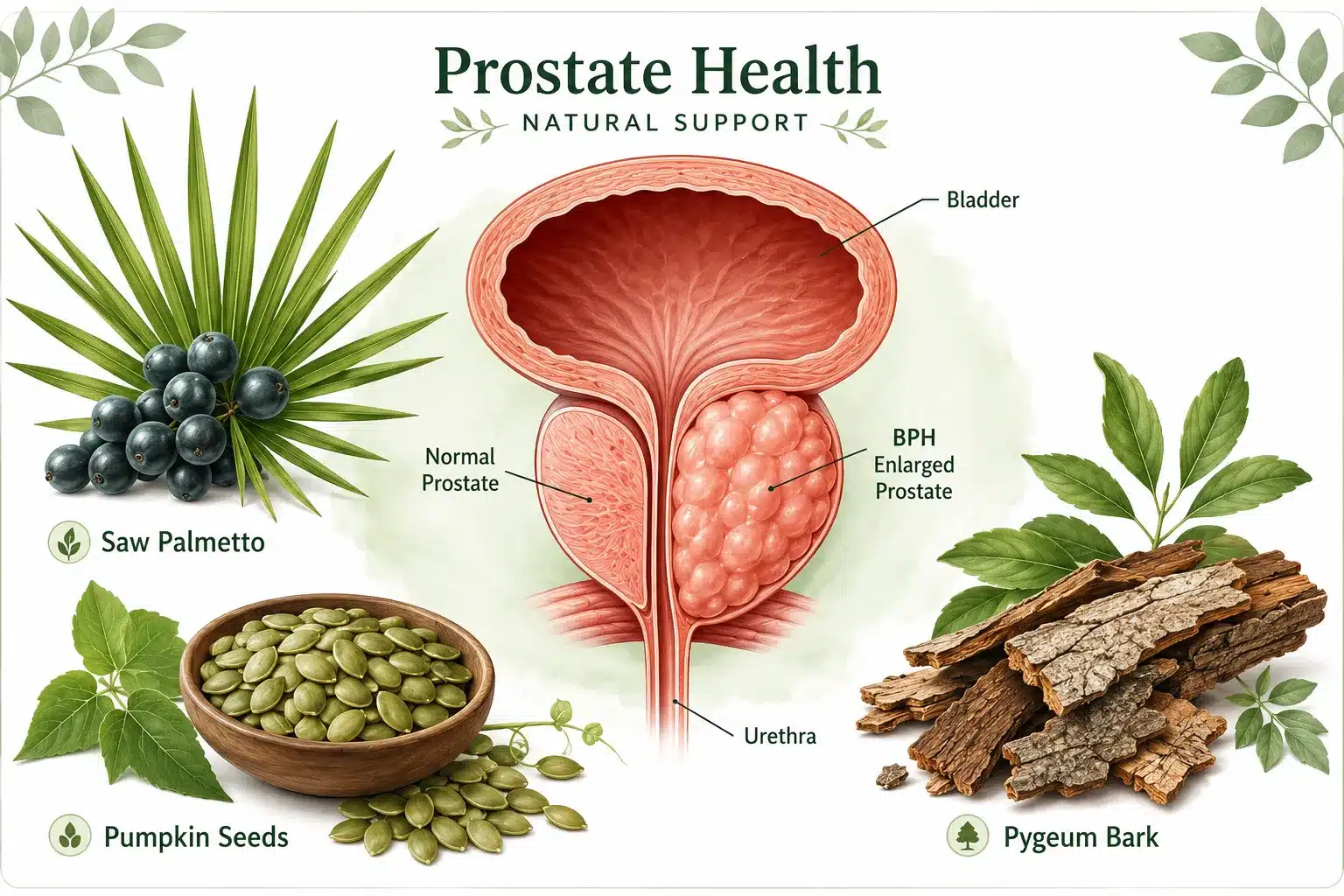
Benign prostatic hyperplasia is a non-cancerous enlargement of the prostate gland that compresses the urethra and disrupts normal urine flow. It is the most common cause of lower urinary tract symptoms (LUTS) in men over 50.
The main drivers of BPH include:
- Hormonal changes with age: As testosterone declines, the ratio of dihydrotestosterone (DHT) and estrogen shifts, stimulating prostate cell growth.
- DHT accumulation: DHT, a potent androgen converted from testosterone by the enzyme 5-alpha reductase, is the primary hormone responsible for prostate tissue proliferation.
- Chronic inflammation: Low-grade prostate inflammation is increasingly recognized as a contributing factor in BPH progression.
- Metabolic syndrome: Obesity, insulin resistance, and elevated blood sugar are associated with faster prostate growth.
- Genetic predisposition: Men with a family history of BPH are more likely to develop it earlier and more severely.
Symptoms range from mild (slightly increased urinary frequency) to severe (inability to empty the bladder, urinary retention requiring catheterization). Most men experience a gradual progression over years.
Understanding the cause matters because it shapes which supplement ingredients are most relevant. For example, supplements targeting DHT production (like saw palmetto and beta-sitosterol) address a different mechanism than anti-inflammatory compounds like curcumin or pygeum.
Do Prostate Supplements Actually Work? The Scientific Evidence
The honest answer is: some ingredients show genuine promise, but the evidence is uneven, and none are officially recommended by major urological associations as primary treatments. [9]
What the research actually shows:
- Beta-sitosterol: A Cochrane review found that beta-sitosterol significantly improved urinary symptom scores and peak urine flow rates compared to placebo. This is the strongest clinical evidence for any single prostate supplement ingredient. [2]
- Saw palmetto: Despite its popularity, a well-designed clinical trial (the STEP trial) and subsequent high-quality studies found saw palmetto performed no better than placebo for urinary symptoms. Harvard Health’s February 2026 update confirms this finding. [1]
- Pygeum: Derived from the African plum tree, pygeum has shown some benefit in reducing nighttime urination and improving urine flow in smaller studies, but long-term safety and effectiveness have not been conclusively proven. [3]
- Curcumin: A June 2026 systematic review and meta-analysis published in the European Journal of Clinical Pharmacology found curcumin supplementation showed potential benefits in managing BPH symptoms, though the authors called for further large-scale trials before clinical recommendations can be made. [4]
- Rye grass pollen extract (Cernilton): Several small trials suggest modest improvements in urinary flow and symptom scores, but the evidence base is limited.
- Pumpkin seed extract: Observational data and a few controlled trials suggest benefit, particularly for nighttime urination, but rigorous evidence is thin.
- Zinc: Prostate tissue has the highest zinc concentration of any organ in the body, and some research links low zinc to BPH progression, but supplementation trials are inconclusive.
Bottom line: Beta-sitosterol and pygeum have the most credible supporting data. Saw palmetto’s reputation outpaces its evidence. Curcumin is an emerging ingredient worth watching. All should be treated as complementary support, not cures.
The 7 Best Enlarged Prostate Supplements of 2026: Side-by-Side Comparison
These seven supplements represent the best enlarged prostate supplements available based on ingredient quality, clinical evidence, third-party testing standards, and user-reported outcomes. Prices reflect current retail as of July 2026.
| Supplement | Key Ingredient(s) | Price Range/Month | 3rd-Party Tested | Best For |
|---|---|---|---|---|
| NOW Foods Beta-Sitosterol Plant Sterols | Beta-sitosterol 180mg | $18,$25 | Yes (Informed Sport) | Urinary flow improvement |
| Jarrow Formulas Saw Palmetto | Saw palmetto 160mg (standardized) | $15,$22 | Yes (NSF) | Mild symptom support |
| NOW Foods Pygeum & Saw Palmetto | Pygeum 50mg + Saw Palmetto 160mg | $16,$24 | Yes (GMP certified) | Nighttime urination |
| Life Extension Ultra Prostate Formula | Beta-sitosterol, pygeum, boron, lycopene | $28,$38 | Yes (COA available) | Comprehensive multi-ingredient |
| Havasu Nutrition Saw Palmetto | Saw palmetto 500mg + pumpkin seed | $20,$28 | Yes (third-party lab) | Budget-friendly combo |
| Thorne Research Zinc Picolinate | Zinc 30mg (picolinate form) | $14,$20 | Yes (NSF Certified) | Zinc deficiency support |
| Curcumin C3 Complex (Sabinsa) | Curcumin 500mg (95% curcuminoids) | $22,$35 | Yes (patented extract) | Inflammation-related BPH |
Important note: Prices vary by retailer. Always verify current pricing on Amazon, iHerb, or the brand’s official website before purchasing.
For a deeper look at one popular prostate formula, see this detailed Prostadine prostate drops review and this Gorilla Flow prostate supplement review.
How Does Saw Palmetto Work for Prostate Health?
Saw palmetto is thought to work primarily by inhibiting 5-alpha reductase, the enzyme that converts testosterone into DHT. Lower DHT levels mean less stimulation of prostate cell growth. Some research also suggests saw palmetto has mild anti-inflammatory and anti-androgenic effects.
The mechanism in plain terms:
- Testosterone is converted to DHT by 5-alpha reductase in prostate tissue.
- DHT binds to androgen receptors in the prostate, triggering cell multiplication.
- Saw palmetto’s active compounds (fatty acids and phytosterols) partially block this conversion.
- Less DHT means less stimulation, potentially slowing prostate growth.
This is the same basic mechanism as the prescription drug finasteride, though finasteride is far more potent and better studied.
The problem: Despite this plausible mechanism, high-quality clinical trials have consistently failed to show that saw palmetto significantly outperforms placebo in reducing urinary symptoms. Harvard Health’s 2026 review of the evidence concludes that high-quality studies show little or no benefit. [1] This does not mean saw palmetto is harmful, just that its real-world effect may be smaller than many supplement labels imply.
Choose saw palmetto if: You want a well-tolerated, low-risk supplement with a long history of use and are comfortable with uncertain efficacy. Avoid it if you are taking blood thinners (warfarin, aspirin), as saw palmetto may increase bleeding risk.
What Is the Difference Between Saw Palmetto and Beta-Sitosterol?
Saw palmetto and beta-sitosterol are both plant-derived prostate supplements, but they work differently and have different evidence profiles. Beta-sitosterol has stronger clinical support; saw palmetto has broader name recognition.
Key differences:
| Feature | Saw Palmetto | Beta-Sitosterol |
|---|---|---|
| Source | Berry extract (Serenoa repens) | Plant sterols (soybeans, nuts, seeds) |
| Primary mechanism | 5-alpha reductase inhibition | Reduces inflammation, improves bladder muscle tone |
| Clinical evidence | Mixed to negative in high-quality trials [1] | Positive Cochrane review for urinary flow [2] |
| Typical dose | 160-320mg (standardized to 85-95% fatty acids) | 60-130mg, 2-3x daily |
| Side effect profile | Generally mild; possible bleeding risk | Generally well tolerated |
| Cost per month | $15,$22 | $18,$25 |
Bottom line: If you are choosing between the two, beta-sitosterol has a stronger evidence base. Many high-quality multi-ingredient prostate formulas include both, which may provide additive benefit.
Prostate Supplement Prices and Where to Buy
Most prostate supplements cost between $14 and $40 per month when purchased from reputable sources. Single-ingredient products (like standalone zinc or beta-sitosterol) tend to be cheaper; comprehensive multi-ingredient formulas cost more.
Where to buy:
- Amazon: Widest selection, competitive pricing, but verify seller authenticity and check for third-party testing seals.
- iHerb: Strong reputation for supplement quality, ships internationally, good for NSF and USP-verified products.
- Brand websites: Often offer subscriptions with 10-20% discounts; best for verifying authenticity.
- Walmart/CVS/Walgreens: Convenient for basic saw palmetto and zinc products, but selection is limited and quality varies.
- Costco: Good value for bulk purchases of well-known brands like Nature Made.
Hidden costs to watch for:
- Auto-ship subscriptions that are difficult to cancel
- “Free trial” offers that charge full price after 30 days
- Proprietary blends that hide individual ingredient doses
- Products without a Certificate of Analysis (COA) or third-party verification
Choose a product if: It clearly lists the dose of each active ingredient, carries a USP, NSF, or Informed Sport seal, and does not rely on a proprietary blend to obscure underdosing.
You can also explore food supplements for prostate health for dietary approaches that complement supplementation, and read about how to shrink the prostate naturally for lifestyle strategies.
Can Prostate Supplements Replace Prescription Medication?
No. Prostate supplements cannot replace prescription medications for moderate-to-severe BPH. They may be appropriate for mild symptoms or as adjuncts to medical treatment, but they should never be used to delay necessary medical evaluation.
Prescription options for BPH include:
- Alpha-blockers (tamsulosin, alfuzosin): Relax prostate and bladder neck muscles; fast-acting, usually within days.
- 5-alpha reductase inhibitors (finasteride, dutasteride): Shrink the prostate over 6-12 months; best for larger prostates.
- Combination therapy: A February 2026 meta-analysis in the European Journal of Medical Research found that combining alpha-blockers with 5-alpha reductase inhibitors provided superior outcomes for men with moderate-to-severe BPH compared to either drug alone. [5]
- PDE5 inhibitors (tadalafil): Also used for BPH-related LUTS, particularly in men who also have erectile dysfunction.
When supplements may be appropriate:
- Mild urinary symptoms (IPSS score below 8)
- Men who decline or cannot tolerate prescription medications
- As adjunctive support alongside prescription treatment (with physician approval)
- Men seeking to support prostate health before symptoms develop
When to see a doctor immediately:
- Complete inability to urinate
- Blood in urine
- Severe pain
- Symptoms that worsen rapidly over days or weeks
For men dealing with both prostate issues and erectile dysfunction, see our guide on fast-acting ED medication options for men in 2026.

Prostate Supplements vs. Prescription Drugs Like Finasteride
Finasteride and dutasteride are prescription 5-alpha reductase inhibitors with decades of clinical trial data showing they reduce prostate volume by 20-30% and significantly improve urinary symptoms in men with larger prostates. No supplement comes close to this level of documented efficacy.
Direct comparison:
- Finasteride: Reduces prostate volume, lowers PSA by roughly 50%, takes 6-12 months for full effect. Side effects include reduced libido, erectile dysfunction, and ejaculatory changes in a minority of men.
- Beta-sitosterol: Improves urinary flow and symptom scores in clinical trials, but does not measurably shrink the prostate. Well tolerated. [2]
- Saw palmetto: Theoretically similar mechanism to finasteride but without the clinical evidence to back it up. [1]
The practical decision rule:
- IPSS score under 8 (mild symptoms): Lifestyle changes and supplements are reasonable first steps.
- IPSS score 8-19 (moderate symptoms): Discuss prescription medication with your urologist; supplements may be used alongside.
- IPSS score 20+ (severe symptoms): Prescription treatment or surgical evaluation is necessary; supplements are not adequate.
The Mayo Clinic explicitly states that no herbal supplement is approved in the U.S. to treat BPH, and all supplement use should be disclosed to your healthcare provider. [3]
Prostate Supplement Side Effects and Drug Interactions
Most prostate supplements are well tolerated at recommended doses, but side effects and interactions are real and worth knowing before you start.
Common side effects by ingredient:
- Saw palmetto: Mild gastrointestinal upset, headache, dizziness. Rare but documented: increased bleeding risk (relevant before surgery or with anticoagulants).
- Beta-sitosterol: Generally well tolerated. High doses may reduce absorption of fat-soluble vitamins.
- Pygeum: Nausea and stomach discomfort in some users, particularly on an empty stomach.
- Zinc: At doses above 40mg/day, zinc can deplete copper, suppress immune function, and reduce HDL cholesterol. Long-term high-dose zinc supplementation is not recommended without medical supervision.
- Curcumin: Generally safe; high doses may cause gastrointestinal discomfort. Curcumin can inhibit platelet aggregation and may interact with blood thinners. [4]
Drug interactions to flag with your doctor:
- Saw palmetto + warfarin or aspirin: Increased bleeding risk
- Curcumin + chemotherapy agents: Potential interaction (relevant for men with concurrent prostate cancer treatment)
- Zinc + antibiotics (quinolones, tetracyclines): Reduced antibiotic absorption if taken simultaneously
- Beta-sitosterol + cholesterol-lowering medications: Additive effect on cholesterol; monitor lipid levels
A January 2026 Healthline review notes that while herbal supplements like saw palmetto and pygeum are popular, their effectiveness remains inconclusive and they carry real interaction risks that are frequently underestimated. [8]
Who Should Take Prostate Supplements and Who Shouldn’t
Prostate supplements are most appropriate for men with mild BPH symptoms who want to try a conservative approach before prescription medication, or men who want general prostate health support as they age.
Good candidates:
- Men over 50 with mild urinary symptoms (mild frequency, slight hesitancy, mild nocturia)
- Men with a family history of BPH who want preventive support
- Men who have tried prescription medications and experienced intolerable side effects
- Men using supplements as an adjunct to prescription treatment (with physician approval)
Not appropriate for:
- Men with moderate-to-severe BPH (IPSS score above 8) as a sole treatment
- Men with suspected prostate cancer (supplements do not treat cancer)
- Men taking anticoagulants without physician clearance
- Men with kidney disease (high-dose zinc is contraindicated)
- Men who have not had a prostate evaluation to rule out cancer or other conditions
Edge case: Men with elevated PSA should not assume supplements will lower their PSA or address the underlying cause. Finasteride and dutasteride reduce PSA by approximately 50%, which must be accounted for when interpreting PSA test results.
Prostate Supplements for Men Under 40
Men under 40 rarely need prostate supplements, and prostate symptoms in this age group usually have a different underlying cause. BPH is uncommon before 40; urinary symptoms in younger men are more likely caused by prostatitis (prostate inflammation), pelvic floor dysfunction, or a urinary tract infection.
If you are under 40 and experiencing urinary symptoms:
- See a urologist before starting any supplement
- Rule out prostatitis, which is the most common prostate condition in men under 50
- Consider pelvic floor physical therapy if pelvic floor dysfunction is suspected
- Avoid self-treating with BPH supplements, which target a different condition
Zinc is the one supplement that may be relevant for younger men with low dietary zinc intake, as zinc plays a role in testosterone metabolism and immune function. But this is a nutritional consideration, not a BPH treatment.
A March 2026 article from ScienceInsights confirms that prostate supplements should be considered complementary rather than primary treatments, and this is especially true for younger men whose symptoms may not stem from BPH at all. [9]
How Long Does It Take for Prostate Supplements to Work?
Most prostate supplements require 4 to 12 weeks of consistent daily use before producing noticeable improvements in urinary symptoms. Some men report modest improvements within 2 to 4 weeks; others see no change after 3 months.
Realistic timelines by ingredient:
- Beta-sitosterol: Clinical trials typically show measurable improvements in urinary flow within 4-8 weeks. [2]
- Saw palmetto: If it works for an individual, effects are usually noticed within 4-6 weeks. Given the weak overall evidence, non-response is common.
- Pygeum: Some studies report improvements in nocturia within 4-8 weeks.
- Curcumin: Emerging data suggests 8-12 weeks may be needed for anti-inflammatory effects to manifest in prostate tissue. [4]
- Zinc: Correcting a deficiency may take 4-8 weeks; effects on prostate symptoms specifically are less predictable.
Practical rule: Give any prostate supplement a minimum 8-week trial at the correct dose before concluding it is not working. If symptoms worsen or do not improve at all after 12 weeks, consult a urologist.
Common Mistakes People Make With Prostate Supplements
The most common mistake is choosing a product based on marketing rather than ingredient evidence. Here are the other errors that reduce results or create risk.
Mistake 1: Buying proprietary blends without disclosed doses Many prostate supplements list 10+ ingredients in a “prostate blend” without stating how much of each ingredient is present. If beta-sitosterol is listed fifth in a 200mg blend, you may be getting less than 20mg, far below the 60-130mg per dose used in clinical trials.
Mistake 2: Expecting supplements to replace prescription treatment Men with moderate-to-severe BPH who use supplements instead of seeking medical care risk disease progression, urinary retention, and kidney damage from chronic obstruction.
Mistake 3: Not disclosing supplement use to their doctor Saw palmetto can affect bleeding time and may interfere with PSA test interpretation. Curcumin can interact with blood thinners. Always tell your urologist what you are taking.
Mistake 4: Buying from unverified sources A 2023 analysis of dietary supplements sold online found that a significant percentage of products did not contain the labeled amount of active ingredient. Buy only from brands with third-party testing (USP, NSF, Informed Sport).
Mistake 5: Ignoring lifestyle factors Supplements work best alongside dietary changes, regular exercise, and weight management. Obesity and metabolic syndrome accelerate BPH progression. No supplement compensates for a poor diet and sedentary lifestyle.
Mistake 6: Stopping too early Many men quit after 2-3 weeks without seeing results. Most ingredients require 6-12 weeks for full effect.
Also consider reading about Prosta Surge X as an example of a multi-ingredient prostate formula, and check whether Prostadine actually works or is a scam before purchasing.
How to Choose a Prostate Supplement That Is Actually Effective
The best enlarged prostate supplements share five characteristics: transparent ingredient dosing, third-party testing, clinically relevant ingredient concentrations, no misleading claims, and a clear return policy.
Step-by-step selection framework:
Check the supplement facts panel. Every active ingredient should have a specific milligram dose listed. Reject any product using a “proprietary blend” that hides individual doses.
Verify third-party testing. Look for USP Verified, NSF Certified for Sport, Informed Sport, or Informed Choice seals. These mean an independent lab has confirmed the product contains what the label says.
Match ingredients to evidence. Beta-sitosterol (60-130mg per dose) and pygeum (50-100mg) have the strongest evidence. Saw palmetto is acceptable if standardized to 85-95% fatty acids at 160-320mg/day.
Avoid megadose zinc. Prostate supplements with more than 30mg of zinc per serving can cause copper depletion with long-term use. Thorne’s Zinc Picolinate at 30mg is appropriate; avoid products with 50mg+ per serving.
Check the return policy. Reputable brands offer 30-90 day money-back guarantees. Avoid brands that make returns difficult or charge restocking fees.
Consult your urologist. Especially if you are on blood thinners, have elevated PSA, or are already using prescription BPH medications.
Red flags to avoid:
- Claims that the product “shrinks the prostate” (no supplement is proven to do this)
- Before-and-after testimonials without clinical data
- Subscription auto-ship that is difficult to cancel
- No contact information or physical address on the brand’s website

Frequently Asked Questions
What is the single best prostate supplement ingredient according to clinical evidence? Beta-sitosterol has the strongest clinical evidence among prostate supplement ingredients. A Cochrane review found it significantly improved urinary symptom scores and peak urine flow compared to placebo. [2] It is not FDA-approved to treat BPH, but the evidence is more consistent than for any other single supplement ingredient.
Is saw palmetto worth taking for an enlarged prostate? The evidence is weak. Multiple high-quality clinical trials, including the large STEP trial, found saw palmetto performed no better than placebo for urinary symptoms. Harvard Health’s 2026 review confirms this finding. [1] It is safe and inexpensive, but men should not expect significant symptom relief.
Can I take prostate supplements with finasteride or tamsulosin? Possibly, but always ask your urologist first. Some combinations are low-risk (beta-sitosterol with tamsulosin), while others carry interaction concerns (saw palmetto with anticoagulants). Disclose all supplements at every medical appointment.
Do prostate supplements affect PSA levels? Most prostate supplements do not significantly affect PSA. However, some research suggests saw palmetto may modestly lower PSA, which could complicate cancer screening. Always tell your doctor you are taking prostate supplements before a PSA test.
How much should I expect to spend on a quality prostate supplement? A well-formulated, third-party-tested prostate supplement typically costs $18,$40 per month. Products below $15/month often use underdosed ingredients or lack quality verification. Products above $50/month are rarely justified by additional evidence.
Are prostate supplements safe for long-term use? Most are considered safe for long-term use at recommended doses, with the exception of high-dose zinc (above 40mg/day). Annual check-ins with a urologist are advisable for any man taking prostate supplements long-term.
What is the fastest-acting prostate supplement? No supplement acts as quickly as prescription alpha-blockers (tamsulosin can improve symptoms within 24-48 hours). Among supplements, beta-sitosterol and pygeum tend to show effects within 4-8 weeks in clinical trials, which is faster than most other ingredients.
Can dietary changes reduce the need for prostate supplements? Yes, significantly. A February 2026 randomized trial found that increasing phytochemical-rich foods and Lactobacillus probiotics had measurable effects in men with prostate conditions. [6] A diet high in vegetables, lycopene-rich tomatoes, pumpkin seeds, and omega-3 fatty acids supports prostate health and may reduce symptom severity.
Are there prostate supplements specifically for men over 60? There are no age-specific formulas, but men over 60 with larger prostates and more significant symptoms benefit most from higher-evidence ingredients like beta-sitosterol and pygeum, and should be under regular urological care regardless of supplement use.
What should I do if my symptoms get worse while taking a prostate supplement? Stop the supplement and see a urologist promptly. Worsening symptoms may indicate BPH progression, acute urinary retention, prostatitis, or another condition that requires medical evaluation. Do not increase the supplement dose in response to worsening symptoms.
Is curcumin a viable prostate supplement in 2026? Curcumin is emerging as a promising ingredient. A June 2026 systematic review found potential benefits for BPH symptom management, but the authors noted that further large-scale trials are needed before it can be clinically recommended. [4] It is a reasonable addition to a multi-ingredient formula but should not be the sole ingredient relied upon.
Do probiotics help with prostate health? Early research is interesting. A February 2026 randomized controlled trial investigated the effects of phytochemical-rich foods and Lactobacillus probiotics in men with prostate conditions, with promising findings. [6] This is an emerging area, and probiotics are not yet a standard prostate health recommendation, but they are low-risk and may provide broader health benefits.
Conclusion
The best enlarged prostate supplements in 2026 are not a replacement for medical care, but they are a legitimate option for men with mild symptoms who want to take an evidence-informed approach to prostate health. Beta-sitosterol stands out as the most clinically supported ingredient. Pygeum and rye grass pollen extract have credible supporting data. Saw palmetto remains popular but its clinical evidence is weaker than its reputation suggests.
Actionable next steps:
- Get a baseline evaluation. Before starting any prostate supplement, have your PSA tested and discuss your urinary symptoms with a urologist using a validated symptom score (IPSS).
- Choose based on evidence, not marketing. Prioritize products with beta-sitosterol at 60-130mg per dose, third-party testing seals, and full ingredient transparency.
- Set a realistic timeline. Commit to 8-12 weeks of consistent use before evaluating whether a supplement is working.
- Disclose everything to your doctor. Especially if you are on blood thinners, statins, or prescription BPH medications.
- Combine supplements with lifestyle changes. Weight management, a plant-rich diet, regular physical activity, and limiting evening fluid intake all reduce BPH symptom severity.
- Escalate if needed. If symptoms worsen or do not improve after 12 weeks, prescription medication or urological evaluation is the appropriate next step, not a higher supplement dose.
No supplement will shrink your prostate the way finasteride does, and none will unblock a severely obstructed urethra. But for mild symptoms and long-term prostate health support, the right supplement, chosen carefully and used consistently, can be a worthwhile part of your health strategy.
References
[1] Can Saw Palmetto Treat An Enlarged Prostate – https://www.health.harvard.edu/mens-health/can-saw-palmetto-treat-an-enlarged-prostate?utm_source=openai
[2] Best Prostate Supplements – https://supplementlist.info/guide/best-prostate-supplements?utm_source=openai
[3] Drc 20370093 – https://www.mayoclinic.org/diseases-conditions/benign-prostatic-hyperplasia/diagnosis-treatment/drc-20370093?gh_jid=4896851003&utm_source=openai
[4] S00228 026 04093 9 – https://link.springer.com/article/10.1007/s00228-026-04093-9?utm_source=openai
[5] S40001 026 03976 Y – https://link.springer.com/article/10.1186/s40001-026-03976-y?utm_source=openai
[6] pubmed.ncbi.nlm.nih.gov – https://pubmed.ncbi.nlm.nih.gov/41152052/?utm_source=openai
[7] Best Prostate Supplements – https://www.healthline.com/nutrition/best-prostate-supplements?utm_source=openai
[8] Over The Counter Enlarged Prostate – https://www.healthline.com/health/over-the-counter-enlarged-prostate?utm_source=openai
[9] Prostate Supplements What Helps And What Backfires – https://scienceinsights.org/prostate-supplements-what-helps-and-what-backfires/?utm_source=openai