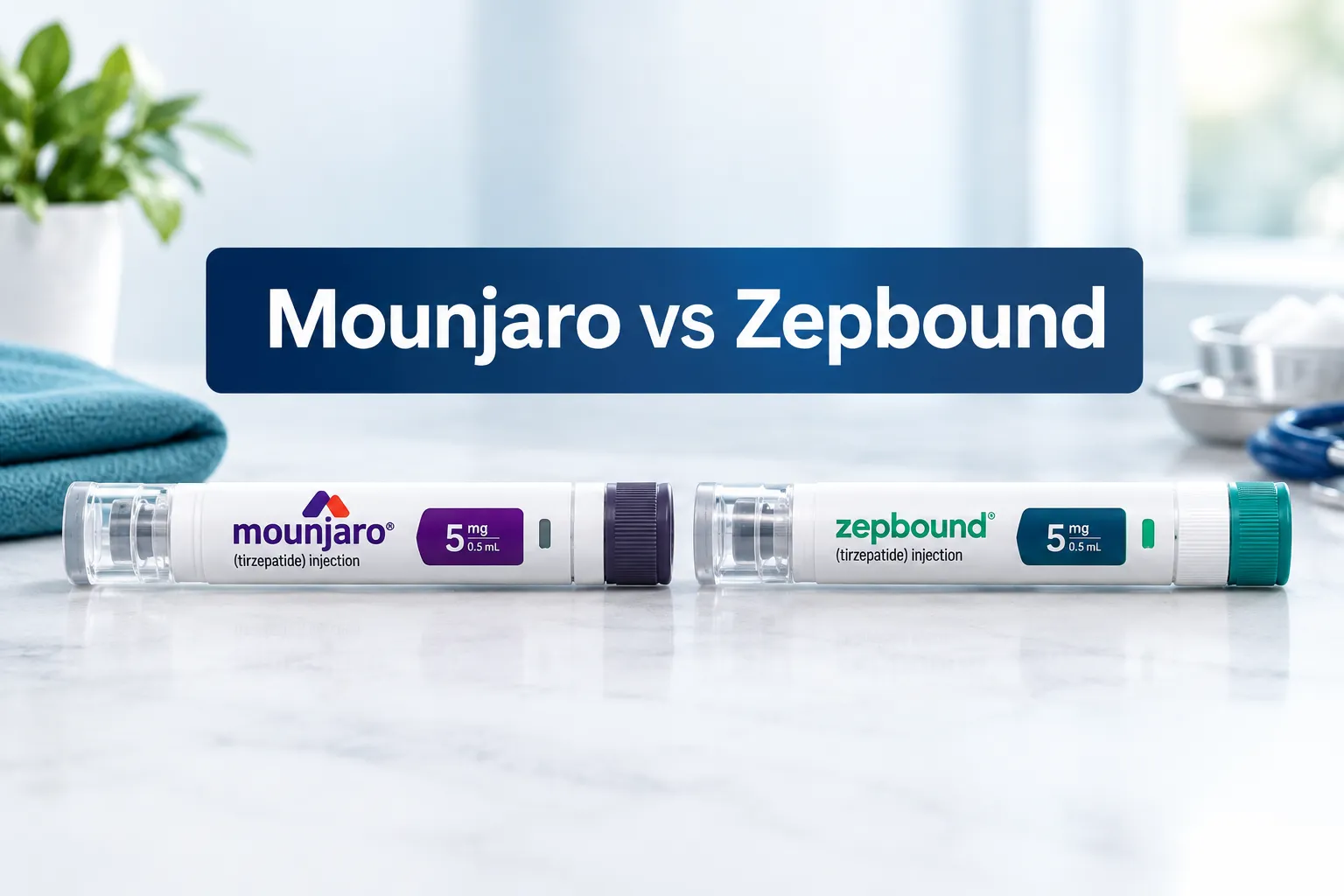
mounjaro vs zepbound
Last updated: October 21, 2026
Quick Answer
Mounjaro and Zepbound both contain tirzepatide, made by Eli Lilly, but they’re approved for different uses. Mounjaro treats type 2 diabetes, while Zepbound is approved specifically for chronic weight management and obstructive sleep apnea (OSA) in adults with obesity [1][2]. The drug itself is nearly identical, the real differences come down to FDA labeling, insurance coverage, and which condition you’re treating.
Doctors sometimes prescribe Mounjaro off-label for weight loss, and that’s where the “mounjaro vs zepbound” confusion usually starts. Below, I’ll walk through the real differences, the costs, the side effects, and how to decide which one makes sense to bring up with your doctor.
7 Best GLP-1 Providers Ranked: Accreditation, Flexibility & Support Compared (2026 Update)
32,000+ Patients Can't All Be Wrong: See the Top-Rated GLP-1 Providers. We compared the leading online GLP-1 providers based on program features, clinical support, convenience, and overall value.

BMI MD GLP-1 Microdosing Plan
- Specialized microdosing options, including sublingual drops and low-dose injections
- Designed for people interested in maintaining weight or gradually adjusting treatment
- Bundled program structure without a separate monthly platform membership
- Online access makes the process convenient from home

DirectMeds Weight Loss Solutions
- Online weight-loss program with a straightforward patient experience
- Compounded medication options through state-licensed compounding pharmacies
- Includes clinical consultation as part of the process
- Provides shipping updates to help patients track their orders

MEDVi Flat-Rate Telehealth
- Flat-rate telehealth approach designed for easier budgeting
- No dosage-based pricing increases within the advertised program structure
- Offers injectable and oral thin-film delivery options
- Includes medical screening and asynchronous provider consultations

Gala GLP-1 Care Program
- Text-based access to state-licensed clinicians
- Cold-chain medication shipping included in the program
- Month-to-month program structure
- Designed for people who value convenient ongoing support

Measured GLP-1 Metabolic Health
- Comprehensive metabolic health screening and intake analysis
- Designed around longer-term metabolic health management
- Responsive dashboard with integrated health tracking tools
- Useful option for patients who value a more data-focused experience

Refills GLP-1 (TryRefills Plan)
- Clinical guidance designed to help patients manage common treatment concerns
- Includes foundational nutritional strategies alongside medication
- Designed around predictable ongoing treatment
- No hidden startup or processing fees according to the program information provided

AltRx GLP-1 Transactional Reorders
- Transactional reorder model without recurring auto-billing
- Designed for patients who already understand their treatment routine
- Fast text-to-order process for convenient reorders
- Offers injectable and fast-dissolving tablet variations
Key Takeaways
- Same active ingredient: Both drugs use tirzepatide, a dual GIP/GLP-1 receptor agonist made by Eli Lilly [1].
- Different approved uses: Mounjaro is FDA-approved for type 2 diabetes; Zepbound is approved for weight management and moderate-to-severe OSA in adults with obesity [2].
- Zepbound shows strong weight-loss data, including a head-to-head comparison showing greater weight loss than semaglutide (Wegovy) in a Lilly-sponsored trial [3][4].
- Insurance coverage differs: Diabetes drugs like Mounjaro are often covered more readily than weight-loss drugs like Zepbound, which many plans still exclude [1][5].
- Side effect profiles are nearly identical since it’s the same molecule, mostly gastrointestinal issues like nausea and diarrhea [5].
- You can switch between the two with a doctor’s guidance, often at an equivalent dose [1].
- Zepbound has become the most-prescribed weight-management drug in its category, according to Lilly’s own reporting [6].
What’s the actual difference between Mounjaro and Zepbound
The core difference is the FDA-approved indication, not the chemistry. Mounjaro and Zepbound both deliver tirzepatide, but Mounjaro’s label covers type 2 diabetes management while Zepbound’s label covers chronic weight management and sleep apnea tied to obesity [1][2].
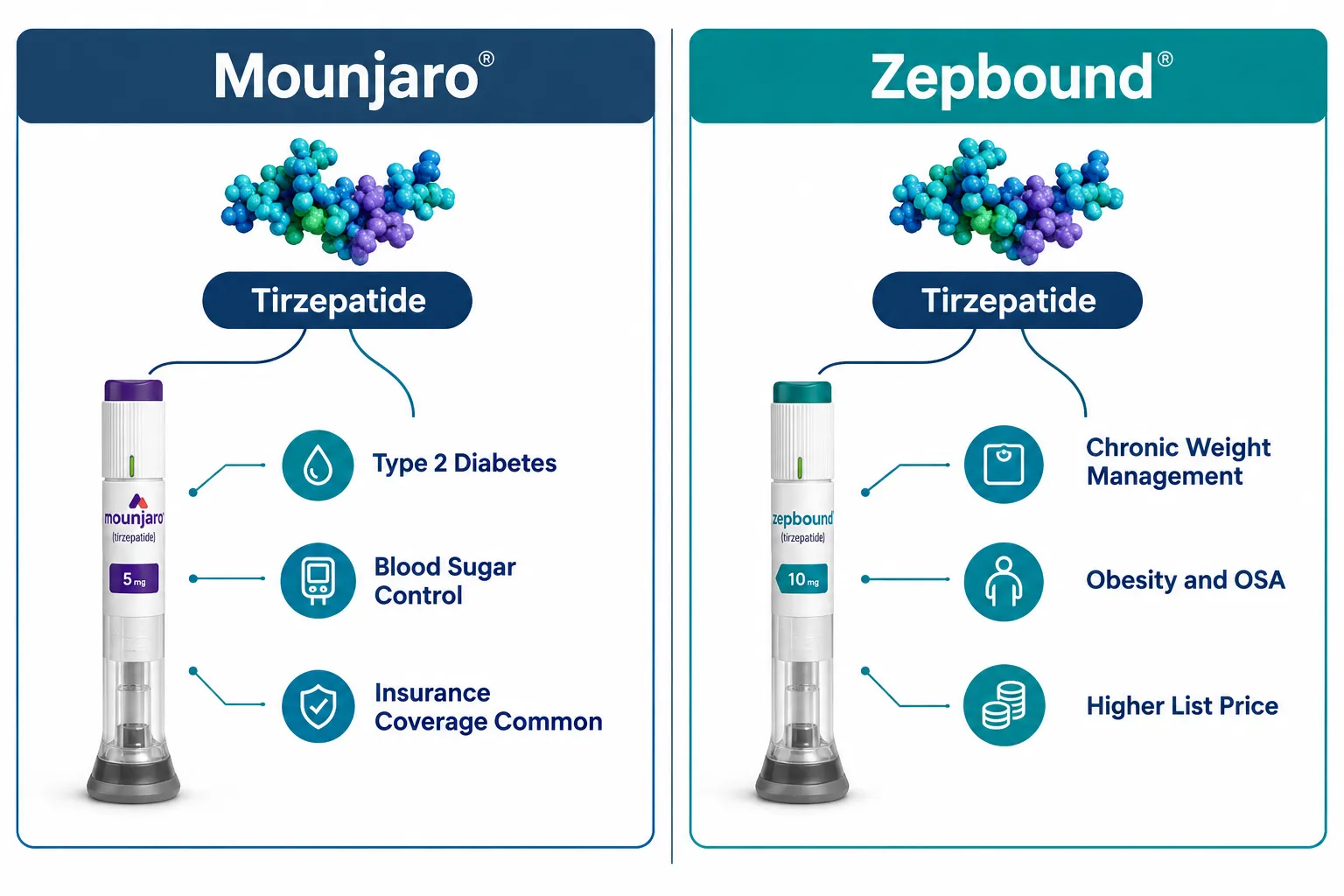
Think of it like two products built from the same formula but marketed for different jobs:
- Mounjaro: approved 2022 for improving blood sugar control in adults with type 2 diabetes.
- Zepbound: approved later specifically for weight loss and, more recently, for OSA in obese adults [2].
The dosing schedules, injection pens, and escalation steps are essentially the same across both products. If you look at the prescribing information side by side, you’ll notice they read almost like twins with different cover pages.
Can you use Mounjaro for weight loss or is it only for diabetes
Mounjaro is only FDA-approved for type 2 diabetes, but doctors can legally prescribe it off-label for weight loss. Off-label use is common with tirzepatide because the weight-loss effect was discovered during diabetes trials, well before Zepbound existed [5].
That said, off-label prescribing comes with trade-offs:
- Insurance is less likely to approve Mounjaro for weight loss since it’s not the labeled use.
- Your doctor assumes more liability when prescribing outside the approved indication.
- The clinical monitoring and counseling that come with an obesity-specific label (like Zepbound’s) won’t automatically apply.
Decision rule: if you have type 2 diabetes and want to lose weight as a side benefit, Mounjaro is the natural fit. If weight loss is your primary goal and you don’t have diabetes, Zepbound is the medication actually built, and insured, for that purpose.
How much does Zepbound cost and is it covered by insurance
Zepbound’s list price is higher than many diabetes drugs, and insurance coverage for weight-loss medications remains inconsistent across plans [1]. Some employer plans exclude obesity drugs entirely, while others require prior authorization and proof of a qualifying BMI.
A few cost factors worth knowing:
- Vial formulations are generally cheaper than the auto-injector pen version, see our breakdown of Zepbound vial vs pen pricing for specifics.
- Manufacturer savings cards can lower out-of-pocket costs for eligible patients, though terms change frequently [VERIFY current savings card terms with Lilly directly].
- If you’re uninsured, programs similar to the Mounjaro savings coupon for uninsured patients sometimes have Zepbound equivalents worth asking your pharmacist about.
Common mistake: assuming Zepbound is automatically covered because Mounjaro is covered for a family member with diabetes. Weight-loss drug coverage is decided separately from diabetes drug coverage, even within the same insurance plan.
What are the side effects of each and which is worse
Side effects are essentially the same for both drugs because they share the identical active ingredient. The most common issues are nausea, diarrhea, vomiting, constipation, and decreased appetite [5].
| Side Effect | Mounjaro | Zepbound |
|---|---|---|
| Nausea | Common | Common |
| Diarrhea | Common | Common |
| Vomiting | Common | Common |
| Injection site reactions | Occasional | Occasional |
| Gallbladder issues | Possible | Possible |
| Pancreatitis (rare) | Possible | Possible |
Neither drug is “worse” in a clinical sense, people report similar tolerability regardless of which brand name is on the box. The dose matters more than the brand: higher doses tend to bring more GI discomfort, especially during the first few weeks of escalation.
Edge case: if you’ve had Mounjaro side effects that were hard to manage, switching to Zepbound won’t change your experience, since it’s the same compound at equivalent doses.
Is Zepbound basically just Mounjaro rebranded
Not exactly rebranded, but close. Zepbound is the same tirzepatide molecule packaged and marketed under a separate FDA approval specifically for weight management, which allowed Lilly to run its own obesity-focused trials, labeling, and marketing campaign [2][7].
This dual-branding strategy isn’t unusual in pharma. Companies often seek separate approvals when a drug has two distinct clinical uses, partly because it lets them target marketing, support different insurance pathways, and run condition-specific trials. Lilly’s public campaigns, including the Shaquille O’Neal-fronted awareness push around OSA and obesity, highlight Zepbound specifically rather than Mounjaro, reinforcing the separate brand identity [7].
Who qualifies for Zepbound vs Mounjaro
Qualification depends on your diagnosis, not personal preference. Mounjaro requires a type 2 diabetes diagnosis; Zepbound requires either a BMI of 30+ (obesity) or a BMI of 27+ with a weight-related condition, and now also covers moderate-to-severe OSA with obesity [2].

Quick qualification checklist:
- Diagnosed with type 2 diabetes? Mounjaro is the labeled option.
- BMI 30+ without diabetes? Zepbound is the labeled option.
- BMI 27+ with a weight-related condition like hypertension or high cholesterol? Zepbound may qualify.
- Diagnosed with obstructive sleep apnea and obesity? Zepbound now has a specific approval for this combination [2].
- Have both diabetes and obesity? Either drug may apply; your doctor will usually pick based on insurance pathway and symptom priority.
If you want a broader view of how tirzepatide stacks up against other options in this category, our guide on which GLP-1 is best for weight loss, comparing 7 options is a useful next read.
What other weight loss drugs are similar to Zepbound
Several GLP-1 and dual-agonist drugs compete in the same space as Zepbound, including Wegovy (semaglutide), Saxenda (liraglutide), and emerging options like retatrutide, a triple agonist currently in Lilly’s pipeline [8].
A quick rundown:
- Wegovy: GLP-1-only drug; Zepbound has shown greater average weight loss in indirect and head-to-head comparisons [3][4][9].
- Wegovy HD: a higher-dose semaglutide option, see our Wegovy HD review for details on how it compares.
- Retatrutide: a triple-hormone-receptor agonist in Phase 3 trials, showing strong weight-loss results, positioned as potential future competition for both Mounjaro and Zepbound [8].
- Compounded tirzepatide: an off-brand alternative some patients use when brand-name costs are prohibitive; read our analysis of compounded tirzepatide reviews before considering this route.
Can you switch from Mounjaro to Zepbound
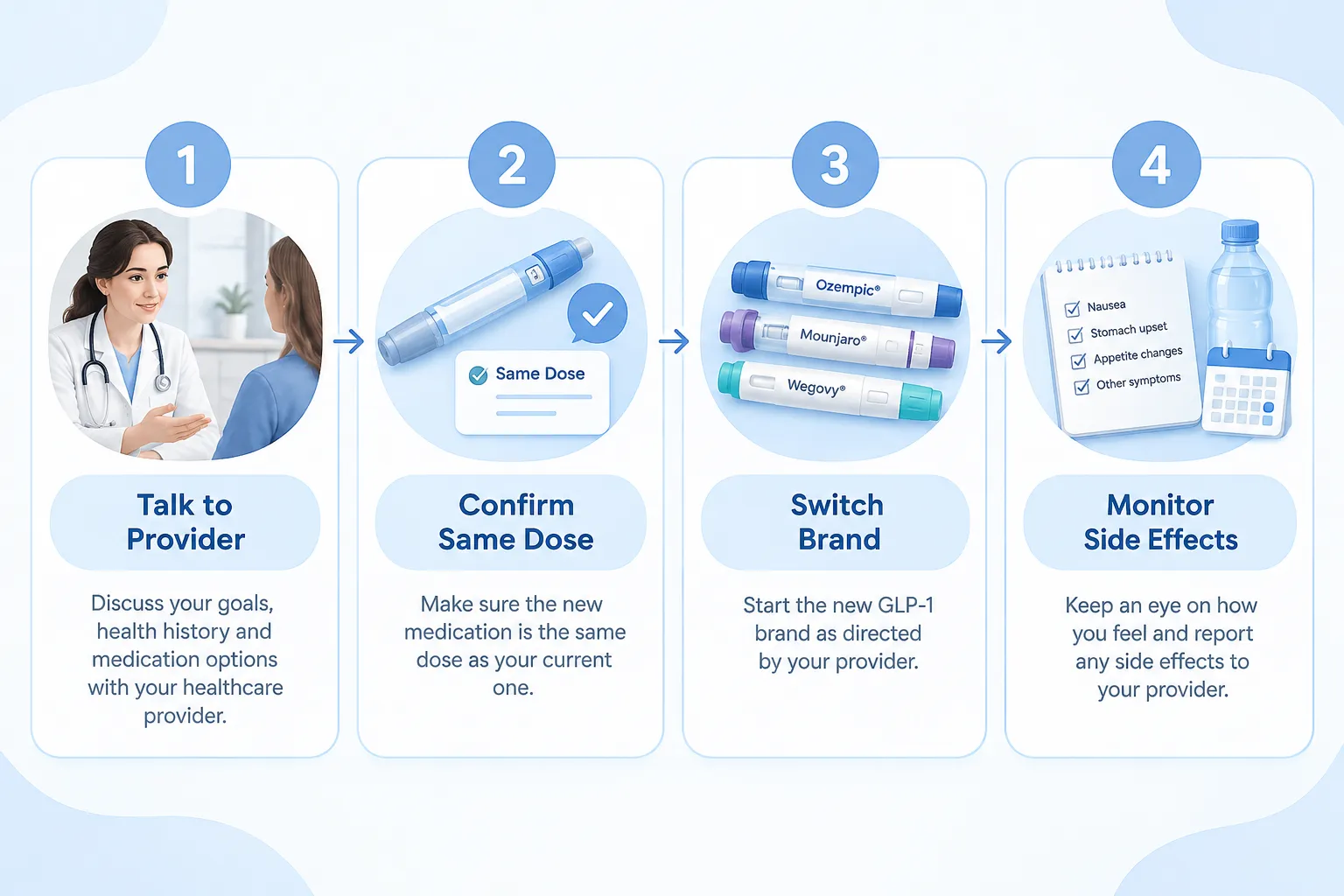
Yes, switching is generally straightforward since both drugs use the same molecule at matching dose strengths. Your doctor can typically transition you at an equivalent dose without needing to restart the escalation process from zero [1].
Reasons people switch:
- Insurance now covers Zepbound for weight management but not Mounjaro off-label use.
- A diabetes diagnosis is no longer the primary treatment goal.
- A new OSA diagnosis makes Zepbound’s specific approval more relevant.
Quick example: a patient on Mounjaro 10 mg for diabetes who later qualifies for Zepbound’s weight-management indication can often move to Zepbound 10 mg with no new titration period, assuming their doctor confirms tolerability.
Why does Zepbound cost so much more than Mounjaro
Pricing differences come down to indication-specific insurance policies rather than manufacturing cost, since the drug itself is identical. Weight-loss medications face more coverage restrictions than diabetes medications, which pushes more of the cost onto patients paying out of pocket [1][5].
Insurers historically treated obesity treatment as elective rather than medically necessary, a view that’s slowly shifting as more data on metabolic and cardiovascular benefits emerges. Until coverage policy catches up broadly, Zepbound will likely carry a higher effective cost for many patients compared to diabetes-labeled Mounjaro, even though the vials coming off the same production line are chemically identical.
How much weight do you actually lose on Zepbound
Clinical trial data shows substantial weight loss on Zepbound, and a 2025 indirect treatment comparison found Zepbound’s 10 mg and 15 mg doses were associated with more weight loss than Wegovy HD (semaglutide 7.2 mg) [9]. A separate head-to-head trial reported by Lilly also showed superior weight loss with Zepbound compared to Wegovy [3], and Cornell researchers covering the trial results described Zepbound as “outdueling” Wegovy in direct comparison [4].
What this means practically:
- Individual results vary based on starting weight, dose, diet, and activity level.
- Trial averages represent group outcomes, not a guarantee for any one person.
- Higher approved doses (10 mg and 15 mg) were specifically linked to the stronger comparative results [9].
I’ve talked to readers who assumed every GLP-1 drug would produce identical results. It doesn’t work that way, dose, duration, and individual metabolism all shift outcomes significantly.
Does Mounjaro work better for weight loss than Zepbound
They work the same, because they’re the same drug at the same doses. Any perceived difference in weight-loss results between Mounjaro and Zepbound comes down to dosing and duration, not the brand name on the pen [1][5].
Since Mounjaro trials were originally built around diabetes outcomes and Zepbound trials around obesity-specific outcomes, direct comparisons technically come from different trial populations. But the active ingredient, mechanism, and typical dose range overlap heavily, so there’s no pharmacological reason one would outperform the other at matched doses.
What’s the difference in side effects between the two
There is no meaningful difference, since both drugs share the identical tirzepatide formula. Reported side effects, nausea, diarrhea, constipation, and appetite suppression, appear at similar rates across both brands at comparable doses [5].
If you’re newly starting either drug, expect the first four to eight weeks of dose escalation to bring the most noticeable GI symptoms. These typically ease as your body adjusts. For general guidance on timing doses to reduce discomfort, see our piece on the best time of day to take a GLP-1 medication.
Do you need a prescription for Zepbound
Yes, Zepbound is a prescription-only medication. You’ll need an evaluation, in person or via telehealth, confirming you meet the BMI or OSA-related qualifying criteria before a provider can prescribe it [2].
Many patients start the process through telehealth platforms that specialize in GLP-1 prescriptions. If you’re exploring options, our guide to getting a tirzepatide prescription online covers what to expect from that process, including typical intake steps and follow-up requirements.
Which one should I ask my doctor about for weight loss
Ask about Zepbound first if weight loss or OSA is your primary concern, since it’s the medication actually approved and studied for that purpose. Bring up Mounjaro only if you already have type 2 diabetes and want a single medication that addresses both conditions [2].
Questions worth bringing to your appointment:
- “Do I qualify under Zepbound’s BMI or OSA criteria, or would Mounjaro make more sense given my diabetes history?”
- “What would my insurance actually cover for each option?”
- “What dose would I start at, and how long is the escalation period?”
- “What happens if I don’t tolerate the starting dose well?”
Mounjaro vs Zepbound at a Glance
| Factor | Mounjaro | Zepbound |
|---|---|---|
| Active ingredient | Tirzepatide | Tirzepatide |
| Manufacturer | Eli Lilly | Eli Lilly |
| FDA-approved use | Type 2 diabetes | Weight management, OSA with obesity |
| Off-label use | Weight loss (common) | Rare, since approval already covers weight |
| Typical insurance path | Diabetes coverage | Obesity-drug coverage (varies widely) |
| Side effects | GI symptoms, nausea | Same GI symptoms, nausea |
| Switching between them | Possible with provider guidance | Possible with provider guidance |
Frequently Asked Questions
Is Zepbound stronger than Mounjaro?
No. They contain the same active ingredient, tirzepatide, at matching dose strengths. Neither is pharmacologically “stronger” than the other [1].
Can I get Zepbound if I have diabetes?
Possibly, but Mounjaro is the labeled option for diabetes. If you also meet Zepbound’s weight or OSA criteria, your doctor may discuss which indication to pursue for insurance purposes [2].
Why would a doctor prescribe Mounjaro instead of Zepbound for weight loss?
Usually because the patient already has type 2 diabetes, making Mounjaro the on-label choice that may be easier to get covered by insurance [5].
Does Zepbound help with sleep apnea?
Yes. Zepbound received FDA approval specifically for moderate-to-severe obstructive sleep apnea in adults with obesity, in addition to its weight-management approval [2].
How long does it take to see weight loss results on Zepbound?
Trial data generally shows progressive weight loss over many months, with the most significant results appearing after sustained use at higher maintenance doses [3][9]. Individual timelines vary.
Is there a generic version of tirzepatide?
No approved generic exists yet. Some compounded versions are available through specialty pharmacies, though these are legally and quality distinct from brand-name Mounjaro or Zepbound; read our compounded tirzepatide reviews before considering this route.
Will my insurance ever cover both drugs under one plan?
Some plans do, depending on diagnosis codes and prior authorization requirements. It’s worth calling your insurer directly to confirm current policy. [VERIFY with your specific insurance plan]
What’s the retatrutide drug I keep hearing about?
Retatrutide is Lilly’s experimental triple-hormone-receptor agonist, currently showing strong weight-loss results in Phase 3 trials, and could eventually compete with both Mounjaro and Zepbound once approved [8].
7 Best GLP-1 Providers Ranked: Accreditation, Flexibility & Support Compared (2026 Update)
32,000+ Patients Can't All Be Wrong: See the Top-Rated GLP-1 Providers: Compared on accreditation, plan flexibility, and patient support — updated for 2026.
BMI MD GLP-1 Microdosing Plan
- Specialized microdosing options (sublingual drops or low-dose injections)
- Ideal for maintaining weight or tapering off higher doses safely
- Fully bundled plan with no hidden monthly platform memberships
DirectMeds Weight Loss Solutions
- Sourced from accredited, state-licensed 503A compounding pharmacies
- No-frills high-volume savings passed directly to the patient
- Includes clinical consultation and cold-chain shipping updates
MEDVi Flat-Rate Telehealth
- Flat monthly rate holds steady even at maximum maintenance doses
- No dosage upcharges or graduation fee penalties
- Offers both injectable and advanced oral thin-film delivery options
Gala GLP-1 Care Program
- All-inclusive plan with no standalone membership costs
- Continuous text-based messaging access with state-licensed clinicians
- Temperature-controlled, cold-chain medication shipping included
Measured GLP-1 Metabolic Health
- Comprehensive metabolic health screening and expert intake analysis
- Predictable long-term budgeting with stable plan pricing
- High-end responsive dashboard with integrated diagnostic support
Refills GLP-1 (TryRefills Plan)
- Flat rate holds steady as titration scales up
- Includes clinical guides for active side-effect management
- Bundles in foundational nutritional strategies alongside medication
AltRx GLP-1 Transactional Reorders
- Zero recurring auto-billing — pay entirely on a transactional basis
- Rapid text-to-order format saves time for experienced patients
- Provides both injectable forms and fast-dissolving tablet variations
Conclusion
Mounjaro and Zepbound are the same tirzepatide molecule wearing two different labels: one built for diabetes, one built for weight management and sleep apnea. The real decision points are your diagnosis, your insurance coverage, and which FDA-approved use actually fits your situation, not which brand name sounds more effective, because neither drug outperforms the other at equal doses.
If you’re uncertain which one applies to you, the next step is a direct conversation with your doctor about your BMI, any diabetes diagnosis, and what your insurance plan actually covers. For a broader comparison of how tirzepatide stacks up against other GLP-1 options on the market, check out our full breakdown of GLP-1 receptor agonists for weight loss.
This article is for informational purposes only and is not medical advice. Talk to a licensed healthcare provider before starting or changing any medication.
References
- Zepbound Mounjaro Complete Comparison Guide 3578880. drugs.com.
- FDA Approves Lillys Zepboundtm Tirzepatide Chronic Weight. investor.lilly.com.
- Zepbound Tirzepatide Showed Superior Weight Loss Over Wegovy. investor.lilly.com.
- Zepbound Outduels Wegovy Weight Loss Clinical Trial. news.cornell.edu.
- Mounjaro Ozempic Wegovy Zepbound Difference. webmd.com.
- Zepbound Tirzepatide Most Prescribed Weight Management. investor.lilly.com.
- Zepbound Tirzepatide and Shaquille Oneal Launch National. investor.lilly.com.
- Lillys Triple Agonist Retatrutide Delivered Powerful Weight Loss in Pivotal Phase 3 Obesity Trial 302778859. prnewswire.com.
- Lillys Zepbound Tirzepatide 10 Mg and 15 Mg Was Associated with More Weight Loss Than Wegovy Hd Semaglutide Injection 7 2 Mg in a New Indirect Treatment Comparison 302892601. prnewswire.com.
SEO Meta Title: Mounjaro vs Zepbound: Key Differences Explained (2026)