
best time of day to take glp 1
Last updated: September 25, 2026
Quick Answer: For weekly GLP-1 injections like semaglutide (Ozempic, Wegovy) and tirzepatide (Mounjaro, Zepbound), there is no single best clock time. You can inject at any time of day, with or without food, as long as you do it on the same day each week. The real exception is oral semaglutide (Rybelsus), which must be taken first thing in the morning on an empty stomach, at least 30 minutes before eating or drinking anything other than a small amount of water.
Key Takeaways
- For weekly injectables, consistency in the day of the week matters far more than the specific hour of the day.
- Official FDA labeling for tirzepatide (Zepbound, Mounjaro) states: inject once weekly at any time of day, with or without meals. [2][3]
- Oral semaglutide requires strict morning fasting: empty stomach, no more than 4 oz of water, 30 minutes before eating. [4][6]
- Short-acting exenatide (Byetta) is the major exception: it must be injected within 60 minutes before your two main meals, at least 6 hours apart. [1]
- Morning dosing can help build a routine; evening dosing may reduce nausea during work hours. Neither is clinically superior for weight loss. [5]
- If nausea is a problem, shifting your injection time to before a light evening meal is a practical adjustment. [5]
- Anchoring your weekly injection to a recurring event (Sunday dinner, Monday morning coffee) is one of the most effective adherence strategies. [9]
- Night-shift workers using oral semaglutide should dose after the longest fasting interval, not necessarily at sunrise. [10]
- You can switch your weekly injection day as long as your doses remain at least 72 hours (3 days) apart. [8]
- Understanding which GLP-1 formulation you are taking is the first step to getting timing right.
What Time of Day Should I Take GLP-1 Medication
The best time of day to take GLP-1 medication depends entirely on which formulation you are using. For weekly injectables, any time of day works. For oral tablets, morning is mandatory.
7 Best GLP-1 Providers Ranked: Accreditation, Flexibility & Support Compared (2026 Update)
32,000+ Patients Can't All Be Wrong: See the Top-Rated GLP-1 Providers. We compared the leading online GLP-1 providers based on program features, clinical support, convenience, and overall value.
BMI MD GLP-1 Microdosing Plan
- Specialized microdosing options, including sublingual drops and low-dose injections
- Designed for people interested in maintaining weight or gradually adjusting treatment
- Bundled program structure without a separate monthly platform membership
- Online access makes the process convenient from home

DirectMeds Weight Loss Solutions
- Online weight-loss program with a straightforward patient experience
- Compounded medication options through state-licensed compounding pharmacies
- Includes clinical consultation as part of the process
- Provides shipping updates to help patients track their orders
MEDVi Flat-Rate Telehealth
- Flat-rate telehealth approach designed for easier budgeting
- No dosage-based pricing increases within the advertised program structure
- Offers injectable and oral thin-film delivery options
- Includes medical screening and asynchronous provider consultations
Gala GLP-1 Care Program
- Text-based access to state-licensed clinicians
- Cold-chain medication shipping included in the program
- Month-to-month program structure
- Designed for people who value convenient ongoing support
Measured GLP-1 Metabolic Health
- Comprehensive metabolic health screening and intake analysis
- Designed around longer-term metabolic health management
- Responsive dashboard with integrated health tracking tools
- Useful option for patients who value a more data-focused experience
Refills GLP-1 (TryRefills Plan)
- Clinical guidance designed to help patients manage common treatment concerns
- Includes foundational nutritional strategies alongside medication
- Designed around predictable ongoing treatment
- No hidden startup or processing fees according to the program information provided
AltRx GLP-1 Transactional Reorders
- Transactional reorder model without recurring auto-billing
- Designed for patients who already understand their treatment routine
- Fast text-to-order process for convenient reorders
- Offers injectable and fast-dissolving tablet variations
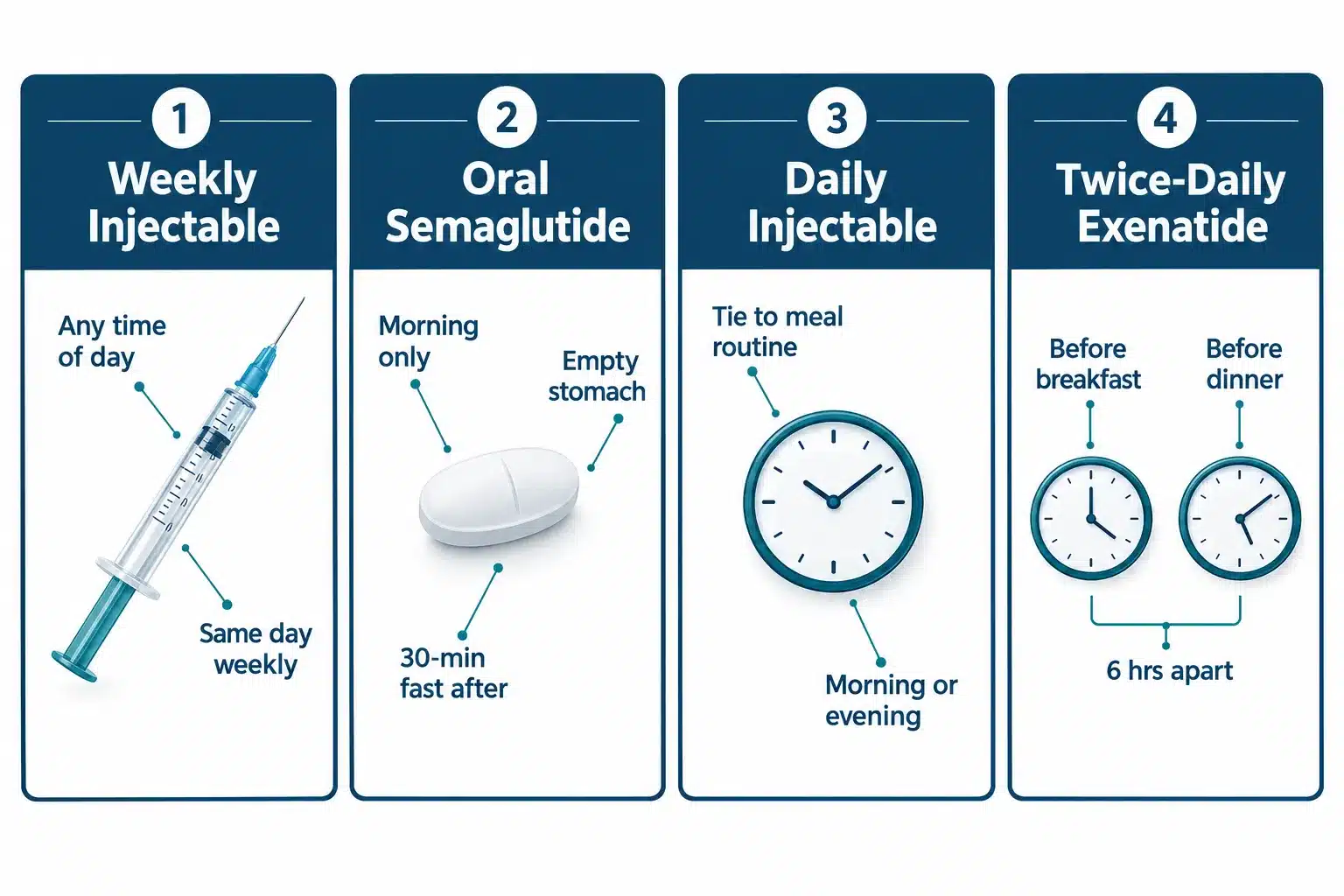
Here is a quick breakdown by formulation:
| Formulation | Examples | Timing Rule |
|---|---|---|
| Weekly injectable | Ozempic, Wegovy, Mounjaro, Zepbound, Bydureon | Any time of day, same day each week |
| Daily injectable | Victoza (liraglutide) | Same time each day, tied to a meal routine |
| Oral tablet | Rybelsus | Morning, empty stomach, 30 min before eating |
| Twice-daily injectable | Byetta (exenatide) | Within 60 min before two main meals, 6+ hrs apart |
The most common mistake people make is assuming all GLP-1 medications follow the same rules. They do not. Knowing your formulation is step one.
Does It Matter When You Take GLP-1: Morning or Night
For weekly injectable GLP-1s, morning versus evening makes no meaningful clinical difference. These drugs have half-lives measured in days, so blood levels stay stable around the clock regardless of when you inject. [6][8]
What does matter is how timing interacts with your side effects and your daily routine:
- Morning with breakfast: Food can help buffer nausea. A good choice if your stomach is sensitive early in treatment.
- Evening before a light dinner: Any nausea or fatigue tends to occur while you sleep, reducing the impact on your workday. [5]
- Midday: Works fine if that fits your schedule better than morning or evening.
The bottom line is that there is no head-to-head clinical data showing morning injections produce better weight loss or blood sugar control than evening injections for long-acting GLP-1s. [6][11] Pick the time that you can maintain consistently and that causes the least disruption to your day.
Should I Take GLP-1 Before or After Meals
For injectable GLP-1s (weekly or daily), it does not matter whether you eat before or after your dose. FDA labeling for both Zepbound and Mounjaro explicitly states that tirzepatide can be administered “with or without meals.” [2][3] The same applies to semaglutide injections. [8]
For oral semaglutide (Rybelsus), the rule is the opposite: you must take it before eating. Specifically:
- Take it on a completely empty stomach (after an overnight fast).
- Use no more than 4 oz (120 mL) of water.
- Wait at least 30 minutes before eating, drinking anything other than water, or taking other oral medications. [4][6]
This strict rule exists because oral semaglutide has very low bioavailability. Food and large amounts of liquid dramatically reduce how much of the drug your body absorbs. A 2023 pharmacokinetic study confirmed that fasting-state morning dosing maximizes absorption and supports the current prescribing guidelines. [6]
Common mistake: Taking oral semaglutide with coffee or a protein shake right after waking. Even a small amount of food or caloric beverage before the 30-minute window can reduce drug absorption significantly.
Do You Take GLP-1 on an Empty Stomach
Whether an empty stomach is required depends on the formulation. For injectable GLP-1s, no empty stomach is needed. For oral semaglutide, an empty stomach is essential. [4][6]
For people wondering about the best time of day to take GLP-1 in the context of fasting protocols or intermittent fasting:
- Weekly injectables: You can inject during a fasting window or after eating. Neither changes how the drug works.
- Oral semaglutide: Your fasting window is your dosing window. If you practice intermittent fasting, time your oral dose at the start of your fasting period, first thing after waking, and eat your first meal 30 minutes later.
If you are also managing blood sugar, pairing your GLP-1 timing with smart food choices matters. See this guide on the best things for diabetics to eat for practical meal planning ideas that complement your medication routine.
How Long After Taking GLP-1 Can I Eat
For injectable GLP-1s, you can eat immediately before or after your injection. There is no waiting period required. [2][3][8]
For oral semaglutide, wait at least 30 minutes after taking the tablet before eating, drinking anything other than water, or taking other oral medications. [4][6] This 30-minute window is not optional. It is built into the prescribing information because the drug’s absorption mechanism requires an empty gastrointestinal tract.
For twice-daily exenatide (Byetta), the timing works in reverse: inject within 60 minutes before your meal, not after. [1] This drug is short-acting and designed to blunt the blood sugar spike that follows eating.
Best Time to Inject GLP-1 for Weight Loss
The best time of day to take GLP-1 for weight loss is whichever time you will actually stick to every week. Adherence is the single biggest driver of outcomes with weekly injectables, not the clock. [9]
That said, here are practical considerations that can support weight loss goals:
- Morning injection before breakfast: Some people find that the mild appetite suppression effect feels most useful earlier in the day, helping them eat less at lunch and dinner.
- Evening injection before a light dinner: Nausea, if it occurs, happens overnight rather than during the workday, making it easier to maintain normal eating patterns.
- Anchoring to a routine: Patients who tie their injection to a recurring weekly event (Sunday evening, Monday morning before coffee) report better long-term consistency. [9]
If you are exploring affordable options for GLP-1 medications, the guide on the best GLP-1 under $300 covers cost-effective access strategies worth reviewing. You may also want to compare options with this breakdown of which GLP-1 medication works best for weight loss.

GLP-1 Once Weekly: Best Day to Take It and Can You Switch
For once-weekly GLP-1 injections, any day of the week works. The priority is picking a day you can maintain reliably. [7][9]
Choosing your day:
- Pick a day with a consistent routine (not a travel day or a day with unpredictable schedule changes).
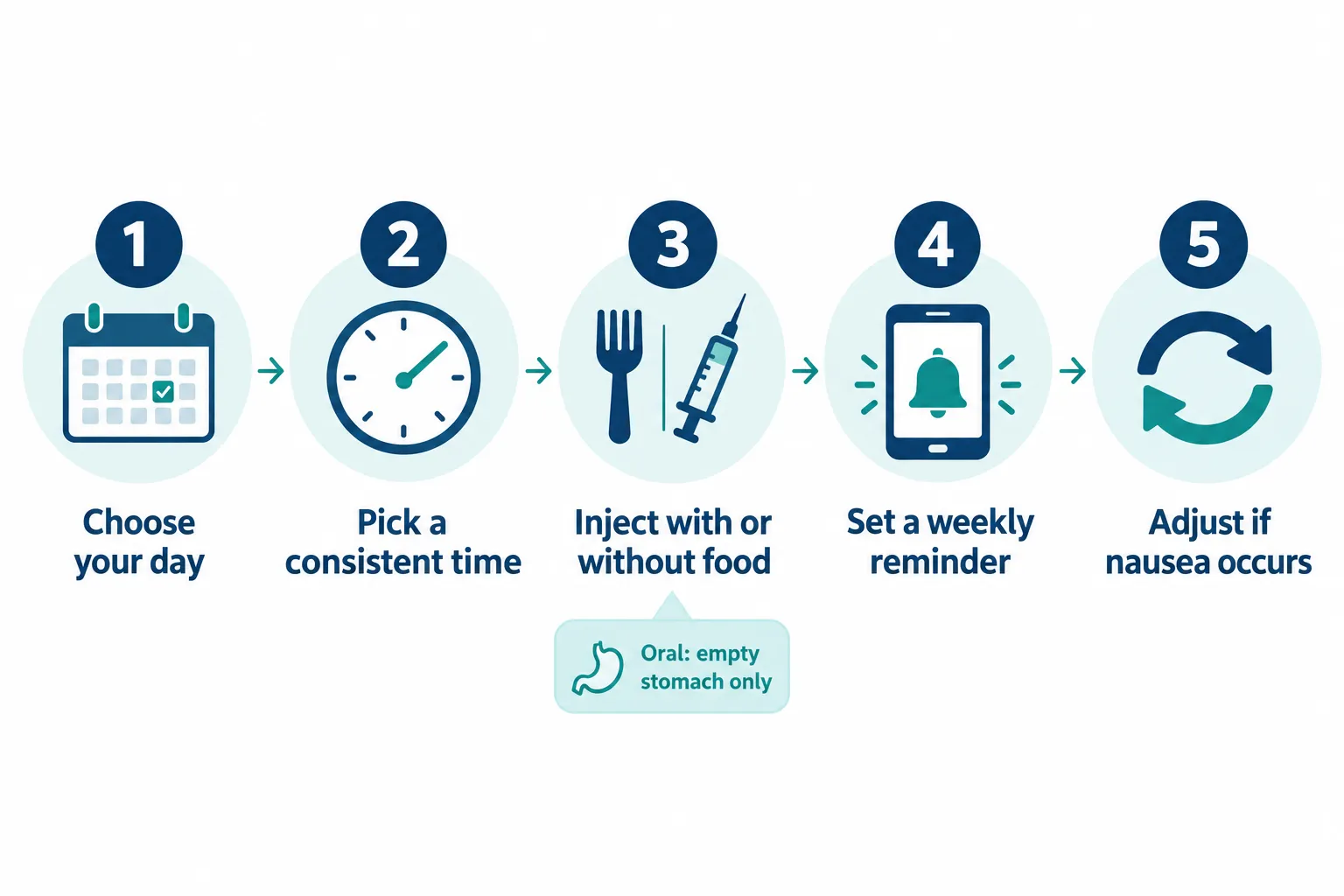
- Anchor it to something you already do weekly: Sunday meal prep, Monday morning coffee, Friday evening.
- Set a phone reminder or use a medication tracking app.
Can you switch your injection day? Yes, but with one rule: your doses must be at least 72 hours (3 days) apart. [8] For example, if you normally inject on Monday and want to switch to Friday, you can do so as long as your last Monday dose was at least 3 days ago.
What if you miss a dose? For semaglutide, if you miss a dose and your next scheduled dose is more than 2 days away, inject as soon as you remember. If your next dose is within 2 days, skip the missed dose and continue on your regular schedule. [8]
GLP-1 Timing and Side Effects: When to Take It to Reduce Nausea
Nausea is the most common side effect of GLP-1 medications, especially during the first few weeks of treatment or after a dose increase. Timing your injection strategically can reduce how much this affects your daily life. [5]
Practical timing adjustments for nausea:
- If morning injections cause nausea that interferes with work or exercise, shift to evening before a light dinner.
- If evening injections cause nausea that disrupts sleep, try morning with a small meal.
- Avoid injecting right before a large, high-fat meal. Large meals can amplify GI symptoms.
- Staying well-hydrated and eating smaller, more frequent meals in the first weeks of treatment helps regardless of timing. [5]
A 2026 clinician guide on GLP-1 dose timing notes that inappropriate timing mainly causes tolerability problems rather than loss of efficacy for injectables. Adjusting your injection time if side effects cluster at certain parts of the day is a legitimate and recommended strategy. [5] The overall drug exposure over the week remains unchanged whether you inject in the morning or evening.
If nausea is affecting your sleep, you might find it helpful to read about nighttime teas that help with sleep as a complementary comfort measure during the adjustment period.
GLP-1 Timing With Other Medications: What to Watch For
For injectable GLP-1s, timing relative to other medications is generally not a concern because the drug is injected subcutaneously and does not interact with oral absorption pathways. [2][3]
For oral semaglutide, timing matters significantly in relation to other oral medications:
- Do not take other oral medications within 30 minutes of your oral semaglutide dose.
- This includes thyroid medications, vitamins, and other supplements.
- The 30-minute fasting window applies to all oral substances except plain water. [4][6]
Insulin and other diabetes medications: If you take GLP-1 alongside insulin or sulfonylureas, discuss timing with your prescriber. GLP-1 medications slow gastric emptying, which can affect how quickly other glucose-lowering drugs act. This is a clinical conversation, not a self-adjustment.
For people managing blood sugar alongside GLP-1 therapy, this overview of best blood sugar supplements and best supplements for blood sugar control may be useful for complementary support.
Taking GLP-1 Consistently at the Same Time Every Day or Week
Consistency is the most important timing principle for all GLP-1 medications. For weekly injectables, the same day of the week is the target. For daily injectables, the same time of day each day. For oral semaglutide, the same morning routine every day. [7][9]
Why consistency matters:
- Weekly injectables maintain stable blood levels when dosed on schedule. Irregular dosing can cause fluctuations in appetite suppression and blood sugar control.
- Oral semaglutide requires the same fasting conditions each morning to maintain consistent absorption.
- Habit formation is a practical benefit: when your dose is tied to a daily or weekly routine, you are less likely to forget it.
Building a reliable routine:
- Choose your day and approximate time.
- Set a recurring phone alarm or calendar reminder.
- Keep your medication in a visible, consistent location (refrigerator door for injectables that require cold storage).
- Tell a household member or close friend your dosing schedule as an accountability measure.
If you are sourcing compounded semaglutide or tirzepatide, reliable supply and consistent access are also part of adherence. The guides on the best compounding pharmacy for semaglutide and best compounding pharmacy for tirzepatide can help you find a trustworthy source.
Special Cases: Night-Shift Workers and Atypical Schedules
Night-shift workers and people with non-standard sleep schedules often struggle with the “morning” requirement for oral semaglutide. The guidance here is practical: define “morning” by your longest fasting interval, not by the clock. [10]
An expert review on oral semaglutide recommends that night-shift workers take their dose after at least 6 hours without food, and at least 30 minutes before their main meal of the day, regardless of what time that falls on the clock. [10] The fasting requirement is the non-negotiable part. The clock time is flexible.
For injectable GLP-1s, shift workers have no special constraints. Pick a consistent day and approximate time that fits your schedule, whether that is 2 a.m. before a night shift or 3 p.m. after sleeping.
FAQ
Q: Can I take my weekly GLP-1 injection at different times each week?
A: For weekly injectables like semaglutide and tirzepatide, minor variations in the time of day are fine as long as you inject on the same day of the week. The drug’s long half-life means a few hours’ difference does not affect efficacy. [8]
Q: Does GLP-1 work better in the morning or evening?
A: No clinical evidence shows that morning versus evening injection of long-acting GLP-1s produces better weight loss or blood sugar outcomes. Long half-lives keep blood levels stable over 24 hours. Pick the time that fits your routine and minimizes side effects. [6][8]
Q: What happens if I take GLP-1 at the wrong time?
A: For injectables, taking your dose a few hours off your usual time has no meaningful clinical consequence. For oral semaglutide, taking it after eating or with too much liquid significantly reduces absorption and may reduce effectiveness. [4][6]
Q: Can I eat right after a GLP-1 injection?
A: Yes, for all injectable forms. You can eat immediately before or after injecting. Only oral semaglutide requires a 30-minute post-dose fast. [2][3][4]
Q: How do I switch my GLP-1 injection day?
A: You can switch your weekly injection day as long as your new dose falls at least 72 hours (3 days) after your previous dose. After the switch, continue on your new day going forward. [8]
Q: Should I take GLP-1 before or after exercise?
A: There is no specific guidance on exercise timing relative to GLP-1 injections. Exercise does not affect how the drug is absorbed or how it works. Time your injection based on your routine and side-effect profile, not your workout schedule.
Q: What if I feel nauseous after my GLP-1 injection?
A: Try shifting your injection to before a light evening meal so nausea occurs during sleep. Avoid large or fatty meals around your injection time. If nausea persists, contact your prescriber. [5]
Q: Can I take oral semaglutide at night instead of the morning?
A: Technically, the requirement is an empty stomach and a 30-minute pre-meal fast, not a specific clock time. For most people, first thing in the morning after an overnight fast is the easiest way to meet this requirement. Night-shift workers can dose after their longest fasting interval. [10]
Q: Is there a best day of the week for weekly GLP-1 injections?
A: No single day is clinically superior. Choose a day with a predictable routine and low scheduling conflicts. Many patients choose Sunday or Monday to start the week with their routine established. [9]
Q: Does it matter if I inject GLP-1 with food in my stomach?
A: For injectable GLP-1s, no. Food in your stomach does not affect subcutaneous absorption or drug efficacy. [2][3] For oral semaglutide, food in your stomach significantly reduces absorption and must be avoided. [4][6]
Q: Can I take GLP-1 if I am intermittent fasting?
A: Yes. For injectables, inject at any point in your fasting or eating window. For oral semaglutide, take it at the start of your fasting period (after your longest overnight fast) and eat your first meal 30 minutes later.
Q: What if I am always hungry and wondering if my GLP-1 is working?
A: Timing alone is unlikely to be the issue for injectables. Persistent hunger may relate to dose, formulation, diet, or other factors. This guide on why you might be hungry all the time covers the broader causes worth reviewing with your prescriber.
7 Best GLP-1 Providers Ranked: Accreditation, Flexibility & Support Compared (2026 Update)
32,000+ Patients Can't All Be Wrong: See the Top-Rated GLP-1 Providers: Compared on accreditation, plan flexibility, and patient support — updated for 2026.
BMI MD GLP-1 Microdosing Plan
- Specialized microdosing options (sublingual drops or low-dose injections)
- Ideal for maintaining weight or tapering off higher doses safely
- Fully bundled plan with no hidden monthly platform memberships
DirectMeds Weight Loss Solutions
- Sourced from accredited, state-licensed 503A compounding pharmacies
- No-frills high-volume savings passed directly to the patient
- Includes clinical consultation and cold-chain shipping updates
MEDVi Flat-Rate Telehealth
- Flat monthly rate holds steady even at maximum maintenance doses
- No dosage upcharges or graduation fee penalties
- Offers both injectable and advanced oral thin-film delivery options
Gala GLP-1 Care Program
- All-inclusive plan with no standalone membership costs
- Continuous text-based messaging access with state-licensed clinicians
- Temperature-controlled, cold-chain medication shipping included
Measured GLP-1 Metabolic Health
- Comprehensive metabolic health screening and expert intake analysis
- Predictable long-term budgeting with stable plan pricing
- High-end responsive dashboard with integrated diagnostic support
Refills GLP-1 (TryRefills Plan)
- Flat rate holds steady as titration scales up
- Includes clinical guides for active side-effect management
- Bundles in foundational nutritional strategies alongside medication
AltRx GLP-1 Transactional Reorders
- Zero recurring auto-billing — pay entirely on a transactional basis
- Rapid text-to-order format saves time for experienced patients
- Provides both injectable forms and fast-dissolving tablet variations
Conclusion
The best time of day to take GLP-1 medication is not a single universal answer. It depends on your formulation, your schedule, and your tolerance for side effects. For weekly injectables like semaglutide and tirzepatide, any time of day works as long as you are consistent with your chosen day each week. For oral semaglutide, morning on an empty stomach is non-negotiable. For short-acting exenatide, pre-meal timing is the rule.
Your actionable next steps:
- Identify your specific GLP-1 formulation and confirm its timing requirements with your prescriber or pharmacist.
- Choose a day and approximate time that fits your weekly routine and is easy to remember.
- Set a recurring reminder on your phone and anchor the injection to an existing habit.
- If nausea is a problem, experiment with shifting your injection time to before a light evening meal.
- If you use oral semaglutide, protect your 30-minute morning fasting window as a non-negotiable part of your routine.
- If you need to switch your injection day, confirm the 72-hour minimum gap before doing so.
Consistency is the mechanism. The exact hour matters far less than showing up on schedule, week after week.
References
[1] Tirzepatide – https://www.drugs.com/tirzepatide.html
[2] 217806s000lbl – https://www.accessdata.fda.gov/drugsatfda_docs/label/2023/217806s000lbl.pdf
[3] 217806s003lbl – https://www.accessdata.fda.gov/drugsatfda_docs/label/2024/217806s003lbl.pdf
[4] GLP-1 Weight Loss Pills: What You Need To Know – https://www.yalemedicine.org/news/glp-1-weight-loss-pills-what-you-need-to-know
[5] Optimal GLP-1s Dose Timing: Minimize Side Effects – https://ubiehealth.com/doctors-note/optimal-glp1s-dose-timing-minimize-side-effects-4771q1
[6] PMC10023024 – https://pmc.ncbi.nlm.nih.gov/articles/PMC10023024/
[7] How To Use Mounjaro – https://mounjaro.lilly.com/how-to-use-mounjaro
[8] When Is the Best Time of Day to Take Ozempic? – https://www.drugs.com/medical-answers/when-best-time-day-take-ozempic-3577204/
[9] Zepbound Injection Tips – https://www.goodrx.com/zepbound/zepbound-injection-tips
[10] PMC9174361 – https://pmc.ncbi.nlm.nih.gov/articles/PMC9174361/


