
best time of day to take glp 1

Last updated: October 4, 2026
Quick Answer
For injectable GLP-1 medications like semaglutide (Ozempic, Wegovy) and tirzepatide (Mounjaro, Zepbound), there is no single “best” time of day proven to improve efficacy. What matters most is consistency: pick a time you can stick to each week and keep it. Oral semaglutide (Rybelsus) is the exception and must be taken first thing in the morning on an empty stomach.
Key Takeaways
- Injectable GLP-1 medications can be taken at any time of day, on any day of the week, as long as doses are spaced at least 7 days apart
- Oral semaglutide (Rybelsus) requires strict morning dosing on an empty stomach, at least 30 minutes before food or drink
- No clinical evidence shows that morning injections outperform evening injections for weight loss or blood sugar control
- Consistency of timing matters more than the specific time chosen
- Many people choose morning to build a routine; others prefer evening to manage dinner-time appetite
- Nausea is the most common GLP-1 side effect and may influence when you choose to inject
- Do not take two doses within 48 hours, even if you miss a dose
- Switching your injection day is allowed with both semaglutide and tirzepatide, provided minimum spacing rules are followed
- Postpartum patients and those asking about GLP-1 medications while breastfeeding should consult a physician before starting any GLP-1 therapy
- If cost is a concern, compounded options may be available through licensed pharmacies
Does It Matter What Time You Take a GLP-1 Injection?
For injectable GLP-1 receptor agonists, the time of day does not appear to affect how well the medication works. Both the Ozempic and Wegovy prescribing information state that the injection can be given on any day of the week, at any time of day, with or without meals. [1][5][10]
7 Best GLP-1 Providers Ranked: Accreditation, Flexibility & Support Compared (2026 Update)
32,000+ Patients Can't All Be Wrong: See the Top-Rated GLP-1 Providers. We compared the leading online GLP-1 providers based on program features, clinical support, convenience, and overall value.
BMI MD GLP-1 Microdosing Plan
- Specialized microdosing options, including sublingual drops and low-dose injections
- Designed for people interested in maintaining weight or gradually adjusting treatment
- Bundled program structure without a separate monthly platform membership
- Online access makes the process convenient from home

DirectMeds Weight Loss Solutions
- Online weight-loss program with a straightforward patient experience
- Compounded medication options through state-licensed compounding pharmacies
- Includes clinical consultation as part of the process
- Provides shipping updates to help patients track their orders
MEDVi Flat-Rate Telehealth
- Flat-rate telehealth approach designed for easier budgeting
- No dosage-based pricing increases within the advertised program structure
- Offers injectable and oral thin-film delivery options
- Includes medical screening and asynchronous provider consultations
Gala GLP-1 Care Program
- Text-based access to state-licensed clinicians
- Cold-chain medication shipping included in the program
- Month-to-month program structure
- Designed for people who value convenient ongoing support
Measured GLP-1 Metabolic Health
- Comprehensive metabolic health screening and intake analysis
- Designed around longer-term metabolic health management
- Responsive dashboard with integrated health tracking tools
- Useful option for patients who value a more data-focused experience
Refills GLP-1 (TryRefills Plan)
- Clinical guidance designed to help patients manage common treatment concerns
- Includes foundational nutritional strategies alongside medication
- Designed around predictable ongoing treatment
- No hidden startup or processing fees according to the program information provided
AltRx GLP-1 Transactional Reorders
- Transactional reorder model without recurring auto-billing
- Designed for patients who already understand their treatment routine
- Fast text-to-order process for convenient reorders
- Offers injectable and fast-dissolving tablet variations
This flexibility exists because injectable semaglutide and tirzepatide have long half-lives. Semaglutide has a half-life of approximately one week, meaning the drug level in your bloodstream stays relatively stable regardless of whether you inject Monday morning or Friday night. Tirzepatide behaves similarly. [2][5]
The practical takeaway: choose a time that fits your schedule and stick with it. Consistency is the actual driver of results, not the clock.
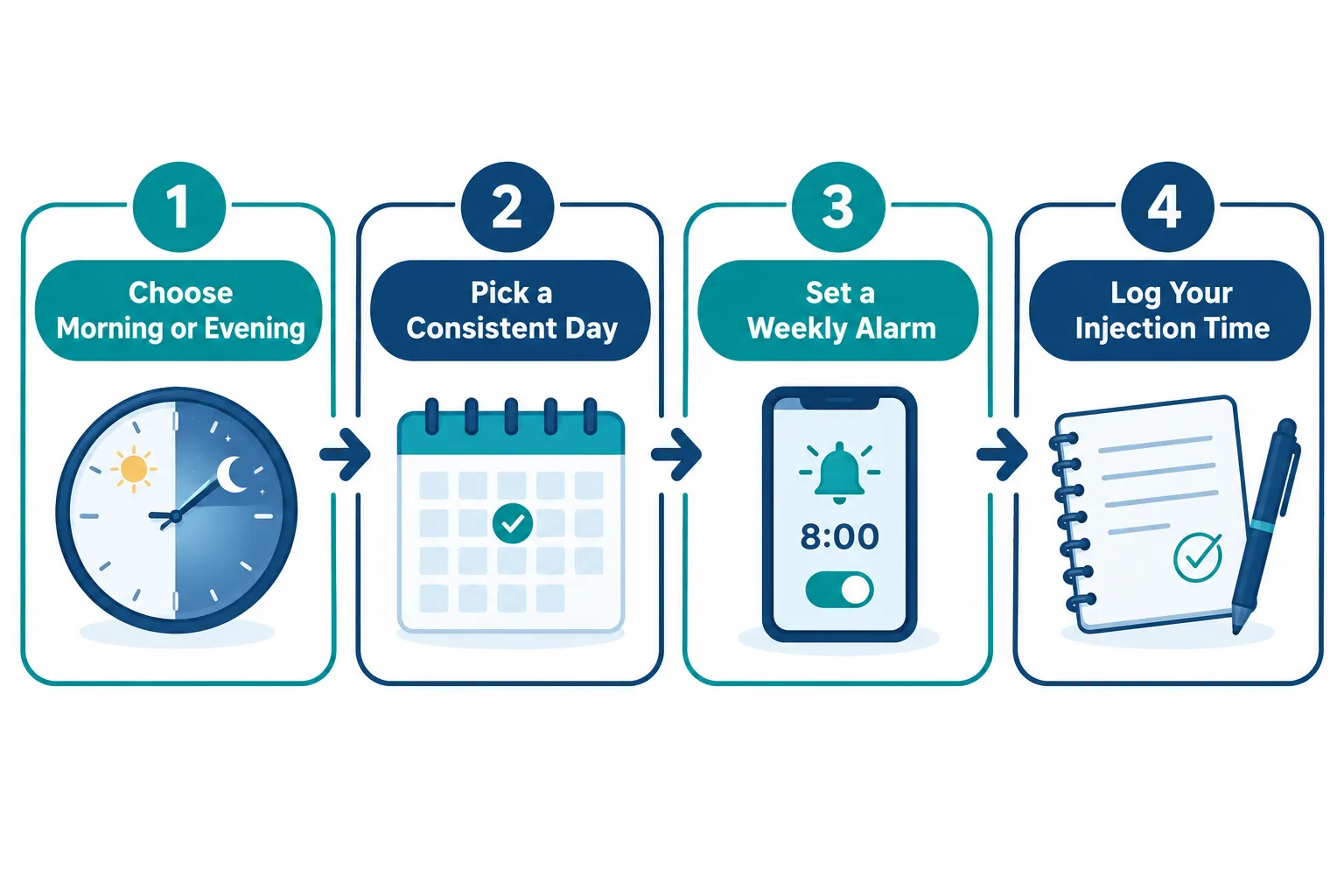
What Time of Day Should I Take My GLP-1 Injection?
You should take your GLP-1 injection at whatever time of day you are most likely to remember it and least likely to skip it. Both morning and evening are equally valid from a clinical standpoint.
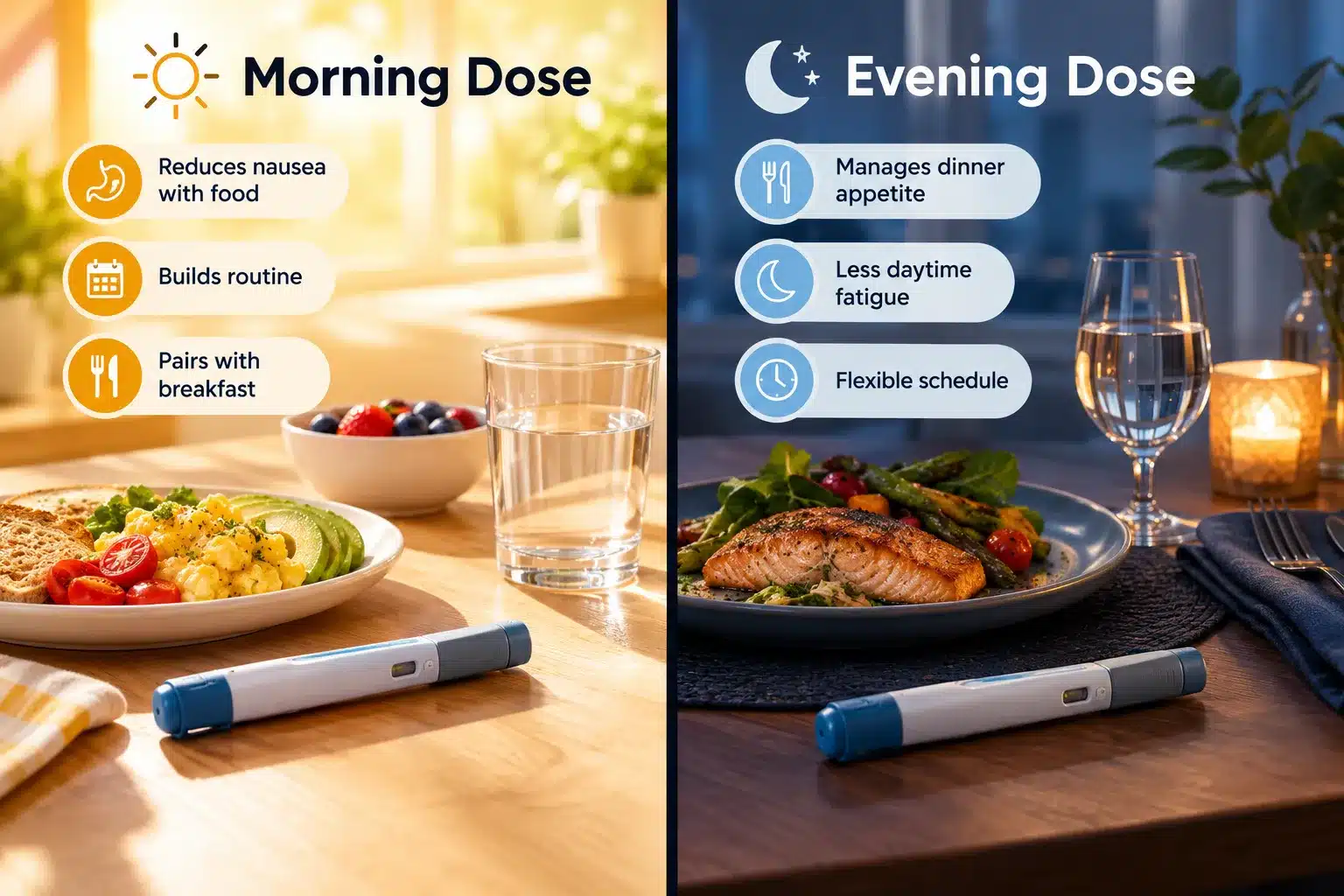
Here are common reasons people choose each window:
Morning dosing:
- Easy to pair with a morning routine (coffee, breakfast, vitamins)
- Any nausea tends to resolve before social or work obligations in the evening
- Aligns with how many clinical trials were conducted, which some patients find reassuring
Evening dosing:
- Can help blunt appetite at dinner, which is when many people overeat
- Nausea from the injection may occur while you sleep, reducing daytime discomfort
- Useful for people who travel frequently for work and find mornings unpredictable
Neither window is medically superior. Pick one, set a weekly reminder on your phone, and treat it like any other non-negotiable health habit.
GLP-1 Morning vs. Evening: Which Is Better?
Neither morning nor evening is definitively better for injectable GLP-1 medications. Clinical trial data for both semaglutide and tirzepatide did not mandate a specific time of day, and no published head-to-head study has shown a measurable efficacy difference based on injection timing alone. [9]
That said, individual experience varies. A patient I spoke with recently switched from morning to evening injections after noticing that nausea was interfering with her work meetings. Within two weeks of switching, she reported the same appetite suppression with far less disruption to her day. Her weight loss trajectory did not change.
Choose morning if: you have a predictable morning routine, tend to forget things in the evening, or find nausea easier to manage during the day.
Choose evening if: dinner-time hunger is your biggest challenge, you prefer to sleep through early-dose nausea, or your mornings are too rushed to be reliable.
Can I Take GLP-1 in the Morning or Should It Be at Night?
Yes, you can take injectable GLP-1 medications in the morning. You can also take them at night. The prescribing labels for both Ozempic and Wegovy explicitly confirm that the injection can be administered at any time of day. [1][10]
Oral semaglutide (Rybelsus) is the one exception. It must be taken in the morning, on an empty stomach, with no more than 4 ounces (120 mL) of plain water. You must then wait at least 30 minutes before eating, drinking anything other than water, or taking other oral medications. This strict protocol exists because food and other beverages significantly reduce the absorption of oral semaglutide. Skipping this rule can cut the drug’s effectiveness substantially.
Summary by formulation:
| Medication | Time of Day | With Food? |
|---|---|---|
| Ozempic (semaglutide injection) | Any time | Yes or no |
| Wegovy (semaglutide injection) | Any time | Yes or no |
| Rybelsus (oral semaglutide) | Morning only | No, empty stomach required |
| Mounjaro (tirzepatide injection) | Any time | Yes or no |
| Zepbound (tirzepatide injection) | Any time | Yes or no |
Should I Take GLP-1 Before or After Meals?
Injectable GLP-1 medications do not need to be timed around meals. You can inject before a meal, after a meal, or at a time when you are not eating at all. The prescribing information for both semaglutide and tirzepatide confirms this. [2][5]
Oral semaglutide is the exception: it must be taken before any food or drink (other than plain water).
Some people prefer to inject just before a meal because it serves as a behavioral cue that reinforces mindful eating. Others inject after dinner so the act of eating does not feel rushed. Both approaches are fine for injectables.
One practical note: if you are experiencing nausea, injecting after a small meal (rather than on a completely empty stomach) may reduce discomfort for some users, though this is anecdotal and not a formal clinical recommendation.
Is It Okay to Take GLP-1 on an Empty Stomach?
For injectable GLP-1 medications, yes, it is perfectly fine to inject on an empty stomach. The drug is delivered subcutaneously (under the skin) and absorbed directly into the bloodstream, so food in your stomach has no meaningful effect on how the medication works. [5]
For oral semaglutide (Rybelsus), an empty stomach is not just okay, it is required. Taking it with food or a full glass of liquid dramatically reduces absorption and can make the medication far less effective.
If you are prone to nausea on injectable GLP-1s and notice it is worse when your stomach is empty, try timing your injection around a light meal. This is a lifestyle adjustment, not a medical requirement.
How Long After Taking GLP-1 Does It Start Working?
Injectable semaglutide and tirzepatide do not produce an immediate effect after a single dose. The medication begins circulating within hours of injection, but meaningful appetite suppression and blood sugar effects typically build over several weeks as the dose is gradually increased. [3][9]
Here is a general timeline:
- Within 24-48 hours: The drug is absorbed and begins circulating, but most people notice little change at the starting dose
- Weeks 1-4: Some appetite reduction may begin at the starting dose; nausea is most common during this period
- Weeks 4-12: As the dose escalates, appetite suppression becomes more noticeable and consistent
- Months 3-6: Most patients reach a maintenance dose and see the most significant weight loss results
This gradual onset is by design. Dose escalation protocols exist specifically to reduce side effects while allowing the body to adjust. [3][6]
If you are curious about which GLP-1 medication may work best for your weight loss goals, see our guide on which GLP-1 medication works best for weight loss.
GLP-1 Timing with Food Interactions and Side Effects
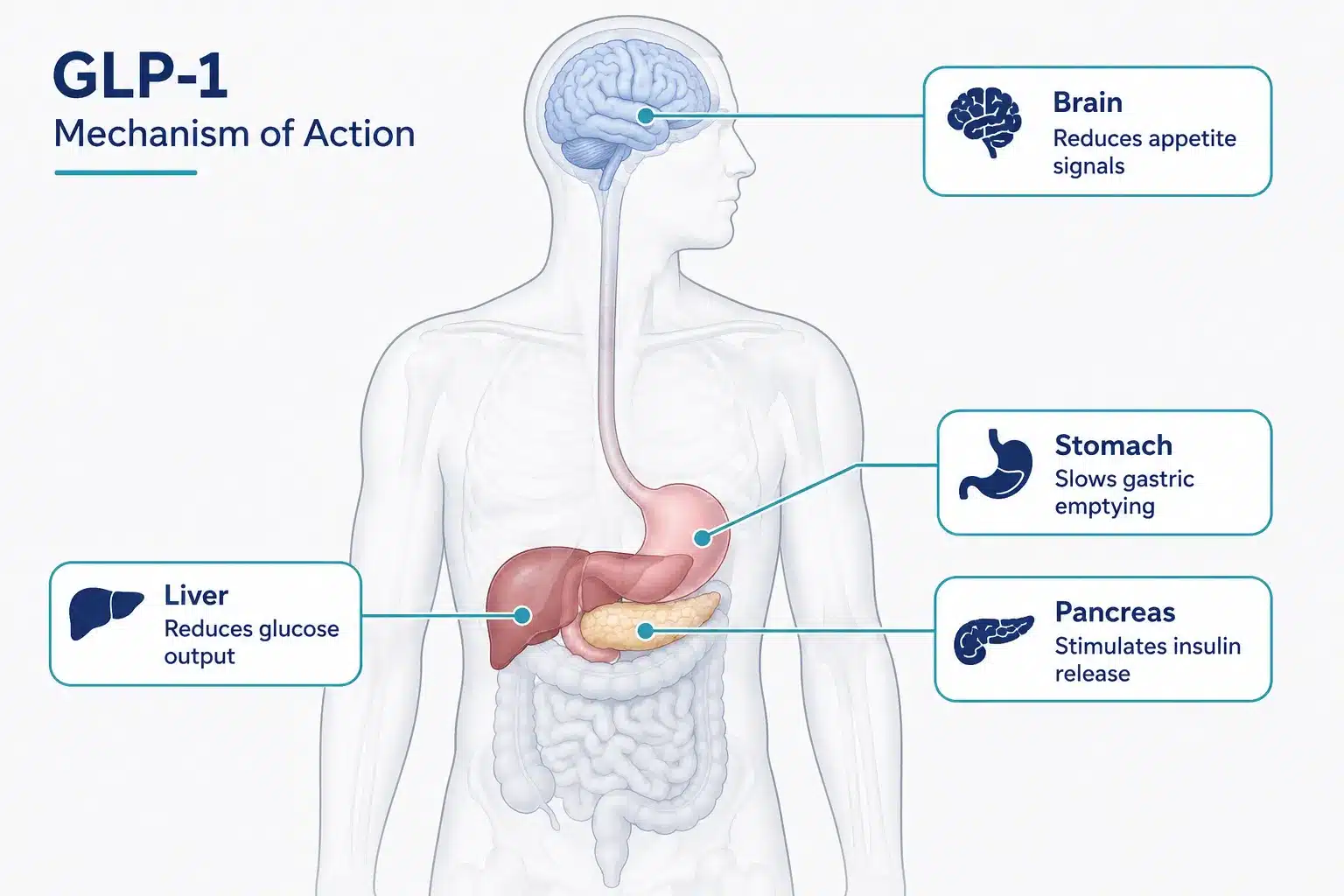
The timing of your GLP-1 injection relative to meals can influence how you experience side effects, even if it does not change how well the drug works. GLP-1 receptor agonists slow gastric emptying, which is part of how they reduce appetite but also why nausea is the most reported side effect.
Practical strategies for managing side effects through timing:
- Inject after a light meal rather than after a heavy one to reduce nausea risk
- Avoid injecting right before a large, high-fat meal, as slowed digestion plus a heavy meal can worsen nausea and bloating
- If evening injections cause disrupted sleep due to nausea or reflux, switch to morning
- If morning injections cause nausea that affects your workday, try evening
Side effects that may be worse at certain times of day:
- Nausea: Most common in the first 1-2 hours after injection; timing it before sleep can help
- Fatigue: Some patients report low energy after injecting; evening dosing may reduce its impact on daily function
- Reflux or bloating: More likely if you inject shortly before lying down; allow 2-3 hours after injection before bed if this is an issue
If persistent hunger is a separate concern for you, our article on why you might feel hungry all the time covers related causes and solutions.
What Happens If I Take GLP-1 at Different Times Each Day?
Taking your injectable GLP-1 at different times each week will not ruin your results, but it can make it harder to build a routine and easier to accidentally take doses too close together. The key rule is that doses must be separated by at least 7 days (for weekly injectables). [1][2]
For example, if you normally inject on Monday morning but take it Tuesday evening one week, your next dose should be no earlier than the following Tuesday evening. The drug’s long half-life provides a buffer, but irregular timing increases the risk of either missing a dose or doubling up too soon.
What does not happen: your medication does not “stop working” because you shifted the time by a few hours. The pharmacokinetics of weekly GLP-1 injectables are stable enough to tolerate modest variation.
What can happen with irregular timing:
- Increased difficulty tracking your schedule
- Risk of taking doses less than 7 days apart, which raises side effect risk without improving results
- Weakened behavioral habit formation, which matters for long-term adherence
Does GLP-1 Work Better If Taken at the Same Time Daily?
Yes, consistency in timing supports better outcomes, though not primarily for pharmacological reasons. Injectable GLP-1 medications work best when taken consistently at the same time each week because consistency reduces missed doses, prevents accidental double-dosing, and strengthens the behavioral routine that supports the lifestyle changes GLP-1 therapy is meant to complement. [1][10]
From a purely biological standpoint, the drug’s long half-life means a few hours of variation will not alter blood levels meaningfully. But from a behavioral and adherence standpoint, a fixed weekly schedule is clearly superior to an ad hoc approach.
“The best time to take your GLP-1 is the time you will actually remember to take it every single week.”
Set a recurring weekly alarm. Pair the injection with a specific anchor habit, such as after Sunday dinner or before your Saturday morning walk. Habit stacking is one of the most reliable tools for long-term medication adherence.
Can I Switch the Time I Take My GLP-1 Injection?
Yes, you can switch the time or day of your GLP-1 injection, provided you follow the minimum spacing rules. [1][2]
For semaglutide (Ozempic, Wegovy): You may change your injection day as long as the new dose is at least 2 days (48 hours) away from the previous dose. After that one-time adjustment, resume your new weekly schedule. [5]
For tirzepatide (Mounjaro, Zepbound): You may also change your injection day, as long as the new dose is at least 3 days (72 hours) away from the last dose. [2][7]
Steps to switch your injection day safely:
- Identify the date and time of your last injection
- Count forward the required minimum gap (48 hours for semaglutide, 72 hours for tirzepatide)
- Take your next dose on the new preferred day, as long as it falls after that gap
- Continue on the new day each week going forward
- Update your phone reminder to reflect the new schedule
If you are sourcing your medication through a compounding pharmacy, see our resource on the best compounding pharmacy for semaglutide in 2026 or the best compounding pharmacy for tirzepatide for guidance on access and cost.
Best Practices for GLP-1 Injection Timing and Consistency
The best practices for GLP-1 injection timing center on three principles: pick a time, protect the spacing, and pair the injection with a habit that makes it automatic.
Checklist for optimal GLP-1 timing:
- Choose a specific day and time of week and write it down
- Set a recurring weekly alarm on your phone labeled with the medication name
- Keep your injection supplies in a visible, consistent location (not buried in a drawer)
- Log each injection date and time in a notes app or medication tracker
- If you travel across time zones, inject based on elapsed time (7 days), not local clock time
- Review your injection log with your prescriber at each follow-up visit
- If nausea is a problem, experiment with morning versus evening timing before assuming the medication is not right for you
For those watching their budget, our guide to the best GLP-1 program under $300 and best cheap GLP-1 program can help you find affordable access without sacrificing quality.
A Note on GLP-1 Medications While Breastfeeding
This is an important safety topic that comes up frequently for postpartum patients seeking GLP-1 weight loss options. Current guidance advises against using GLP-1 medications while breastfeeding. Neither semaglutide while breastfeeding nor tirzepatide while breastfeeding has been established as safe, because there is insufficient data on whether these drugs pass into breast milk and what effect they might have on a nursing infant.
GLP-1 breastfeeding safety is an area where caution is the standard recommendation. If you are considering GLP-1 postpartum weight loss and are currently nursing, speak with your OB-GYN or a maternal-fetal medicine specialist before starting any GLP-1 therapy. The timing question becomes secondary when the fundamental safety question has not yet been answered for your situation.
For patients managing blood sugar alongside weight concerns, our article on best supplements for blood sugar control covers complementary non-prescription options. Similarly, if diet is part of your metabolic management plan, our guide on the best things for diabetics to eat offers practical nutritional guidance.
Frequently Asked Questions
Q: Can I take my GLP-1 shot in the morning?
Yes. Injectable GLP-1 medications like Ozempic, Wegovy, Mounjaro, and Zepbound can all be taken in the morning. There is no clinical evidence that morning dosing is more or less effective than evening dosing.
Q: Is it better to take semaglutide at night?
Not necessarily. Evening dosing is a valid choice, particularly if it helps you manage dinner-time appetite or sleep through early nausea. It is not superior to morning dosing in terms of weight loss or blood sugar outcomes.
Q: What if I forget to take my GLP-1 on my scheduled day?
For semaglutide, if you miss a dose and your next scheduled dose is more than 2 days away, take it as soon as you remember. If the next scheduled dose is within 2 days, skip the missed dose and resume your regular schedule. Do not take two doses to make up for a missed one. [5]
Q: Can I take GLP-1 with food?
Injectable GLP-1 medications can be taken with or without food. Oral semaglutide (Rybelsus) must be taken on an empty stomach, at least 30 minutes before eating or drinking anything other than plain water.
Q: Does the injection site affect timing or effectiveness?
No. The recommended injection sites (abdomen, thigh, upper arm) do not change the timing recommendations. Rotate sites to avoid skin irritation, but the timing rules remain the same regardless of where you inject.
Q: Can I take GLP-1 and GLP-1 medications while breastfeeding?
Current medical guidance does not support using GLP-1 medications while breastfeeding due to insufficient safety data. Consult your physician before starting semaglutide or tirzepatide if you are nursing.
Q: Does taking GLP-1 at the same time each week really matter?
Pharmacologically, a few hours of variation will not change how the drug works. Practically, a consistent schedule significantly reduces the risk of missed doses and accidental double-dosing, both of which affect your results.
Q: How long until I feel the effects of my GLP-1 injection?
Most people begin noticing appetite suppression within the first few weeks, though significant effects typically build over 4 to 12 weeks as the dose escalates. Full results at a maintenance dose are generally seen between months 3 and 6.
Q: Can I change my GLP-1 injection day?
Yes. For semaglutide, ensure at least 48 hours between doses when switching. For tirzepatide, ensure at least 72 hours. After the one-time switch, resume your new weekly schedule.
Q: Is evening dosing better for nausea?
For some people, yes. Injecting in the evening means nausea peaks during sleep, when it is less disruptive. This is a personal preference strategy, not a clinical protocol.
Q: Should I take GLP-1 before or after exercise?
There is no evidence that timing your GLP-1 injection relative to exercise changes its effectiveness. Inject at your chosen consistent time, regardless of your workout schedule.
Q: What is the strict timing rule for oral semaglutide?
Oral semaglutide (Rybelsus) must be taken first thing in the morning, with no more than 4 ounces of plain water, at least 30 minutes before any food, other beverages, or other oral medications. This rule is non-negotiable for the drug to absorb properly.
7 Best GLP-1 Providers Ranked: Accreditation, Flexibility & Support Compared (2026 Update)
32,000+ Patients Can't All Be Wrong: See the Top-Rated GLP-1 Providers: Compared on accreditation, plan flexibility, and patient support — updated for 2026.
BMI MD GLP-1 Microdosing Plan
- Specialized microdosing options (sublingual drops or low-dose injections)
- Ideal for maintaining weight or tapering off higher doses safely
- Fully bundled plan with no hidden monthly platform memberships
DirectMeds Weight Loss Solutions
- Sourced from accredited, state-licensed 503A compounding pharmacies
- No-frills high-volume savings passed directly to the patient
- Includes clinical consultation and cold-chain shipping updates
MEDVi Flat-Rate Telehealth
- Flat monthly rate holds steady even at maximum maintenance doses
- No dosage upcharges or graduation fee penalties
- Offers both injectable and advanced oral thin-film delivery options
Gala GLP-1 Care Program
- All-inclusive plan with no standalone membership costs
- Continuous text-based messaging access with state-licensed clinicians
- Temperature-controlled, cold-chain medication shipping included
Measured GLP-1 Metabolic Health
- Comprehensive metabolic health screening and expert intake analysis
- Predictable long-term budgeting with stable plan pricing
- High-end responsive dashboard with integrated diagnostic support
Refills GLP-1 (TryRefills Plan)
- Flat rate holds steady as titration scales up
- Includes clinical guides for active side-effect management
- Bundles in foundational nutritional strategies alongside medication
AltRx GLP-1 Transactional Reorders
- Zero recurring auto-billing — pay entirely on a transactional basis
- Rapid text-to-order format saves time for experienced patients
- Provides both injectable forms and fast-dissolving tablet variations
Conclusion
The best time of day to take GLP-1 injectable medications is, simply, the time you will reliably take them every week. Clinical evidence does not favor morning over evening or vice versa for semaglutide or tirzepatide injections. What does matter is consistency, proper weekly spacing, and choosing a time that minimizes side effects for your individual lifestyle.
Actionable next steps:
- Decide today whether morning or evening fits your schedule better, and commit to it
- Set a recurring weekly alarm on your phone right now, before you close this page
- If you use oral semaglutide, make morning-before-breakfast dosing a non-negotiable habit
- If you are switching injection days, count the required minimum gap before your next dose
- If you are postpartum and considering GLP-1 weight loss while breastfeeding, speak with your physician first
- If cost is a barrier, explore compounded GLP-1 options through licensed pharmacies
The medication works best when you do not have to think about it because the habit is already built. Start with timing, and everything else follows.
References
[1] When Best Time Day Take Ozempic 3577204 – https://www.drugs.com/medical-answers/when-best-time-day-take-ozempic-3577204/
[2] Tirzepatide – https://www.drugs.com/tirzepatide.html
[3] How Should Mounjaro Tirzepatide Doses Be Increased 110552 – https://medical.lilly.com/us/products/answers/how-should-mounjaro-tirzepatide-doses-be-increased-110552
[4] 217806s000lbl – https://www.accessdata.fda.gov/drugsatfda_docs/label/2023/217806s000lbl.pdf
[5] Drg 20406730 – https://www.mayoclinic.org/drugs-supplements/semaglutide-subcutaneous-route/description/drg-20406730
[6] 217806s003lbl – https://www.accessdata.fda.gov/drugsatfda_docs/label/2024/217806s003lbl.pdf
[7] Auspar Mounjaro 231113 Pi – https://www.tga.gov.au/sites/default/files/2023-11/auspar-mounjaro-231113-pi.pdf
[8] 217806s002lbl – https://www.accessdata.fda.gov/drugsatfda_docs/label/2026/217806s002lbl.pdf
[9] Pmc10192986 – https://pmc.ncbi.nlm.nih.gov/articles/PMC10192986/
[10] When Best Time Day Take Wegovy 3578870 – https://www.drugs.com/medical-answers/when-best-time-day-take-wegovy-3578870/