
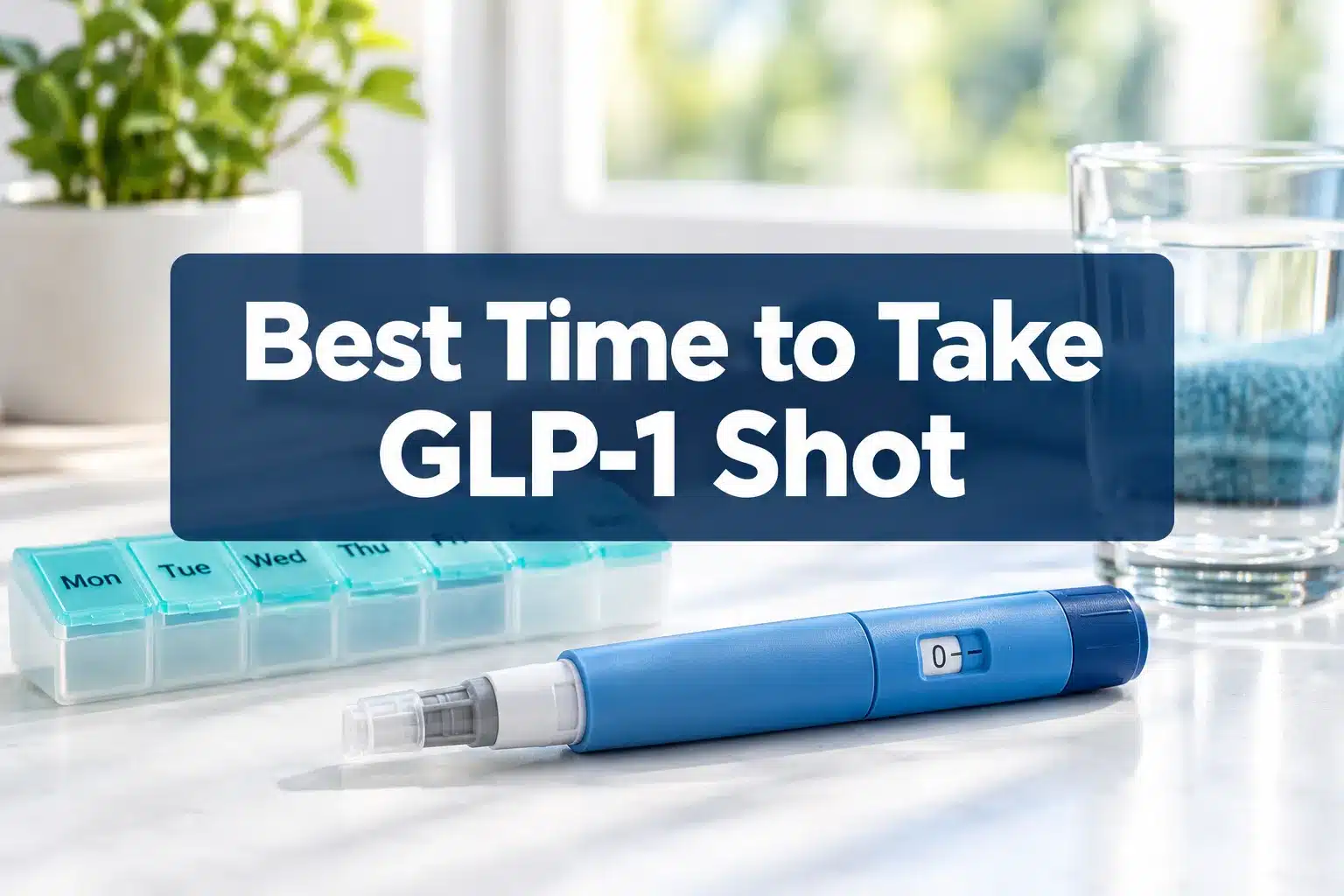
best time to take glp 1 shot

Last updated: October 4, 2026
Quick Answer
For weekly GLP-1 medications like semaglutide (Ozempic, Wegovy), there is no single best time of day, the FDA-approved prescribing information confirms you can inject on any day of the week, at any time of day, with or without food [1][2]. What matters most is picking a consistent day and time you can stick to every week. Consistency drives adherence, and adherence drives results.
Key Takeaways
- Weekly GLP-1 injections (semaglutide, tirzepatide) can be taken at any time of day, morning, afternoon, or evening
- The most important factor is choosing the same day each week, not a specific clock hour
- Short-acting GLP-1s like exenatide (Byetta) must be taken within 60 minutes before a meal, timing is critical for those
- Taking your shot in the evening may help some people manage nausea by sleeping through early side effects
- If you miss your weekly dose, inject as soon as you remember, as long as your next scheduled dose is at least 2 days away
- Never take two doses to make up for a missed one
- You can change your injection day if needed, as long as doses are at least 2 days apart
- GLP-1 medications are not recommended during pregnancy or breastfeeding, always consult your doctor
- Picking a memorable anchor (like Sunday morning with coffee) dramatically improves weekly adherence
- Nausea management, not efficacy, is the main reason some people prefer a specific time of day
What Time of Day Should I Take My GLP-1 Injection?
For once-weekly GLP-1 medications, any time of day works equally well. The FDA prescribing label for semaglutide states it can be administered on any day of the week, at any time of day, with or without meals [2][9]. There is no clinical evidence that morning injections outperform evening ones, or vice versa.
7 Best GLP-1 Providers Ranked: Accreditation, Flexibility & Support Compared (2026 Update)
32,000+ Patients Can't All Be Wrong: See the Top-Rated GLP-1 Providers. We compared the leading online GLP-1 providers based on program features, clinical support, convenience, and overall value.
BMI MD GLP-1 Microdosing Plan
- Specialized microdosing options, including sublingual drops and low-dose injections
- Designed for people interested in maintaining weight or gradually adjusting treatment
- Bundled program structure without a separate monthly platform membership
- Online access makes the process convenient from home

DirectMeds Weight Loss Solutions
- Online weight-loss program with a straightforward patient experience
- Compounded medication options through state-licensed compounding pharmacies
- Includes clinical consultation as part of the process
- Provides shipping updates to help patients track their orders
MEDVi Flat-Rate Telehealth
- Flat-rate telehealth approach designed for easier budgeting
- No dosage-based pricing increases within the advertised program structure
- Offers injectable and oral thin-film delivery options
- Includes medical screening and asynchronous provider consultations
Gala GLP-1 Care Program
- Text-based access to state-licensed clinicians
- Cold-chain medication shipping included in the program
- Month-to-month program structure
- Designed for people who value convenient ongoing support
Measured GLP-1 Metabolic Health
- Comprehensive metabolic health screening and intake analysis
- Designed around longer-term metabolic health management
- Responsive dashboard with integrated health tracking tools
- Useful option for patients who value a more data-focused experience
Refills GLP-1 (TryRefills Plan)
- Clinical guidance designed to help patients manage common treatment concerns
- Includes foundational nutritional strategies alongside medication
- Designed around predictable ongoing treatment
- No hidden startup or processing fees according to the program information provided
AltRx GLP-1 Transactional Reorders
- Transactional reorder model without recurring auto-billing
- Designed for patients who already understand their treatment routine
- Fast text-to-order process for convenient reorders
- Offers injectable and fast-dissolving tablet variations
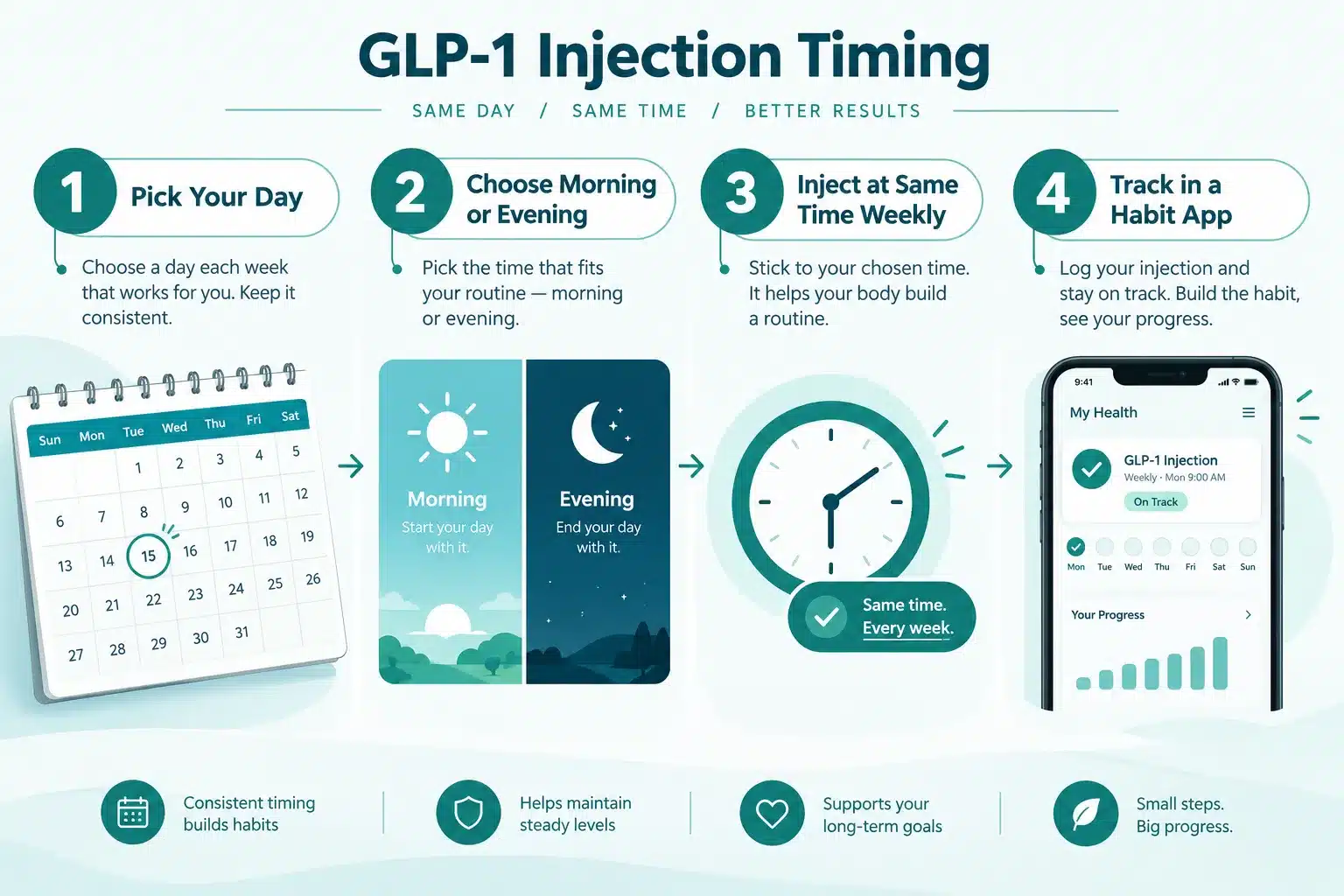
The practical guidance from major health authorities, including the Mayo Clinic and MedlinePlus, echoes this: choose a time that fits your routine and stick with it [2][4]. Think of it less like a medication schedule and more like setting a weekly alarm. The best time is simply the time you will actually remember.
Practical anchor points people use:
- Sunday morning before breakfast
- Monday evening after dinner
- Friday night before bed
- A specific day tied to a recurring weekly event (gym day, grocery day)
For once-daily GLP-1 medications like liraglutide (Victoza, Saxenda), the same flexibility applies, any time of day, consistent daily timing preferred [4].
Does It Matter If I Take GLP-1 in the Morning or Evening?
No, for long-acting weekly or daily GLP-1 medications, morning versus evening makes no difference to how well the drug works. The pharmacology of semaglutide and tirzepatide involves a half-life measured in days, so a few hours’ variation in timing has no meaningful effect on blood levels or appetite suppression [3][9].
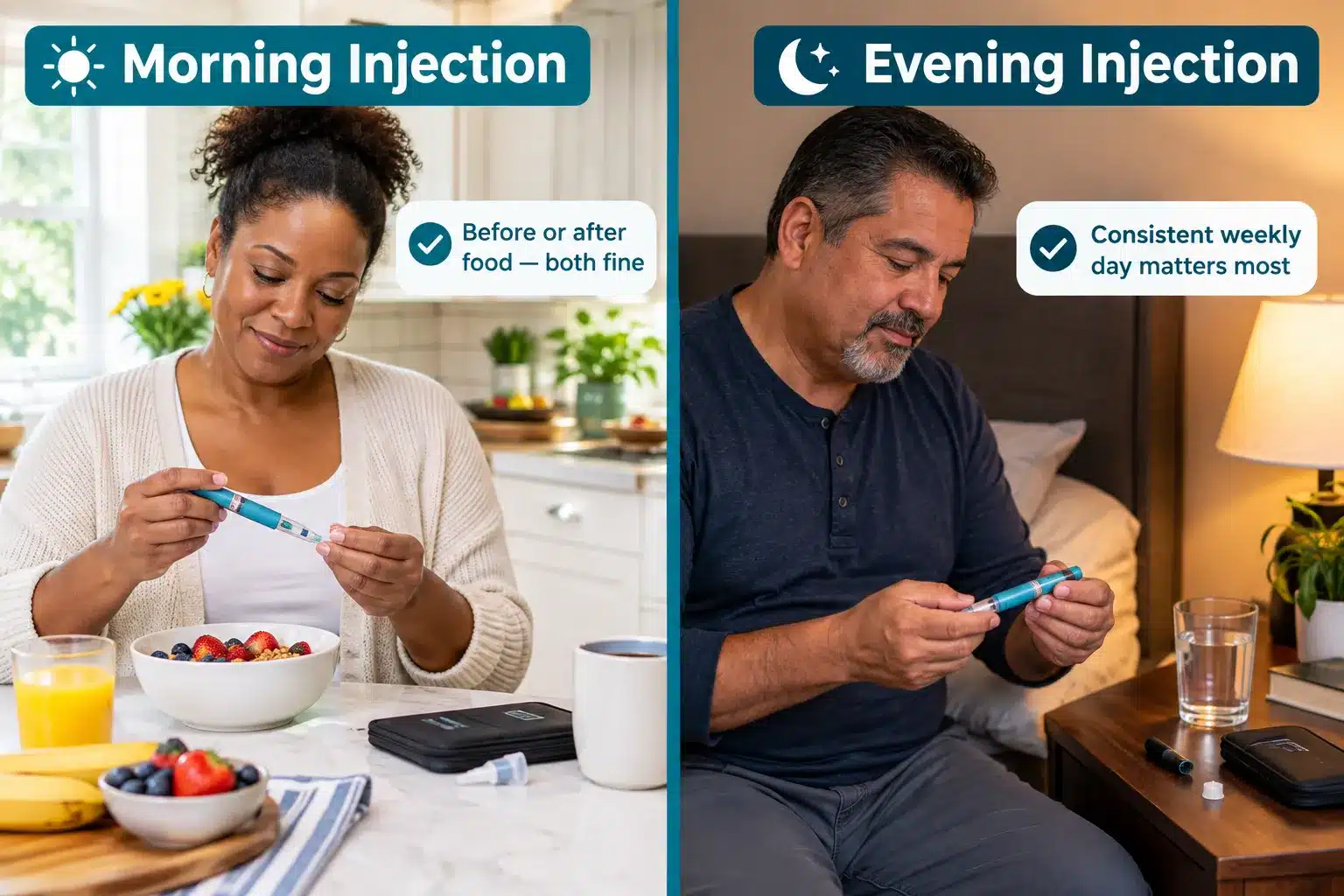
The one area where time of day can matter is nausea management. Some people find that injecting in the evening means they sleep through the first few hours of potential nausea, which tends to be most noticeable when starting or increasing the dose. This is a comfort strategy, not a clinical requirement.
Choose morning if:
- You want to pair the injection with an established morning routine
- You prefer to be awake and alert if any injection-site reaction occurs
- You find it easier to remember tasks in the morning
Choose evening if:
- You experience nausea after injecting and want to sleep through it
- Your evenings are more predictable and routine than your mornings
- You already take other medications at night and want to consolidate
Should I Take GLP-1 Before or After Eating?
Weekly semaglutide and tirzepatide can be taken before or after eating, food timing does not affect their absorption or effectiveness [1][2]. This is one of the more convenient aspects of these medications compared to older diabetes drugs.
The exception is short-acting GLP-1 agonists. Exenatide (Byetta), taken twice daily, must be injected within 60 minutes before a meal. Lixisenatide (Adlyxin) is also meal-timed. If you are on one of these shorter-acting agents, always follow your prescriber’s specific instructions.
For weekly agents like Ozempic or Wegovy, the FDA label is clear: administer with or without meals [9]. So if you forget before breakfast and remember after lunch, that is fine, take it then.
Is It Better to Take GLP-1 on an Empty Stomach?
No. For once-weekly semaglutide and tirzepatide, an empty stomach is not required and does not improve how the medication works [3][4]. Unlike some oral medications, subcutaneous GLP-1 injections bypass the digestive tract entirely, so food in your stomach has no effect on absorption.
Some people do report that injecting when they have eaten a light meal reduces nausea, but this is anecdotal and not supported by prescribing guidelines as a formal recommendation. If you find that a small snack before your injection makes you feel better, that is a reasonable personal strategy, just not a clinical necessity.
If you are curious about managing hunger between doses, our article on why you feel hungry all the time and what causes it covers the underlying biology in detail.
Does GLP-1 Work Better If Taken at the Same Time Every Week?
Yes, not because the pharmacology demands it, but because consistency dramatically improves adherence, and adherence is what drives weight loss outcomes [6][7]. Missing doses or injecting erratically is one of the most common reasons people do not see the results they expect.
A 2022 review published in the Journal of Clinical Pharmacy and Therapeutics noted that adherence to weekly injectable regimens is strongly associated with sustained glycemic and weight outcomes [7]. Picking a fixed anchor day and time removes the decision-making burden and makes the habit automatic.
To build a consistent injection routine:
- Choose a specific day (e.g., every Sunday)
- Pair it with an existing habit (morning coffee, evening shower)
- Set a recurring phone alarm or calendar reminder
- Keep your pen in a visible, easy-to-access location (refrigerator door, medicine cabinet)
- Log each injection in a simple notes app or habit tracker
For people exploring affordable access to GLP-1 medications, our guide to the best GLP-1 programs under $300 is worth reading alongside this one.
What Happens If I Take My GLP-1 Shot Late?
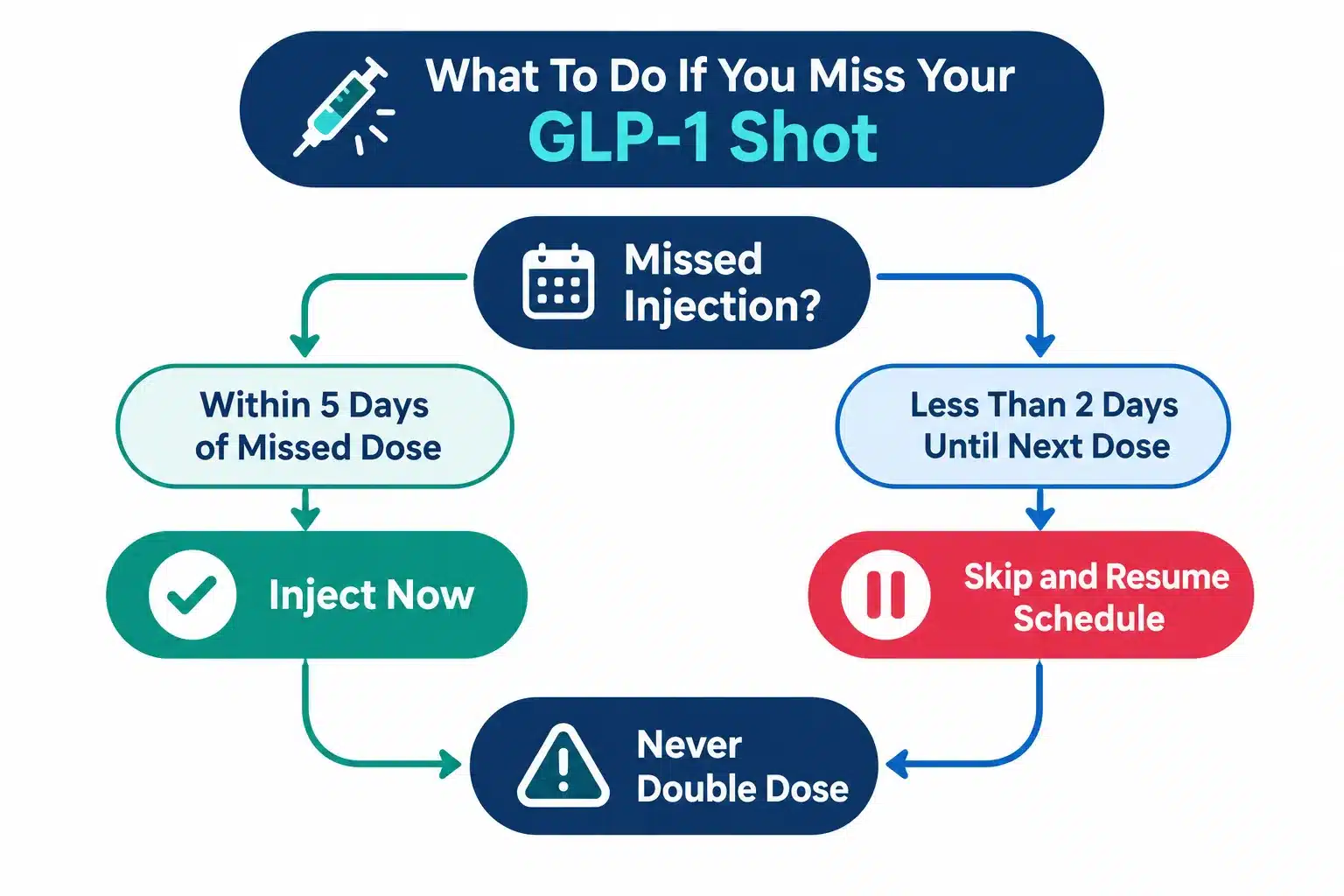
If you take your weekly GLP-1 shot late, meaning you missed your usual day, inject it as soon as you remember, provided your next scheduled dose is at least 2 days (48 hours) away [1][2]. After that, resume your normal weekly schedule from the new injection day.
Never take two doses within 2 days of each other to compensate for a missed one. Doubling up increases the risk of nausea, vomiting, and other side effects without improving outcomes.
Quick decision guide for a missed weekly dose:
| Situation | What to Do |
|---|---|
| Remembered within 5 days of missed dose | Inject now, then resume normal weekly schedule |
| Less than 2 days until next scheduled dose | Skip the missed dose, take next dose as planned |
| Unsure of timing | Contact your prescriber or pharmacist |
What If I Miss My GLP-1 Injection Day Entirely?
Missing one weekly injection is not a crisis. The long half-life of semaglutide (approximately one week) means that drug levels decline gradually, and a single missed dose does not erase your progress [2][9]. However, some people notice a return of appetite or a slight increase in blood sugar readings in the days following a missed dose.
The key steps are:
- Do not panic or try to compensate with a double dose
- Follow the 5-day / 2-day rule described above
- Note the missed dose in your log so you can discuss patterns with your prescriber
- If you are missing doses frequently, talk to your doctor about whether your injection day needs to change
For people managing blood sugar alongside weight, our resource on the best supplements for blood sugar control covers complementary strategies.
Can I Change My GLP-1 Injection Day?
Yes. You can change your weekly injection day as long as the new dose is administered at least 2 days after your last injection [1][2]. After that single adjustment, you simply continue on the new day each week going forward.
Example: You normally inject on Mondays but want to switch to Thursdays. If your last Monday injection was recent, wait until Thursday of the following week (ensuring at least 2 days have passed) and then continue every Thursday from that point.
This flexibility is especially useful if your schedule changes seasonally, if you travel frequently, or if you find a different day works better with your routine. The NHS guidance also confirms this flexibility while emphasizing that the new day should then be kept consistent [1].
Can I Take GLP-1 at Night Before Bed?
Yes, taking your GLP-1 injection at night before bed is a valid and commonly used approach [3][6]. There is no clinical contraindication to bedtime injections for weekly agents. In fact, many people prefer it precisely because any nausea that follows tends to occur while they are asleep.
A few practical considerations for nighttime injections:
- Make sure your pen has been at room temperature for at least 30 minutes if stored in the refrigerator
- Avoid injecting immediately after a large, heavy meal if nausea is a concern for you
- Keep a record of the date and time so you do not accidentally inject twice in one week
If sleep quality is something you are also working on, which can affect weight and metabolic health, our guide to nighttime teas that help you fall asleep quickly may be a useful companion resource.
What Is the Difference Between Taking GLP-1 Morning vs Night?
The clinical difference is essentially zero for long-acting weekly agents. Both timing options produce the same drug exposure, the same appetite suppression, and the same weight loss outcomes over time [3][9]. The practical differences come down to personal preference and side effect management.
Morning vs. Evening: A Side-by-Side Summary
| Factor | Morning Injection | Evening Injection |
|---|---|---|
| Efficacy | No difference | No difference |
| Nausea management | May be more noticeable during waking hours | Sleep through peak nausea window |
| Routine anchoring | Pairs well with morning habits | Pairs well with evening wind-down |
| Injection-site monitoring | Easy to check during the day | May need to check next morning |
| Adherence | Good if mornings are predictable | Good if evenings are more consistent |
The bottom line: choose the time that makes your weekly injection feel automatic, not effortful. That is the real answer to finding the best time to take your GLP-1 shot.
A Note on GLP-1 and Breastfeeding
One population that requires special attention around GLP-1 timing and use is postpartum women. GLP-1 medications while breastfeeding, including semaglutide while breastfeeding and tirzepatide while breastfeeding, are not currently recommended. There is insufficient safety data on whether semaglutide or tirzepatide passes into breast milk in clinically significant amounts, and the FDA labels for these medications advise against use during pregnancy and lactation [5][9].
If you are considering GLP-1 weight loss while breastfeeding or exploring GLP-1 postpartum weight loss options, the most important step is a direct conversation with your OB-GYN or prescribing physician before starting any GLP-1 medication. GLP-1 breastfeeding safety has not been established in controlled trials, and your provider can help you weigh the risks and timing of when to begin treatment after weaning.
For those who are past the breastfeeding stage and ready to explore options, our guide to which GLP-1 medication works best for weight loss breaks down the current options clearly. You can also explore GLP-1 shots explained for weight loss and diabetes for a broader overview of how these medications work.
FAQ
Q: Can I take my GLP-1 shot at different times each week?
A: Minor variations in time of day are fine for weekly agents like semaglutide. What you should not change is the day of the week, keep that consistent. Injecting on the same day each week is the standard recommendation from the FDA label and major clinical references [1][2].
Q: How long after eating can I inject GLP-1?
A: For weekly semaglutide and tirzepatide, there is no required waiting period after eating. You can inject immediately after a meal or hours later, food timing does not affect absorption for subcutaneous weekly agents [3][9].
Q: Does it matter if I take GLP-1 in the morning or at night for weight loss?
A: No. Clinical evidence does not support one time of day over another for weight loss outcomes with weekly GLP-1 medications. Adherence, taking the shot consistently every week, matters far more than the clock time [7].
Q: Should I take GLP-1 with food or without?
A: Weekly GLP-1 injections can be taken with or without food. This is explicitly stated in the FDA prescribing information for semaglutide [9]. Short-acting agents like exenatide must be taken before meals, check your specific medication’s label.
Q: What if I accidentally take my GLP-1 shot twice in one week?
A: Contact your prescriber or a pharmacist promptly. An accidental double dose increases the risk of nausea, vomiting, and low blood sugar (in people with diabetes). Do not attempt to manage it on your own without guidance.
Q: Can I change my GLP-1 injection day permanently?
A: Yes. As long as the new injection is at least 2 days after the previous one, you can shift to a new weekly day and continue from there [1][2].
Q: Is there a best time to take GLP-1 shot to reduce nausea?
A: Evening or bedtime injections are commonly preferred by people who experience nausea, since sleeping through the first few hours after injection can reduce how much discomfort they notice. This is a practical strategy, not a clinical requirement.
Q: Can I take GLP-1 medications while breastfeeding?
A: Current guidance advises against GLP-1 medications while breastfeeding due to insufficient safety data. Both semaglutide while breastfeeding and tirzepatide while breastfeeding lack controlled trial evidence on infant safety. Speak with your doctor before starting any GLP-1 medication postpartum [5][9].
Q: Does taking GLP-1 at the same time every week improve results?
A: Indirectly, yes. Consistent timing supports habit formation and reduces missed doses, which are the primary driver of better outcomes. The drug itself does not work differently based on clock time for weekly agents [6][7].
Q: What should I do if I miss more than one GLP-1 injection in a row?
A: Contact your prescriber. Missing multiple doses may affect your blood sugar control (if treating diabetes) and may require a dose re-escalation to minimize side effects when restarting.
7 Best GLP-1 Providers Ranked: Accreditation, Flexibility & Support Compared (2026 Update)
32,000+ Patients Can't All Be Wrong: See the Top-Rated GLP-1 Providers: Compared on accreditation, plan flexibility, and patient support — updated for 2026.
BMI MD GLP-1 Microdosing Plan
- Specialized microdosing options (sublingual drops or low-dose injections)
- Ideal for maintaining weight or tapering off higher doses safely
- Fully bundled plan with no hidden monthly platform memberships
DirectMeds Weight Loss Solutions
- Sourced from accredited, state-licensed 503A compounding pharmacies
- No-frills high-volume savings passed directly to the patient
- Includes clinical consultation and cold-chain shipping updates
MEDVi Flat-Rate Telehealth
- Flat monthly rate holds steady even at maximum maintenance doses
- No dosage upcharges or graduation fee penalties
- Offers both injectable and advanced oral thin-film delivery options
Gala GLP-1 Care Program
- All-inclusive plan with no standalone membership costs
- Continuous text-based messaging access with state-licensed clinicians
- Temperature-controlled, cold-chain medication shipping included
Measured GLP-1 Metabolic Health
- Comprehensive metabolic health screening and expert intake analysis
- Predictable long-term budgeting with stable plan pricing
- High-end responsive dashboard with integrated diagnostic support
Refills GLP-1 (TryRefills Plan)
- Flat rate holds steady as titration scales up
- Includes clinical guides for active side-effect management
- Bundles in foundational nutritional strategies alongside medication
AltRx GLP-1 Transactional Reorders
- Zero recurring auto-billing — pay entirely on a transactional basis
- Rapid text-to-order format saves time for experienced patients
- Provides both injectable forms and fast-dissolving tablet variations
Conclusion
The best time to take your GLP-1 shot is the time you will reliably take it every single week. For weekly agents like semaglutide and tirzepatide, the FDA label, Mayo Clinic guidance, and NHS recommendations all confirm that time of day and food timing are flexible, consistency of the weekly schedule is what actually matters [1][2][4].
Actionable next steps:
- Pick a specific day and time that fits naturally into your existing weekly routine
- Set a recurring phone alarm and pair the injection with an existing habit
- Use the 5-day / 2-day rule if you ever miss a dose, never double up
- If nausea is a concern, try an evening or bedtime injection to sleep through early side effects
- If you are postpartum or breastfeeding, consult your doctor before starting any GLP-1 medication
- Talk to your prescriber if you are missing doses regularly, your injection day may simply need to change
For those still exploring which medication to start with, our guide to the best cheap GLP-1 programs and the best compounding pharmacy for semaglutide in 2026 are practical starting points for accessing affordable care.
References
[1] Semaglutide – https://www.nhs.uk/medicines/semaglutide/
[2] Semaglutide Subcutaneous Route – Mayo Clinic – https://www.mayoclinic.org/drugs-supplements/semaglutide-subcutaneous-route/description/drg-20406730
[3] When Is the Best Time of Day to Take Ozempic – Drugs.com – https://www.drugs.com/medical-answers/when-best-time-day-take-ozempic-3577204/
[4] Semaglutide Injection – MedlinePlus – https://medlineplus.gov/druginfo/meds/a618008.html
[5] Wegovy FDA Prescribing Label (2021) – https://www.accessdata.fda.gov/drugsatfda_docs/label/2021/215256s000lbl.pdf
[6] GLP-1 Injection Timing – https://bookings.hants.gov.uk/glp-1-injection-timing
[7] Journal of Clinical Pharmacy and Therapeutics – GLP-1 Adherence Review – https://onlinelibrary.wiley.com/doi/10.1111/jcpt.13230
[8] How to Inject Semaglutide for Weight Loss – Mayo Clinic Diet Blog – https://diet.mayoclinic.org/us/blog/2024/how-to-inject-semaglutide-for-weight-loss/
[9] Ozempic FDA Prescribing Label (2025 Update) – https://www.accessdata.fda.gov/drugsatfda_docs/label/2025/209637s025lbl.pdf
[10] GLP-1 Dosage and Safety – Healthline – https://www.healthline.com/guides/glp-1s/using-glp-1s/dosage-and-safety