
Does Ozempic Cause Hair Loss? Why It Happens & How to Stop It


Last updated: October 23, 2026
Quick Answer
Does Ozempic cause hair loss? The evidence says it can, but indirectly. Research shows people on Ozempic and other GLP-1 drugs have a modestly higher rate of hair-loss diagnoses than people on other diabetes or weight-loss medications, though absolute risk remains low. Most cases trace back to telogen effluvium, a temporary shedding pattern triggered by rapid weight loss and nutrient shortfalls, not a direct attack on the drug itself.
A 2026 BMJ study of adults with type 2 diabetes found significantly higher non-scarring alopecia rates in GLP-1 users compared with two other diabetes drug classes, though the researchers could not prove the drug directly caused it [1]. I’ll walk through why this happens, how long it lasts, and what actually helps.
7 Best GLP-1 Providers Ranked: Accreditation, Flexibility & Support Compared (2026 Update)
32,000+ Patients Can't All Be Wrong: See the Top-Rated GLP-1 Providers. We compared the leading online GLP-1 providers based on program features, clinical support, convenience, and overall value.

BMI MD GLP-1 Microdosing Plan
- Specialized microdosing options, including sublingual drops and low-dose injections
- Designed for people interested in maintaining weight or gradually adjusting treatment
- Bundled program structure without a separate monthly platform membership
- Online access makes the process convenient from home

DirectMeds Weight Loss Solutions
- Online weight-loss program with a straightforward patient experience
- Compounded medication options through state-licensed compounding pharmacies
- Includes clinical consultation as part of the process
- Provides shipping updates to help patients track their orders

MEDVi Flat-Rate Telehealth
- Flat-rate telehealth approach designed for easier budgeting
- No dosage-based pricing increases within the advertised program structure
- Offers injectable and oral thin-film delivery options
- Includes medical screening and asynchronous provider consultations

Gala GLP-1 Care Program
- Text-based access to state-licensed clinicians
- Cold-chain medication shipping included in the program
- Month-to-month program structure
- Designed for people who value convenient ongoing support

Measured GLP-1 Metabolic Health
- Comprehensive metabolic health screening and intake analysis
- Designed around longer-term metabolic health management
- Responsive dashboard with integrated health tracking tools
- Useful option for patients who value a more data-focused experience

Refills GLP-1 (TryRefills Plan)
- Clinical guidance designed to help patients manage common treatment concerns
- Includes foundational nutritional strategies alongside medication
- Designed around predictable ongoing treatment
- No hidden startup or processing fees according to the program information provided

AltRx GLP-1 Transactional Reorders
- Transactional reorder model without recurring auto-billing
- Designed for patients who already understand their treatment routine
- Fast text-to-order process for convenient reorders
- Offers injectable and fast-dissolving tablet variations
Key Takeaways
- Ozempic is not officially listed as causing hair loss, but observational data link GLP-1 drugs to higher rates of hair-loss diagnoses [2][3].
- Most cases are telogen effluvium: temporary, diffuse shedding tied to rapid weight loss, not permanent follicle damage.
- A 2026 cohort of 27,000+ adults found GLP-1 users were 37% to 68% more likely to get a hair-loss diagnosis, though annual incidence stayed around 7 per 1,000 users [4].
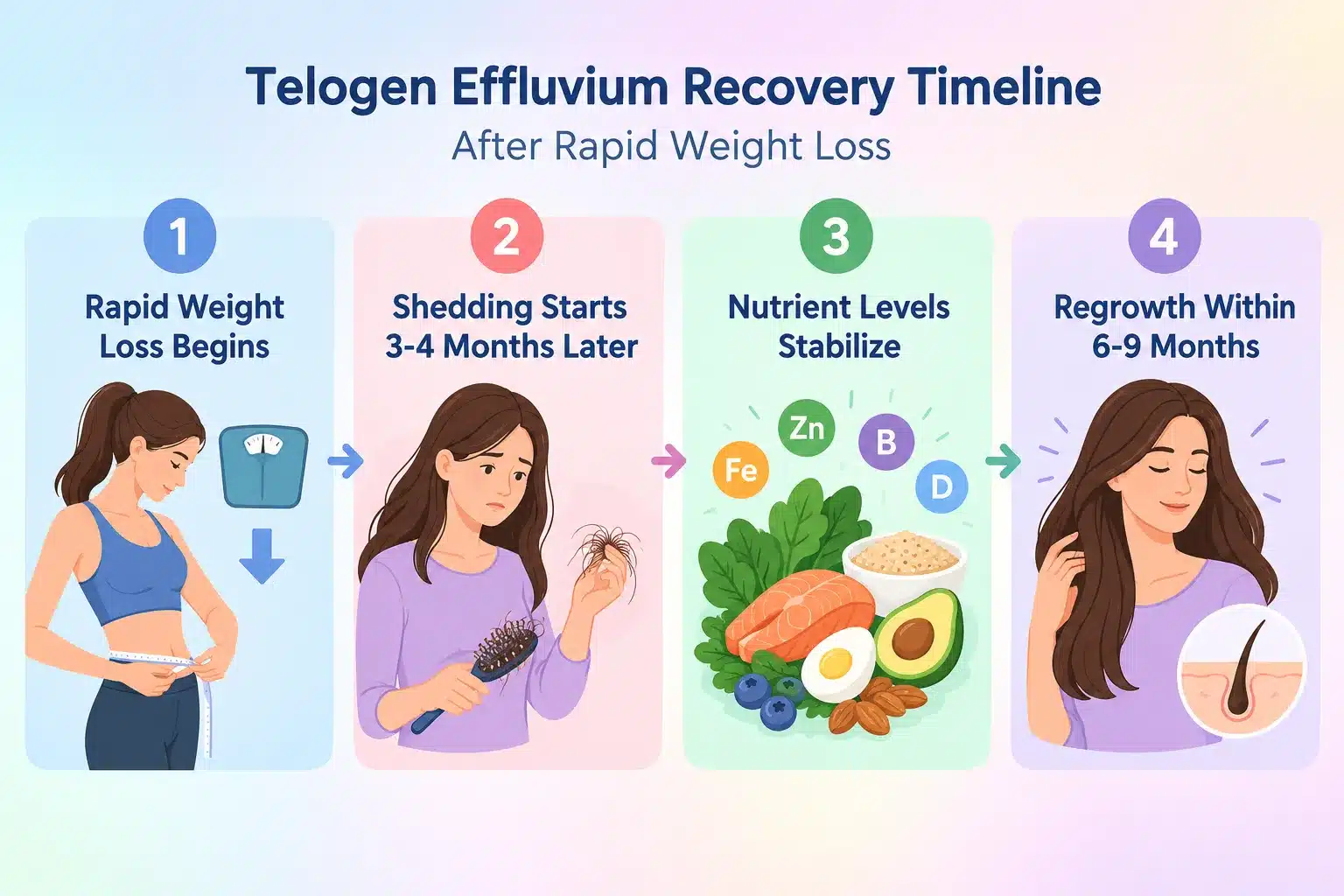
- Shedding usually starts 3 to 4 months after rapid weight loss begins and improves within 6 to 9 months once weight and nutrition stabilize [4][5].
- Hair loss can be reversible if you correct nutrient gaps and slow the pace of weight loss; permanent loss is rare and usually tied to pre-existing androgenetic alopecia [3][6].
- Men and women with a genetic predisposition to pattern baldness appear to be at higher risk of the drug “unmasking” that condition earlier [6].
- Protein intake, iron, vitamin D, B12, and zinc status matter more than any single supplement marketed for hair regrowth [3][5].
Why does Ozempic cause hair loss
Ozempic itself does not directly damage hair follicles. Instead, the rapid weight loss, calorie restriction, and metabolic stress it produces can push hair follicles into a resting phase early, called telogen effluvium.
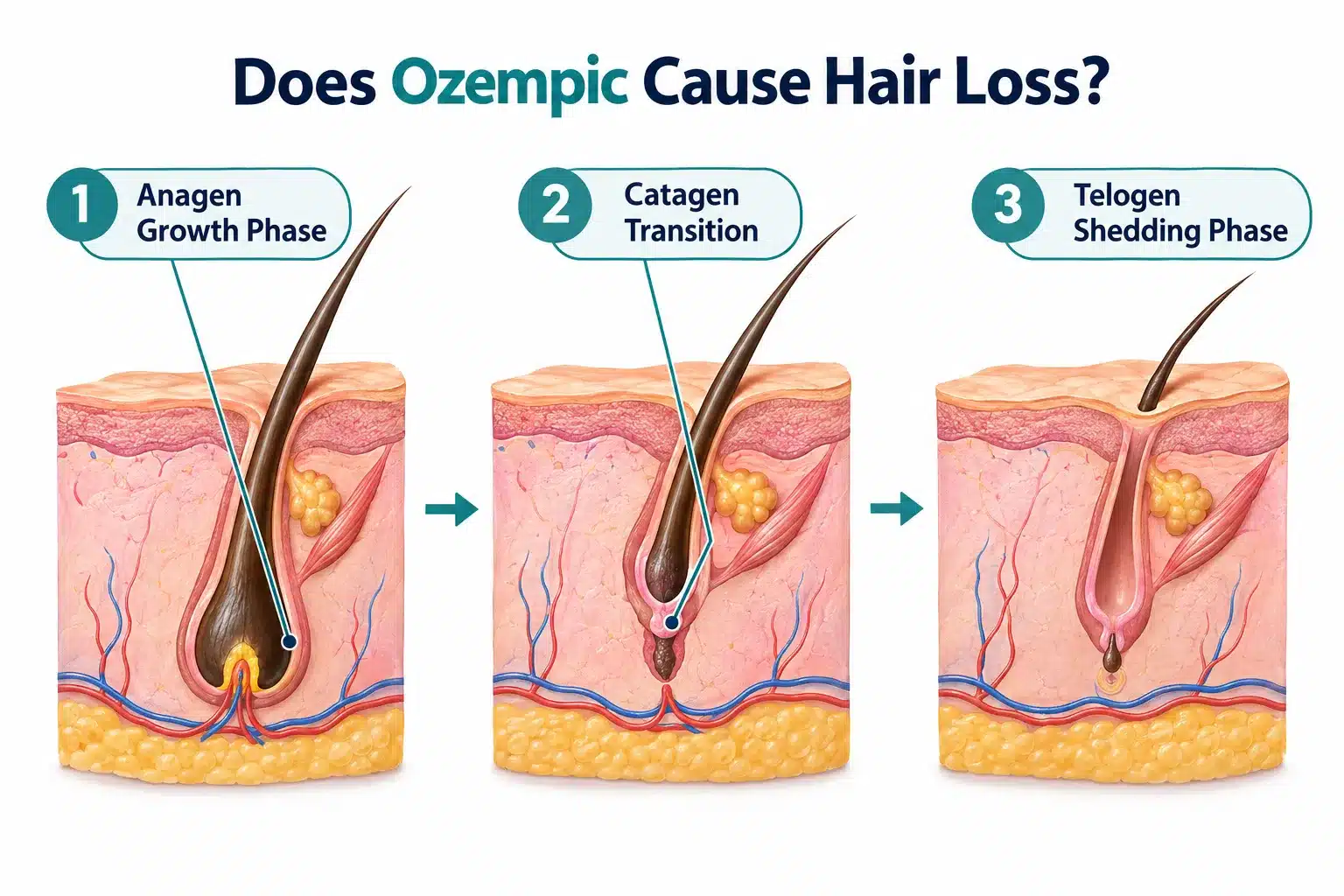
Hair grows in cycles: an active growth phase (anagen), a short transition (catagen), and a resting phase (telogen) before the strand sheds. Big physical stressors, including fast weight loss, crash dieting, surgery, or illness, can force a larger-than-normal share of follicles into telogen at once. Weeks or months later, that batch of hairs sheds together, which feels sudden and alarming even though it started much earlier.
Dermatologists, including researchers cited in a George Washington University analysis of nearly 550,000 patients, found that telogen effluvium was the most common pattern among GLP-1 users, followed by acceleration of androgenetic (pattern) alopecia in people already genetically prone to it [3].
Choose to worry less if: you’ve lost weight quickly, your diet has been low in protein or calories, and the shedding started three or more months after your biggest drop in weight. That timeline fits classic telogen effluluvium far more than drug toxicity.
How common is hair shedding with Ozempic
Hair shedding with Ozempic is uncommon in absolute terms but measurably more frequent than with non-GLP-1 medications. A 2026 meta-analysis found alopecia incidence of about 6.0 per 1,000 patient-years in GLP-1 users versus 0.8 per 1,000 in placebo groups, roughly a three-fold relative increase [7][8].
That sounds dramatic until you look at raw numbers. The cohort study of 27,000+ adults found incidence around seven cases per 1,000 GLP-1 users annually, compared with four to five per 1,000 in people on other diabetes drugs [4]. Most people on Ozempic will never experience noticeable shedding.
Risk appears elevated in women specifically, with one large cohort reporting an adjusted hazard ratio of about 2.1 compared to a non-GLP-1 weight-loss drug [7]. If you’re a woman losing weight quickly on semaglutide, your odds of noticing shedding are higher than a man’s, all else equal.
For context on how Ozempic compares to other options for weight management, see our Ozempic reviews breakdown.
How long does Ozempic hair loss last
Ozempic-related hair shedding typically lasts a few months and resolves once weight stabilizes and nutrition improves. Telogen effluvium is, by nature, self-limiting.
Here’s the general timeline clinicians describe:
- Months 0 to 3: Rapid weight loss and calorie restriction begin; follicles start shifting into resting phase, no visible shedding yet.
- Months 3 to 5: Noticeable shedding appears, often in the shower or on a pillow.
- Months 5 to 9: Shedding slows as weight loss pace stabilizes and the body adjusts.
- Months 9 to 12: New hair growth becomes visible; full regrowth can take up to a year for longer hair.
Mistake to avoid: panicking and stopping Ozempic the moment shedding starts. Since the triggering event already happened months earlier, stopping the drug immediately often doesn’t speed recovery and may undo progress on other health goals.
Can hair loss from Ozempic be reversed
Yes, in most cases. Telogen effluvium linked to Ozempic is generally reversible once weight loss slows and nutrient levels are corrected. The follicles themselves usually aren’t destroyed, they’re just dormant.
Steps that support reversal:
- Slow the rate of weight loss if you’re losing faster than 1 to 2 pounds per week, talk to your prescriber about dose timing or pacing.
- Get bloodwork for iron, ferritin, vitamin D, B12, zinc, and thyroid function. Deficiencies in any of these can prolong shedding [3][5].
- Increase protein intake. Hair is built from protein; chronic under-eating undermines regrowth even after shedding stops.
- Be patient. Visible improvement can take 3 to 6 months after the underlying cause is addressed.
Case reports have also described a rarer, different issue: alopecia areata, a patchy autoimmune hair loss, appearing after several months of semaglutide use, with improvement after stopping the drug [5][9]. This is uncommon and distinct from typical diffuse telogen shedding, and the authors caution it doesn’t prove the drug caused it.
What supplements help with Ozempic hair loss
No supplement reverses hair loss on its own, but correcting documented deficiencies in iron, vitamin D, B12, and zinc genuinely helps regrowth. Supplements only help if you’re actually low in something.
Before buying anything, get labs drawn. Supplementing blindly can waste money or, in some cases, cause harm (excess iron, for example, is not benign).
| Nutrient | Why it matters for hair | How to check |
|---|---|---|
| Iron/ferritin | Low ferritin is strongly linked to diffuse shedding | Blood ferritin test |
| Vitamin D | Low levels associated with follicle cycling problems | Blood 25-OH vitamin D test |
| B12 | Deficiency can mimic or worsen shedding | Blood B12 test |
| Zinc | Needed for follicle repair; deficiency common with reduced food intake | Blood zinc test |
| Protein | Structural building block of hair shaft | Diet review with provider or dietitian |
Topical minoxidil is also a standard dermatologic option that clinicians may recommend alongside nutrient correction [3][5]. Always run new supplements or medications past your prescriber, since some interact with GLP-1 drugs or each other.
If you’re exploring topical options, our review of a hair loss treatment spray covers one non-prescription approach, and the Viviscal hair growth supplement review looks at a popular nutrient-based option for women.
Best vitamins to take while on Ozempic to prevent hair loss
There’s no single “best vitamin” that prevents Ozempic hair loss for everyone; prevention depends on which nutrients you’re actually at risk of running low on while eating less overall. That said, a general multivitamin plus adequate protein covers most bases for people with no diagnosed deficiency.
Practical prevention checklist:
- Eat at least 60 to 100 grams of protein daily, adjusted to your body size and activity level, confirmed with your provider.
- Take a basic multivitamin if your calorie intake has dropped significantly, since eating less usually means fewer micronutrients overall.
- Recheck iron and vitamin D levels every 3 to 6 months if you’re losing weight quickly.
- Avoid mega-dosing biotin or other “hair vitamins” without lab evidence of deficiency, since excess biotin can also distort certain lab test results.
Edge case: if you were already borderline low on iron or vitamin D before starting Ozempic (common in menstruating women and older adults), prevention should start on day one, not after shedding appears.
Do all GLP-1 drugs cause hair loss like Ozempic does
Hair loss has been reported across the GLP-1 drug class, not just with Ozempic. A 2025-2026 narrative review described alopecia as an “emerging adverse effect” of GLP-1 receptor agonists broadly, citing rising reports for semaglutide, liraglutide, tirzepatide, and dulaglutide [10].
Comparisons across this drug class:
- Semaglutide (Ozempic, Wegovy): Strong safety-signal detection for hair-loss reports in recent reviews [7].
- Tirzepatide (Mounjaro, Zepbound): Also showed strong signal strength in the same meta-analysis [7][8].
- Liraglutide (Saxenda, Victoza): Included in pharmacovigilance reviews with reported cases, though less frequently studied than newer drugs [10].
- Dulaglutide (Trulicity): Also appears in pooled adverse-event reporting, with fewer total cases than semaglutide or tirzepatide [10].
If you’re comparing which GLP-1 option fits your situation, our guide on which GLP-1 is best for weight loss and our semaglutide vs tirzepatide comparison break down other differences beyond hair-loss risk.
Is Ozempic hair loss permanent
Ozempic-related hair loss is usually not permanent when it’s telogen effluvium from rapid weight loss. It becomes functionally “permanent” mainly in people whose underlying genetic pattern baldness was simply accelerated, not caused, by the drug.
An October 2026 analysis found that in men genetically predisposed to male-pattern baldness, GLP-1 drugs including Ozempic and Wegovy were associated with about a 7% higher risk of a hair-loss diagnosis, suggesting the drugs can unmask or speed up a process that was already going to happen eventually [6]. In those cases, the underlying androgenetic alopecia follows its own course regardless of the GLP-1 drug, and standard pattern-baldness treatments (not weight stabilization) are what actually help.
Quick example: if a 45-year-old man with a family history of early balding starts Ozempic and notices receding at the temples within a year, that’s more likely accelerated androgenetic alopecia than pure drug-induced telogen effluvium, and it won’t fully reverse just by stopping the medication.
How much weight loss triggers telogen effluvium
There’s no single weight-loss threshold confirmed in research, but clinicians generally associate rapid or large losses, often more than 10% of body weight within a few months, with a higher likelihood of triggering telogen effluvium. Slower, steadier weight loss appears gentler on hair follicles.
Factors that raise risk beyond the amount lost:
- Speed of loss (faster losses stress the body more than gradual ones)
- Severity of calorie restriction alongside the medication
- Pre-existing nutrient deficiencies before starting treatment
- Overall health stressors happening at the same time (illness, surgery, major life stress)
If you’re losing weight unusually fast on a GLP-1 drug, it’s worth discussing pacing with your prescriber. Our article on how long GLP-1 medications take to work explains typical weight-loss timelines so you can judge whether your rate of loss is unusually aggressive.
Should I stop taking Ozempic if I’m losing hair
Don’t stop Ozempic on your own just because of hair shedding; talk to your prescriber first, since the shedding you’re seeing today likely reflects something that happened months ago, not a current crisis. Stopping abruptly can also undo progress on blood sugar control or weight management without guaranteed hair benefit.
Decision guide:
- Choose to continue and manage it if: shedding is diffuse, mild to moderate, and started 3+ months after a period of rapid weight loss. Address nutrition and pacing instead.
- Choose to flag it for your doctor urgently if: you notice patchy bald spots (possible alopecia areata), scalp pain, redness, or sudden severe loss. These patterns differ from typical diffuse shedding and deserve direct evaluation [5][9].
- Choose to reassess the whole treatment plan if: hair loss is combined with other concerning side effects, or if weight loss has become faster or more extreme than intended.
Does hair grow back after stopping Ozempic
Hair typically grows back after stopping Ozempic if the loss was telogen effluvium, though regrowth isn’t instant and depends on resolving the underlying nutritional or metabolic stress, not just stopping the drug. Simply discontinuing the medication doesn’t guarantee faster regrowth if diet and nutrient status don’t also improve.
What actually predicts regrowth:
- Weight stabilizes instead of continuing to drop rapidly
- Protein and micronutrient intake normalize
- Any underlying deficiency (iron, vitamin D, B12, thyroid) gets corrected
- Enough time passes, typically 6 to 12 months, for the follicle cycle to reset
If pattern baldness was accelerated rather than purely triggered, stopping the drug won’t reverse that component, since androgenetic alopecia follows its own genetic and hormonal course.
Ozempic vs other weight loss drugs hair loss comparison
Ozempic’s hair-loss risk profile looks similar to other GLP-1 drugs and notably higher than some older weight-loss medications, though direct head-to-head data remains limited. The GW University study’s near 550,000-patient dataset found increased hair-loss risk across GLP-1 drugs broadly, including both Ozempic and Wegovy, after adjusting for demographic and clinical factors [3].
| Drug class | Hair loss signal | Typical cause when reported |
|---|---|---|
| GLP-1 drugs (Ozempic, Wegovy, Mounjaro) | Elevated vs comparators; ~3x relative risk in meta-analysis [7][8] | Telogen effluvium from rapid weight loss |
| Other diabetes drug classes (comparator in BMJ study) | Lower non-scarring alopecia rates [1] | Less associated with rapid weight loss |
| Non-GLP-1 weight-loss drugs | Lower hazard ratio for women vs GLP-1 in one cohort [7] | Varies by mechanism |
For a broader look at how GLP-1 drugs stack up against each other on effectiveness and side effects generally, see our GLP-1 receptor agonists for weight loss guide.
Who is most at risk for hair loss on Ozempic
People losing weight very quickly, eating very restrictive diets, already low in key nutrients, or with a strong family history of pattern baldness face the highest apparent risk of noticeable hair loss on Ozempic. The drug-related metabolic stress seems to push already-vulnerable follicles over an edge they were already near.
Higher-risk groups based on current research:
- Women, who showed a higher adjusted hazard ratio in cohort data [7]
- People with pre-existing thyroid disease
- Anyone with undiagnosed iron, B12, or vitamin D deficiency before starting treatment
- People losing weight unusually fast relative to their calorie intake
- Men and women with close relatives who experienced early pattern baldness [6]
“The drugs can unmask or accelerate underlying androgenetic alopecia rather than create an entirely new pattern of hair loss.” This framing, echoed across multiple 2026 analyses, matters because it changes the question from “will Ozempic cause hair loss” to “am I someone whose hair was already vulnerable.”
What’s the difference between Ozempic shedding and male pattern baldness
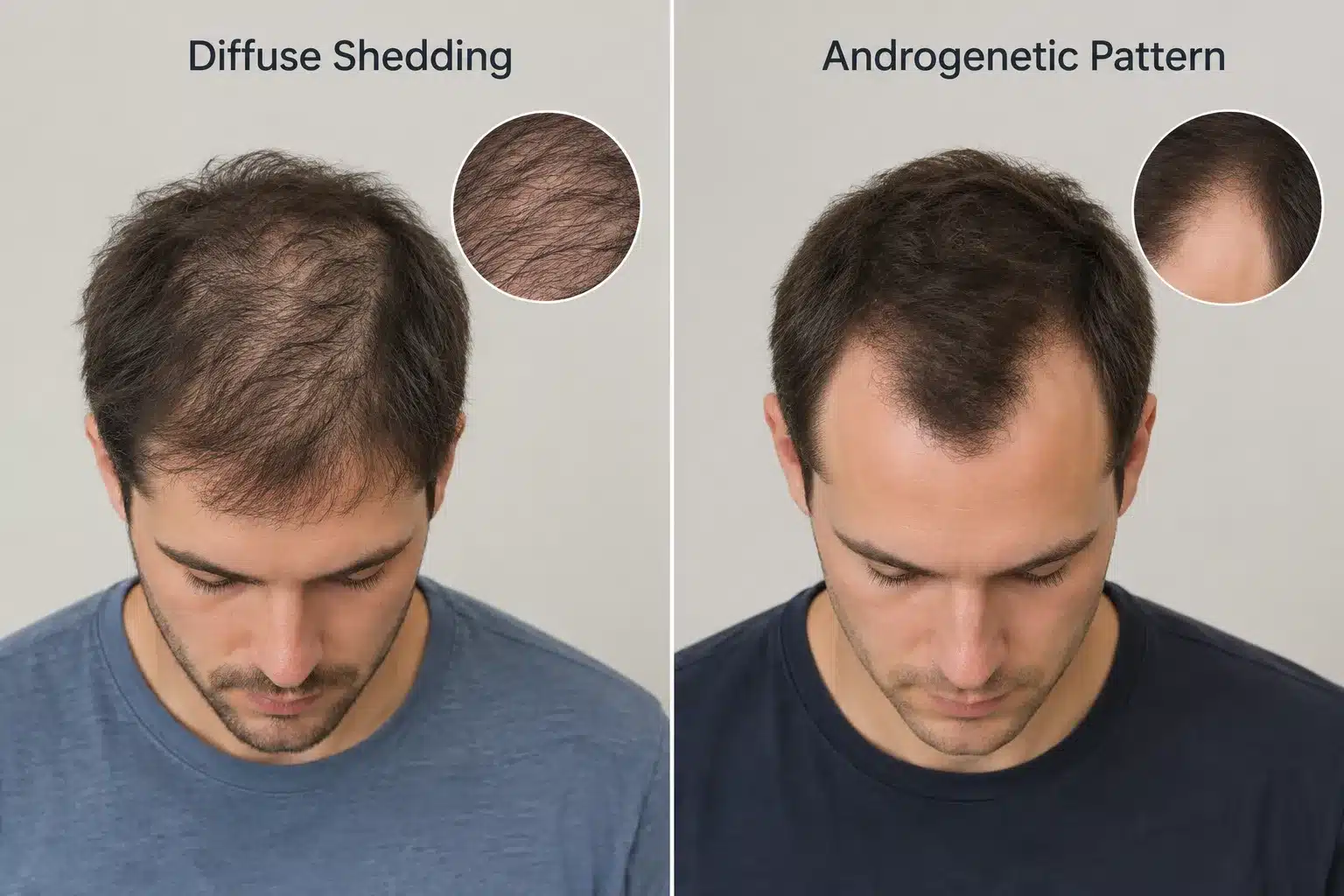
Ozempic-related shedding (telogen effluvium) is diffuse, temporary, and affects the whole scalp evenly, while male pattern baldness is localized, progressive, and follows a genetic hormonal pattern at the hairline and crown. Telling them apart matters because the solutions are completely different.
Key differences:
- Pattern of loss: Telogen effluvium thins hair evenly across the whole head; pattern baldness recedes at the temples or thins at the crown specifically.
- Timeline: Telogen effluvium has a clear trigger and clear recovery window; pattern baldness progresses slowly over years regardless of any single event.
- Hair pull test: Telogen effluvium often shows increased shedding on a gentle pull test across the scalp; pattern baldness shows miniaturized (thinner, shorter) hairs concentrated in specific zones.
- Response to stopping the trigger: Telogen effluvium resolves once the stressor (rapid weight loss, deficiency) resolves; pattern baldness continues its genetic course independent of weight or diet.
A dermatologist can confirm which pattern you’re dealing with through exam and, if needed, a scalp biopsy. This distinction is worth getting right before investing in any treatment plan.
7 Best GLP-1 Providers Ranked: Accreditation, Flexibility & Support Compared (2026 Update)
32,000+ Patients Can't All Be Wrong: See the Top-Rated GLP-1 Providers: Compared on accreditation, plan flexibility, and patient support — updated for 2026.
BMI MD GLP-1 Microdosing Plan
- Specialized microdosing options (sublingual drops or low-dose injections)
- Ideal for maintaining weight or tapering off higher doses safely
- Fully bundled plan with no hidden monthly platform memberships
DirectMeds Weight Loss Solutions
- Sourced from accredited, state-licensed 503A compounding pharmacies
- No-frills high-volume savings passed directly to the patient
- Includes clinical consultation and cold-chain shipping updates
MEDVi Flat-Rate Telehealth
- Flat monthly rate holds steady even at maximum maintenance doses
- No dosage upcharges or graduation fee penalties
- Offers both injectable and advanced oral thin-film delivery options
Gala GLP-1 Care Program
- All-inclusive plan with no standalone membership costs
- Continuous text-based messaging access with state-licensed clinicians
- Temperature-controlled, cold-chain medication shipping included
Measured GLP-1 Metabolic Health
- Comprehensive metabolic health screening and expert intake analysis
- Predictable long-term budgeting with stable plan pricing
- High-end responsive dashboard with integrated diagnostic support
Refills GLP-1 (TryRefills Plan)
- Flat rate holds steady as titration scales up
- Includes clinical guides for active side-effect management
- Bundles in foundational nutritional strategies alongside medication
AltRx GLP-1 Transactional Reorders
- Zero recurring auto-billing — pay entirely on a transactional basis
- Rapid text-to-order format saves time for experienced patients
- Provides both injectable forms and fast-dissolving tablet variations
Conclusion
Does Ozempic cause hair loss? The honest answer is: it can contribute to it, mostly through rapid weight loss and nutrient shortfalls that trigger temporary telogen effluvium, not through direct damage to hair follicles. Research from 2026 shows a real but modest increase in hair-loss diagnoses among GLP-1 users, with absolute risk still low for most people. Recovery is the norm, especially if you slow your pace of weight loss, correct nutrient gaps with real bloodwork, and eat enough protein. If you notice patchy loss, scalp symptoms, or shedding that doesn’t fit the usual timeline, bring it to your prescriber rather than guessing. Your next step: get baseline bloodwork now, before or early in treatment, so you have a clear comparison point if shedding ever starts.
This article is for informational purposes only and is not medical advice. Talk to a licensed healthcare provider before starting or changing any medication.
FAQ
Does Ozempic directly damage hair follicles?
No. Current evidence points to indirect causes like rapid weight loss and nutrient deficiency, not direct follicle damage from the drug itself [2][5].
How soon after starting Ozempic does hair loss start?
Shedding typically appears 3 to 4 months after significant weight loss begins, following the normal hair cycle delay [4][5].
Will my hair fully grow back?
In most telogen effluvium cases, yes, usually within 6 to 12 months once weight stabilizes and nutrition improves. Pre-existing pattern baldness that was accelerated may not fully reverse [3].
Should I take biotin for Ozempic hair loss?
Only if you have confirmed low biotin or related deficiencies; mega-dosing without a documented need can interfere with certain lab tests and isn’t proven to help in the absence of deficiency.
Are women more affected than men?
Cohort data suggests women may have a higher relative risk of a hair-loss diagnosis on GLP-1 drugs compared to men, though both can experience it [7].
Does Wegovy or Mounjaro cause hair loss too?
Yes, hair-loss reports appear across the GLP-1 class, including semaglutide (Wegovy), tirzepatide (Mounjaro), liraglutide, and dulaglutide [7][10].
Can I prevent hair loss while still losing weight on Ozempic?
You can lower your risk by losing weight more gradually, eating adequate protein, and correcting any nutrient deficiencies early, though no approach guarantees zero shedding.
When should I see a dermatologist instead of just waiting it out?
See a dermatologist if you notice patchy bald spots, scalp redness or pain, or shedding that doesn’t improve after your weight and diet stabilize for several months.
References
- 260723084047. sciencedaily.com.
- Ozempic Wegovy Mounjaro Cause Hair Loss. drugs.com.
- GW Researchers Find Certain Weight Loss Drugs May Increase Risk Hair Loss. dermatology.smhs.gwu.edu.
- Does Ozempic Cause Hair Loss. health.yahoo.com.
- Does Ozempic Cause Hair Loss. healthline.com.
- 260911214241. sciencedaily.com.
- Pmc13100445. pmc.ncbi.nlm.nih.gov.
- Jocd.70967. onlinelibrary.wiley.com.
- Pmc12329471. pmc.ncbi.nlm.nih.gov.
- Pmc13243728. pmc.ncbi.nlm.nih.gov.


