
GLP-1 Lozenges Rx Sublingual lozenge, dissolves under the tongue
Last updated: August 10, 2026
Quick Answer: A GLP-1 Lozenges Rx sublingual lozenge, dissolves under the tongue, is a compounded prescription medication containing a GLP-1 receptor agonist (most commonly semaglutide) in a small dissolvable tablet placed under the tongue. As of 2026, no sublingual GLP-1 lozenge has received direct FDA approval, but compounding pharmacies legally produce them under 503A regulations for patients with valid prescriptions. They are primarily used for weight loss and blood sugar management in people who prefer to avoid injections.
Key Takeaways
- GLP-1 sublingual lozenges (also called troches) dissolve under the tongue in roughly 5 to 15 minutes, allowing the active ingredient to absorb directly into the bloodstream through the mucous membrane.
- No sublingual GLP-1 lozenge is currently FDA-approved; all available versions are compounded, meaning they are made by licensed compounding pharmacies on a per-patient prescription basis.
- Shed is the most recognized branded provider offering a semaglutide troche that dissolves under the tongue as of 2026.
- Cost typically ranges from $100 to $300 per month depending on dose and provider, which is significantly lower than brand-name injectable GLP-1 drugs.
- Insurance rarely covers compounded sublingual lozenges; most patients pay out of pocket.
- You must let the lozenge dissolve fully under the tongue and avoid eating, drinking, or swallowing for at least 30 minutes before and after dosing.
- Side effects are similar to injectable GLP-1 drugs: nausea, reduced appetite, and occasional digestive discomfort are most common.
- People with a personal or family history of medullary thyroid carcinoma or multiple endocrine neoplasia syndrome type 2 should not take any GLP-1 medication.
- Sublingual lozenges are not equivalent in bioavailability to injections; absorption rates vary and clinical evidence is still limited compared to injectable forms.
- Always obtain these medications through a licensed prescriber and a verified compounding pharmacy.
What Are GLP-1 Lozenges and How Do They Work
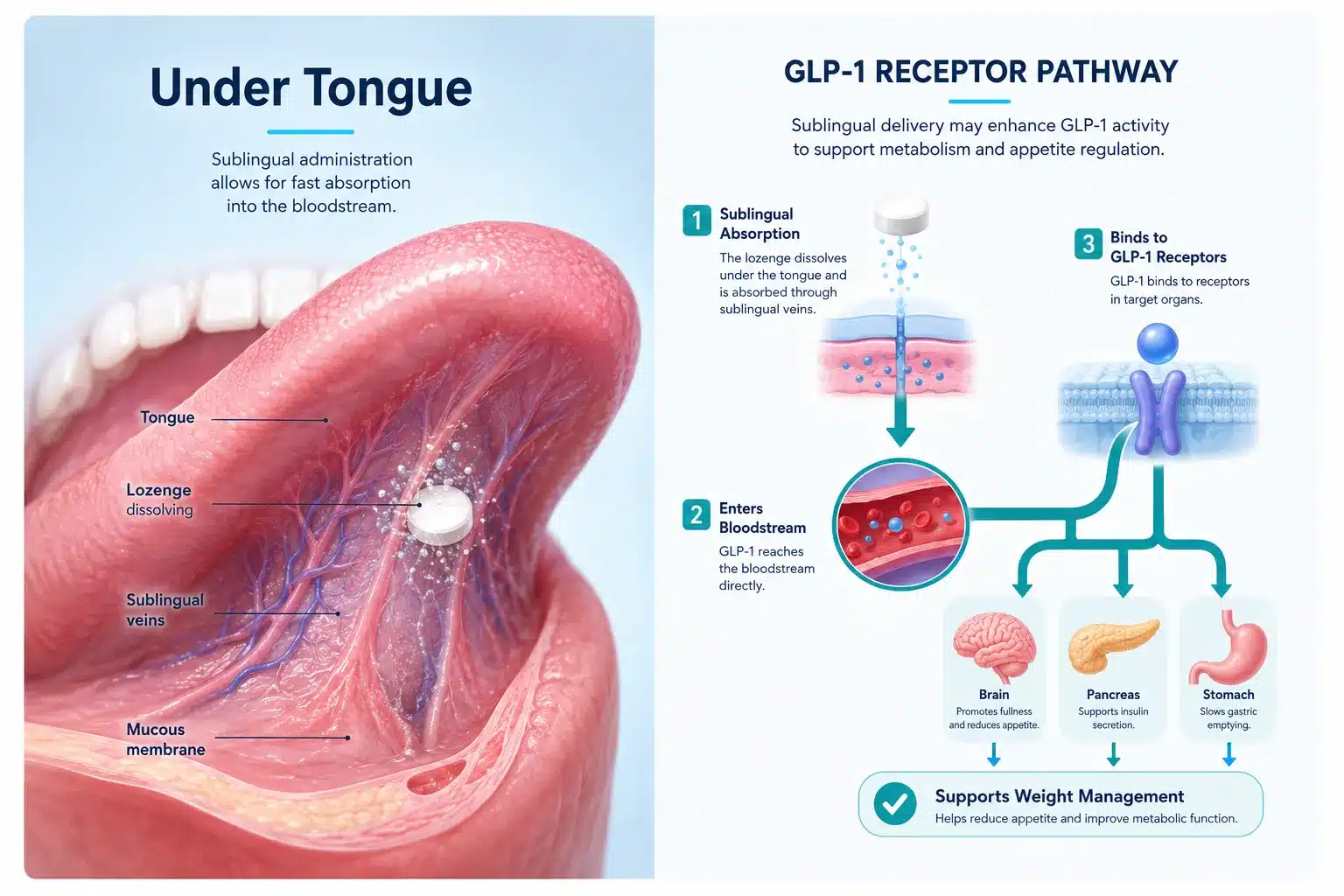
A GLP-1 lozenge is a small, compounded prescription tablet placed under the tongue, where it dissolves and releases a GLP-1 receptor agonist (typically semaglutide) directly into the sublingual mucosa. The drug is then absorbed into the bloodstream without passing through the digestive tract first, bypassing the liver’s first-pass metabolism to some degree [1].
GLP-1 stands for glucagon-like peptide-1, a hormone your body naturally produces after eating. It signals the pancreas to release insulin, slows gastric emptying, and tells the brain you are full [9]. When you take a GLP-1 receptor agonist, you are mimicking and amplifying this signal.
Here is what happens step by step when you use a GLP-1 Lozenges Rx sublingual lozenge, dissolves under the tongue:
- You place the lozenge under your tongue and keep it there.
- Saliva activates the lozenge and begins dissolving the outer matrix.
- The active ingredient (semaglutide or similar) absorbs through the thin tissue under the tongue.
- The drug enters the bloodstream and binds to GLP-1 receptors in the pancreas, gut, and brain.
- Blood sugar regulation improves, appetite decreases, and gastric emptying slows.
Why sublingual? The sublingual route avoids the stomach acid that would otherwise break down peptide-based drugs like semaglutide before they reach the bloodstream [8]. This is the same logic behind sublingual medications used in other therapeutic areas. For a related example of how sublingual absorption works in practice, see this review of tadalafil sublingual tablets.
GLP-1 Sublingual Lozenges vs. Injections: Which Is Better
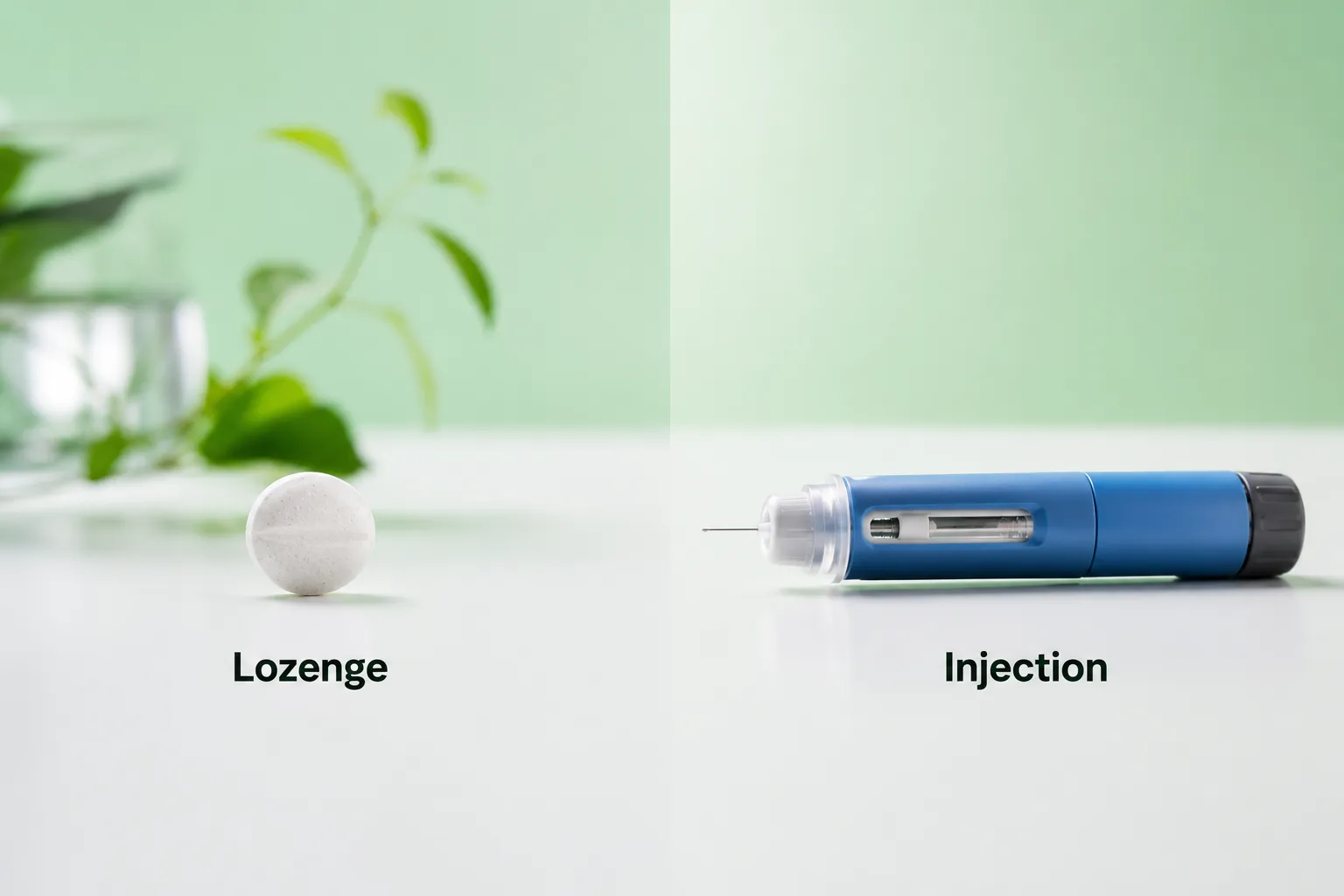
Neither format is universally better. Injections (like Ozempic or Wegovy) have far more clinical evidence behind them and are FDA-approved. Sublingual lozenges are more convenient and needle-free, but their bioavailability is less well-established [5].
Here is a direct comparison:
| Feature | Sublingual Lozenge | Injectable (e.g., Ozempic) |
|---|---|---|
| FDA approval | No (compounded) | Yes |
| Needle required | No | Yes |
| Bioavailability | Lower, variable | High, consistent |
| Clinical evidence | Limited | Extensive |
| Typical monthly cost | $100,$300 | $900,$1,400 (brand); $150,$400 (compounded) |
| Dosing frequency | Daily or as prescribed | Weekly |
| Insurance coverage | Rarely covered | Sometimes covered |
Choose a sublingual lozenge if: You have needle phobia, cannot tolerate injections, or want a lower-cost entry point while working with a prescriber.
Choose an injectable if: You want the most clinically validated option with the strongest evidence for weight loss and blood sugar outcomes.
Research into sublingual and oral GLP-1 delivery methods is ongoing. One company, Lexaria Bioscience, has conducted human pilot studies specifically examining whether their proprietary delivery technology improves GLP-1 absorption through mucosal routes [7]. Results are preliminary, but they suggest that delivery method meaningfully affects how much active drug reaches the bloodstream.
For a broader look at GLP-1 medication options, see our guide to GLP-1 medications for weight loss and diabetes.
GLP-1 Lozenge Cost and Does Insurance Cover It
Most GLP-1 sublingual lozenges cost between $100 and $300 per month, depending on the compounding pharmacy, the dose, and whether a telehealth consultation fee is bundled in. This is substantially less than brand-name injectable GLP-1 drugs, which can exceed $1,000 per month without insurance.
Insurance almost never covers compounded sublingual GLP-1 lozenges. Because they are not FDA-approved products, most private insurers and Medicare Part D plans exclude them from formularies. Patients typically pay entirely out of pocket.
Ways to reduce cost:
- Use a 503A compounding pharmacy directly rather than a branded telehealth platform with a markup.
- Ask your prescriber about tirzepatide lozenge or ODT (oral disintegrating tablet) options, which some compounding pharmacies offer at competitive pricing [2].
- Check whether your HSA or FSA account covers compounded prescription medications (many do, with a valid prescription).
- Compare compounding pharmacy pricing before committing. Our compounding pharmacy semaglutide cost breakdown covers verified pricing from multiple sources.
For patients specifically looking at budget-friendly GLP-1 programs, our guide to best GLP-1 options under $300 is worth reviewing before you decide.
How Long Does a GLP-1 Lozenge Take to Dissolve
A GLP-1 sublingual lozenge typically dissolves in 5 to 15 minutes when placed correctly under the tongue. The exact time depends on the lozenge’s base formulation, your saliva production, and whether you keep the tablet still rather than moving it around.
Tips for proper dissolution:
- Place the lozenge under the tongue, not on top of it or between cheek and gum.
- Keep your mouth closed and let saliva do the work naturally.
- Do not chew, suck, or swallow the lozenge before it fully dissolves.
- Avoid talking excessively during dissolution, as this can dislodge the tablet.
- If the lozenge dissolves in under 3 minutes or feels gritty and incomplete after 20 minutes, contact your compounding pharmacy, as the base formulation may need adjustment.
Some compounding pharmacies use a polyethylene glycol (PEG) base while others use a fatty acid base. The base affects both dissolution time and absorption rate, so it is worth asking your pharmacy which base they use [1].
GLP-1 Lozenges Side Effects and What to Expect
Side effects from a GLP-1 Lozenges Rx sublingual lozenge, dissolves under the tongue, are broadly similar to those from injectable GLP-1 drugs, though individual experience varies. The most common effects are gastrointestinal.
Common side effects:
- Nausea (most frequent, especially when starting or increasing dose)
- Reduced appetite
- Mild stomach discomfort or bloating
- Occasional loose stools or constipation
- Dry mouth or mild irritation under the tongue at the placement site
Less common but notable:
- Headache during dose adjustment periods
- Fatigue in the first 1 to 2 weeks
- Dizziness if caloric intake drops too sharply
When to contact your prescriber immediately:
- Severe or persistent abdominal pain (possible pancreatitis signal)
- Rapid heart rate without exertion
- Signs of allergic reaction (swelling, difficulty breathing)
- Vision changes if you have diabetes
Most side effects are dose-dependent and improve as your body adjusts over 2 to 4 weeks. Starting at a low dose and titrating upward slowly is the standard approach to minimizing early discomfort [9].

Who Should Not Take GLP-1 Sublingual Lozenges
People with specific medical histories should not use any GLP-1 receptor agonist, including sublingual lozenges. This is not a format-specific restriction but applies to the drug class as a whole [9].
Do not take GLP-1 lozenges if you have:
- A personal or family history of medullary thyroid carcinoma (MTC)
- Multiple endocrine neoplasia syndrome type 2 (MEN 2)
- A history of serious hypersensitivity to semaglutide or related compounds
- Severe gastroparesis (GLP-1 drugs slow gastric emptying further)
- Active pancreatitis or a history of recurrent pancreatitis
Use with caution and only under close supervision if you have:
- Type 1 diabetes
- Severe kidney or liver impairment
- Are pregnant or breastfeeding (safety data is limited)
- Are under 18 years old (not studied in pediatric populations for this format)
Always disclose your full medication list to your prescriber before starting. GLP-1 drugs can interact with insulin and other diabetes medications, increasing hypoglycemia risk [6].
Can You Swallow a GLP-1 Lozenge or Does It Have to Dissolve
You should not swallow a GLP-1 sublingual lozenge. The entire point of the sublingual format is that the drug absorbs through the mucous membrane under the tongue. If you swallow it, the peptide compound is largely broken down by stomach acid and digestive enzymes before it can reach the bloodstream in meaningful concentrations [8].
This is the fundamental difference between a sublingual lozenge and an oral semaglutide tablet like Rybelsus. Rybelsus is specifically formulated with an absorption enhancer (SNAC) that allows it to survive the stomach environment [6]. A compounded sublingual lozenge does not contain this enhancer and is not designed for swallowing.
What to do if you accidentally swallow it: Do not double-dose. Simply resume your normal dosing schedule at the next scheduled time and inform your prescriber if it happens repeatedly.
GLP-1 Lozenges for Weight Loss vs. Diabetes
GLP-1 sublingual lozenges are used for both weight loss and blood sugar management, though the evidence base differs significantly between these two applications.
For weight loss: GLP-1 receptor agonists reduce appetite, slow gastric emptying, and promote satiety. Injectable semaglutide (Wegovy) has demonstrated average weight loss of approximately 15% of body weight in clinical trials (STEP trial program, published 2021). Sublingual lozenge formulations have not been studied in large-scale weight loss trials specifically, so extrapolating these results requires caution [5].
For type 2 diabetes: GLP-1 drugs improve glycemic control by stimulating insulin secretion in response to meals and suppressing glucagon. The Cleveland Clinic notes that GLP-1 agonists are among the most effective non-insulin options for type 2 diabetes management [9].
Who benefits most from the lozenge format specifically:
- People pursuing weight loss who want to avoid injections
- Patients with mild to moderate type 2 diabetes who are needle-averse
- Individuals who have already established a GLP-1 response via injection and want a maintenance-phase alternative
For a structured comparison of weight loss programs that include GLP-1 medications, see our roundup of best GLP-1 weight loss programs.
Best GLP-1 Lozenge Brands Available by Prescription
As of 2026, the GLP-1 sublingual lozenge market is narrow. There is no FDA-approved branded sublingual GLP-1 lozenge. The options available come from compounding pharmacies and telehealth platforms that partner with them.
Shed is currently the most prominent branded option. Shed offers a semaglutide troche that dissolves under the tongue, prescribed through their telehealth platform and compounded by a licensed 503A pharmacy. For an in-depth look at their offering, see our Shed GLP-1 review.
Other sources:
- Independent 503A compounding pharmacies (require a prescription from your own provider)
- Absolute Pharmacy, which offers oral disintegrating tablet (ODT) formulations of semaglutide and tirzepatide [3]
- Emerge Weight, which provides tirzepatide ODT as an alternative to the sublingual lozenge format [2]
Important distinction: A sublingual lozenge (troche) and an ODT (oral disintegrating tablet) are not identical. An ODT dissolves on the tongue or in the mouth and is swallowed with saliva. A true sublingual lozenge is held under the tongue for direct mucosal absorption. The clinical implications differ, and patients should clarify which format they are receiving.
To understand the regulatory framework around compounded medications, our guide to 503A vs. 503B compounding pharmacies explains the key differences in oversight and quality standards.
What Happens If You Eat or Drink Before Taking a GLP-1 Lozenge
Eating or drinking within 30 minutes before taking a GLP-1 sublingual lozenge can reduce absorption. Food and liquid wash away the lozenge material before it fully dissolves and absorbs, and they can alter the pH environment under the tongue in ways that reduce drug uptake [1].
Standard guidance:
- Fast for at least 30 minutes before placing the lozenge under your tongue.
- Do not eat, drink (including water), or rinse your mouth for at least 30 minutes after the lozenge fully dissolves.
- Avoid alcohol near dosing time, as it can irritate the sublingual mucosa and unpredictably alter absorption.
- Morning dosing on an empty stomach is the most common protocol, though your prescriber may adjust this.
This fasting window is one practical inconvenience of the sublingual format compared to a weekly injection, where timing relative to meals is less critical.
GLP-1 Lozenge Not Working: What Should I Do
If a GLP-1 sublingual lozenge is not producing noticeable effects after 4 to 6 weeks at a stable dose, the most likely causes are inadequate absorption, incorrect dosing technique, or a dose that is too low for your individual physiology.
Troubleshooting steps:
- Review your technique. Are you placing the lozenge under the tongue (not on top)? Are you fasting 30 minutes before and after? Are you letting it dissolve fully without swallowing?
- Check the lozenge base. Ask your compounding pharmacy whether the formulation uses a base optimized for sublingual absorption. Some bases are better suited to mucosal delivery than others [1].
- Assess your dose. Discuss with your prescriber whether your current dose is appropriate. Titration schedules for sublingual lozenges are not standardized the way injectable protocols are.
- Consider bioavailability limitations. Sublingual GLP-1 absorption is inherently lower and more variable than injection. Some patients simply do not absorb enough drug through this route to see meaningful effects [5].
- Discuss switching formats. If the lozenge is consistently ineffective after proper technique and dose optimization, your prescriber may recommend transitioning to an injectable or to an oral semaglutide tablet like Rybelsus.
How Often Do You Take GLP-1 Sublingual Lozenges
Most GLP-1 sublingual lozenge protocols call for daily dosing, which is a key difference from weekly injectable GLP-1 drugs. Because sublingual absorption produces lower and shorter-lived drug levels compared to a subcutaneous injection, more frequent dosing is needed to maintain therapeutic concentrations [8].
Typical dosing schedule:
- Once daily, in the morning, on an empty stomach
- Starting dose is low (often 0.25 mg semaglutide equivalent or less) and titrated upward every 2 to 4 weeks based on tolerance and response
- Some protocols use twice-daily dosing at lower individual doses
Your prescriber will set your specific schedule. Do not adjust dosing frequency on your own, as GLP-1 drugs have dose-dependent side effects that require careful management.
GLP-1 Lozenges vs. Oral Semaglutide Tablets
Oral semaglutide tablets (brand name Rybelsus) are FDA-approved, swallowed whole, and use a patented absorption enhancer called SNAC to survive stomach acid [6]. Sublingual lozenges are compounded, not FDA-approved, and rely on mucosal absorption under the tongue.
Key differences:
- Rybelsus is taken once daily, 30 minutes before eating, with a small sip of water (no more than 4 oz). It has a well-established clinical evidence base.
- Sublingual lozenges are also taken daily but dissolve under the tongue rather than being swallowed. They have less clinical data but are available at lower cost through compounding pharmacies.
- Bioavailability: Rybelsus achieves roughly 1% oral bioavailability with SNAC enhancement [6]. Sublingual lozenges aim to improve on this through mucosal delivery, but independent data confirming superior bioavailability is limited [5].
Choose Rybelsus if: You want an FDA-approved oral option with a strong evidence base and your prescriber can write for it.
Choose a sublingual lozenge if: Cost is a primary concern, you cannot access Rybelsus, or your prescriber recommends the compounded route.
Are GLP-1 Lozenges Safe Long Term
Long-term safety data specific to sublingual GLP-1 lozenges does not yet exist in published literature. However, the safety profile of semaglutide itself is well-studied through years of injectable and oral use, and the sublingual format delivers the same active compound [9].
Known long-term considerations for GLP-1 receptor agonists as a drug class include:
- Thyroid C-cell effects: Animal studies showed thyroid tumors at high doses; human risk is considered low but not zero, and monitoring is recommended for long-term users [9].
- Muscle mass: Rapid weight loss from GLP-1 drugs can include muscle loss if protein intake and resistance exercise are not maintained.
- Gallbladder: Rapid weight loss increases gallstone risk; this applies to any effective GLP-1 therapy.
- Dependency on the drug for weight maintenance: Many patients regain weight after stopping GLP-1 medications, suggesting long-term or indefinite use may be needed for sustained results.
The sublingual delivery route itself does not introduce new long-term risks beyond the known drug class profile, but the lack of large-scale trials means some unknowns remain [5].
Frequently Asked Questions
Q: Is a GLP-1 sublingual lozenge the same as a troche?
A: Yes. “Troche” and “sublingual lozenge” are used interchangeably in compounding pharmacy contexts. Both refer to a small medicated tablet designed to dissolve under the tongue for mucosal drug absorption rather than being swallowed.
Q: Do I need a prescription for a GLP-1 sublingual lozenge?
A: Yes. All GLP-1 sublingual lozenges are prescription-only medications. They are compounded by licensed pharmacies and require a valid prescription from a licensed prescriber. You cannot legally obtain them over the counter.
Q: How does sublingual semaglutide compare to Ozempic for weight loss?
A: Ozempic (injectable semaglutide) has extensive clinical trial data showing significant weight loss. Sublingual semaglutide lozenges have not been studied in equivalent trials, and their bioavailability is lower and more variable. Most clinicians consider injectable semaglutide more reliably effective for weight loss.
Q: Can I use a GLP-1 lozenge if I have type 2 diabetes and take metformin?
A: Many patients use GLP-1 medications alongside metformin; this combination is common in type 2 diabetes management. However, your prescriber must review your full medication list and blood sugar levels before prescribing, as dose adjustments may be needed.
Q: Will a GLP-1 sublingual lozenge cause low blood sugar?
A: GLP-1 receptor agonists alone rarely cause hypoglycemia because they stimulate insulin release only in response to elevated blood glucose. The risk increases if you also take insulin or sulfonylureas. Discuss this with your prescriber.
Q: How do I store GLP-1 sublingual lozenges?
A: Most compounded lozenges should be stored at room temperature away from heat and moisture, or refrigerated if specified by your pharmacy. Always follow the storage instructions on your prescription label.
Q: Can I take a GLP-1 lozenge while pregnant?
A: No. GLP-1 receptor agonists are not recommended during pregnancy due to insufficient safety data. If you become pregnant while taking a GLP-1 lozenge, contact your prescriber immediately.
Q: What is the difference between a sublingual lozenge and an ODT for GLP-1?
A: A sublingual lozenge is held under the tongue and absorbed through the mucous membrane. An oral disintegrating tablet (ODT) dissolves in the mouth and is swallowed, entering the digestive system. The absorption pathway and clinical implications differ between the two formats [3].
Q: Is Shed the only company offering GLP-1 sublingual lozenges?
A: Shed is the most visible branded platform as of 2026, but independent compounding pharmacies and other telehealth providers also offer sublingual semaglutide troches. The market is small and evolving.
Q: Can teenagers use GLP-1 sublingual lozenges?
A: GLP-1 sublingual lozenges have not been studied in patients under 18. They are not recommended for pediatric use without specific guidance from a specialist.
Conclusion
The GLP-1 Lozenges Rx sublingual lozenge, dissolves under the tongue, represents a genuinely useful option for people who want the metabolic benefits of GLP-1 receptor agonists without needles. The format is real, the pharmacology is sound, and the cost advantage over brand-name injectables is significant. But the evidence gap compared to FDA-approved injectable GLP-1 drugs is also real, and patients should enter this path with clear expectations.
Your next steps:
- Consult a licensed prescriber, either in person or through a telehealth platform, to determine whether a sublingual GLP-1 lozenge is appropriate for your health profile.
- If cost is a concern, compare compounding pharmacy pricing and consider whether a best GLP-1 weight loss program might bundle prescription access with support at a lower total cost.
- Ask your pharmacy specifically about the lozenge base formulation and dissolution characteristics before you start.
- Track your response at 4 and 8 weeks. If you see no effect despite correct technique, discuss switching to an injectable or oral semaglutide tablet with your prescriber.
References
[1] Semaglutide Troche Complete Guide – https://www.seekpeptides.com/blog/articles/semaglutide-troche-complete-guide
[2] Tirzepatide ODT – https://www.emergeweight.com/tirzepatideodt
[3] Absolute Pharmacy ODTs – https://wellya-mwl.zendesk.com/hc/en-us/articles/38455764319123-Absolute-Pharmacy-ODTs
[5] GLP-1 Drops, Sprays, Sublingual Evidence Review – https://www.weightlossrankings.org/research/glp1-drops-sprays-sublingual-evidence-review
[6] Semaglutide Oral Route – Mayo Clinic – https://www.mayoclinic.org/drugs-supplements/semaglutide-oral-route/description/drg-20492085
[7] Dosing Continues in Lexaria’s Second GLP-1 Human Pilot Study – https://www.accessnewswire.com/newsroom/en/consumer-and-retail-products/dosing-continues-in-lexarias-second-glp-1-human-pilot-study-871596
[8] Sublingual Oral Semaglutide: Complete Guide to Non-Injectable GLP-1 Options – https://formblends.com/articles/glp1-hub/sublingual-oral-semaglutide-complete-guide-to-non-injectable-glp-1-options
[9] GLP-1 Agonists – Cleveland Clinic – https://my.clevelandclinic.org/health/treatments/13901-glp-1-agonists

With over 13 years of experience in holistic health blogging, I aim to help you navigate your wellness journey with honest insights, expert-backed advice, and a sprinkle of real-world practicality.
Certified Wellness Writer | Herbal Nutrition Advocate | Wellness Research Enthusiast


