Wegovy vs mounjaro: Key Differences, Cost, Effectiveness & What to Know

Last updated: November 2, 2026
Quick Answer
Wegovy (semaglutide) and Mounjaro (tirzepatide) are both injectable weight-management drugs, but they work differently. Mounjaro activates two gut hormone receptors (GLP-1 and GIP), while Wegovy activates only one (GLP-1). Clinical trial data suggests Mounjaro users tend to lose more weight on average, but Wegovy has a longer FDA-approved track record specifically for chronic weight management [1][2].
Key Takeaways
- Mounjaro targets two hormone receptors (GLP-1 and GIP); Wegovy targets one (GLP-1 only) [1].
- Head-to-head trial data (SURMOUNT-5) found tirzepatide produced greater average weight loss than semaglutide in people with obesity or overweight [3][4].
- Mounjaro is FDA-approved for type 2 diabetes; its weight-loss-specific version is branded Zepbound, though many people still refer to “Mounjaro vs Wegovy” informally [5].
- Both drugs share similar side effects, mostly nausea, diarrhea, and constipation, with differences in intensity for some users [6][7].
- Cost varies widely depending on insurance, location, and whether you use savings programs or telehealth providers.
- Switching between the two is common when one stalls or causes side effects, but it should always happen under medical supervision.
- Newer Wegovy dosing (7.2 mg) narrows some of the effectiveness gap, so comparisons are evolving [8].
Nine out of ten people I talk to researching these drugs ask the same question first: which one actually works better? That’s the wrong starting point. The better question is which one fits your biology, your budget, and your tolerance for side effects, because both drugs can work extremely well for the right person.
7 Best GLP-1 Providers Ranked: Accreditation, Flexibility & Support Compared (2026 Update)
32,000+ Patients Can't All Be Wrong: See the Top-Rated GLP-1 Providers. We compared the leading online GLP-1 providers based on program features, clinical support, convenience, and overall value.

BMI MD GLP-1 Microdosing Plan
- Specialized microdosing options, including sublingual drops and low-dose injections
- Designed for people interested in maintaining weight or gradually adjusting treatment
- Bundled program structure without a separate monthly platform membership
- Online access makes the process convenient from home

DirectMeds Weight Loss Solutions
- Online weight-loss program with a straightforward patient experience
- Compounded medication options through state-licensed compounding pharmacies
- Includes clinical consultation as part of the process
- Provides shipping updates to help patients track their orders

MEDVi Flat-Rate Telehealth
- Flat-rate telehealth approach designed for easier budgeting
- No dosage-based pricing increases within the advertised program structure
- Offers injectable and oral thin-film delivery options
- Includes medical screening and asynchronous provider consultations

Gala GLP-1 Care Program
- Text-based access to state-licensed clinicians
- Cold-chain medication shipping included in the program
- Month-to-month program structure
- Designed for people who value convenient ongoing support

Measured GLP-1 Metabolic Health
- Comprehensive metabolic health screening and intake analysis
- Designed around longer-term metabolic health management
- Responsive dashboard with integrated health tracking tools
- Useful option for patients who value a more data-focused experience

Refills GLP-1 (TryRefills Plan)
- Clinical guidance designed to help patients manage common treatment concerns
- Includes foundational nutritional strategies alongside medication
- Designed around predictable ongoing treatment
- No hidden startup or processing fees according to the program information provided

AltRx GLP-1 Transactional Reorders
- Transactional reorder model without recurring auto-billing
- Designed for patients who already understand their treatment routine
- Fast text-to-order process for convenient reorders
- Offers injectable and fast-dissolving tablet variations
What’s the main difference between Wegovy and Mounjaro
The core difference is mechanism. Wegovy contains semaglutide, a GLP-1 receptor agonist. Mounjaro contains tirzepatide, which activates both GLP-1 and GIP receptors [1]. That second receptor pathway is why many clinicians describe Mounjaro as having a broader metabolic effect.
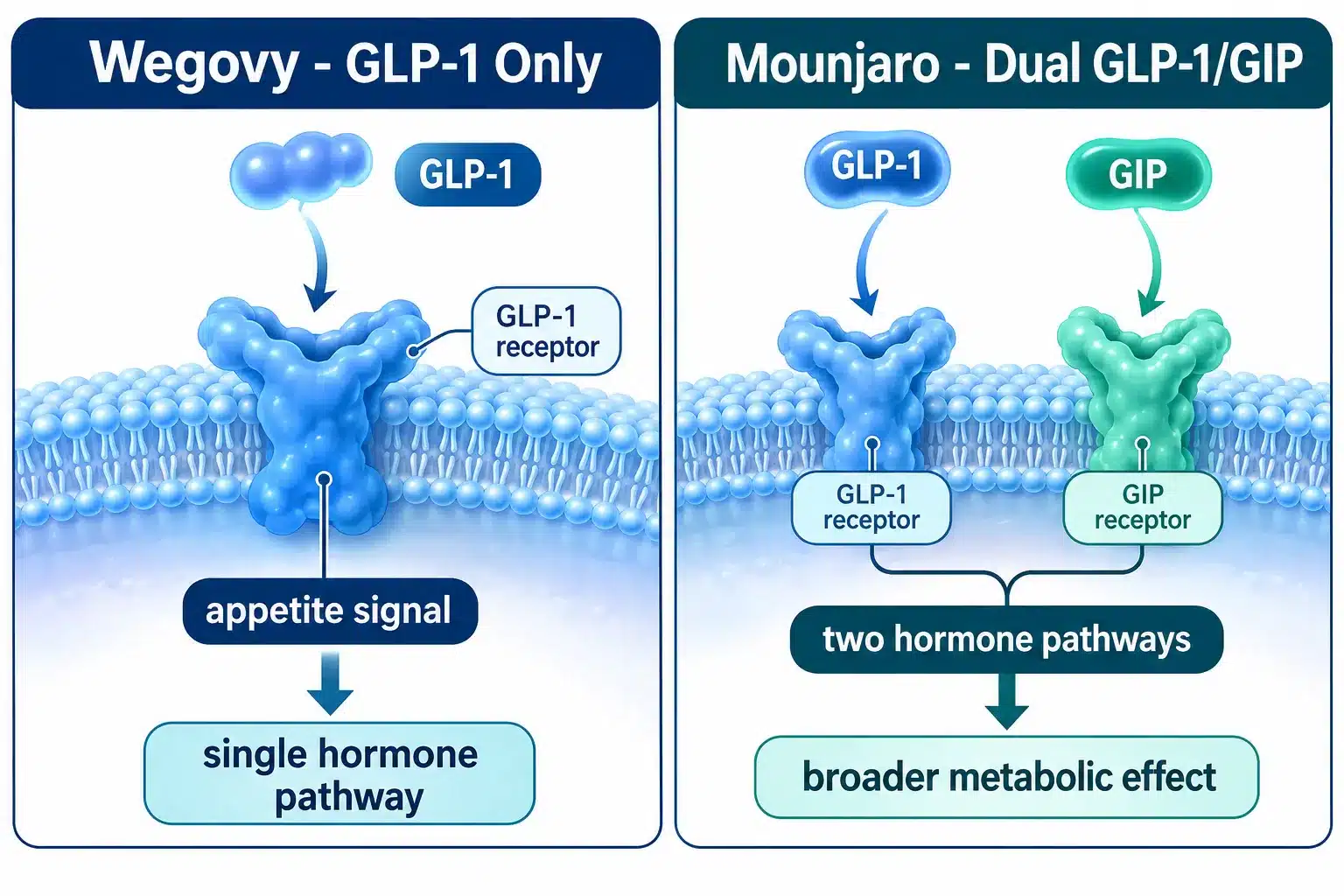
- Wegovy: single-hormone pathway, approved specifically for chronic weight management in adults and some adolescents.
- Mounjaro: dual-hormone pathway, FDA-approved for type 2 diabetes; the identical drug sold for weight loss alone is called Zepbound in the US [5].
- Both slow stomach emptying and reduce appetite signals to the brain, which is why people on either drug report feeling full faster.
Decision rule: if your doctor is primarily managing blood sugar alongside weight, Mounjaro’s dual mechanism may offer more metabolic benefit. If you want a drug with the longest-standing approval specifically for weight loss, Wegovy has more years of real-world use.
Which one works better for weight loss, Wegovy or Mounjaro
Trial data consistently shows tirzepatide (Mounjaro/Zepbound) produces greater average weight loss than semaglutide (Wegovy) in direct comparisons. The SURMOUNT-5 trial, a head-to-head study, found tirzepatide users lost more weight on average than semaglutide users over roughly a year and a half [3][4].
Other major trials report ranges rather than single numbers, since individual results vary by dose, duration, and adherence [2][8]. Eli Lilly’s own announcement of the SURMOUNT-5 results emphasized a statistically significant advantage for tirzepatide [4], and independent reporting from drugtopics.com corroborated the “bests semaglutide” framing based on relative average weight loss [2].
That said, newer Wegovy dosing strategies, including a higher 7.2 mg option, are narrowing the gap in some analyses published in 2026, which means older head-to-head comparisons may not fully reflect current treatment protocols [8]. For a deeper look at how semaglutide stacks up against other options, our Wegovy reviews and Mounjaro reviews break down real patient outcomes.
Common mistake: assuming “more weight loss on average” means a bigger loss for every person. Individual response varies a lot based on starting weight, metabolism, and consistency with diet and activity.
How much does Wegovy cost compared to Mounjaro
List prices for both drugs run high without insurance, often several hundred to over a thousand dollars monthly depending on dose and pharmacy, though exact figures shift by country and plan. In markets like Australia, cost comparisons from October 2026 show both drugs priced competitively against each other depending on the pharmacy and subsidy status [7].
- U.S. list prices for both drugs are high without coverage; savings cards and manufacturer coupons can reduce out-of-pocket cost significantly for eligible patients.
- Telehealth and compounding pathways have emerged as lower-cost alternatives for some patients, though quality and regulatory oversight vary.
- For a detailed cost breakdown, see our guides on GLP-1 weight loss cost, tirzepatide cost, and GLP-1 medication cost.
Edge case: if you’re uninsured, check manufacturer savings programs first. Some patients pay drastically less than the list price simply by enrolling correctly.
What are the side effects of Mounjaro vs Wegovy
Both drugs share a largely overlapping side effect profile dominated by gastrointestinal symptoms. Nausea, vomiting, diarrhea, and constipation are the most frequently reported issues for both medications [6][7].
| Side effect | Wegovy (semaglutide) | Mounjaro (tirzepatide) |
|---|---|---|
| Nausea | Common, often early weeks | Common, often early weeks |
| Diarrhea/constipation | Common | Common |
| Injection site reaction | Occasional | Occasional |
| Gallbladder issues | Reported, rare | Reported, rare |
| Low blood sugar (with insulin/sulfonylureas) | Possible | Possible, slightly higher risk noted by some clinicians |
Some patients report tolerating one drug better than the other even though the side effect categories look similar on paper [6]. If nausea from one drug is unmanageable, a doctor may suggest the other as an alternative rather than stopping GLP-1 therapy altogether.
Who shouldn’t take either drug: people with a personal or family history of medullary thyroid carcinoma, those with Multiple Endocrine Neoplasia syndrome type 2, and anyone with a known hypersensitivity to the active ingredients should avoid both medications. Pregnant or breastfeeding individuals should also avoid these drugs unless a doctor advises otherwise.
Can you switch from Wegovy to Mounjaro if it’s not working
Yes, switching is a recognized option when a patient plateaus, experiences intolerable side effects, or simply wants to try the dual-hormone approach. This should always be done with physician guidance, since dosing schedules and titration differ between the two drugs.
- Doctors typically evaluate whether a weight loss plateau is due to the drug itself, diet, activity level, or dose not being maximized before switching.
- Switching usually involves a washout consideration and starting Mounjaro at its lowest dose, regardless of what Wegovy dose you were on.
- Insurance approval for a switch can be harder to get than a first-time prescription, since payers often require documented failure on the first drug.
Example: a patient stalled at 10% body weight loss on Wegovy after eight months. Their doctor switched them to Mounjaro, starting at the lowest titration dose, and documented the plateau for insurance purposes before approval was granted.
Is Mounjaro approved for weight loss or just diabetes
Mounjaro itself is FDA-approved for type 2 diabetes management, not weight loss specifically. The identical tirzepatide molecule sold under the brand name Zepbound carries the weight-loss indication [5].
- Doctors can still prescribe Mounjaro “off-label” for weight loss in some cases, which is part of why the drug is so often compared directly to Wegovy in search queries.
- Zepbound and Mounjaro contain the same active ingredient and dosing options; the difference is branding and labeled indication.
- Wegovy, unlike Mounjaro, carries a direct weight-management approval under its own brand name.
Common mistake: assuming Mounjaro and Zepbound are different drugs. They are the same tirzepatide formulation marketed under two names for two different approved uses [5].
How long does it take to see results on each drug
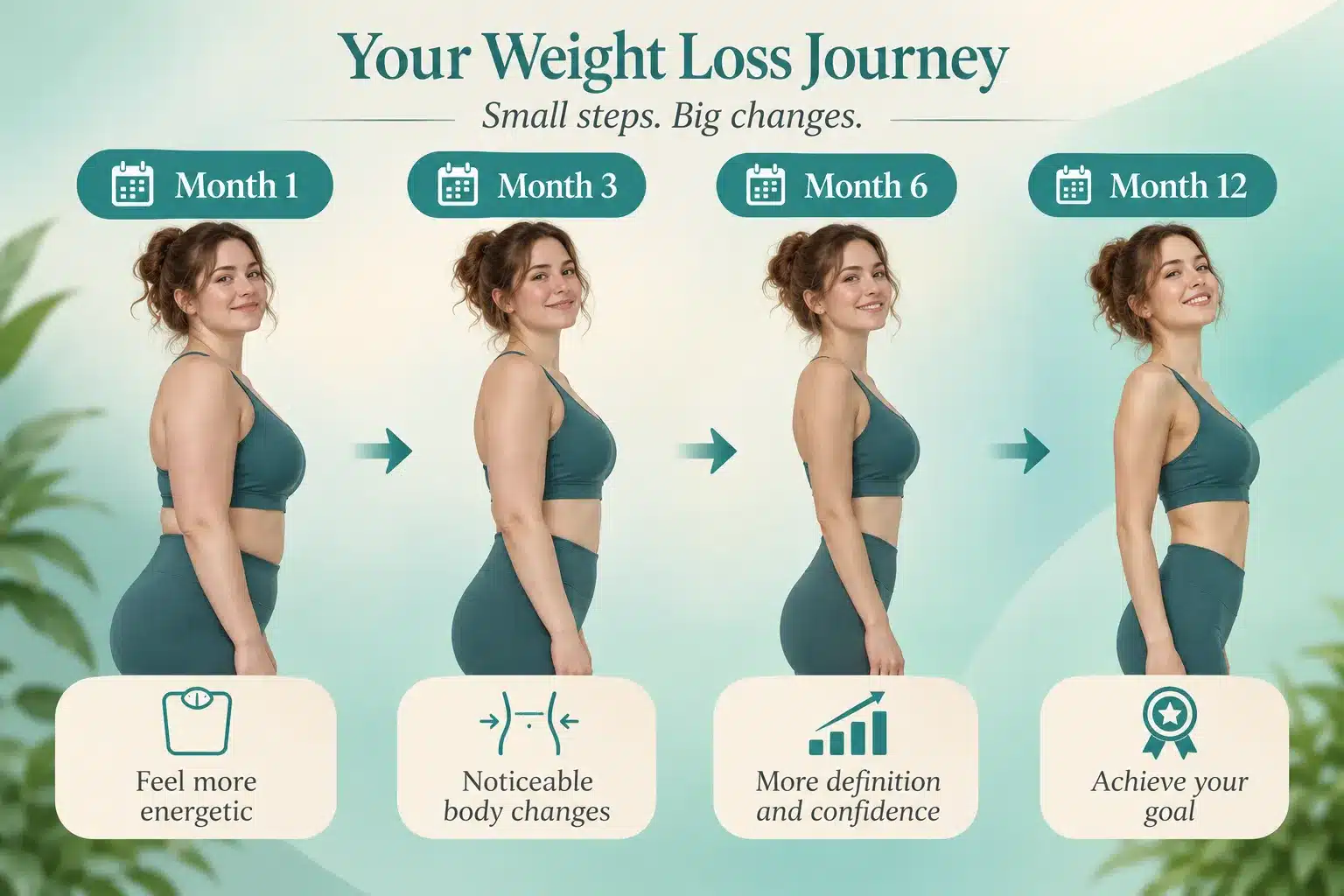
Most patients on either drug notice appetite changes within the first one to two weeks, with measurable weight loss typically visible by weeks four to eight as doses are titrated upward. Meaningful cumulative results, in the 10 to 20 percent body weight range reported across major trials, generally build over six to eighteen months [2][8].

- Weeks 1-4: appetite suppression begins, some nausea as the body adjusts.
- Months 1-3: steady weight loss as dose increases; this is often when people search “how much weight do people lose on mounjaro in 3 months.”
- Months 3-6: continued loss, often the most noticeable phase for non-scale changes like clothing fit.
- Months 6-18: weight loss plateaus near trial-reported maximums for many patients [3][4].
On the specific question of three-month results on Mounjaro: individual results vary significantly by starting dose and body weight, and publicly available trial data reports averages over longer periods (36-72 weeks) rather than a standardized three-month figure, so treat any specific three-month number you see online as an estimate rather than a guarantee [2][8].
Does insurance cover Wegovy and Mounjaro the same way
No, coverage is not guaranteed to be equal, and it depends heavily on your specific insurer, employer plan, and the diagnosis code used for prescribing. Diabetes-coded prescriptions for Mounjaro are often easier to get covered than weight-loss-only prescriptions for Wegovy, since many plans still treat obesity coverage differently from diabetes coverage.
- Check whether your plan has an explicit exclusion for weight-loss medications, which is common even when diabetes drugs are covered.
- Prior authorization is standard for both drugs; documentation of BMI, comorbidities, and prior weight-loss attempts usually speeds approval.
- If coverage is denied, manufacturer savings programs and telehealth platforms are common fallback options; see our guide on Ozempic cost without insurance for strategies that often apply across GLP-1 drugs.
What’s the injection schedule difference between them
Both Wegovy and Mounjaro are administered as once-weekly subcutaneous injections, so the basic schedule is nearly identical. The real differences show up in dose titration steps and pen design.
- Both use pre-filled pens injected into the abdomen, thigh, or upper arm.
- Dose increases happen on a step-up schedule over several weeks for both drugs to reduce gastrointestinal side effects.
- Wegovy also now offers an oral option in development discussions, which would differ from Mounjaro’s injection-only format; see our coverage of the Wegovy weekly injection pen and semaglutide pills vs injections for more on this emerging format.
Are there other weight loss drugs besides these two
Yes, the GLP-1 and dual-agonist category has expanded quickly, and several alternatives exist beyond Wegovy and Mounjaro. Ozempic (semaglutide, same molecule as Wegovy but diabetes-indicated) and emerging drugs like retatrutide are part of the same broader conversation.

- Ozempic: same active ingredient as Wegovy, diabetes-indicated; read our Ozempic reviews for real user experiences.
- Retatrutide: a newer triple-agonist drug still in trials; see our breakdown of retatrutide vs Ozempic trial data.
- Oral semaglutide: a pill alternative for people who prefer not to inject.
Can you use Wegovy and Mounjaro at the same time
No, combining Wegovy and Mounjaro is not recommended and is not a standard medical practice. Both drugs act on overlapping appetite and digestive pathways, so taking them together significantly raises the risk of severe gastrointestinal side effects without established evidence of added benefit.
- Doctors prescribe one GLP-1-class drug at a time, not a combination.
- If one isn’t working, the standard approach is switching, not stacking.
- Any patient considering combining these medications outside clinical guidance should talk to a prescribing physician first.
What do people get wrong about these medications
The biggest misconception is treating these drugs as guaranteed, automatic weight loss with no lifestyle component. Both medications work best alongside dietary changes and activity, not as a replacement for them [6][7].
- People often expect identical results to clinical trial averages, but individual response varies by metabolism, adherence, and starting weight.
- Many assume Mounjaro and Zepbound are separate drugs instead of the same tirzepatide formulation marketed differently [5].
- Some stop too early during the nausea-heavy titration phase instead of giving the dose adjustment period time to settle.
- Diet matters: our guide on Ozempic foods to avoid applies broadly to GLP-1 class drugs, including Mounjaro and Wegovy.
I’ve seen people give up in week three, right when nausea peaks, assuming the drug “doesn’t work for them.” In most cases that’s simply the adjustment phase, not a sign of failure.
FAQ
Is Mounjaro stronger than Wegovy?
Mounjaro tends to produce greater average weight loss in head-to-head trial data due to its dual GLP-1/GIP mechanism, but “stronger” doesn’t mean better for every individual [3][4].
Can I switch from Mounjaro to Wegovy instead?
Yes, switching works both directions. Doctors consider side effects, cost, and insurance coverage when recommending which direction makes sense for a given patient.
Does Zepbound work the same as Mounjaro?
Yes, Zepbound and Mounjaro contain the identical tirzepatide molecule; they’re simply marketed under different brand names for different approved uses [5].
Which drug has fewer side effects?
Side effect profiles largely overlap between the two, mostly gastrointestinal symptoms, though individual tolerance varies [6][7].
How fast will I lose weight on Mounjaro in three months?
Results vary by person; published trial data reports averages over longer periods like 36 to 72 weeks rather than a standardized three-month figure, so treat short-term estimates cautiously [2][8].
Is Wegovy cheaper than Mounjaro?
Pricing depends heavily on insurance, location, and savings programs; neither drug is reliably cheaper than the other across all markets [7].
Can both drugs be used long-term?
Both are generally intended for long-term use under physician supervision, since stopping often leads to weight regain.
Do I need diabetes to get Mounjaro?
Mounjaro itself is labeled for type 2 diabetes; people without diabetes seeking weight loss are typically prescribed Zepbound instead [5].
7 Best GLP-1 Providers Ranked: Accreditation, Flexibility & Support Compared (2026 Update)
32,000+ Patients Can't All Be Wrong: See the Top-Rated GLP-1 Providers: Compared on accreditation, plan flexibility, and patient support — updated for 2026.
BMI MD GLP-1 Microdosing Plan
- Specialized microdosing options (sublingual drops or low-dose injections)
- Ideal for maintaining weight or tapering off higher doses safely
- Fully bundled plan with no hidden monthly platform memberships
DirectMeds Weight Loss Solutions
- Sourced from accredited, state-licensed 503A compounding pharmacies
- No-frills high-volume savings passed directly to the patient
- Includes clinical consultation and cold-chain shipping updates
MEDVi Flat-Rate Telehealth
- Flat monthly rate holds steady even at maximum maintenance doses
- No dosage upcharges or graduation fee penalties
- Offers both injectable and advanced oral thin-film delivery options
Gala GLP-1 Care Program
- All-inclusive plan with no standalone membership costs
- Continuous text-based messaging access with state-licensed clinicians
- Temperature-controlled, cold-chain medication shipping included
Measured GLP-1 Metabolic Health
- Comprehensive metabolic health screening and expert intake analysis
- Predictable long-term budgeting with stable plan pricing
- High-end responsive dashboard with integrated diagnostic support
Refills GLP-1 (TryRefills Plan)
- Flat rate holds steady as titration scales up
- Includes clinical guides for active side-effect management
- Bundles in foundational nutritional strategies alongside medication
AltRx GLP-1 Transactional Reorders
- Zero recurring auto-billing — pay entirely on a transactional basis
- Rapid text-to-order format saves time for experienced patients
- Provides both injectable forms and fast-dissolving tablet variations
Conclusion
Choosing between Wegovy and Mounjaro comes down to mechanism, cost, coverage, and how your body responds. Mounjaro’s dual-hormone approach shows a statistical edge in head-to-head weight loss data, but Wegovy remains a well-established, extensively studied option with its own approval history [3][4]. Side effects overlap heavily between the two, so tolerance often becomes the deciding factor in practice.
My practical advice: talk to a prescribing doctor about your specific metabolic profile, insurance situation, and any prior GLP-1 experience before deciding. If you’ve already tried one and stalled or struggled with side effects, ask specifically about switching protocols rather than giving up on the drug class entirely. And if cost is your main barrier, explore manufacturer savings programs and telehealth options before assuming either drug is out of reach.
References
- Tirzepatide Semaglutide How Compare 3576410. drugs.com.
- Tirzepatide Bests Semaglutide in Relative Average Weight Loss in Obesity Overweight. drugtopics.com.
- Zepbound Tops Wegovy First Head Head Weight Loss Trial. pharmaphorum.com.
- Lillys Zepboundr Tirzepatide Superior Wegovyr Semaglutide Head. investor.lilly.com.
- Wegovy vs. Ozempic vs. Mounjaro. thefrankjuice.com.
- Mounjaro vs. Wegovy. medexpress.co.uk.
- Mounjaro vs. Wegovy. weightloss.com.au.
- Clinical Trial Results. keytohealth.ai.