
Retatrutide vs Ozempic: What the Trial Data Shows

Last updated: October 23, 2026
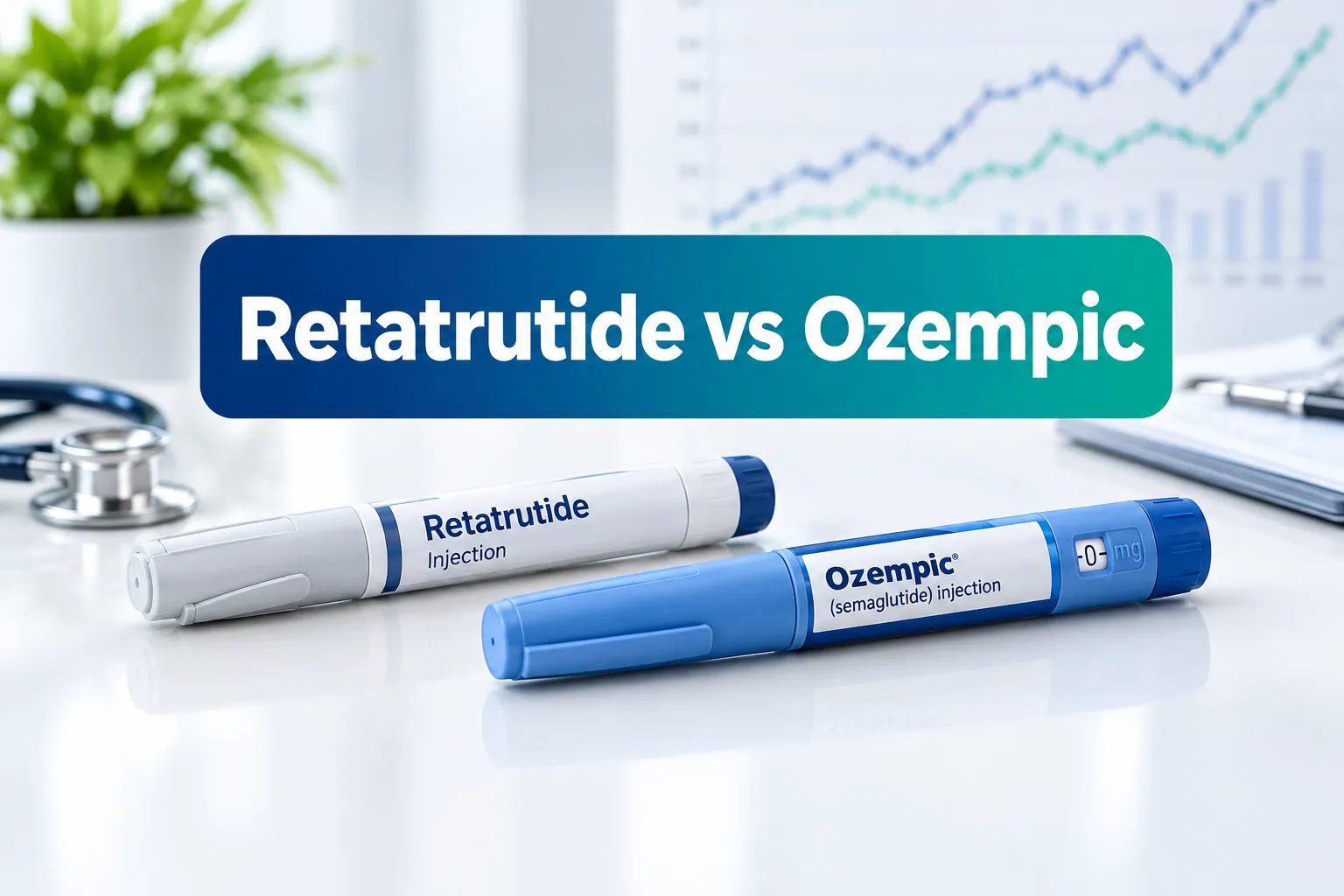
Retatrutide vs Ozempic: What the Trial Data Shows comes down to one core fact: retatrutide hits three metabolic receptors instead of one, and early trial data suggests that difference may translate into larger average weight loss than semaglutide (Ozempic) has produced in comparable studies. But retatrutide is still not FDA-approved, while Ozempic has been on pharmacy shelves since 2017. This article breaks down what the phase 2 and emerging phase 3 data actually show, how the two drugs differ mechanically, and what that means if you’re deciding on a GLP-1 strategy right now.
Quick Answer
Retatrutide is an experimental triple-hormone-receptor agonist (GLP-1, GIP, and glucagon) that produced greater average weight loss in phase 2 trials than semaglutide (Ozempic) has shown in its own studies, though the two drugs have not been tested head-to-head in a single trial [1][2]. Ozempic remains FDA-approved and widely available today; retatrutide is still moving through Eli Lilly’s TRIUMPH phase 3 program and is not approved for any use as of October 2026 [3][4]. If you need a medication now, Ozempic (or its higher-dose sibling Wegovy) is the real option. If you’re tracking what may come next, retatrutide’s trial data is the one to watch.
7 Best GLP-1 Providers Ranked: Accreditation, Flexibility & Support Compared (2026 Update)
32,000+ Patients Can't All Be Wrong: See the Top-Rated GLP-1 Providers. We compared the leading online GLP-1 providers based on program features, clinical support, convenience, and overall value.

BMI MD GLP-1 Microdosing Plan
- Specialized microdosing options, including sublingual drops and low-dose injections
- Designed for people interested in maintaining weight or gradually adjusting treatment
- Bundled program structure without a separate monthly platform membership
- Online access makes the process convenient from home

DirectMeds Weight Loss Solutions
- Online weight-loss program with a straightforward patient experience
- Compounded medication options through state-licensed compounding pharmacies
- Includes clinical consultation as part of the process
- Provides shipping updates to help patients track their orders

MEDVi Flat-Rate Telehealth
- Flat-rate telehealth approach designed for easier budgeting
- No dosage-based pricing increases within the advertised program structure
- Offers injectable and oral thin-film delivery options
- Includes medical screening and asynchronous provider consultations

Gala GLP-1 Care Program
- Text-based access to state-licensed clinicians
- Cold-chain medication shipping included in the program
- Month-to-month program structure
- Designed for people who value convenient ongoing support

Measured GLP-1 Metabolic Health
- Comprehensive metabolic health screening and intake analysis
- Designed around longer-term metabolic health management
- Responsive dashboard with integrated health tracking tools
- Useful option for patients who value a more data-focused experience

Refills GLP-1 (TryRefills Plan)
- Clinical guidance designed to help patients manage common treatment concerns
- Includes foundational nutritional strategies alongside medication
- Designed around predictable ongoing treatment
- No hidden startup or processing fees according to the program information provided

AltRx GLP-1 Transactional Reorders
- Transactional reorder model without recurring auto-billing
- Designed for patients who already understand their treatment routine
- Fast text-to-order process for convenient reorders
- Offers injectable and fast-dissolving tablet variations
Key Takeaways
- Retatrutide is a triple agonist (GLP-1, GIP, glucagon receptors); Ozempic (semaglutide) is a GLP-1-only agonist [1][5].
- In its phase 2 obesity trial, retatrutide produced substantially greater mean weight loss than placebo over 48 weeks, with higher doses showing the largest effect [1][2].
- Retatrutide is not FDA-approved. It remains in Eli Lilly’s phase 3 TRIUMPH program as of late 2026 [3][4].
- Side effects for both drugs are mostly gastrointestinal (nausea, diarrhea, constipation), and these appear to track with dose, not just drug class [1][2].
- No completed, published head-to-head trial has directly pitted retatrutide against Ozempic in the same study population.
- Muscle loss alongside fat loss has been observed with GLP-1 and multi-agonist drugs broadly; retatrutide trial data has started reporting body composition detail [5].
- Cost and insurance coverage questions are largely unanswered for retatrutide because it isn’t approved or priced yet.
What’s the Main Difference Between Retatrutide and Ozempic
The main difference is the number of hormone receptors each drug activates. Ozempic activates only the GLP-1 receptor, while retatrutide activates three: GLP-1, GIP, and glucagon [1][5].
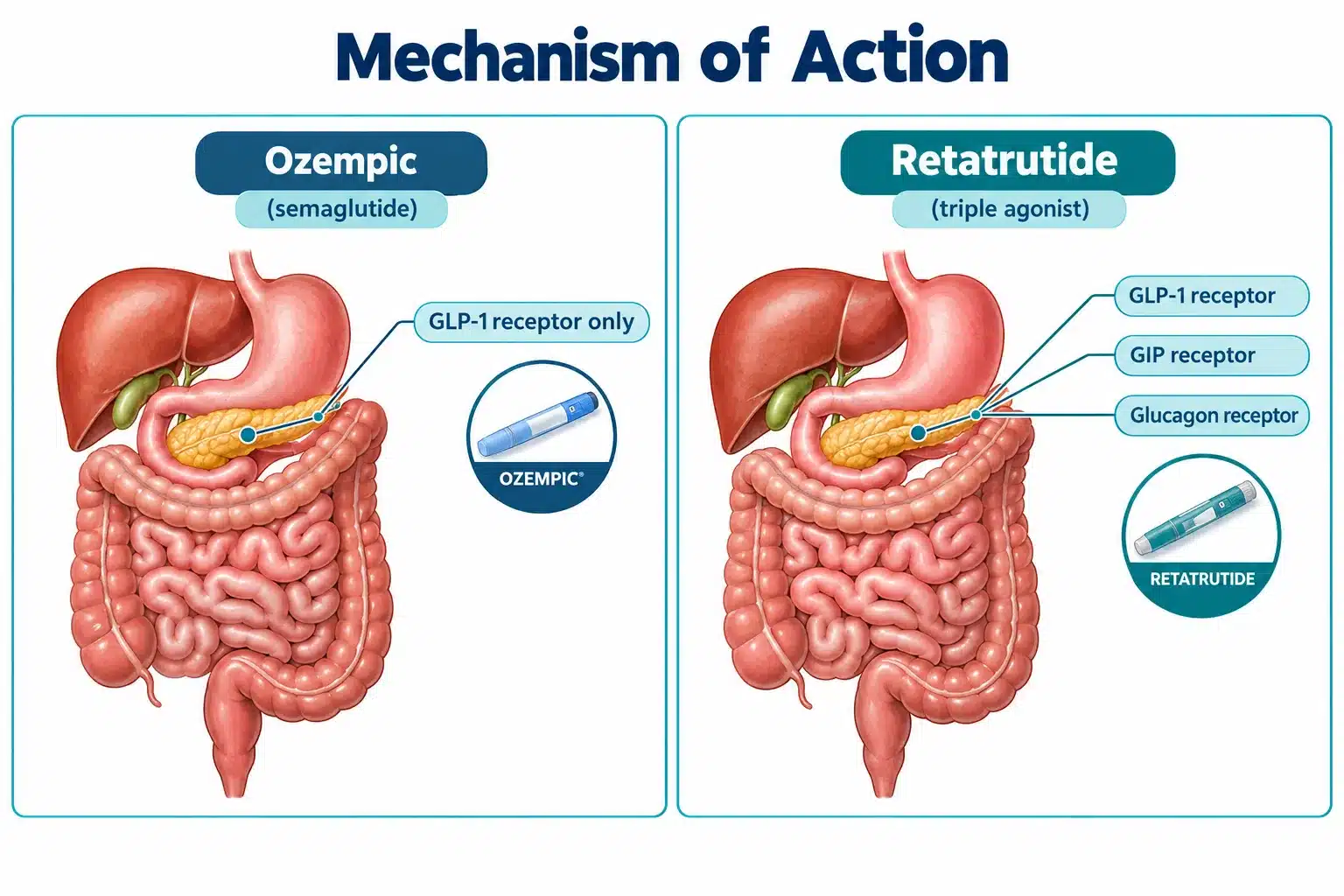
This matters because each receptor pathway does slightly different metabolic work:
- GLP-1 slows stomach emptying, reduces appetite, and improves insulin response.
- GIP may improve insulin sensitivity and fat metabolism.
- Glucagon receptor activity increases energy expenditure, which is unique to retatrutide among this drug class.
Choose Ozempic if you want a therapy with nearly a decade of real-world safety data. Choose to keep watching retatrutide trial data if you’re interested in a potentially more powerful mechanism that is still being studied for long-term safety.
Does Retatrutide Cause More Weight Loss Than Ozempic
Based on phase 2 data, retatrutide produced larger average weight loss percentages than what semaglutide has shown in its own obesity trials, though this is an indirect comparison, not a head-to-head study [1][2].
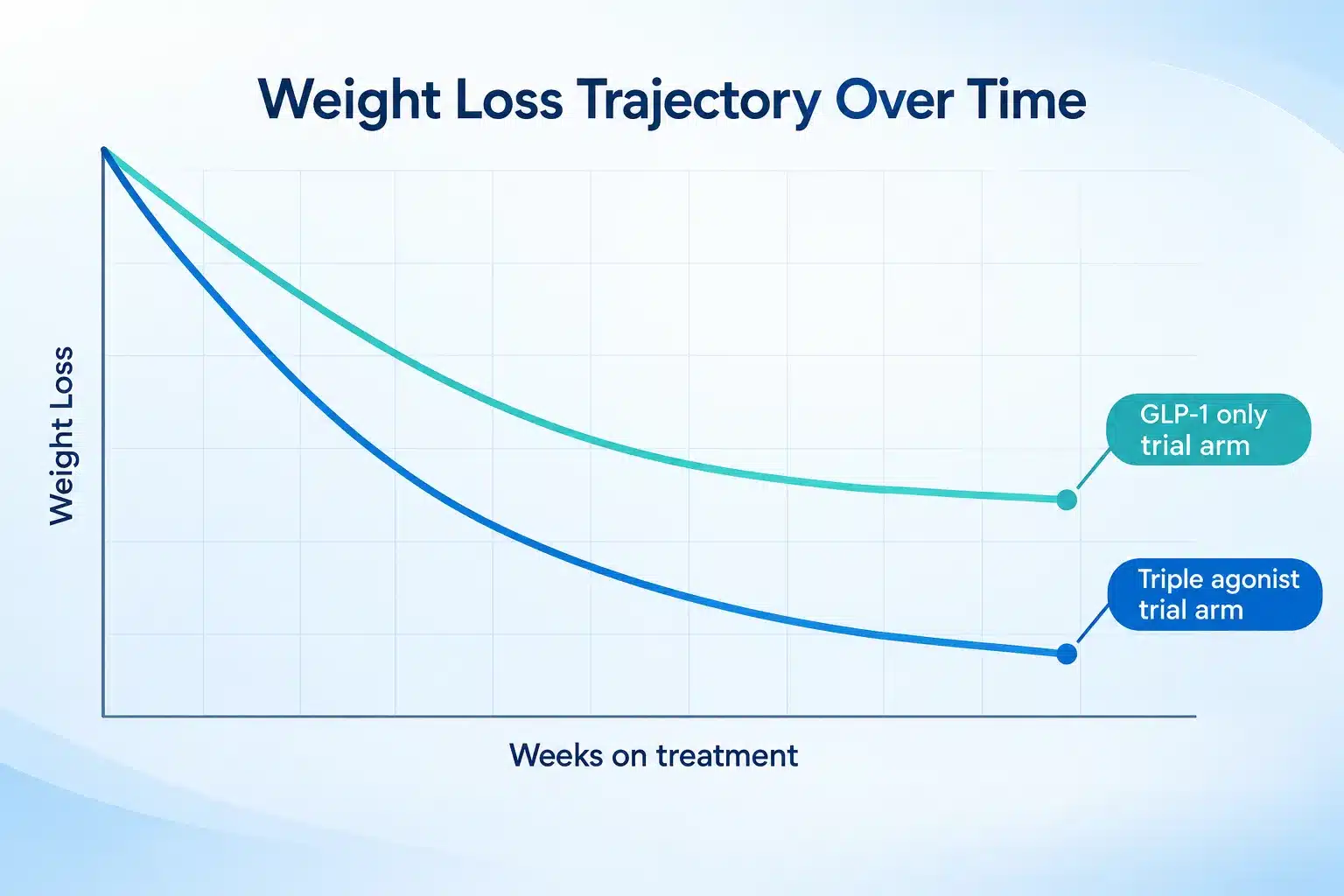
In the phase 2 obesity trial published in the New England Journal of Medicine, participants on the highest retatrutide dose lost a substantial percentage of body weight over 48 weeks, with weight loss curves still trending downward at the end of the study, suggesting results may have continued with longer treatment [1][2]. Semaglutide’s major obesity trials have shown meaningful but generally smaller average losses at comparable time points.
Important caveat: different trials have different populations, baseline weights, and dosing schedules. Treat any “X% vs Y%” comparison online with caution unless it comes from a trial designed to compare the two directly, which does not yet exist for these two specific drugs.
Retatrutide Side Effects vs Ozempic Side Effects
Both drugs cause mostly the same category of side effects: nausea, vomiting, diarrhea, constipation, and reduced appetite, with gastrointestinal symptoms being the most common reason people stop treatment [1][2].
Retatrutide’s phase 2 safety data shows a dose-dependent pattern of GI side effects, similar to what’s documented for GLP-1 drugs broadly [1][5]. Because retatrutide also activates the glucagon receptor, researchers have paid close attention to heart rate changes, which were observed to increase modestly at higher doses in early trials [2].
A common mistake: assuming a “triple agonist” automatically means triple the side effects. Trial data so far doesn’t support that. Side effect severity has tracked more with dose titration pace than with the number of receptors involved [1].
How Much Weight Do People Lose on Retatrutide Compared to Ozempic
People in retatrutide’s phase 2 obesity trial lost more weight on average at the highest tested doses than what’s typically reported for semaglutide trials over similar durations, but exact numbers vary by study and should not be treated as interchangeable [1][2].
A few data points worth understanding:
- Retatrutide’s phase 2 trial used a 48-week timeframe with multiple dose arms, and higher doses consistently outperformed lower doses [1].
- Responder rates (the share of participants reaching clinically meaningful weight loss thresholds) were notably high at the top doses in that trial [6][7].
- Ozempic’s own obesity-focused trials have reported solid but comparatively smaller average losses, which is part of why Wegovy (the higher-dose semaglutide brand) was later approved specifically for weight management.
If you want to understand how semaglutide performs in smaller, more gradual dosing approaches, our guide on microdosing Ozempic and what the science says covers that pattern in more depth.
When Will Retatrutide Be Available
Retatrutide is not available for prescription use as of October 2026. It remains in Eli Lilly’s phase 3 TRIUMPH clinical trial program, and a realistic availability timeline depends on how quickly those trials finish and how regulators review the data [3][4].
Here’s what’s confirmed and what’s an estimate:
- Confirmed: Eli Lilly has run and reported phase 2 trials and has multiple phase 3 TRIUMPH studies underway or completed as of 2026, covering obesity and type 2 diabetes populations [3][4].
- Estimate, not confirmed: Based on typical phase 3-to-approval timelines for similar drugs, an approval decision would plausibly follow full phase 3 data readouts and FDA review, which can take well over a year after submission. [VERIFY: current Eli Lilly regulatory filing timeline]
Don’t make purchasing decisions based on rumors of an imminent launch. Rely on official Eli Lilly investor announcements for the most current status.
Is Retatrutide Approved by the FDA Yet
No. As of October 2026, retatrutide has no FDA approval for any indication, including obesity or type 2 diabetes [3][4]. It is only available through clinical trials.
This means any product sold online labeled as “retatrutide” outside of a registered clinical trial is not a legitimate, regulated pharmaceutical product. Be skeptical of telehealth sites or compounding pharmacies claiming to offer approved retatrutide treatment right now. Compare that against Ozempic, which has full FDA approval and an established manufacturing and insurance pathway, as covered in our overview of how compounded semaglutide differs from Ozempic.
Retatrutide or Ozempic Which Is Better for Type 2 Diabetes
For people managing type 2 diabetes today, Ozempic is the better choice simply because it is approved, widely covered by insurance, and backed by years of outcome data, including cardiovascular benefit data. Retatrutide shows promising early signals for glucose control but isn’t an approved option yet [1][3].
Retatrutide’s TRIUMPH-2 trial specifically targets type 2 diabetes and obesity together, testing it against background therapy rather than Ozempic directly [4]. Early phase 2 data showed meaningful reductions in A1C alongside weight loss, which is notable because better glucose control often follows weight loss in this drug class [1][7].
Decision rule: if you have type 2 diabetes and need treatment now, work with your provider on an approved option like Ozempic. If you’re a candidate for a clinical trial and want to be part of early-stage research, ask your endocrinologist about TRIUMPH enrollment eligibility.
How Does Retatrutide Work Differently From Ozempic
Retatrutide works on three separate hormone receptor pathways at once, while Ozempic works on just one. This broader mechanism is the central reason researchers expect retatrutide may outperform single-pathway drugs on weight loss metrics [1][5].
Think of it like this: Ozempic turns down appetite and slows digestion through one signaling system. Retatrutide does that too, but also nudges the body’s GIP-driven fat metabolism and adds glucagon receptor activity, which can modestly raise resting energy expenditure. That third piece is the mechanical reason some researchers have called triple agonists a meaningfully different category rather than just “a stronger GLP-1 drug” [5][8].
Retatrutide Cost and Insurance Coverage
Retatrutide has no established retail price or insurance coverage because it isn’t FDA-approved and isn’t commercially sold [VERIFY: current status as of your reading date]. Any specific dollar figure circulating online for retatrutide should be treated as speculation.
For comparison, Ozempic’s pricing and coverage situation is well established, though it varies by insurance plan, dose, and pharmacy. If cost is a current concern, our breakdowns of Ozempic reviews and tirzepatide pricing through Medvi outline what people are actually paying for approved GLP-1 and dual-agonist options today.
Can You Switch From Ozempic to Retatrutide
You cannot switch to retatrutide outside of a clinical trial right now, because it isn’t commercially available. If you’re currently on Ozempic and curious about multi-receptor options, the closest legitimately available alternative today is tirzepatide (Mounjaro/Zepbound), a dual GIP/GLP-1 agonist, not a triple agonist.

Never stop or change a GLP-1 medication without talking to your prescriber first. Abruptly stopping Ozempic can lead to appetite rebound and partial weight regain, which is a common and underreported issue people miss when comparing these drugs on headline weight-loss numbers alone.
Does Retatrutide Cause Muscle Loss Like Ozempic
Both drug classes are associated with some loss of lean mass alongside fat loss, and retatrutide trial data has begun reporting body composition breakdowns to track this more closely [5]. This isn’t unique to one drug; it’s a known pattern across GLP-1 and multi-agonist weight loss therapies.
What trial data generally shows:
- A portion of total weight lost on GLP-1 drugs, including semaglutide, comes from lean mass, not just fat.
- Retatrutide’s phase 2 body composition data suggests a similar pattern, though exact fat-to-lean ratios vary by study and dose [5].
- Resistance training and adequate protein intake are the most consistently recommended strategies to offset lean mass loss during treatment with either drug. [VERIFY with your healthcare provider for personalized guidance]
Who Should Use Retatrutide vs Who Should Use Ozempic
Ozempic is appropriate today for adults with type 2 diabetes (its approved indication) or those using Wegovy, its sister drug, for chronic weight management. Retatrutide is currently appropriate only for people eligible and willing to enroll in a clinical trial, since it has no approved use [3].
| Factor | Ozempic (semaglutide) | Retatrutide |
|---|---|---|
| FDA status | Approved | Not approved, phase 3 trials ongoing |
| Mechanism | GLP-1 receptor only | GLP-1, GIP, glucagon receptors |
| Average weight loss (trial data) | Moderate, well-documented over years | Larger in phase 2 data, not yet confirmed in full phase 3 results |
| Availability | Pharmacies nationwide, insurance pathways exist | Clinical trials only |
| Side effects | GI symptoms, generally well characterized | GI symptoms, similar pattern, dose-dependent heart rate changes noted |
| Best for | Diabetes management, approved weight loss now | Research participation, future treatment planning |
Retatrutide Trial Data Results Explained
Retatrutide’s key published data comes from a phase 2 obesity trial in the New England Journal of Medicine, which tested multiple doses against placebo over 48 weeks and found a clear, dose-dependent weight loss effect, with the largest effect at the highest dose tested [1][2]. This trial is considered well-designed by endocrinology researchers because it used randomization, placebo control, and multiple dose tiers, which is the standard for credible phase 2 obesity research [2][9].
Since then, Eli Lilly has moved into the TRIUMPH phase 3 program, which is larger in scale and designed to confirm whether the phase 2 effect holds up in broader, longer-term populations, including separate trials for obesity (TRIUMPH-1) and type 2 diabetes with obesity (TRIUMPH-2) [3][4]. As of 2026, Eli Lilly has reported some top-line phase 3 results showing continued substantial weight loss, though full peer-reviewed publication and regulatory review are still pending [3][4].
Edge case to know: phase 2 results, even strong ones, don’t always hold up exactly the same way in larger phase 3 populations. That’s precisely why retatrutide isn’t approved yet despite encouraging early numbers.
What Are the Common Side Effects People Miss About These Drugs
The side effects people most often overlook with both Ozempic and retatrutide are gallbladder issues, dehydration from persistent GI symptoms, and the psychological adjustment to drastically reduced appetite. These are less discussed than nausea but matter just as much day to day.
- Gallbladder problems: rapid weight loss itself (not just the drug) raises gallbladder risk, which is true for anyone losing weight quickly on either medication.
- Dehydration: diarrhea or vomiting combined with reduced thirst cues can lead to dehydration, especially in the first few weeks of dose titration.
- Appetite psychology: many people aren’t prepared for how quickly food interest drops, which can create nutrition gaps if meals aren’t planned deliberately.
- Injection site reactions: mild but common, and rarely mentioned compared to GI side effects.
If you’re exploring GLP-1 options broadly and want to understand brand differences, our comparison of semaglutide brand names Ozempic, Wegovy, and Rybelsus is a useful next read.
FAQ
Is retatrutide stronger than Ozempic? Based on phase 2 trial data, retatrutide produced greater average weight loss than semaglutide trials have typically shown, but there’s no direct head-to-head trial confirming this yet [1][2].
Can I buy retatrutide right now? No. Retatrutide is not FDA-approved and is only accessible through clinical trial enrollment as of October 2026 [3][4].
What trial is testing retatrutide for obesity? The TRIUMPH-1 phase 3 trial is Eli Lilly’s main study testing retatrutide specifically for obesity, following up on earlier phase 2 results [3][4].
Does retatrutide help with diabetes too? Early data from TRIUMPH-2 suggests retatrutide improves blood sugar control alongside weight loss, but it is not approved for diabetes treatment yet [4].
Will retatrutide be cheaper or more expensive than Ozempic? There’s no confirmed pricing yet since retatrutide isn’t commercially available. [VERIFY: current pricing once approved]
Are the side effects of retatrutide worse than Ozempic’s? Side effects are similar in type (mostly GI symptoms) and scale with dose rather than being dramatically worse due to the triple-receptor mechanism [1][2].
Can I switch from Ozempic to retatrutide today? Not through a prescription, since retatrutide isn’t commercially available; switching is only possible through clinical trial participation [3].
Does either drug cause muscle loss? Yes, both drug classes are linked to some lean mass loss alongside fat loss, which is why resistance training and protein intake are commonly recommended during treatment [5].
7 Best GLP-1 Providers Ranked: Accreditation, Flexibility & Support Compared (2026 Update)
32,000+ Patients Can't All Be Wrong: See the Top-Rated GLP-1 Providers: Compared on accreditation, plan flexibility, and patient support — updated for 2026.
BMI MD GLP-1 Microdosing Plan
- Specialized microdosing options (sublingual drops or low-dose injections)
- Ideal for maintaining weight or tapering off higher doses safely
- Fully bundled plan with no hidden monthly platform memberships
DirectMeds Weight Loss Solutions
- Sourced from accredited, state-licensed 503A compounding pharmacies
- No-frills high-volume savings passed directly to the patient
- Includes clinical consultation and cold-chain shipping updates
MEDVi Flat-Rate Telehealth
- Flat monthly rate holds steady even at maximum maintenance doses
- No dosage upcharges or graduation fee penalties
- Offers both injectable and advanced oral thin-film delivery options
Gala GLP-1 Care Program
- All-inclusive plan with no standalone membership costs
- Continuous text-based messaging access with state-licensed clinicians
- Temperature-controlled, cold-chain medication shipping included
Measured GLP-1 Metabolic Health
- Comprehensive metabolic health screening and expert intake analysis
- Predictable long-term budgeting with stable plan pricing
- High-end responsive dashboard with integrated diagnostic support
Refills GLP-1 (TryRefills Plan)
- Flat rate holds steady as titration scales up
- Includes clinical guides for active side-effect management
- Bundles in foundational nutritional strategies alongside medication
AltRx GLP-1 Transactional Reorders
- Zero recurring auto-billing — pay entirely on a transactional basis
- Rapid text-to-order format saves time for experienced patients
- Provides both injectable forms and fast-dissolving tablet variations
Conclusion
Retatrutide vs Ozempic: what the trial data shows is a story of a promising triple-receptor drug with strong early numbers facing off against an established, approved single-receptor drug with years of real-world use. Retatrutide’s phase 2 and emerging phase 3 data point to potentially greater weight loss, but it remains unapproved and unavailable outside trials. Ozempic, meanwhile, is a proven, accessible option today for diabetes and, through Wegovy, for weight management. If you need treatment now, talk to your provider about Ozempic or related approved GLP-1 options. If you’re watching the research, keep an eye on TRIUMPH phase 3 publications for the real verdict on retatrutide’s long-term safety and effectiveness.
This article is for informational purposes only and is not medical advice. Talk to a licensed healthcare provider before starting or changing any medication.
References
- Lillys Phase 2 Retatrutide Results Published New England Journal. investor.lilly.com.
- Nejmoa2301972. nejm.org.
- Lillys Triple Agonist Retatrutide Drove Substantial Improvements. investor.lilly.com.
- Lillys Triple Agonist Retatrutide Successful Two Additional. investor.lilly.com.
- Pmc11420505. pmc.ncbi.nlm.nih.gov.
- Ada Sci Sessions 2023 News Release Retatrutide 0. diabetes.org.
- Phase 2 Trial Results Demonstrate Benefits of Retatrutide in Obesity Type 2 Diabetes Nash. adameetingnews.org.
- Results of Phase 2 Trial with Gip Glp 1 and Glucagon Receptor Agonist to Treat Obesity. pace-cme.org.
- Fullarticle. jamanetwork.com.
SEO Meta Title: Retatrutide vs Ozempic: What the Trial Data Shows


