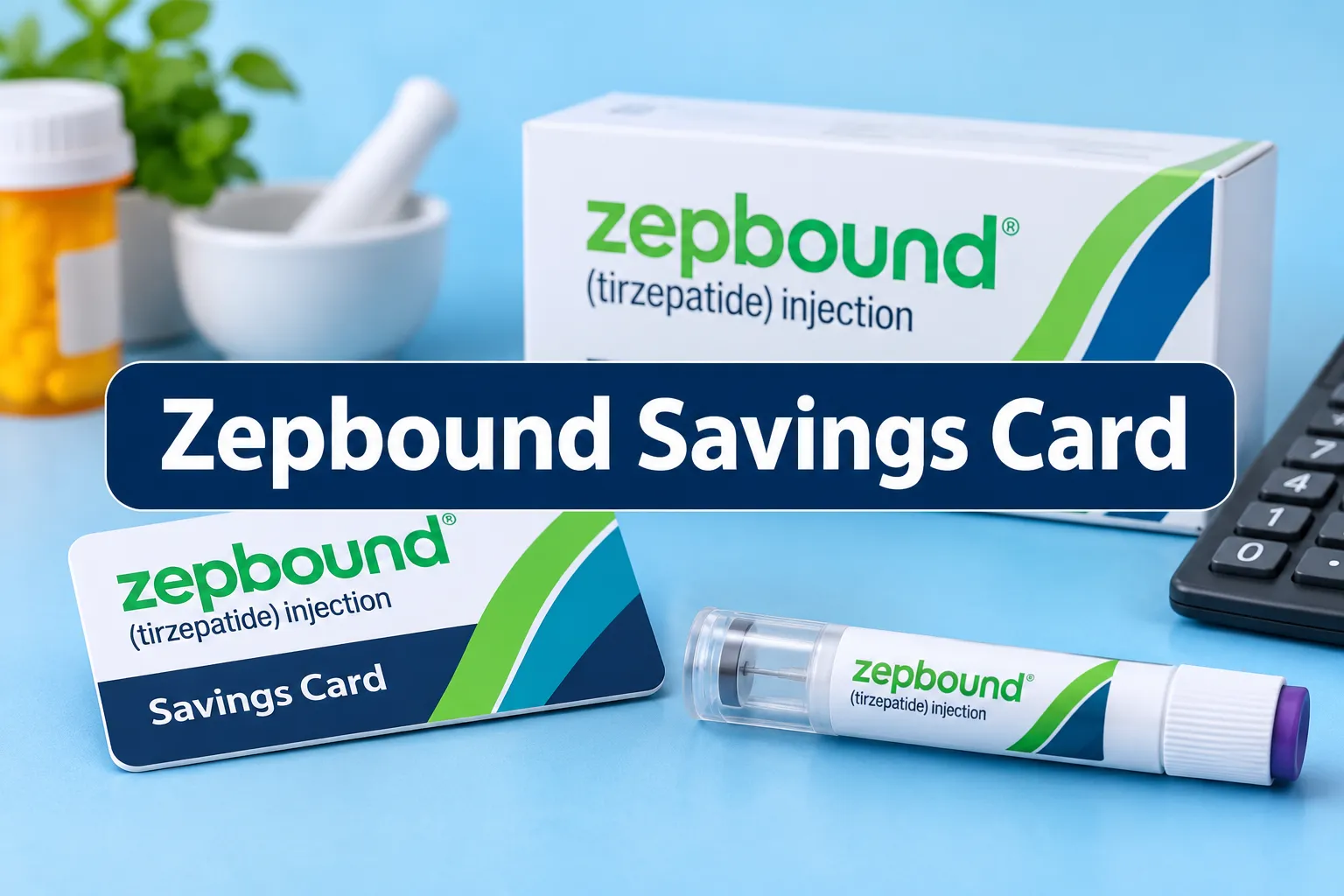
Zepbound Savings Card: Eligibility, Limits & How to Use It

Last updated: November 11, 2026
Eli Lilly runs more than one Zepbound discount program, and mixing them up is the single biggest reason people get denied at the pharmacy counter. Some cards require commercial insurance. Others were built specifically for people paying cash. Knowing which one applies to you before you show up at the register saves a wasted trip and an awkward conversation with the pharmacist.
Quick Answer
The Zepbound Savings Card is a manufacturer discount program from Eli Lilly that lowers out-of-pocket costs for eligible patients with commercial insurance coverage for Zepbound [1]. Separate programs exist for self-pay patients using the KwikPen, for a limited group tied to Taltz, and for Canadian patients. Eligibility, savings amounts, and monthly limits vary by program and can change without notice [2].
7 Best GLP-1 Providers Ranked: Accreditation, Flexibility & Support Compared (2026 Update)
32,000+ Patients Can't All Be Wrong: See the Top-Rated GLP-1 Providers. We compared the leading online GLP-1 providers based on program features, clinical support, convenience, and overall value.

BMI MD GLP-1 Microdosing Plan
- Specialized microdosing options, including sublingual drops and low-dose injections
- Designed for people interested in maintaining weight or gradually adjusting treatment
- Bundled program structure without a separate monthly platform membership
- Online access makes the process convenient from home

DirectMeds Weight Loss Solutions
- Online weight-loss program with a straightforward patient experience
- Compounded medication options through state-licensed compounding pharmacies
- Includes clinical consultation as part of the process
- Provides shipping updates to help patients track their orders

MEDVi Flat-Rate Telehealth
- Flat-rate telehealth approach designed for easier budgeting
- No dosage-based pricing increases within the advertised program structure
- Offers injectable and oral thin-film delivery options
- Includes medical screening and asynchronous provider consultations

Gala GLP-1 Care Program
- Text-based access to state-licensed clinicians
- Cold-chain medication shipping included in the program
- Month-to-month program structure
- Designed for people who value convenient ongoing support

Measured GLP-1 Metabolic Health
- Comprehensive metabolic health screening and intake analysis
- Designed around longer-term metabolic health management
- Responsive dashboard with integrated health tracking tools
- Useful option for patients who value a more data-focused experience

Refills GLP-1 (TryRefills Plan)
- Clinical guidance designed to help patients manage common treatment concerns
- Includes foundational nutritional strategies alongside medication
- Designed around predictable ongoing treatment
- No hidden startup or processing fees according to the program information provided

AltRx GLP-1 Transactional Reorders
- Transactional reorder model without recurring auto-billing
- Designed for patients who already understand their treatment routine
- Fast text-to-order process for convenient reorders
- Offers injectable and fast-dissolving tablet variations
Key Takeaways
- The “Zepbound Savings Card” is actually a family of programs, not one single offer [1][3].
- Most savings cards require commercial (private) insurance that already covers Zepbound for an FDA-approved use [1].
- Government insurance (Medicare, Medicaid, TRICARE, VA) generally disqualifies you from the classic copay card [2][4].
- A separate self-pay KwikPen program launched in March 2026 for people without insurance coverage [5][6].
- Savings cards can be used more than once per calendar year, subject to a maximum dollar benefit set in the terms and conditions [2][7].
- FSA and HSA funds can typically be used alongside savings card discounts for the remaining balance [1].
- Lilly reserves the right to modify, suspend, or end any Zepbound savings offer at any time without notice [2][7].
- If your card is declined, the most common causes are an expired card, a lapsed insurance plan, or use of the wrong program for your situation.
What Is the Zepbound Savings Card and How Does It Work
The Zepbound Savings Card is a copay assistance program from Eli Lilly that reduces what eligible, commercially insured patients pay at the pharmacy for Zepbound (tirzepatide) [1]. It works like a coupon: the pharmacy applies the card’s discount on top of your existing insurance coverage, lowering your copay at checkout.
Here’s the mechanics in plain terms:
- You must already have insurance coverage for Zepbound through your plan.
- You activate or download the card (digital or printable) from Lilly’s official savings site [1][3].
- The pharmacist enters the card’s processor information alongside your insurance info.
- The discount applies automatically; you pay the reduced amount instead of your full copay.
This is not a card that replaces insurance. It supplements it. If you have no insurance coverage for the drug at all, the standard savings card usually will not apply, which is exactly why Lilly created the separate self-pay KwikPen program described below [5].
Am I Eligible for the Zepbound Savings Card
Eligibility generally requires commercial (private) insurance that covers Zepbound for an FDA-approved indication, U.S. residency, and enrollment in the Lilly savings program before your prescription is filled [1][2]. You don’t need a diagnosis of diabetes, Zepbound’s approved uses include chronic weight management, so eligibility hinges on insurance type and FDA-approved use, not just one condition.
Typical requirements include:
- You have commercial health insurance (employer-sponsored or marketplace plans usually qualify).
- Your plan already provides some coverage for Zepbound.
- You are a legal U.S. resident, 18 or older (program rules vary by product, so check current terms).
- You are not enrolled in a government healthcare program such as Medicare or Medicaid [2][4].
Choose the standard savings card if: you have private insurance and a plan that lists Zepbound as a covered drug, even with a high copay. If you’re uninsured or your insurance excludes GLP-1 medications entirely, look at the self-pay options instead.
What Are the Income Limits for Zepbound Savings Card
There is no published income limit for the standard Zepbound Savings Card, eligibility is based on insurance status, not household income [1][2]. This surprises a lot of people who assume copay cards work like need-based assistance programs. They don’t. The gating factor is whether you have qualifying commercial insurance, not what you earn.
That said, income can matter indirectly:
- Patient assistance programs (separate from the savings card) sometimes use income thresholds for free or heavily discounted drug access.
- The self-pay KwikPen program and other cash-pay offers are priced flat rates rather than tied to income [5][6].
- If cost remains out of reach, Lilly’s broader coverage and access resources are worth reviewing on the Zepbound coverage and savings page for current program details.
Edge case: if your income changes and you move from a commercial plan to Medicaid, you could lose eligibility for the classic savings card mid-year, even though nothing about the card’s own rules changed.
How Much Money Can You Save With the Zepbound Savings Card
Savings amounts depend on which program you qualify for and are capped by an annual or per-fill maximum benefit spelled out in Lilly’s official terms [2][7]. For commercially insured patients, the savings card is designed to bring the copay down substantially compared to the list price, though the exact dollar figure depends on your plan’s cost-sharing structure.
For people without insurance coverage, Lilly’s KwikPen self-pay program introduced in March 2026 offers a flat cash price around $299 per month for certain starter doses under specific offers, making costs more predictable even without a card discount [5][6]. Always confirm the current self-pay price directly through Lilly’s official pages, since self-pay pricing structures have shifted more than once.
A quick example: a patient with employer insurance that covers Zepbound but has a high copay might see their out-of-pocket cost drop significantly with the card applied, while a patient with no insurance at all would instead look at the flat self-pay monthly rate rather than a percentage-based discount.
How Do I Apply for the Zepbound Savings Card
You apply directly through Lilly’s official Zepbound savings website by entering basic insurance and contact information, then printing or saving your card for pharmacy use [1][3]. There is no third-party application process, and you should be cautious of any site charging a fee to “register” you for the card, the official program is free.
Steps to apply:
- Visit Lilly’s official Zepbound savings page and locate the current savings card offer.
- Confirm you meet the insurance-based eligibility criteria listed in the terms and conditions [2].
- Enter your information to generate a digital card or download a printable version.
- Bring the card (or have the digital version ready) the first time you fill your prescription.
- Ask your pharmacist to apply the card alongside your insurance information.
Common mistake: applying for the card after your prescription has already been processed without it. Some pharmacies can reprocess the claim with the card applied retroactively within the same visit, but not always, bring the card information before you check out, not after.
Can You Use the Zepbound Savings Card More Than Once
Yes, the Zepbound Savings Card is designed for repeat use across multiple fills within a benefit period, not just a one-time discount [2][7]. The program functions more like an ongoing copay assistance tool than a single-use coupon, as long as your eligibility status (insurance type, program enrollment) stays the same.
Key details:
- Most savings cards reset their benefit limit annually or per calendar year, per the official terms [2].
- You do not need to reapply for every single fill, but your pharmacy may re-verify your insurance periodically.
- If you switch insurance plans or lose commercial coverage mid-year, your card may stop working even if you haven’t hit the dollar limit.
Does the Zepbound Savings Card Work With Insurance
Yes, the standard Zepbound Savings Card is specifically built to work alongside commercial insurance, applying on top of your plan’s existing coverage to lower your copay [1]. It is not a substitute for insurance and generally will not process as a standalone discount if you have no underlying coverage for the drug.
- With commercial insurance that covers Zepbound: the card typically reduces your copay meaningfully.
- With commercial insurance that excludes GLP-1 weight-loss drugs: the card usually won’t apply, since there’s no underlying coverage to supplement.
- With Medicare, Medicaid, TRICARE, or VA benefits: you’re generally excluded from the standard card, though newer programs are starting to carve out exceptions for some government-insured patients [2][4].
For patients watching the Medicare GLP-1 bridge conversation, it’s worth tracking separately from the standard savings card, since bridge or demonstration programs operate under different rules than manufacturer copay cards.
What Disqualifies You From the Zepbound Savings Card
The most common disqualifiers are government insurance, lack of any insurance coverage for Zepbound, residency outside the U.S. for the standard card, and use of the drug for a non-FDA-approved purpose [2][4]. Each of these is spelled out in Lilly’s official terms and conditions, and the company can update these exclusions at any time [7].
Disqualifying factors include:
- Enrollment in Medicare, Medicaid, TRICARE, or VA health benefits.
- No insurance plan covering Zepbound at all (you’d need the self-pay program instead).
- Living outside the United States (Canadian patients have their own separate “my zepbound” program) [3].
- Using the card for cash purchases where no insurance claim is being processed, unless using a self-pay specific offer.
- Prior enrollment in certain other manufacturer discount programs that the terms specifically exclude, such as the Taltz-linked offer in some structures [7].
Edge case: a patient who had commercial insurance when they first enrolled but switched to a Medicare Advantage plan mid-year will likely lose eligibility, even if their card hasn’t expired yet.
Zepbound Savings Card Not Working, What To Do
If your Zepbound Savings Card is declined at the pharmacy, the most common causes are an expired or inactive card, a change in insurance status, or submitting the card under the wrong program type [2]. Before assuming the program itself has ended, work through a short troubleshooting checklist.
Troubleshooting steps:
- Confirm the card hasn’t expired, Lilly periodically updates or replaces card numbers.
- Verify your insurance is still active and still commercial (not switched to a government plan).
- Double-check you’re using the correct program for your situation (standard card vs. self-pay vs. Canadian program).
- Ask the pharmacist to re-run the claim, since processor codes occasionally need manual entry.
- Call the support number printed on the card or listed on Lilly’s official savings page for a real-time eligibility check [1].
Because Lilly retains broad rights to modify or discontinue savings programs without advance notice, a card that worked last month can stop working without any error on your part [2][7]. If that happens, check the official Zepbound savings page for the latest active offers before assuming you’re permanently excluded.
Is There a Limit on How Many Times I Can Refill With the Zepbound Savings Card
Yes, refill limits exist in the form of an annual maximum savings benefit rather than a strict count of fills, meaning you can usually refill monthly until the dollar cap is reached [2][7]. Once the benefit cap is hit within the program year, you’d pay standard copay amounts for the remainder of that period unless the program resets.
- Monthly refills are generally supported as long as your prescription and insurance stay active.
- The benefit resets based on the terms published for that specific card, often annually.
- Exceeding the cap doesn’t disqualify you from future use; it just means the discount pauses until reset.
Alternatives to the Zepbound Savings Card for Cost
If you don’t qualify for the standard savings card, realistic alternatives include the self-pay KwikPen program, manufacturer patient assistance programs, and comparing pharmacy cash prices [5][6]. Weight-loss drug costs vary enough between pharmacies and programs that it’s worth comparing more than one option rather than assuming the savings card is your only path.
Alternatives worth checking:
- Self-pay KwikPen program: flat monthly pricing for uninsured patients, introduced in 2026 [5][6].
- Patient assistance programs: income-based free or reduced-cost drug access for qualifying patients.
- Employer or marketplace plan changes: switching to a plan that explicitly covers GLP-1 medications during open enrollment.
- Comparing GLP-1 options broadly: reviewing how GLP-1 medications work for weight loss if you’re not diabetic can help you understand where Zepbound fits among other options.
- Other manufacturer savings programs: for comparison, Novo Nordisk runs a similar Ozempic savings card program worth reviewing if you’re weighing GLP-1 options generally.
- TrumpRx and broader drug pricing initiatives: some patients are tracking TrumpRx eligibility and pricing changes as a possible future cost-lowering avenue.
Can I Use the Zepbound Savings Card at Any Pharmacy
Generally yes, the Zepbound Savings Card is accepted at most major U.S. retail pharmacies that fill the prescription and process commercial insurance claims [1]. It is not restricted to a single pharmacy chain, but your specific pharmacy still needs to successfully process your insurance claim for the discount to apply correctly.
- Large chain pharmacies and most independent pharmacies that accept commercial insurance should accept the card.
- Mail-order or specialty pharmacies tied to your insurance plan may have slightly different processing steps.
- If one location has trouble processing the card, calling ahead to a different pharmacy in the same chain sometimes resolves it faster than troubleshooting on the spot.
Does the Zepbound Savings Card Work for All Doses and Pen Types
The savings card generally applies across standard Zepbound dose strengths and the single-dose pen, but self-pay pricing for the KwikPen has its own separate structure introduced in 2026 [5][6]. If you’re prescribed a different pen type than what your card program covers, check the current terms before assuming automatic coverage.
- Standard commercial-insurance savings cards typically apply across the approved dose range as your prescription changes over time.
- The KwikPen self-pay program was specifically expanded for patients without insurance, with its own flat pricing structure separate from the copay card [5][6].
- If you’re switching doses (a normal part of Zepbound’s titration schedule), confirm with your pharmacist that the card still applies to the new strength before you leave the counter.
For general information on how the pen and dosing schedule work, see our overview of the Zepbound weekly injection pen and tirzepatide dosing.
What’s the Difference Between a Zepbound Coupon and a Savings Card
A “Zepbound coupon” is often informal shorthand for the same manufacturer savings card program, but the term can also refer to different, time-limited offers such as the Taltz-linked promotion running through December 31, 2026 [7]. The distinction matters because different coupons carry different eligibility rules, expiration dates, and benefit caps.
- “Savings card” usually refers to the main, ongoing commercial-insurance copay program [1].
- “Coupon” sometimes refers to a specific, limited-time promotional offer with its own separate terms [7].
- Always check the expiration date and specific terms printed on whatever offer you’re holding, don’t assume all Zepbound discount paper is interchangeable.
If you’re also researching broader Zepbound information, our pages on Zepbound reviews and ordering Zepbound online cover related questions many readers ask alongside savings card eligibility.
FAQ
Does the Zepbound Savings Card cost anything to use? No, enrollment in the official Lilly savings card program is free. Be wary of third-party sites charging a fee to “register” you.
Can I use the savings card if I’m on Medicaid? Generally no. Government insurance programs typically disqualify you from the standard commercial savings card [2][4].
Is the self-pay KwikPen program the same as the savings card? No. It’s a separate cash-pay program launched in 2026 for people without insurance coverage for Zepbound [5][6].
Does the card expire? Yes, savings cards and specific promotional offers carry expiration dates listed in the official terms, and Lilly can change or end programs at any time [2][7].
Can I combine the savings card with my FSA or HSA? Yes, you can typically use FSA or HSA funds to pay the remaining balance after the card discount is applied [1].
What if my insurance doesn’t cover Zepbound at all? The standard savings card likely won’t help. Look into the self-pay KwikPen program or patient assistance options instead.
Is there a Canadian version of the savings card? Yes, the “my zepbound” Savings & Support Program in Canada offers savings regardless of insurance status [3].
Why did my card stop working after months of success? Common reasons include a lapsed card, an insurance plan change, or a program update from Lilly, since terms can change without notice [2][7].
7 Best GLP-1 Providers Ranked: Accreditation, Flexibility & Support Compared (2026 Update)
32,000+ Patients Can't All Be Wrong: See the Top-Rated GLP-1 Providers: Compared on accreditation, plan flexibility, and patient support — updated for 2026.
BMI MD GLP-1 Microdosing Plan
- Specialized microdosing options (sublingual drops or low-dose injections)
- Ideal for maintaining weight or tapering off higher doses safely
- Fully bundled plan with no hidden monthly platform memberships
DirectMeds Weight Loss Solutions
- Sourced from accredited, state-licensed 503A compounding pharmacies
- No-frills high-volume savings passed directly to the patient
- Includes clinical consultation and cold-chain shipping updates
MEDVi Flat-Rate Telehealth
- Flat monthly rate holds steady even at maximum maintenance doses
- No dosage upcharges or graduation fee penalties
- Offers both injectable and advanced oral thin-film delivery options
Gala GLP-1 Care Program
- All-inclusive plan with no standalone membership costs
- Continuous text-based messaging access with state-licensed clinicians
- Temperature-controlled, cold-chain medication shipping included
Measured GLP-1 Metabolic Health
- Comprehensive metabolic health screening and expert intake analysis
- Predictable long-term budgeting with stable plan pricing
- High-end responsive dashboard with integrated diagnostic support
Refills GLP-1 (TryRefills Plan)
- Flat rate holds steady as titration scales up
- Includes clinical guides for active side-effect management
- Bundles in foundational nutritional strategies alongside medication
AltRx GLP-1 Transactional Reorders
- Zero recurring auto-billing — pay entirely on a transactional basis
- Rapid text-to-order format saves time for experienced patients
- Provides both injectable forms and fast-dissolving tablet variations
Conclusion
The Zepbound Savings Card can meaningfully cut your out-of-pocket cost, but only if you match the right program to your actual insurance situation. Commercially insured patients should start with the standard card. Uninsured patients should look at the 2026 self-pay KwikPen pricing instead. Government-insured patients face more limited options and should check current terms directly, since rules shift.
Next steps: confirm your insurance type, visit Lilly’s official Zepbound savings page to check current eligibility, and keep your card information ready before your next pharmacy visit. If a card stops working, troubleshoot before assuming you’re disqualified for good, these programs change often, and this guide will be updated as new terms are published.
References
- Savings. zepbound.lilly.com.
- Terms and Conditions. zepbound.lilly.com.
- Coverage Savings. zepbound.lilly.com.
- Zepbound Covered Insurance 3577162. drugs.com.
- Media Statement Zepbound Tirzepatide Kwikpen Now Available Self. lilly.gcs-web.com.
- Media Statement Zepbound Tirzepatide Kwikpen Now Available Self. investor.lilly.com.
- Zepbound Tirzepatide Full Terms Conditions. lilly.com.