
Saxenda vs Victoza: Same Drug, Different Doses & Uses

Last updated: October 29, 2026
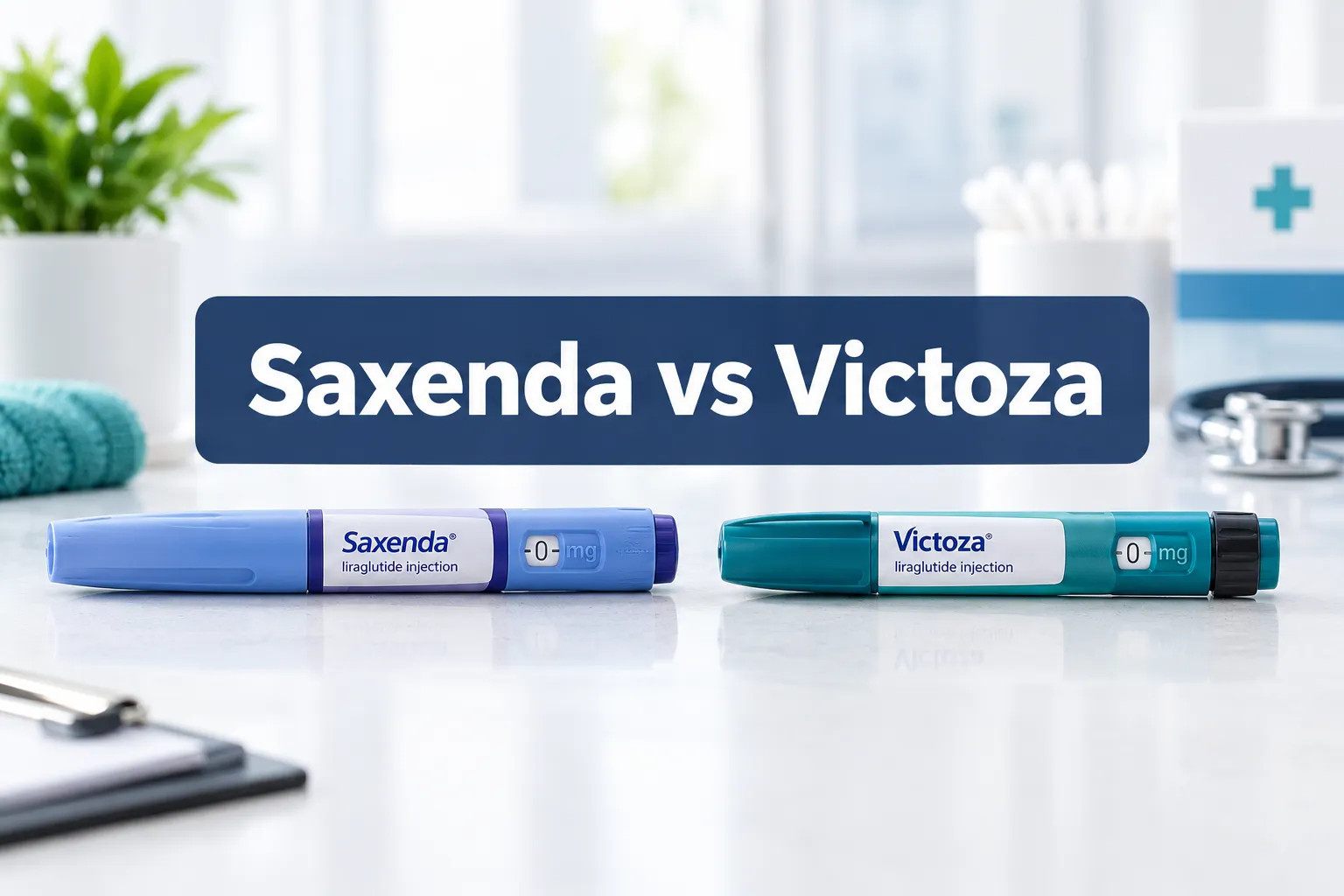
Both pens contain the exact same molecule, liraglutide, yet one is approved for weight loss and the other for diabetes. That single fact confuses more patients than almost anything else in the GLP-1 world. This guide breaks down Saxenda vs Victoza: Same Drug, Different Doses & Uses so you know which pen matches your medical situation, your insurance plan, and your goals.
Quick Answer
Saxenda and Victoza both contain liraglutide made by Novo Nordisk, but they’re approved for different conditions and dosed differently. Victoza tops out at 1.8 mg daily for type 2 diabetes and cardiovascular risk reduction, while Saxenda goes up to 3 mg daily for chronic weight management.[1][2] You cannot use them interchangeably or combine them.[2][3][4]
7 Best GLP-1 Providers Ranked: Accreditation, Flexibility & Support Compared (2026 Update)
32,000+ Patients Can't All Be Wrong: See the Top-Rated GLP-1 Providers. We compared the leading online GLP-1 providers based on program features, clinical support, convenience, and overall value.

BMI MD GLP-1 Microdosing Plan
- Specialized microdosing options, including sublingual drops and low-dose injections
- Designed for people interested in maintaining weight or gradually adjusting treatment
- Bundled program structure without a separate monthly platform membership
- Online access makes the process convenient from home

DirectMeds Weight Loss Solutions
- Online weight-loss program with a straightforward patient experience
- Compounded medication options through state-licensed compounding pharmacies
- Includes clinical consultation as part of the process
- Provides shipping updates to help patients track their orders

MEDVi Flat-Rate Telehealth
- Flat-rate telehealth approach designed for easier budgeting
- No dosage-based pricing increases within the advertised program structure
- Offers injectable and oral thin-film delivery options
- Includes medical screening and asynchronous provider consultations

Gala GLP-1 Care Program
- Text-based access to state-licensed clinicians
- Cold-chain medication shipping included in the program
- Month-to-month program structure
- Designed for people who value convenient ongoing support

Measured GLP-1 Metabolic Health
- Comprehensive metabolic health screening and intake analysis
- Designed around longer-term metabolic health management
- Responsive dashboard with integrated health tracking tools
- Useful option for patients who value a more data-focused experience

Refills GLP-1 (TryRefills Plan)
- Clinical guidance designed to help patients manage common treatment concerns
- Includes foundational nutritional strategies alongside medication
- Designed around predictable ongoing treatment
- No hidden startup or processing fees according to the program information provided

AltRx GLP-1 Transactional Reorders
- Transactional reorder model without recurring auto-billing
- Designed for patients who already understand their treatment routine
- Fast text-to-order process for convenient reorders
- Offers injectable and fast-dissolving tablet variations
Key Takeaways
- Saxenda and Victoza are both liraglutide, supplied in 18 mg/3 mL pens, but with different maximum doses.[1][2]
- Victoza’s max dose is 1.8 mg daily; Saxenda’s max dose is 3 mg daily.[1][2]
- Victoza is FDA-approved for type 2 diabetes and cardiovascular risk reduction, not weight loss.[2][4][5]
- Saxenda is approved specifically for chronic weight management, not diabetes treatment.[2][4]
- Higher-dose Saxenda produces more weight loss on average (about 6.0%) than max-dose Victoza (about 4.7%).[1]
- You should never take Saxenda and Victoza together or substitute one for the other without medical guidance.[2][3][4]
- Saxenda availability is changing in some markets, including a reported discontinuation in Australia after December 2025.[6]
What’s the actual difference between Saxenda and Victoza
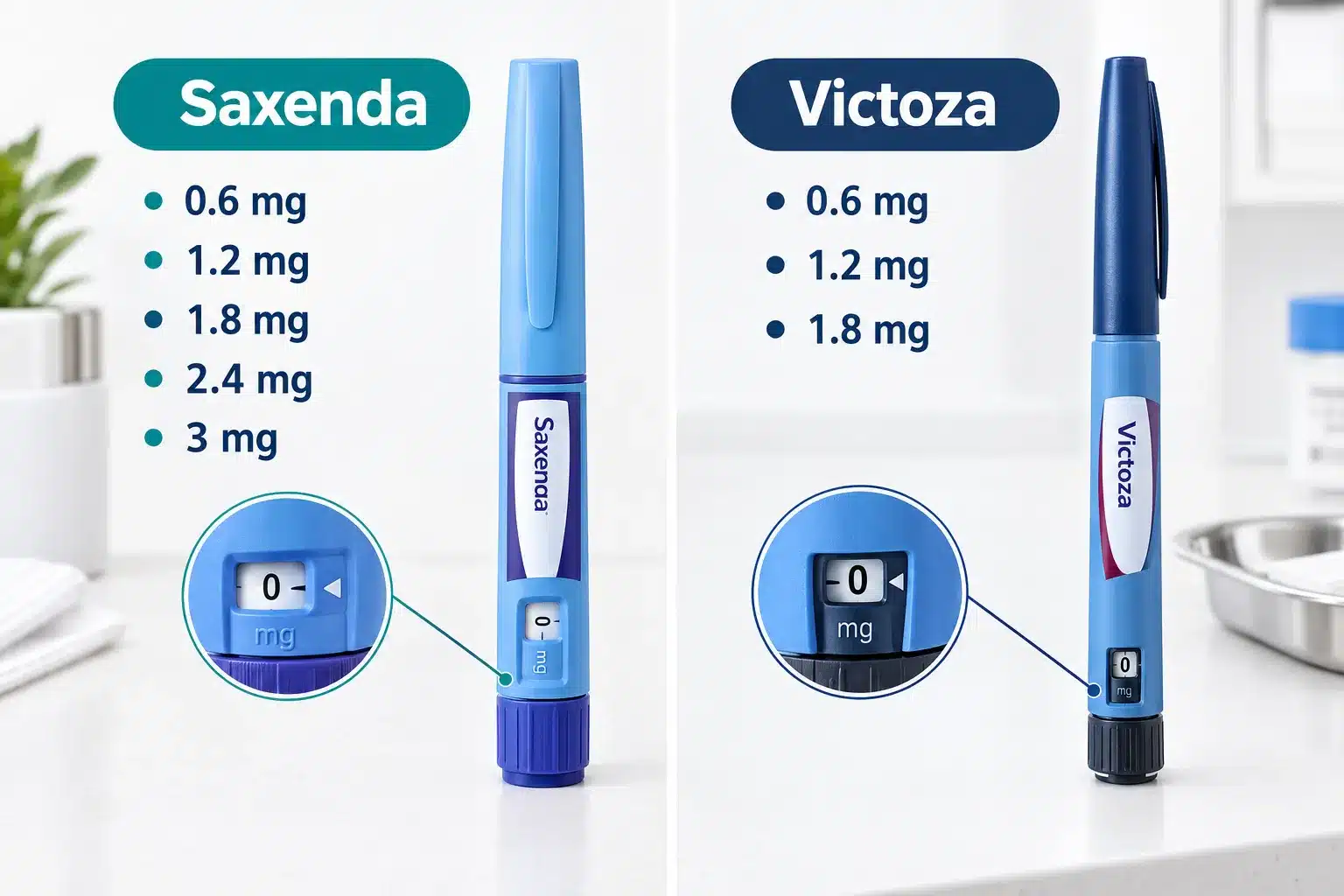
The active drug is identical: liraglutide. What differs is the dose range and the FDA-approved purpose.[1][2] Victoza pens deliver 0.6 mg, 1.2 mg, or 1.8 mg, while Saxenda pens deliver 0.6 mg, 1.2 mg, 1.8 mg, 2.4 mg, or 3 mg.[1][2]
Think of it this way: Victoza was designed first, for blood sugar control. Researchers later found that liraglutide at higher doses produced meaningful weight loss, so Novo Nordisk developed Saxenda as a separate product with its own titration schedule and its own label.[1][2]
Decision rule: if your main problem is blood sugar and heart risk, Victoza’s dose range is appropriate. If your main problem is body weight and you don’t have diabetes, Saxenda’s higher dose range is the one studied for that purpose.
Why are Saxenda and Victoza the same drug but different names
Novo Nordisk markets liraglutide under two brand names because each brand carries its own FDA indication, packaging, and titration schedule. Victoza launched first for type 2 diabetes; Saxenda followed as a dedicated obesity treatment once higher-dose trials showed clinically significant weight loss.[1][2]
This is common in pharmaceuticals. Separating the brands lets insurance companies, pharmacists, and providers track usage by purpose, and it keeps diabetes-focused prescribing separate from weight-management prescribing. It also means each brand’s clinical trial data, warning labels, and age approvals can differ even though the molecule is the same.[1][2][4]
Common mistake: assuming you can simply buy whichever brand is cheaper and use it at the same dose. The two products are not meant to be substituted milligram-for-milligram without a provider’s guidance.
Can you use Victoza for weight loss like Saxenda
Victoza may cause some weight loss as a side effect, but it is not FDA-approved for weight management and typically produces less weight loss than Saxenda’s higher dose range.[1][4][5] Some patients and providers discuss this off-label use, but it isn’t the drug’s intended purpose.
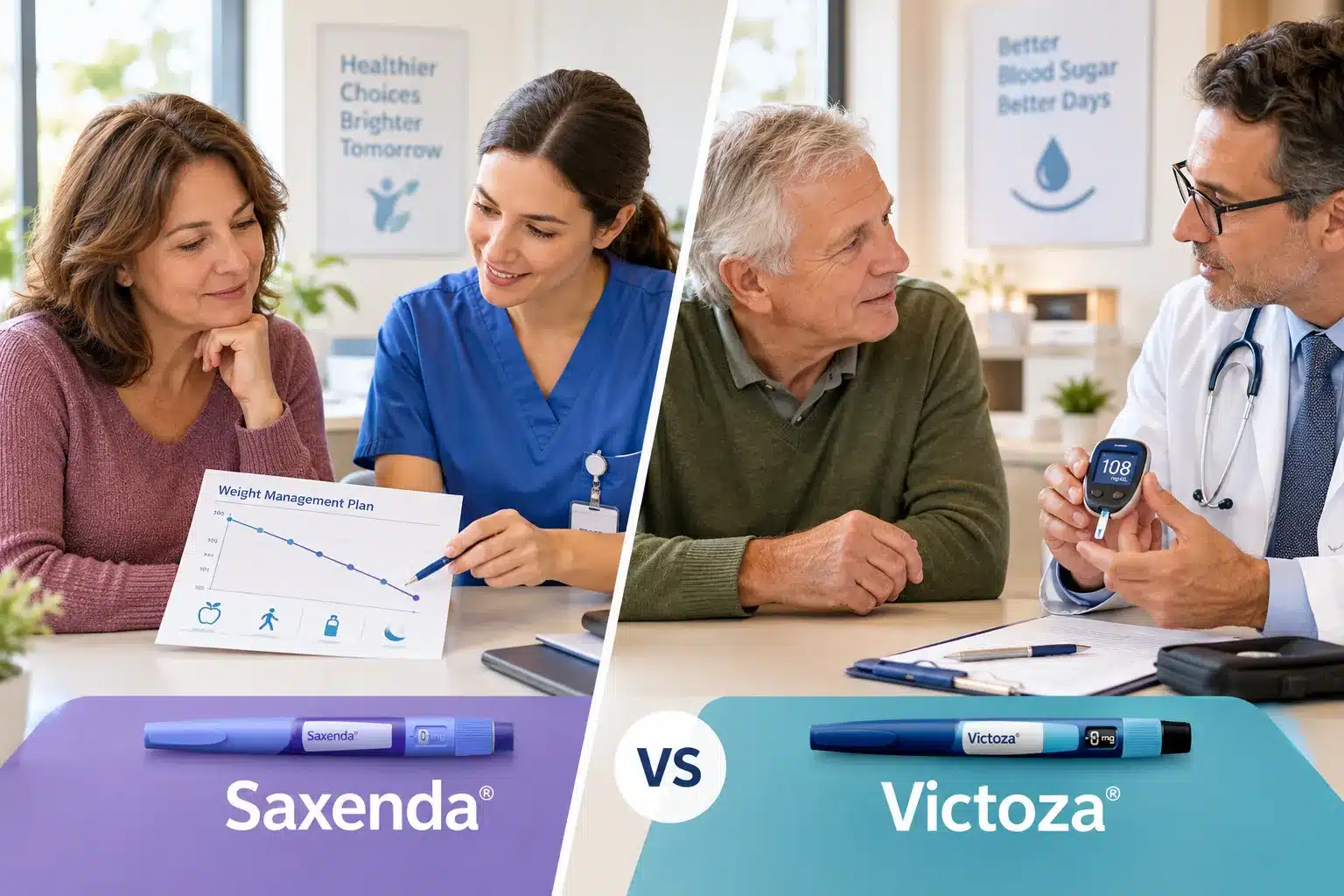
Here’s why the distinction matters: Victoza’s maximum approved dose (1.8 mg) is lower than Saxenda’s maximum (3 mg), and clinical data show the higher dose drives more weight loss.[1][2] If weight loss is your primary goal and you don’t have diabetes, Saxenda’s approved dosing schedule is built for that outcome.
Edge case: if you have type 2 diabetes and are already on Victoza, your doctor may note incidental weight loss as a benefit, but switching specifically to chase bigger weight-loss numbers should be a medical decision, not a self-directed one.
Saxenda vs Victoza cost and insurance coverage
Insurance coverage usually depends on your diagnosis, not the molecule itself. Victoza is more often covered for patients with a type 2 diabetes diagnosis, while Saxenda coverage depends heavily on whether your plan includes an obesity-medication benefit.[1][2] [VERIFY: exact copay and coverage figures change by plan and year, confirm with your insurer]
Many patients without diabetes find Saxenda harder to get covered, which pushes some toward comparing prices across pharmacies or exploring discount programs. If cost is a barrier, it’s worth checking resources like the TrumpRx drug list for discounted prices or reviewing TrumpRx weight-loss GLP-1 pricing before assuming a medication is out of reach.
Quick example: a patient with type 2 diabetes and employer insurance may pay a modest copay for Victoza, while a non-diabetic patient seeking Saxenda purely for weight loss might face full cash price unless their plan specifically covers obesity treatment.
Saxenda vs Victoza which works better for weight loss
Saxenda works better for weight loss because it’s dosed higher and was specifically studied for that outcome. In comparative data, patients on the maximum Saxenda dose (3 mg) lost an average of about 6.0% of body weight, versus about 4.7% for patients on the maximum Victoza dose (1.8 mg).[1]
That roughly 1.3 percentage point gap reflects dose, not a different drug. Saxenda’s extra titration steps (2.4 mg and 3 mg) push the appetite-suppressing and gastric-emptying effects of liraglutide further than Victoza’s ceiling allows.[1][2]
Choose Saxenda if: your goal is maximum weight loss and you don’t have diabetes. Choose Victoza if: your primary need is glycemic control, with any weight loss as a secondary benefit.
How much weight do you lose on Saxenda vs Victoza, and how fast
Weight loss on Saxenda typically builds gradually over the titration period and continues through roughly the first six months of consistent use, with the average result around 6.0% of body weight at the 3 mg dose in comparative data.[1] Victoza at its 1.8 mg ceiling has shown roughly 4.7% average weight loss in the same comparison.[1]
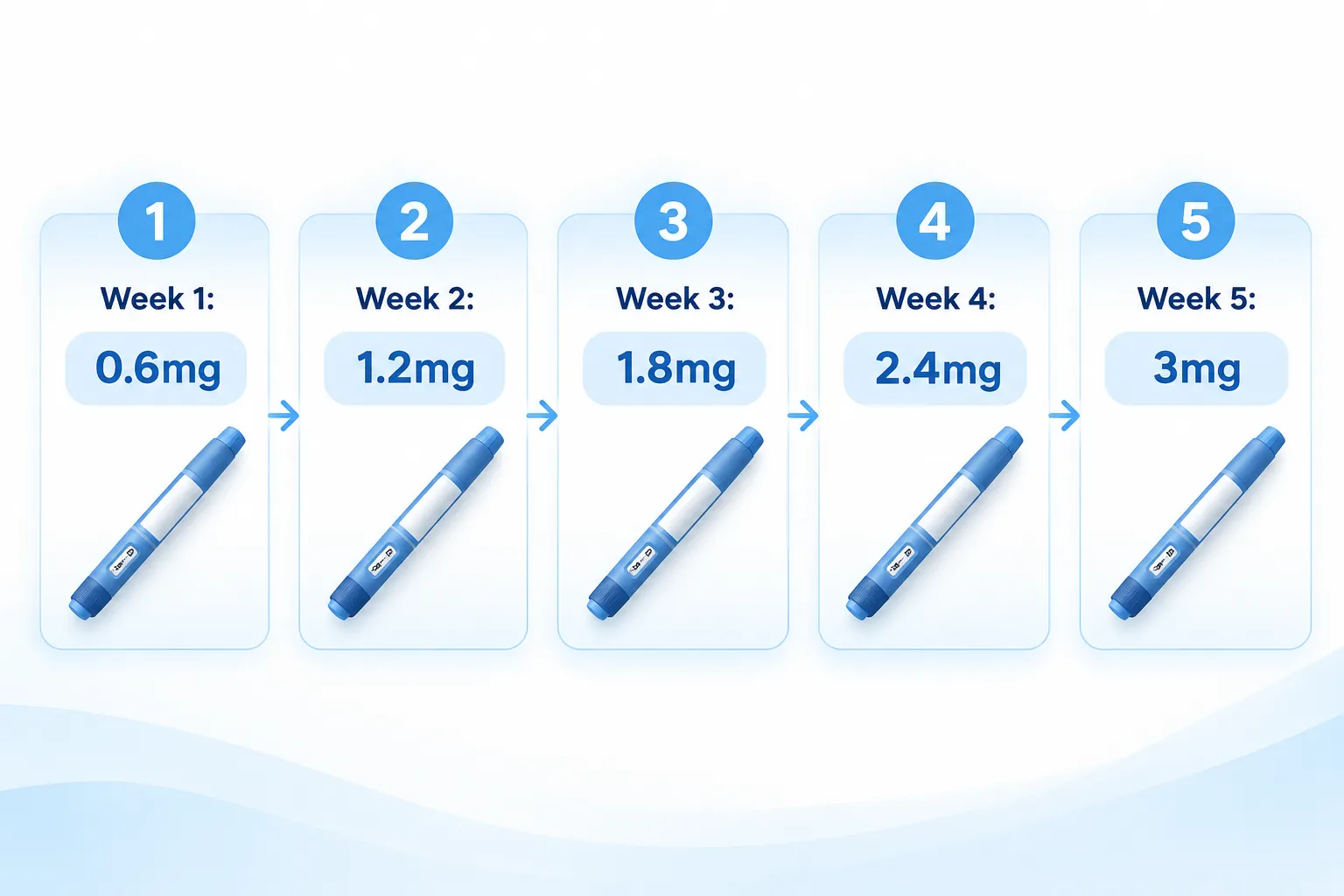
The titration schedule itself takes time: most patients start at 0.6 mg and increase roughly every week, reaching Saxenda’s 3 mg target around week five if tolerated.[1][2][5] Noticeable appetite changes often show up within the first two to four weeks, but meaningful scale movement usually takes longer. For a broader look at onset timing across GLP-1 drugs, see how long it takes for GLP-1 medications to work.
Common mistake: expecting rapid results in week one. Both drugs require weeks of titration before reaching a dose that produces consistent appetite suppression.
Who qualifies for Saxenda vs Victoza
Saxenda is approved for adults with a BMI of 30 or higher, or 27 or higher with at least one weight-related condition like high blood pressure, and for adolescents 12 and older who meet specific BMI criteria.[1][2][4] Victoza is approved for adults and children 10 and older with type 2 diabetes, plus adults with type 2 diabetes and established cardiovascular disease for heart-risk reduction.[1][2][4][5]
Saxenda is explicitly not indicated for type 1 or type 2 diabetes treatment, even though it can lower blood sugar somewhat as a side effect.[2][3][4] Victoza, meanwhile, is only approved for diabetes-related indications, not obesity treatment.[2][4]
Decision rule: your diagnosis, not your preference, should determine which brand your provider prescribes. A BMI-only candidate without diabetes qualifies for Saxenda; a type 2 diabetes diagnosis points toward Victoza.
Is Saxenda or Victoza better for type 2 diabetes
Victoza is the correct choice for type 2 diabetes because it’s the version actually approved and studied for glycemic control and cardiovascular risk reduction.[2][4][5] Saxenda is not indicated for diabetes treatment at all, even though some blood sugar improvement can occur as a side effect of weight loss.[3][4]
If you have both diabetes and a need for significant weight loss, your provider might consider other GLP-1 or dual-agonist options approved for both conditions, rather than relying on Saxenda off-label. For broader context on GLP-1 options beyond liraglutide, see this overview of GLP-1 weight loss injections available online.
Edge case: a patient with prediabetes but not full type 2 diabetes may still qualify for Saxenda based on BMI criteria, since prediabetes alone isn’t the same as a diabetes diagnosis.
Saxenda and Victoza side effects: which is worse
Saxenda is more likely to cause side effects than Victoza, mainly because its approved maximum dose is higher.[1] Both share the typical GLP-1 side effect profile: nausea, vomiting, diarrhea, constipation, and injection-site reactions.[1]
A June 2026 update to the Australian product information for Victoza added dysaesthesia, alopecia, and non-arteritic anterior ischaemic optic neuropathy (NAION) to the listed adverse effects, noting NAION cases reported with GLP-1 receptor agonists including liraglutide, and advising urgent eye evaluation for sudden vision loss.[7] This update applies to liraglutide generally, so it’s relevant to anyone using either brand. If you’re dealing with digestive side effects on any GLP-1 drug, our guide on Ozempic diarrhea and constipation causes and relief tips covers management strategies that often apply across the drug class.
Common mistake: assuming side effects mean the drug is “not working.” Nausea during titration is expected and usually eases as your body adjusts to each dose step.
Can I switch from Victoza to Saxenda
Switching from Victoza to Saxenda is possible but should only happen under medical supervision, since the products have different titration schedules and different approved purposes.[1][2] Your provider will likely restart you on Saxenda’s own titration path rather than jumping straight to a higher dose.
This switch makes sense for patients who have type 2 diabetes under control but also want a dedicated weight-management approach, or for non-diabetic patients who were prescribed Victoza off-label for weight loss and now want the dose range actually studied for that purpose.[2][5]
Decision rule: switch if your diagnosis or treatment goal has changed and your provider confirms the new brand matches your current needs. Don’t switch purely because one pen seems cheaper that month.
What happens if you take Saxenda at the Victoza dose, or vice versa
Taking Saxenda at Victoza’s lower dose range (up to 1.8 mg) likely won’t cause harm beyond typical GLP-1 side effects, but you’d be underdosing for weight-loss purposes and not following the approved titration.[1][2] Taking Victoza at Saxenda’s higher doses (2.4 mg or 3 mg) is not supported by Victoza’s label and could increase side effect risk without added diabetes benefit, since Victoza’s diabetes indication was studied only up to 1.8 mg.[1][2]
This is exactly why providers insist on using each pen according to its own label. Mixing dose schedules defeats the purpose of having two differently studied products from the same molecule.
Edge case: a patient who accidentally takes an extra dose should contact their provider promptly rather than guessing whether it’s safe to continue as normal.
Saxenda vs Victoza for non-diabetics
Non-diabetics who want to use liraglutide for weight management should generally be prescribed Saxenda, not Victoza, because Saxenda is the product actually indicated and dosed for obesity treatment.[1][2][4] Victoza was never studied as a primary weight-loss drug and its ceiling dose is lower.[1][2]
Some providers have historically prescribed Victoza off-label for weight loss, often due to cost or insurance quirks, but this approach delivers smaller average results than Saxenda’s approved dosing.[1] If you’re non-diabetic and weighing GLP-1 options broadly, see our guide on GLP-1 weight loss for non-diabetics for more context on eligibility and alternatives.
Common mistake: assuming any liraglutide pen will work the same for weight loss regardless of brand. The approved dose range is what drives the difference in outcomes.
Saxenda vs Victoza vs Ozempic vs Wegovy: which is best
There’s no single “best” GLP-1 drug; the right choice depends on your diagnosis, dosing tolerance, and goals. Saxenda and Victoza are both liraglutide (daily injections), while Ozempic (diabetes) and Wegovy (weight loss) are both semaglutide (weekly injections), a related but different molecule often associated with stronger average weight-loss results in trials.[8]
Here’s a simple comparison:
| Drug | Molecule | Dosing | Primary Approval |
|---|---|---|---|
| Victoza | Liraglutide | Daily, up to 1.8 mg | Type 2 diabetes, cardiovascular risk |
| Saxenda | Liraglutide | Daily, up to 3 mg | Chronic weight management |
| Ozempic | Semaglutide | Weekly | Type 2 diabetes |
| Wegovy | Semaglutide | Weekly | Chronic weight management |
Decision rule: if you prefer a weekly injection and want to compare semaglutide-based weight loss, read our Wegovy reviews for real-world results. If daily dosing and liraglutide’s longer track record matter more to you, Saxenda or Victoza remain reasonable choices depending on your diagnosis.
Frequently Asked Questions
Is Saxenda stronger than Victoza?
Saxenda allows a higher maximum dose (3 mg vs 1.8 mg) of the same drug, liraglutide, which generally produces more weight loss but also a higher chance of side effects.[1][2]
Can I take Saxenda and Victoza together?
No. Guidance consistently warns against using Saxenda and Victoza at the same time, since both deliver the same active drug and combining them raises dosing risk without added benefit.[2][3][4]
Does Victoza cause weight loss even though it’s for diabetes?
Yes, some weight loss can occur on Victoza as a side effect, but it’s generally smaller than what Saxenda produces at its higher approved dose.[1][5]
Why is Saxenda being discontinued in some countries?
Reports indicate Saxenda will be unavailable for purchase in Australia after December 2025, with providers advised to discuss alternatives with patients.[6] Separately, Novo Nordisk removed Saxenda from a patient support program in Brazil starting March 2025.[9] These changes appear related to access and support programs rather than new safety concerns.[6][9]
Is liraglutide the same as semaglutide?
No. Liraglutide (Saxenda, Victoza) and semaglutide (Ozempic, Wegovy) are both GLP-1 receptor agonists but are chemically different molecules with different dosing schedules and typically different average weight-loss results.[8]
How long does it take to reach the full Saxenda dose?
Most patients titrate from 0.6 mg up to the 3 mg target over about five weeks, increasing roughly weekly as tolerated.[1][2][5]
Can children use Victoza or Saxenda?
Victoza is approved for children 10 and older with type 2 diabetes. Saxenda is approved for adolescents 12 and older who meet specific BMI and weight criteria.[1][2][4]
Should I worry about eye problems on liraglutide?
A 2026 safety update added NAION, a rare eye condition, to Victoza’s adverse effects list, following reports with GLP-1 drugs including liraglutide. Sudden vision loss on either drug warrants urgent medical evaluation.[7]
7 Best GLP-1 Providers Ranked: Accreditation, Flexibility & Support Compared (2026 Update)
32,000+ Patients Can't All Be Wrong: See the Top-Rated GLP-1 Providers: Compared on accreditation, plan flexibility, and patient support — updated for 2026.
BMI MD GLP-1 Microdosing Plan
- Specialized microdosing options (sublingual drops or low-dose injections)
- Ideal for maintaining weight or tapering off higher doses safely
- Fully bundled plan with no hidden monthly platform memberships
DirectMeds Weight Loss Solutions
- Sourced from accredited, state-licensed 503A compounding pharmacies
- No-frills high-volume savings passed directly to the patient
- Includes clinical consultation and cold-chain shipping updates
MEDVi Flat-Rate Telehealth
- Flat monthly rate holds steady even at maximum maintenance doses
- No dosage upcharges or graduation fee penalties
- Offers both injectable and advanced oral thin-film delivery options
Gala GLP-1 Care Program
- All-inclusive plan with no standalone membership costs
- Continuous text-based messaging access with state-licensed clinicians
- Temperature-controlled, cold-chain medication shipping included
Measured GLP-1 Metabolic Health
- Comprehensive metabolic health screening and expert intake analysis
- Predictable long-term budgeting with stable plan pricing
- High-end responsive dashboard with integrated diagnostic support
Refills GLP-1 (TryRefills Plan)
- Flat rate holds steady as titration scales up
- Includes clinical guides for active side-effect management
- Bundles in foundational nutritional strategies alongside medication
AltRx GLP-1 Transactional Reorders
- Zero recurring auto-billing — pay entirely on a transactional basis
- Rapid text-to-order format saves time for experienced patients
- Provides both injectable forms and fast-dissolving tablet variations
Conclusion
Saxenda and Victoza both deliver liraglutide, but they are not interchangeable: Victoza targets blood sugar and cardiovascular risk at doses up to 1.8 mg, while Saxenda targets weight management at doses up to 3 mg.[1][2][4] Your diagnosis, not personal preference or cost alone, should guide which one you use, and the two should never be combined.[2][3][4]
If you’re deciding between these options, or considering alternatives like semaglutide-based drugs, talk with a healthcare provider about your specific BMI, blood sugar status, and goals before starting or switching any GLP-1 medication. For a broader comparison of GLP-1 options and real patient feedback, explore our GLP-1 medication reviews.
This article is for informational purposes only and is not medical advice. Talk to a licensed healthcare provider before starting or changing any medication.
References
- Saxenda vs. Victoza. drugs.com.
- Liraglutide. drugs.com.
- Foods Avoid Saxenda 3569176. drugs.com.
- Liraglutide Weight Loss 3562077. drugs.com.
- Victoza Weight Loss 3544579. drugs.com.
- In Practice Discontinuation of Diabetes Obesity Dr. www1.racgp.org.au.
- Product Information Safety Updates. tga.gov.au.
- Liraglutide Semaglutide How Compare 3579997. drugs.com.
- Saxenda Fevereiro 2025 Descontinuidade Novodia. novonordisk.com.br.





