
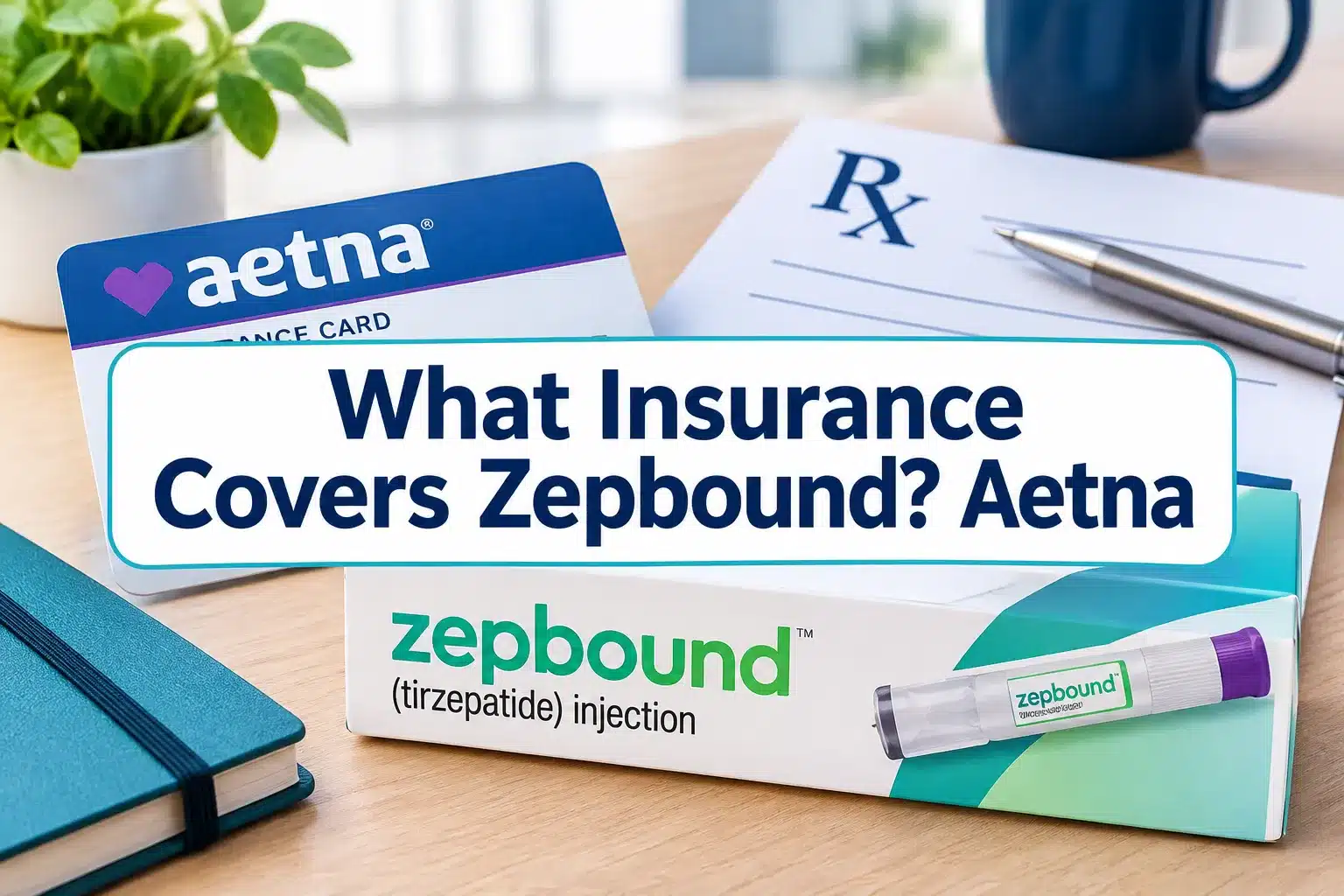
What Insurance Covers Zepbound? Aetna, Cigna, BCBS & UHC

Last updated: November 11, 2026
Quick Answer
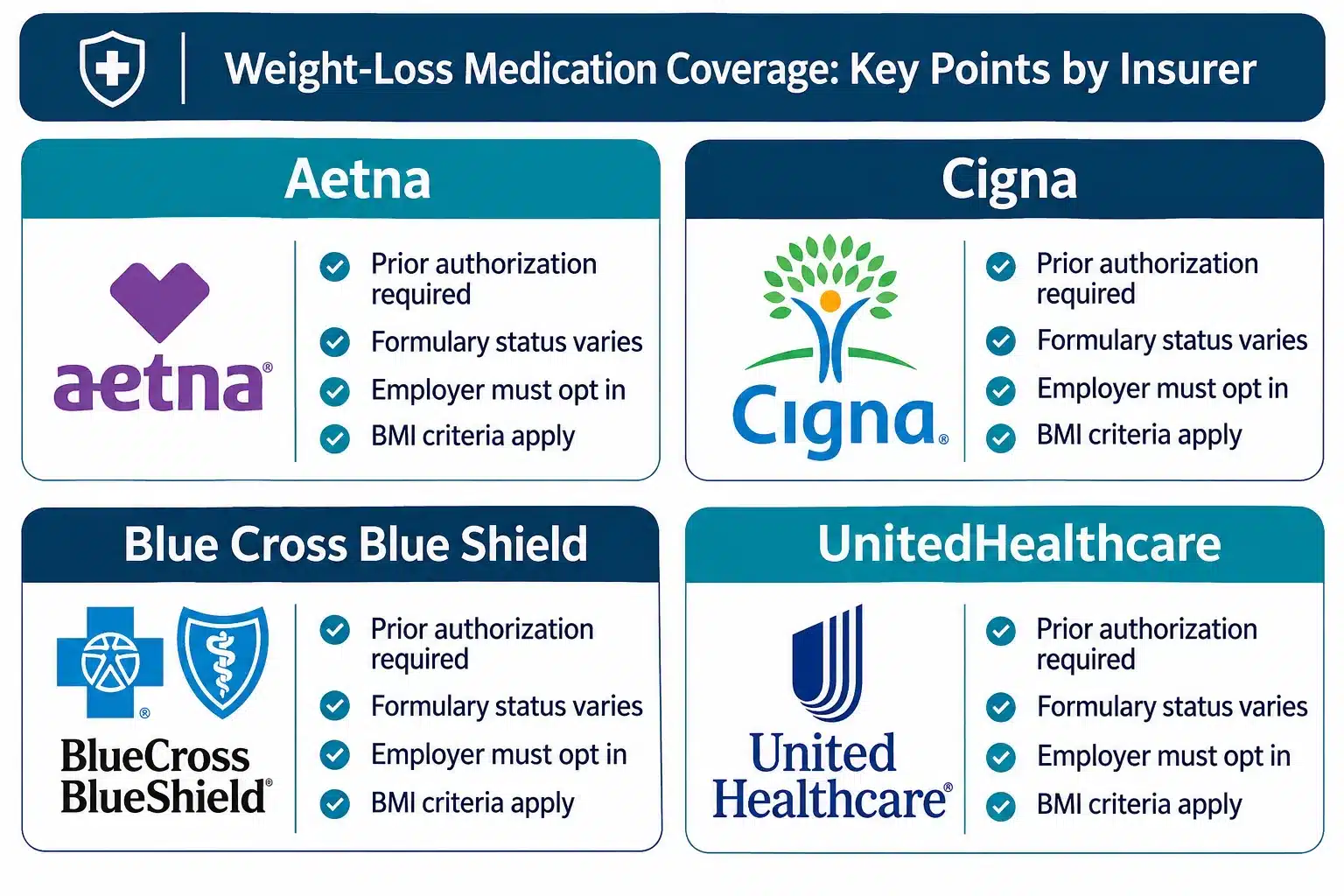
No insurer covers Zepbound automatically. Coverage depends on whether your employer chose to include weight-loss drugs in your plan, then whether you pass prior authorization. As of late 2026, Aetna and Cigna cover Zepbound on select formularies with prior authorization, some Blue Cross Blue Shield plans exclude it entirely, and UnitedHealthcare approves it in phases tied to weight-loss results, all only when the employer has opted into weight-loss coverage.
Key Takeaways
- Over 60% of insured Americans now have no coverage for Zepbound, up from 51% a year earlier.
- Aetna added Zepbound back to three main formularies starting October 1, 2026, but only for employers who chose weight-loss coverage.
- Cigna requires 3 months of documented diet and behavior change attempts plus a BMI threshold before approving an 8-month initial course.
- Blue Cross Blue Shield coverage varies wildly by state and plan, Massachusetts excludes it at 2026 renewals, while FEP Blue covers it with approval.
- UnitedHealthcare approves a 6-month trial, then requires 5% weight loss to renew for another 12 months.
- CVS Caremark restored Zepbound to its standard commercial formulary in 2026, covering roughly 25-30 million Americans.[1]
- Without insurance, Zepbound’s list price runs well above $1,000 monthly, though savings cards and self-pay options can lower that.[2]
- A new Medicare GLP-1 Bridge program aims to let eligible beneficiaries pay as little as $50 per month starting mid-2026.[3]
More than half of adults who ask for a GLP-1 prescription today walk away with a denial letter instead of a pharmacy pickup. That’s not a guess, it’s the direction insurance data has moved for Zepbound coverage through 2026. If you’re trying to figure out what insurance covers Zepbound? Aetna, Cigna, BCBS & UHC policies all answer the question differently, and the answer often hinges less on the insurer’s name and more on what your specific employer decided to pay for. This guide breaks down each major carrier’s actual rules, the costs you’ll face with and without coverage, and what to do if you’re denied.
7 Best GLP-1 Providers Ranked: Accreditation, Flexibility & Support Compared (2026 Update)
32,000+ Patients Can't All Be Wrong: See the Top-Rated GLP-1 Providers. We compared the leading online GLP-1 providers based on program features, clinical support, convenience, and overall value.
BMI MD GLP-1 Microdosing Plan
- Specialized microdosing options, including sublingual drops and low-dose injections
- Designed for people interested in maintaining weight or gradually adjusting treatment
- Bundled program structure without a separate monthly platform membership
- Online access makes the process convenient from home

DirectMeds Weight Loss Solutions
- Online weight-loss program with a straightforward patient experience
- Compounded medication options through state-licensed compounding pharmacies
- Includes clinical consultation as part of the process
- Provides shipping updates to help patients track their orders
MEDVi Flat-Rate Telehealth
- Flat-rate telehealth approach designed for easier budgeting
- No dosage-based pricing increases within the advertised program structure
- Offers injectable and oral thin-film delivery options
- Includes medical screening and asynchronous provider consultations
Gala GLP-1 Care Program
- Text-based access to state-licensed clinicians
- Cold-chain medication shipping included in the program
- Month-to-month program structure
- Designed for people who value convenient ongoing support
Measured GLP-1 Metabolic Health
- Comprehensive metabolic health screening and intake analysis
- Designed around longer-term metabolic health management
- Responsive dashboard with integrated health tracking tools
- Useful option for patients who value a more data-focused experience
Refills GLP-1 (TryRefills Plan)
- Clinical guidance designed to help patients manage common treatment concerns
- Includes foundational nutritional strategies alongside medication
- Designed around predictable ongoing treatment
- No hidden startup or processing fees according to the program information provided
AltRx GLP-1 Transactional Reorders
- Transactional reorder model without recurring auto-billing
- Designed for patients who already understand their treatment routine
- Fast text-to-order process for convenient reorders
- Offers injectable and fast-dissolving tablet variations
What Is Zepbound Used for and How Does It Work
Zepbound (tirzepatide) is an FDA-approved injectable medication for chronic weight management and, in some cases, moderate-to-severe obstructive sleep apnea.[4] It works by mimicking two gut hormones, GIP and GLP-1, which slow digestion and reduce appetite.
Doctors prescribe it for adults who are obese (BMI 30 or higher) or overweight (BMI 27 or higher) with a weight-related health condition like high blood pressure or type 2 diabetes. It’s given as a once-weekly injection using a prefilled pen, and dosing starts low and increases over several weeks.
Choose Zepbound if your doctor has confirmed you meet BMI and health criteria and you’re prepared for a long-term treatment plan, this isn’t a short-term fix. For a deeper look at how patients describe results, see this roundup of Zepbound reviews and details on the Zepbound weekly injection pen.
How Much Does Zepbound Cost With Insurance Coverage
With insurance coverage that includes Zepbound on the formulary, many commercially insured patients can pay as little as $25 per month using Lilly’s savings program, provided their prescription matches an FDA-approved indication.[5]
That low price only applies when all these conditions line up:
- Your plan includes weight-loss drug coverage (not every employer selects this).
- Zepbound is on your plan’s formulary.
- You’ve passed prior authorization.
- You qualify for and enroll in the manufacturer savings card.
Without meeting every condition, your out-of-pocket cost jumps dramatically, sometimes to the full list price. Edge case: some plans cover the drug but place it on a high-cost specialty tier, meaning your copay could still run into hundreds of dollars monthly even with “coverage.”
Why Did My Insurance Deny Zepbound Coverage
Insurance denies Zepbound most often because the employer excluded weight-loss drugs from the plan entirely, not because of a clerical error. Even when weight-loss drugs are included, failing to meet BMI thresholds or missing required documentation of prior diet attempts leads to denial.[6][7]
Common denial reasons include:
- The employer’s plan design excludes anti-obesity medications altogether.
- BMI falls below the insurer’s required cutoff (sometimes as high as 40).
- Missing proof of a supervised diet or behavior-change program.
- The prescription doesn’t match an FDA-approved use.
- Prior authorization paperwork was incomplete or submitted incorrectly.
If you’re denied, ask your insurer for the specific denial code and reason in writing. Many denials can be appealed successfully once the missing documentation is added. For a broader view of out-of-pocket strategies, see GLP-1 without insurance.
Does Cigna Cover Zepbound Like Aetna Does
Cigna and Aetna both cover Zepbound under similar structures, but Cigna applies stricter documented clinical criteria before approval. Cigna’s policy, effective September 1, 2026, approves an initial 8-month course only for adults who’ve tried a reduced-calorie diet and behavior changes for at least 3 months and meet BMI thresholds.
Aetna, by contrast, added Zepbound to three main formularies as of October 1, 2026, with prior authorization still required but somewhat more flexible criteria depending on the employer group.
| Insurer | Coverage Status (2026) | Key Requirement |
|---|---|---|
| Aetna | On formulary (3 plans, since Oct 2026) | Prior authorization; varies by employer |
| Cigna | Covered with PA (since Sept 2026) | 3-month diet trial + BMI threshold |
| BCBS | Varies by state/plan | Some plans exclude entirely |
| UHC | Covered with PA | 6-month trial, renew after 5% weight loss |
Both insurers only cover Zepbound when the employer selected weight-loss drug coverage in the plan design, this is the deciding factor more often than the insurer’s own policy.
What BMI Do You Need for Insurance to Cover Zepbound
Most insurers require a BMI of 30 or higher, or 27 or higher with a weight-related condition such as type 2 diabetes, hypertension, sleep apnea, knee osteoarthritis, or PCOS. Some plans set the bar even higher, requiring BMI 40 for approval.
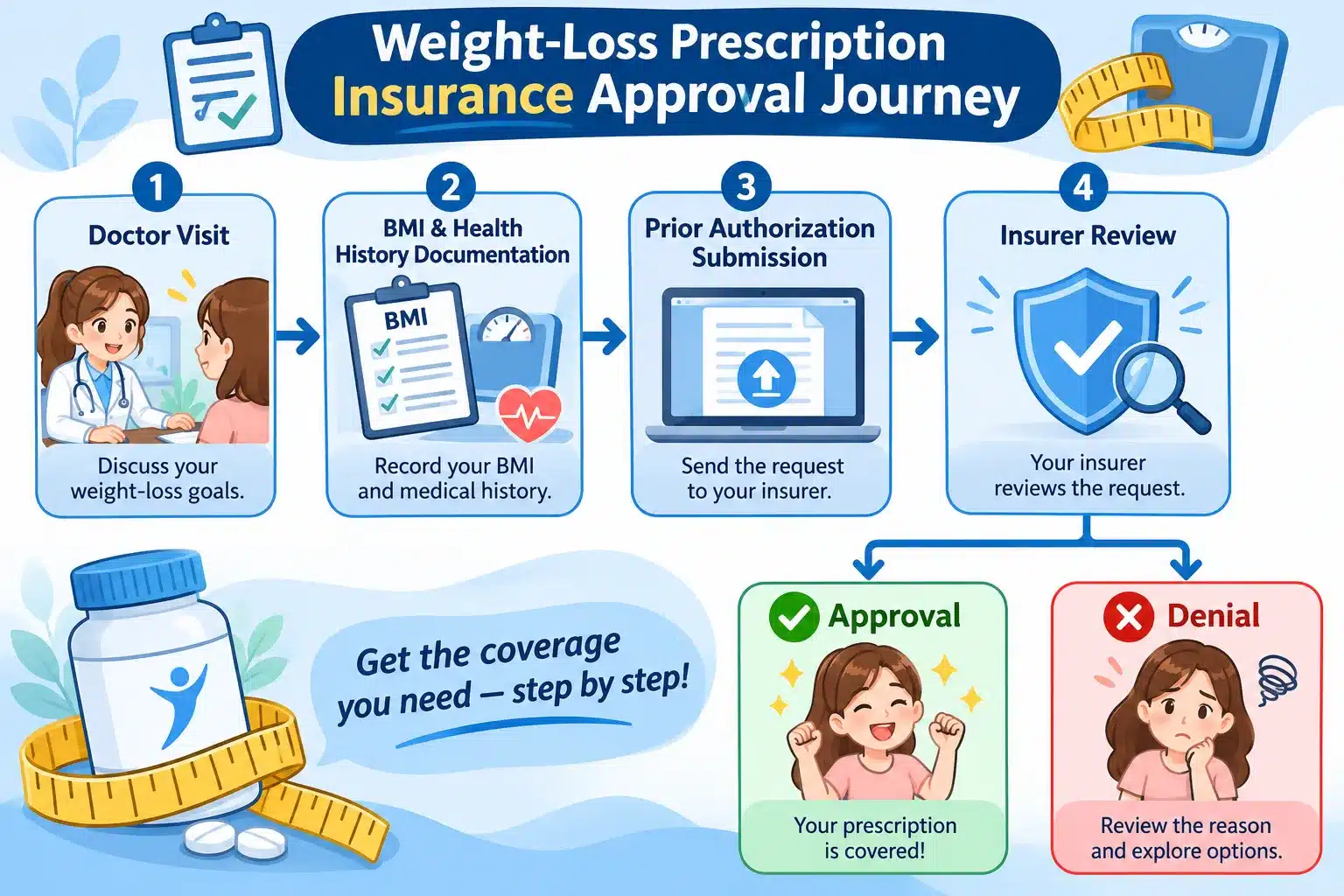
Example: UnitedHealthcare generally approves an initial 6-month course for BMI 30+, or BMI 27+ with a qualifying condition, then requires proof of at least 5% weight loss to continue coverage for another 12 months.
Mistake to avoid: assuming your BMI alone guarantees coverage. Insurers also check whether your employer included weight-loss drugs in the plan at all, a high BMI means nothing if that benefit was never selected.
How Long Does It Take to Get Zepbound Approved by Insurance
Prior authorization decisions for Zepbound typically take anywhere from a few days to a few weeks, depending on the insurer and how complete your doctor’s paperwork is. Delays usually happen when documentation of diet attempts, BMI, or related health conditions is missing or inconsistent.
Steps that speed up approval:
- Ask your doctor to submit full chart notes documenting BMI and any related conditions.
- Confirm your employer’s plan actually includes weight-loss drug coverage before applying.
- Provide records of prior diet or lifestyle program attempts if required.
- Follow up with the insurer directly if you haven’t heard back in 5-7 business days.
- If denied, request the appeal process in writing immediately, appeals have their own review timelines.
Choose to start this process early if you have an upcoming need, since approvals rarely happen same-day.
How Much Is Zepbound Without Any Insurance
Without insurance, Zepbound carries a list price well above $1,000 per month, though Lilly offers a self-pay option for the Zepbound KwikPen starting at $299 per month for the 2.5 mg starting dose through a savings card.[2]
This self-pay price applies even to patients with no obesity-drug coverage at all, making it a meaningful alternative to paying full list price. For more on navigating costs without coverage, read the most affordable GLP-1 options without insurance and GLP-1s without insurance.
What Weight Loss Alternatives Are Covered if Zepbound Isn’t
If Zepbound isn’t covered, other GLP-1 medications like Wegovy or Ozempic (the latter typically prescribed for diabetes) may be covered under different formulary rules, depending on your plan. Some insurers cover one GLP-1 drug but exclude another based on manufacturer contracts and formulary agreements, not clinical superiority.
Decision rule: if Zepbound is denied, ask your insurer specifically which weight-loss or diabetes medications are on your formulary before assuming none are covered. For related coverage details, see does insurance cover Ozempic and does Kaiser cover GLP-1 for weight loss.
What’s the Difference Between Zepbound and Wegovy for Insurance
Zepbound and Wegovy are both GLP-1-class weight-loss drugs, but they come from different manufacturers (Lilly and Novo Nordisk), which means insurers often negotiate separate formulary deals for each. A plan might cover one and exclude the other purely based on pharmacy benefit manager contracts, not medical necessity.
If your plan denies Zepbound, it’s worth asking specifically whether Wegovy is covered instead, the clinical criteria (BMI thresholds, comorbidity documentation) tend to be similar, but formulary placement can differ sharply between the two.
Is Zepbound Covered by Insurance for Diabetes or Just Weight Loss
Zepbound is FDA-approved for chronic weight management and moderate-to-severe obstructive sleep apnea, not specifically for type 2 diabetes, that’s a key difference from Ozempic or Mounjaro, which share the same active ingredient but target diabetes management.[4]
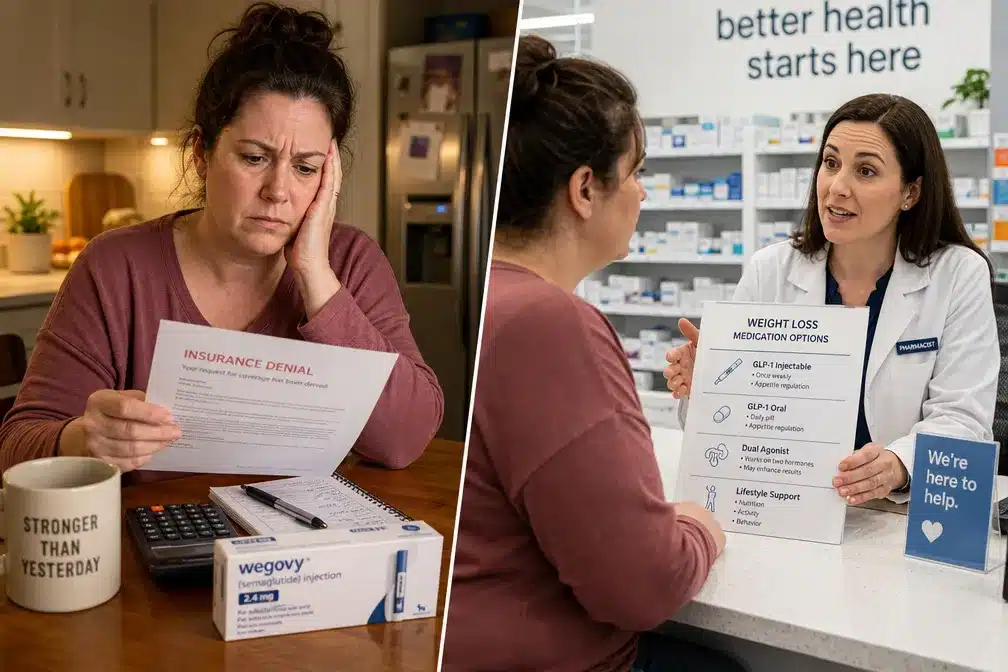
Because of this, insurers typically process Zepbound claims under weight-loss or sleep apnea coverage policies rather than diabetes drug benefits. If you have diabetes and are prescribed tirzepatide, your doctor may prescribe Mounjaro instead, which often falls under different (sometimes more favorable) diabetes drug coverage rules. Check how blood sugar management ties into broader treatment decisions in this guide on what to do with high blood sugar.
What Do You Need to Qualify for Zepbound Insurance Coverage
To qualify for Zepbound coverage, you generally need a BMI of 30+ (or 27+ with a qualifying condition), documentation of prior diet or behavior-change efforts, and an employer plan that includes weight-loss drug benefits.
Checklist to prepare before requesting a prescription:
- Confirm your plan document explicitly lists weight-loss drug coverage.
- Get your BMI measured and documented by your doctor.
- Gather records of any related conditions (hypertension, sleep apnea, PCOS, knee osteoarthritis).
- Document at least 3 months of diet or lifestyle change attempts if your insurer requires it.
- Ask your prescriber to submit prior authorization paperwork promptly and completely.
Why Do Insurance Companies Reject Zepbound Claims So Often
Insurance companies reject Zepbound claims largely because employers are choosing to exclude weight-loss drugs due to cost, not because the drug lacks clinical support. GoodRx’s 2026 tracking shows the share of people with unrestricted coverage dropped to just 4%, while those with no coverage rose to 60%, over 114 million people.
NPR’s April 2026 reporting describes this as “spotty insurance coverage” getting worse, driven by high BMI thresholds and extra documentation requirements insurers use to control utilization and cost. This is a cost-control decision at the plan level, not a reflection of whether Zepbound works.
Can You Buy Zepbound Out of Pocket and Skip Insurance
Yes, you can buy Zepbound out of pocket through Lilly’s self-pay program, which starts at $299 per month for the 2.5 mg KwikPen dose using a savings card, even without any insurance coverage for obesity medicines.[2]
This route makes sense if:
- Your employer plan permanently excludes weight-loss drugs.
- You’ve exhausted the appeals process without success.
- You want to start treatment now rather than wait on prior authorization.
For comparison shopping, review Zepbound online options and general cost breakdowns in the GLP-1 without insurance guide.
Does Blue Cross Blue Shield Cover Zepbound Like Other Insurers
Blue Cross Blue Shield coverage for Zepbound is inconsistent across state plans, making it the least predictable of the four major insurers covered here. Blue Cross Blue Shield of Massachusetts is excluding Zepbound at renewals starting January 1, 2026, and Blue Cross Blue Shield of Michigan already ended weight-loss coverage for fully insured large groups back on January 1, 2025.
On the other hand, FEP Blue (the federal employee program) covers Zepbound with prior approval for eligible federal workers who meet clinical criteria, but again, only where the employer opted into weight-loss coverage. If you have BCBS, don’t assume coverage based on another state’s BCBS plan; call your specific plan administrator and ask directly.
7 Best GLP-1 Providers Ranked: Accreditation, Flexibility & Support Compared (2026 Update)
32,000+ Patients Can't All Be Wrong: See the Top-Rated GLP-1 Providers: Compared on accreditation, plan flexibility, and patient support — updated for 2026.
BMI MD GLP-1 Microdosing Plan
- Specialized microdosing options (sublingual drops or low-dose injections)
- Ideal for maintaining weight or tapering off higher doses safely
- Fully bundled plan with no hidden monthly platform memberships
DirectMeds Weight Loss Solutions
- Sourced from accredited, state-licensed 503A compounding pharmacies
- No-frills high-volume savings passed directly to the patient
- Includes clinical consultation and cold-chain shipping updates
MEDVi Flat-Rate Telehealth
- Flat monthly rate holds steady even at maximum maintenance doses
- No dosage upcharges or graduation fee penalties
- Offers both injectable and advanced oral thin-film delivery options
Gala GLP-1 Care Program
- All-inclusive plan with no standalone membership costs
- Continuous text-based messaging access with state-licensed clinicians
- Temperature-controlled, cold-chain medication shipping included
Measured GLP-1 Metabolic Health
- Comprehensive metabolic health screening and expert intake analysis
- Predictable long-term budgeting with stable plan pricing
- High-end responsive dashboard with integrated diagnostic support
Refills GLP-1 (TryRefills Plan)
- Flat rate holds steady as titration scales up
- Includes clinical guides for active side-effect management
- Bundles in foundational nutritional strategies alongside medication
AltRx GLP-1 Transactional Reorders
- Zero recurring auto-billing — pay entirely on a transactional basis
- Rapid text-to-order format saves time for experienced patients
- Provides both injectable forms and fast-dissolving tablet variations
Conclusion
Figuring out what insurance covers Zepbound? Aetna, Cigna, BCBS & UHC policies each answer differently, and the real deciding factor is almost always your employer’s plan design, not the insurer’s brand name. Aetna and Cigna have reopened formulary access with prior authorization, UnitedHealthcare ties renewal to weight-loss results, and Blue Cross Blue Shield varies so much by state that you need to check your specific plan document rather than general news.
Start by calling your insurer’s member services line and asking two direct questions: does my plan include weight-loss drug coverage, and is Zepbound on my formulary. If the answer is no, ask about alternatives like Wegovy, or consider the self-pay and savings card routes covered here. If you’re denied despite meeting BMI and documentation requirements, file a written appeal immediately, many reversals happen once missing paperwork is corrected. Whatever path you take, confirm current numbers directly with your plan, since coverage rules have shifted multiple times in 2026 alone.
FAQ
Does Aetna require prior authorization for Zepbound?
Yes. Even on plans where Zepbound is on the formulary, Aetna generally requires prior authorization, and approval criteria can vary by employer group.
Will Cigna cover Zepbound without a documented diet history?
Unlikely. Cigna’s 2026 policy requires at least 3 months of documented diet and behavior-change attempts before approving an initial 8-month course.
Does every Blue Cross Blue Shield plan exclude Zepbound?
No. Coverage varies by state and plan; some, like FEP Blue, cover it with prior approval, while others, like BCBS Massachusetts, exclude it starting in 2026.
How does UnitedHealthcare decide whether to continue Zepbound coverage?
UHC approves an initial 6-month course, then renews for 12 more months only if the member shows at least 5% weight loss.
Is Zepbound ever covered for diabetes treatment?
No, Zepbound is approved for weight management and sleep apnea, not diabetes; Mounjaro, the diabetes version of tirzepatide, is prescribed for that purpose instead.[4]
What if my employer never included weight-loss drugs in our plan?
Then no insurer coverage applies, regardless of carrier. Your options are appealing to your employer’s HR benefits team, exploring Wegovy if it’s treated differently, or paying out of pocket.
Can Medicare cover Zepbound?
A new Medicare GLP-1 Bridge program may let eligible Part D patients pay around $50 per month for Zepbound or Foundayo starting July 1, 2026 through December 31, 2027, if they meet CMS criteria.[3]
What’s the cheapest way to get Zepbound without insurance?
Lilly’s self-pay KwikPen program starts at $299 per month for the 2.5 mg dose, which is well below the full list price for uninsured patients.[2]
References
- Cvs Restores Coverage Eli Lilly Obesity Drugs Zepbound Foundayo. fiercepharma.com.
- Media Statement Zepbound Tirzepatide Kwikpen Now Available Self. lilly.gcs-web.com.
- Weight Management. lilly.com.
- Coverage Savings. zepbound.lilly.com.
- Savings. zepbound.lilly.com.
- Access Coverage. zepbound.lilly.com.
- Access Coverage. zepbound.lilly.com.
zepbound insurance coverage, Aetna Zepbound, Cigna Zepbound, Blue Cross Blue Shield weight loss drugs, UnitedHealthcare Zepbound, GLP-1 medication coverage, weight loss drug prior authorization, tirzepatide cost, Zepbound without insurance, obesity medication insurance, BMI requirements insurance, Medicare GLP-1 coverage