
Can You Take GLP 1 While Breastfeeding? Here Is What You Must Know
Last updated: October 4, 2026
Quick Answer: Most medical authorities, including the UK’s Medicines and Healthcare products Regulatory Agency (MHRA), advise against taking GLP-1 medications while breastfeeding because there is not enough human safety data to confirm these drugs are safe for nursing infants [3]. The question of whether you can take GLP-1 while breastfeeding does not have a simple yes or no answer, it depends on the specific drug, your clinical situation, and how your doctor weighs the risks. In most cases, the guidance in 2026 is to delay GLP-1 therapy until after you have stopped breastfeeding.
Key Takeaways
- GLP-1 medications, including semaglutide (Ozempic, Wegovy) and tirzepatide (Mounjaro, Zepbound), are not currently recommended for use while breastfeeding due to limited human safety data.
- Oral semaglutide (Rybelsus) carries an extra concern: its absorption enhancer may cause additional risks and is specifically not recommended during lactation.
- Injectable tirzepatide shows very low or undetectable levels in breast milk in early studies, but drug labels still urge caution and advise against use during breastfeeding.
- No large-scale clinical trials have confirmed GLP-1 safety for nursing infants, making firm conclusions impossible in 2026.
- Most doctors recommend postponing GLP-1 weight loss therapy until after weaning, then reassessing.
- Safe, evidence-backed alternatives for postpartum weight management exist and should be the first line of action for nursing mothers.
- If a mother has type 2 diabetes and requires medication, her doctor may weigh the risks differently, this is a clinical decision, not a self-managed one.
- Always consult an OB-GYN, endocrinologist, or certified lactation consultant before starting or continuing any GLP-1 drug while nursing.
Is It Safe to Take GLP-1 Medications While Breastfeeding?
The short answer: current evidence does not support calling GLP-1 medications safe during breastfeeding. Regulatory bodies and clinical guidance consistently recommend against their use during lactation, primarily because human data is scarce and the potential for infant harm cannot be ruled out [3].
GLP-1 receptor agonists work by mimicking a gut hormone that regulates insulin secretion, appetite, and gastric emptying. They are large peptide molecules, which means they may not transfer into breast milk in large amounts, but “low transfer” is not the same as “no transfer,” and infants have immature digestive and metabolic systems that respond differently to drug exposure than adults do.
Key reasons regulators advise against GLP-1 use during lactation:
- Insufficient human data: Most safety studies excluded pregnant and breastfeeding women.
- Animal study signals: Some preclinical studies showed adverse effects in nursing offspring, though animal data does not always translate directly to humans.
- Infant vulnerability: Newborns and young infants cannot metabolize drugs the same way adults can.
- No established safe dose: There is no defined threshold below which GLP-1 exposure through breast milk is confirmed harmless.
For a broader overview of how these medications work, see our guide to GLP-1 shots explained for weight loss and diabetes.
What GLP-1 Drugs Pass Into Breast Milk?
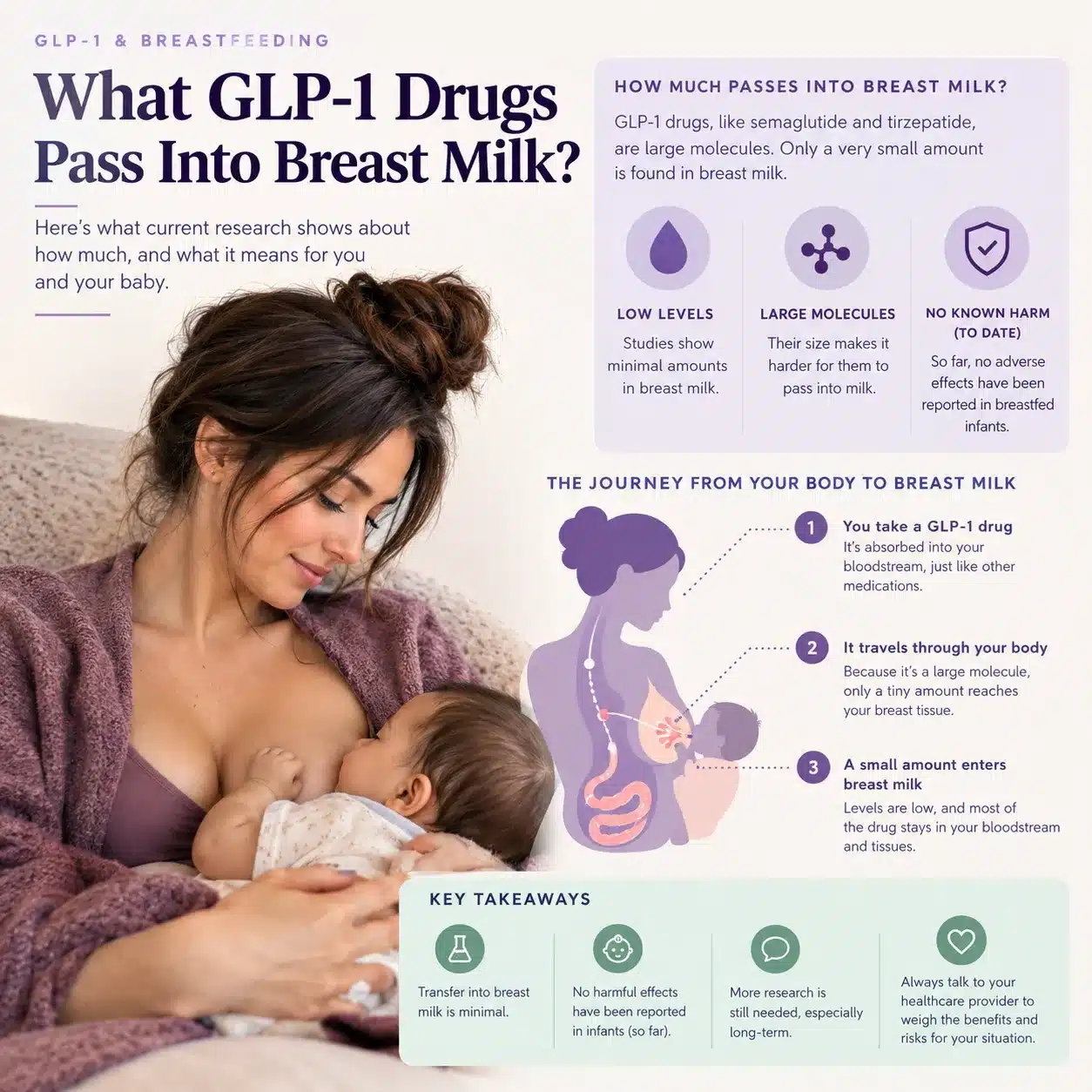
GLP-1 drugs are large peptide molecules, and early data suggests they transfer into breast milk at very low levels, but the research is still limited. The degree of transfer varies by drug, and the clinical significance of even small amounts for a nursing infant is not yet fully understood [6].
Here is what is currently known by drug:
| Drug | Breast Milk Transfer | Current Guidance |
|---|---|---|
| Semaglutide injectable (Ozempic, Wegovy) | Very low; limited human data | Not recommended during breastfeeding [3] |
| Oral semaglutide (Rybelsus) | Unknown; absorption enhancer adds risk | Specifically not recommended [3] |
| Tirzepatide (Mounjaro, Zepbound) | Very low to undetectable in early studies | Caution advised; avoid if possible [7] |
| Liraglutide (Victoza, Saxenda) | Low; limited human data | Avoid during lactation [4] |
| Dulaglutide (Trulicity) | Very low molecular transfer expected | Not recommended; insufficient data [9] |
Important edge case: Even if a drug shows minimal milk transfer, the infant’s gut absorption of that drug is a separate question. Some peptides are broken down in the infant’s gut before reaching the bloodstream, but this has not been confirmed for all GLP-1 agents in all infant age groups.
Ozempic, Semaglutide, and Breastfeeding Safety
Semaglutide, sold as Ozempic for diabetes and Wegovy for weight loss, is not recommended during breastfeeding. The UK government’s official guidance explicitly lists semaglutide among GLP-1 medicines that should not be used while nursing [3].
The Breastfeeding Network, a UK-based clinical resource, similarly advises that semaglutide should be avoided during breastfeeding, noting that data from human lactation studies is insufficient to confirm safety [1].
For oral semaglutide (Rybelsus), there is an additional layer of concern. The tablet contains sodium N-(8-[2-hydroxybenzoyl]amino)caprylate (SNAC), an absorption enhancer that helps the drug survive stomach acid. This compound has its own unknown profile in breast milk and adds to the reasons why oral semaglutide is specifically singled out as not appropriate during lactation [3].
If you were taking semaglutide before becoming pregnant or before starting to breastfeed, talk to your prescriber before resuming the medication. Do not restart on your own. For more on semaglutide dosing considerations, see our semaglutide injections dosage guide.
Mounjaro and Tirzepatide: Is Breastfeeding Safe?
Tirzepatide (Mounjaro for diabetes, Zepbound for weight loss) shows very low or undetectable levels in breast milk in early studies, but its prescribing label still advises against use during breastfeeding. The drug’s Canadian product monograph states it should not be used while breastfeeding because it is unknown whether tirzepatide is excreted in human milk and what effect it might have on the nursing infant [10].
Hale’s Medications & Mothers’ Milk, a widely used clinical lactation reference, classifies tirzepatide as probably compatible with breastfeeding based on its low milk transfer, but recommends caution, particularly with exclusive breastfeeding of newborns [2]. LactMed, the National Institutes of Health’s lactation database, takes a similar position: the data is not sufficient for a firm safety conclusion.
The drugs.com monograph for tirzepatide notes that animal studies showed reduced body weight gain in nursing offspring, which adds to the precautionary stance [7].
Bottom line for tirzepatide: It may be the most “breastfeeding-compatible” GLP-1 option if therapy is truly necessary, but this is a clinical judgment, not a green light for self-prescribing.
Clinical Studies on GLP-1 Breast Milk Transfer
As of 2026, clinical data on GLP-1 transfer into human breast milk is limited to small case series and observational reports, no large randomized trials exist. A 2025 review published in a peer-reviewed journal found that available human series suggest minimal drug transfer to milk and no documented short-term infant harms, but the sample sizes were too small to draw firm conclusions [6].
What the emerging data shows:
- GLP-1 receptor agonists are large peptide molecules with high protein binding, which generally limits their passage into breast milk.
- Even when trace amounts appear in milk, oral bioavailability in infants may be low because the drugs are likely degraded in the infant’s gut.
- No published case reports document acute adverse effects in nursing infants whose mothers were taking GLP-1 medications, but systematic surveillance has not been conducted.
The gap in evidence is the problem. “No reported harms” is not the same as “confirmed safe.” The expert consensus in 2026 is that more data is needed before any GLP-1 drug can be declared safe for breastfeeding mothers.
GLP-1 Side Effects on Baby Through Breast Milk
No confirmed adverse effects in nursing infants have been documented in published literature, but the absence of evidence is not evidence of absence. Theoretical concerns include effects on the infant’s developing gut, appetite regulation, and blood sugar [5].
Potential theoretical risks if GLP-1 drugs do reach the infant through milk:
- Reduced appetite or feeding: GLP-1 suppresses appetite; even small doses could theoretically reduce an infant’s desire to feed.
- Hypoglycemia: GLP-1 drugs affect insulin secretion; effects on infant blood sugar are unknown.
- Gastrointestinal effects: Nausea, vomiting, and delayed gastric emptying are common adult side effects; infant susceptibility is unknown.
- Long-term developmental effects: Completely unknown; no follow-up data exists.
Clinical focus in 2026 is shifting toward maternal nutrition and infant monitoring rather than relying solely on milk drug level measurements. If a mother does use a GLP-1 drug while breastfeeding under medical supervision, monitoring the infant’s weight gain, feeding patterns, and general well-being is considered essential.
How Long After Stopping GLP-1 Can You Breastfeed? (And Stopping Before Breastfeeding: How Long?)
There is no officially established washout period for GLP-1 drugs before breastfeeding, but the drug’s half-life provides a practical reference point. Semaglutide has a half-life of approximately one week, meaning it takes roughly five half-lives (about five weeks) to clear most of the drug from the body [8]. Tirzepatide has a similar half-life of approximately five days [7].
Practical guidance based on pharmacokinetics:
- Semaglutide (Ozempic/Wegovy): Allow at least 4 to 8 weeks after the last dose before breastfeeding, though no official guidance specifies an exact interval.
- Tirzepatide (Mounjaro/Zepbound): Similar 4 to 6 week washout is a reasonable estimate based on half-life data.
- Oral semaglutide (Rybelsus): Shorter half-life than injectable forms, but the absorption enhancer adds uncertainty.
Edge case: If you were taking a GLP-1 drug for type 2 diabetes management and need to restart after delivery, discuss timing carefully with your endocrinologist. Stopping diabetes medication abruptly carries its own risks.
For context on how semaglutide is formulated and delivered, see our overview of semaglutide oral tablets (Rybelsus).
What Do Doctors Recommend for Weight Management While Breastfeeding?
Most doctors recommend postponing GLP-1 weight loss therapy until after weaning and focusing on evidence-backed nutrition and activity strategies in the meantime. GLP-1 postpartum weight loss is a legitimate goal, but the method matters when you are nursing.
Clinically supported alternatives for postpartum weight management while breastfeeding:
- Caloric balance without severe restriction: Breastfeeding itself burns roughly 300 to 500 calories per day. A modest caloric deficit of 300 to 500 calories below maintenance is generally considered safe for nursing mothers, though very low-calorie diets can reduce milk supply.
- Protein-forward eating: Higher protein intake supports satiety and preserves lean mass during postpartum weight loss.
- Gradual return to exercise: Starting with walking and progressing to resistance training after clearance from your OB is well-supported.
- Sleep optimization: Poor sleep drives appetite dysregulation and weight retention. If sleep is a struggle postpartum, addressing it is a legitimate part of weight management. Our guide on what to do when you can’t sleep may help.
- Blood sugar management: Stabilizing blood glucose through diet reduces cravings and supports metabolic health. See our resource on best supplements for blood sugar control for evidence-based options.
- Metformin: For mothers with type 2 diabetes or insulin resistance, metformin has a longer safety record during lactation than GLP-1 drugs, though it is not a weight loss drug per se. Read more about why some doctors are reconsidering metformin.
When GLP-1 therapy is appropriate after weaning: Once you have stopped breastfeeding, GLP-1 medications become a viable option for postpartum weight management. To understand the cost landscape before you start, see our GLP-1 price per month comparison for Wegovy, Zepbound, and new oral options.
GLP-1 Diabetes Medication and Breastfeeding Compatibility
For mothers who need GLP-1 drugs specifically to manage type 2 diabetes, not just for weight loss, the risk-benefit calculation is more complex. In this context, the risks of uncontrolled blood sugar to both mother and infant may outweigh the theoretical risks of drug exposure through breast milk [9].
The NHS Specialist Pharmacy Service notes that for GLP-1 receptor agonists used in diabetes management, the decision to use during lactation should be individualized, weighing maternal disease control against infant exposure risk [9]. The Breastfeeding Network similarly acknowledges that diabetes management needs may justify a different approach than weight loss use [1].
If you have type 2 diabetes and are breastfeeding:
- Do not stop your diabetes medication without medical supervision.
- Ask your endocrinologist or OB whether a GLP-1 drug is necessary or whether insulin or metformin could serve as a safer alternative during lactation.
- If a GLP-1 drug is deemed necessary, prefer an injectable over oral semaglutide.
- Monitor your infant’s weight, feeding behavior, and growth at every well-baby visit.
GLP-1 Weight Loss Options for Postpartum Nursing Mothers: What to Expect After Weaning
Once you stop breastfeeding, GLP-1 medications become a realistic and effective option for postpartum weight loss. The postpartum period is often when women first seek medical support for weight they retained during pregnancy, and GLP-1 therapy can be highly effective in this context.
What to expect when starting GLP-1 therapy after weaning:
- Onset of action: Appetite suppression typically begins within the first week, though meaningful weight loss usually takes 4 to 12 weeks to become visible.
- Dose escalation: Most GLP-1 protocols start at a low dose and increase gradually to minimize nausea and GI side effects.
- Cost considerations: GLP-1 medications can be expensive without insurance. Compounding pharmacies offer lower-cost alternatives in some cases. See our guide to what a compounding pharmacy GLP-1 is and how it works and our breakdown of least expensive GLP-1 options for weight loss.
- Realistic outcomes: Clinical trials show average weight loss of 10 to 20 percent of body weight over 12 to 18 months with semaglutide or tirzepatide, combined with lifestyle changes.
Frequently Asked Questions
Can I take Ozempic while breastfeeding?
No. Ozempic (semaglutide) is not recommended during breastfeeding. The UK government and most clinical guidelines advise against it due to insufficient safety data for nursing infants [3].
Can I take Wegovy while nursing?
No. Wegovy is the same active ingredient as Ozempic (semaglutide) at a higher dose. The same restrictions apply. Delay use until after you have stopped breastfeeding.
Is tirzepatide safer than semaglutide during breastfeeding?
Early data shows tirzepatide transfers into breast milk at very low or undetectable levels, which is somewhat reassuring. However, its label still advises against breastfeeding during use, and the data is not sufficient to call it “safe” [7][10].
How long should I wait after stopping semaglutide before breastfeeding?
Based on semaglutide’s half-life of approximately one week, waiting at least four to eight weeks after the last dose is a reasonable precaution, though no official washout period has been established [8].
What weight loss options are safe while breastfeeding?
A moderate caloric deficit, high-protein diet, gradual exercise, and blood sugar management are the safest approaches. GLP-1 drugs should be deferred until after weaning in most cases.
Does breastfeeding itself help with postpartum weight loss?
Yes. Breastfeeding burns an estimated 300 to 500 calories per day and can support gradual postpartum weight loss, though results vary considerably between individuals.
Can GLP-1 drugs reduce my milk supply?
This is unknown. GLP-1 drugs suppress appetite, and if a mother eats significantly less while nursing, caloric restriction could potentially affect milk production. This is another reason to avoid GLP-1 use during active breastfeeding.
What if I accidentally took a GLP-1 dose while breastfeeding?
Contact your prescriber or a lactation consultant promptly. A single accidental dose is unlikely to cause serious harm, but you should seek guidance rather than continue dosing without medical oversight.
Are compounded GLP-1 medications safer during breastfeeding?
No. Compounded versions of semaglutide or tirzepatide carry the same active ingredient and the same lactation concerns as branded versions. The same restrictions apply.
When can I restart GLP-1 therapy after having a baby?
Once you have fully stopped breastfeeding and your milk supply has ceased, you can discuss restarting GLP-1 therapy with your doctor. There is no mandated waiting period after weaning is complete.
Does the type of GLP-1 drug matter for breastfeeding decisions?
Yes. Injectable GLP-1s are generally preferred over oral semaglutide if therapy is considered necessary during lactation, because oral semaglutide contains an absorption enhancer with its own unknown safety profile [3].
Should I tell my doctor I am breastfeeding before starting a GLP-1?
Absolutely. This is one of the most important pieces of information your prescriber needs. Always disclose breastfeeding status before starting any new medication.
Conclusion
The question of whether you can take GLP-1 while breastfeeding comes down to a clear but nuanced answer: current guidance says no for most mothers, and for good reason. The evidence base is still thin, regulatory bodies across the US and UK advise against it, and the theoretical risks to a nursing infant are not trivial even if drug transfer into milk is low.
That said, the science is evolving. Tirzepatide’s early lactation data is more reassuring than older GLP-1 agents, and the clinical community is increasingly distinguishing between different drugs rather than treating the entire class identically. More studies are underway, and guidance will likely become more nuanced over the next few years.
Actionable next steps if you are a breastfeeding mother concerned about weight management:
- Do not self-prescribe GLP-1 medications while nursing. Consult your OB-GYN, endocrinologist, or a certified lactation consultant first.
- Focus on safe postpartum strategies now: moderate caloric deficit, protein-forward eating, gradual exercise, and blood sugar stabilization.
- Plan ahead: Set a target date for when you intend to wean, and schedule a conversation with your doctor about GLP-1 options at that point.
- If you have diabetes: Do not stop existing medication without guidance. Work with your care team to find the safest diabetes management approach during lactation.
- Stay informed: The evidence landscape for GLP-1 breastfeeding safety is changing. Check back with your provider and trusted resources regularly.
Your postpartum health matters. Waiting a few months to start GLP-1 therapy after weaning is a small delay for a much safer outcome.
References
[1] Diabetes – https://www.breastfeedingnetwork.org.uk/factsheet/diabetes/
[3] GLP-1 Medicines For Weight Loss And Diabetes What You Need To Know – https://www.gov.uk/government/publications/glp-1-medicines-for-weight-loss-and-diabetes-what-you-need-to-know/glp-1-medicines-for-weight-loss-and-diabetes-what-you-need-to-know
[4] NBK581488 – https://www.ncbi.nlm.nih.gov/books/NBK581488/
[5] US Mothers GLP-1 Drugs Diabetes Weight Loss – https://www.independent.co.uk/news/health/us-mothers-glp1-drugs-diabetes-weight-loss-b3059985.html
[6] PMC13261203 – https://pmc.ncbi.nlm.nih.gov/articles/PMC13261203/
[7] Tirzepatide – https://www.drugs.com/monograph/tirzepatide.html
[8] 215866s000lbl – https://www.accessdata.fda.gov/drugsatfda_docs/label/2022/215866s000lbl.pdf
[9] Considerations And Interactions With GLP-1 Receptor Agonists – https://sps.nhs.uk/articles/considerations-and-interactions-with-glp-1-receptor-agonists/
[10] Mounjaro CA PM – https://pi.lilly.com/ca/mounjaro-ca-pm.pdf

With over 13 years of experience in holistic health blogging, I aim to help you navigate your wellness journey with honest insights, expert-backed advice, and a sprinkle of real-world practicality.
Certified Wellness Writer | Herbal Nutrition Advocate | Wellness Research Enthusiast


