
Compounded Semaglutide Injections Rx – Complete Guide 2026
Last updated: August 10, 2026
Quick Answer: Compounded semaglutide injections Rx refers to a prescription-only, pharmacy-prepared version of the active ingredient in Ozempic and Wegovy, made by licensed compounding pharmacies. It works the same way as the brand-name drugs, suppressing appetite and slowing digestion through GLP-1 receptor activation, but typically costs 60-80% less. You need a valid prescription from a licensed provider to obtain it legally.
Key Takeaways
- Compounded semaglutide injections Rx require a prescription from a licensed healthcare provider, you cannot legally buy them over the counter.
- Compounding pharmacies prepare these injections in-house, which means they are not FDA-approved as finished drug products, though the active ingredient (semaglutide) is an FDA-recognized compound.
- Cost typically ranges from $150 to $400 per month, compared to $900,$1,300+ for brand-name Ozempic or Wegovy without insurance.
- Most patients begin to see measurable weight loss results within 4-8 weeks, with significant results at 12-16 weeks.
- Common side effects include nausea, constipation, and fatigue, most are mild and improve after the first few weeks.
- People with a personal or family history of medullary thyroid carcinoma or MEN2 syndrome should not use semaglutide in any form.
- Compounded semaglutide is not covered by most insurance plans or Medicare, though HSA and FSA funds may apply.
- Storage matters: most compounded semaglutide vials require refrigeration and are stable for 28-90 days depending on the formulation.
- Telehealth platforms have made getting a prescription faster and more accessible than ever in 2026.
- The FDA’s position on compounded semaglutide has shifted in 2026, staying current on regulations is essential before you start.
What Is Compounded Semaglutide and How Does It Work
Compounded semaglutide is a version of the drug semaglutide prepared by a licensed compounding pharmacy, rather than manufactured by a pharmaceutical company like Novo Nordisk. It contains the same active molecule that makes Ozempic and Wegovy effective for blood sugar control and weight loss.
Semaglutide is a GLP-1 receptor agonist. GLP-1 (glucagon-like peptide-1) is a hormone your gut naturally releases after you eat. It signals your brain to feel full, slows how quickly food leaves your stomach, and reduces the liver’s glucose output. Semaglutide mimics this hormone, but with a much longer half-life, roughly one week, which is why it’s dosed as a once-weekly injection.
How the mechanism plays out practically:
- You feel full sooner and stay full longer after meals.
- Cravings, especially for high-calorie foods, often decrease noticeably.
- Blood sugar spikes after eating are blunted.
- Over time, a consistent caloric deficit leads to meaningful weight loss.
Compounded versions deliver the same active ingredient through the same subcutaneous injection method. The difference is in the manufacturing source and, in some cases, added ingredients like vitamin B12 or cyanocobalamin, which some compounders include to reduce injection-site discomfort or support energy levels. For more on that combination, see our guide on semaglutide B12 compounding benefits.
Compounded Semaglutide vs Brand-Name Ozempic: What’s the Real Difference
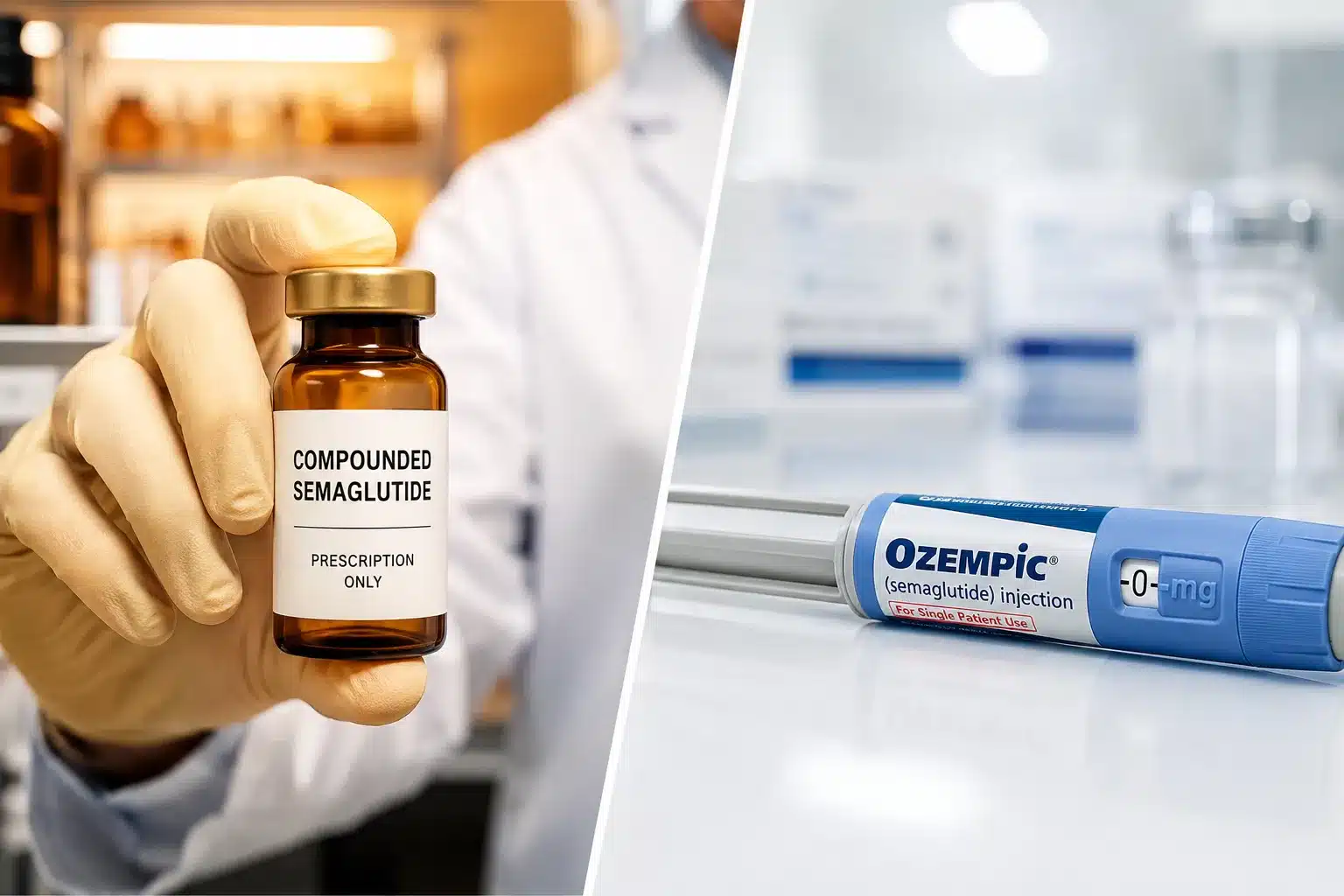
Compounded semaglutide and brand-name Ozempic or Wegovy contain the same active ingredient, but they differ in manufacturing oversight, regulatory status, and cost. Brand-name products go through FDA’s full approval process for safety, efficacy, and manufacturing quality. Compounded versions do not, they are prepared under Section 503A or 503B of the Federal Food, Drug, and Cosmetic Act.
Here’s a direct comparison:
| Feature | Compounded Semaglutide | Brand-Name (Ozempic/Wegovy) |
|---|---|---|
| Active ingredient | Semaglutide | Semaglutide |
| FDA-approved finished product | No | Yes |
| Monthly cost (est., no insurance) | $150,$400 | $900,$1,300+ |
| Requires prescription | Yes | Yes |
| Dosing flexibility | High (custom doses) | Fixed pen doses |
| Additives possible | Yes (e.g., B12) | No |
| Insurance coverage | Rarely | Sometimes |
The practical implication: if you respond well to semaglutide and cost is a barrier, compounded versions offer a real, accessible alternative. If you want the highest manufacturing consistency and FDA oversight, brand-name products are the standard. For a deeper breakdown, read our compounded vs brand semaglutide pros, cons, and costs comparison.
Is Compounded Semaglutide FDA Approved and Safe
Compounded semaglutide injections are not FDA-approved as finished drug products, but that statement needs context. The FDA does not approve compounded medications the same way it approves manufactured drugs. What matters legally is whether the pharmacy is operating under valid compounding regulations and whether the active ingredient meets USP standards.
What “safe” actually means here:
- Reputable 503A and 503B compounding pharmacies are inspected and must follow Current Good Manufacturing Practice (CGMP) guidelines.
- The semaglutide base compound used by accredited pharmacies is sourced from FDA-registered API (active pharmaceutical ingredient) suppliers.
- Risks rise significantly when medications come from unaccredited or overseas sources, these should be avoided entirely.
The FDA issued updated guidance in 2025 and 2026 regarding the shortage status of semaglutide, which directly affects the legal landscape for compounders. Because Ozempic and Wegovy were on the FDA drug shortage list, compounding was permitted under federal law. As shortage status changes, so does legal permissibility. Stay current with our FDA rules on compounded semaglutide 2026 update for the latest.
Choose a compounding pharmacy that:
- Is accredited by PCAB (Pharmacy Compounding Accreditation Board)
- Provides a Certificate of Analysis (COA) for each batch
- Is licensed in your state
- Requires a valid prescription
How Much Does Compounded Semaglutide Cost Without Insurance
Without insurance, compounded semaglutide injections typically cost between $150 and $400 per month, depending on the dose, provider, and pharmacy. This compares to $900,$1,300+ per month for brand-name Ozempic or Wegovy at retail prices.
Factors that affect your monthly cost:
- Dose level: Higher doses (1.7 mg or 2.4 mg weekly) cost more than starter doses (0.25 mg).
- Pharmacy source: Telehealth platforms bundle the consultation fee, which can add $50,$100/month.
- Subscription vs. one-time: Monthly subscription programs often reduce per-vial cost.
- Added ingredients: Formulations with B12 or other compounds may cost slightly more.
For a full breakdown by provider and dose, see our compounding pharmacy semaglutide cost breakdown and our guide on how much semaglutide costs in 2026.
HSA and FSA accounts can typically be used to pay for compounded semaglutide when prescribed for a qualifying medical condition (obesity or type 2 diabetes). Always confirm with your plan administrator.
Where Can I Get a Prescription for Compounded Semaglutide Injections Rx
You can get a prescription for compounded semaglutide injections Rx through your primary care physician, an endocrinologist, a weight loss specialist, or a telehealth platform. Telehealth has become the most common route in 2026 because it’s faster, often cheaper for the consultation, and ships directly to your door.
The typical process looks like this:
- Complete an online intake form or schedule a telehealth visit.
- A licensed provider reviews your health history, BMI, and any contraindications.
- If appropriate, the provider issues a prescription to a partnered compounding pharmacy.
- The pharmacy prepares and ships your medication (usually within 3-7 business days).
- You self-inject once weekly at home.
Telehealth platforms that commonly offer this include:
- Hims/Hers (see our Hims semaglutide review)
- Henry Meds (see our Henry Meds semaglutide review)
- Ivy Rx (see our Ivy Rx GLP-1 review)
To qualify, most providers require a BMI of 27 or higher with at least one weight-related condition, or a BMI of 30 or higher without additional conditions, mirroring the clinical criteria for Wegovy.
Compounded Semaglutide Injection Side Effects: What to Expect
The most common side effects of compounded semaglutide are gastrointestinal: nausea, vomiting, diarrhea, and constipation. These are the same side effects reported with brand-name Ozempic and Wegovy because the active molecule is identical.
Side effects by frequency:
- Very common (reported by 20-40% of users): Nausea, especially in the first 2-4 weeks
- Common: Constipation, fatigue, headache, reduced appetite
- Less common: Vomiting, diarrhea, acid reflux, dizziness
- Rare but serious: Pancreatitis, gallbladder disease, severe allergic reaction
Most GI side effects peak in the first month and improve significantly as your body adjusts. Starting at a low dose (0.25 mg/week) and titrating slowly is the most effective way to reduce early discomfort.
Practical tips to manage side effects:
- Eat smaller meals and avoid high-fat foods during the first few weeks.
- Stay well hydrated, dehydration worsens nausea.
- Inject in the evening so peak nausea occurs while you sleep.
- Avoid lying down immediately after eating.
If you experience severe abdominal pain, persistent vomiting, or signs of an allergic reaction, stop the medication and seek medical care immediately.
How to Inject Compounded Semaglutide at Home: Step by Step
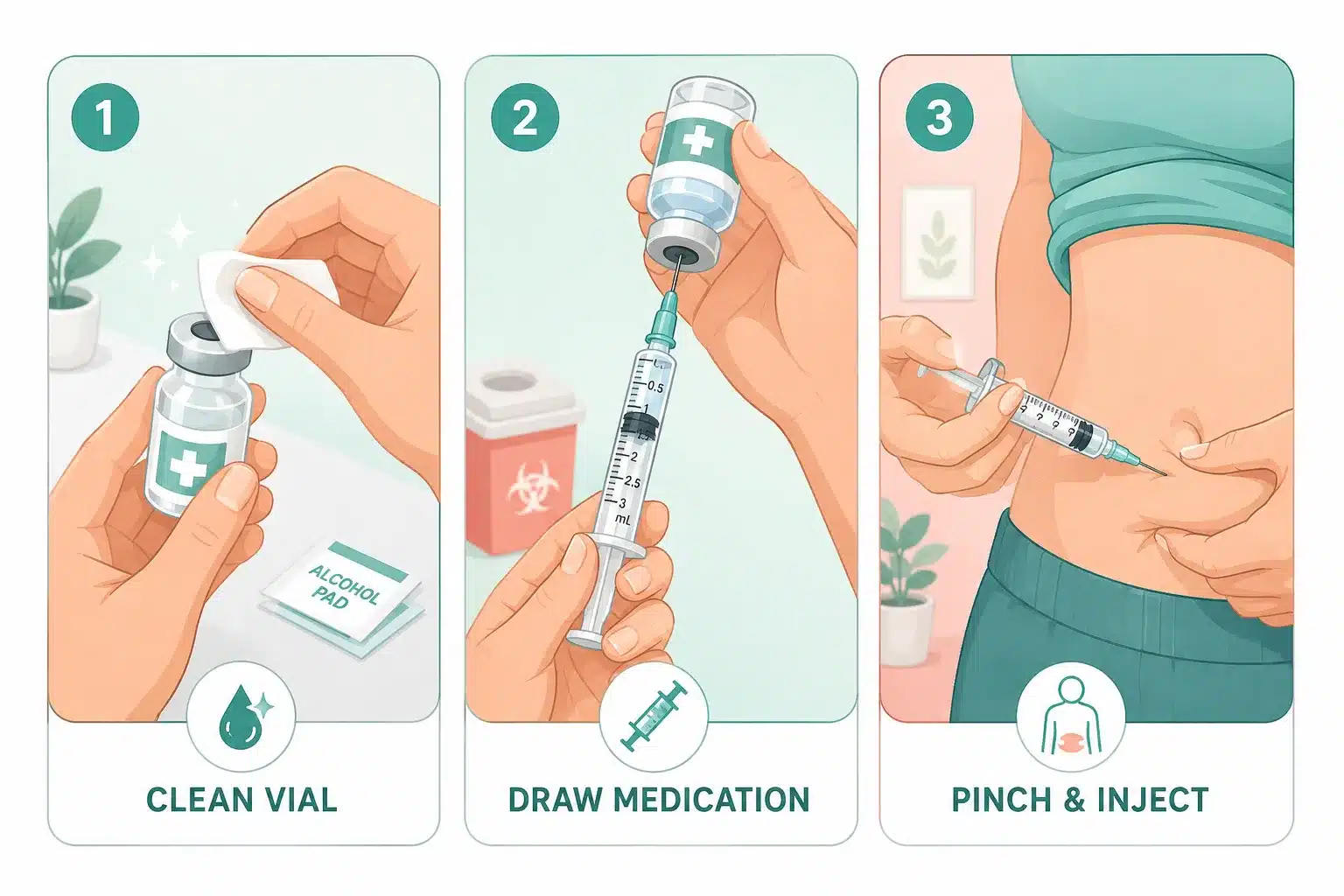
Injecting compounded semaglutide at home is straightforward once you’ve done it once or twice. It’s a subcutaneous injection, meaning it goes into the fatty tissue just under the skin, not into muscle.
What you’ll need:
- Your compounded semaglutide vial
- Insulin syringes (typically 29-31 gauge, 0.3 mL or 0.5 mL)
- Alcohol swabs
- A sharps disposal container
Step-by-step injection process:
- Wash your hands thoroughly with soap and water.
- Inspect the vial, the solution should be clear and colorless. Do not use if cloudy or discolored.
- Wipe the vial top with an alcohol swab and let it dry for 10 seconds.
- Draw the correct dose into the syringe. Your provider will specify the volume in milliliters (e.g., 0.25 mg may equal 0.05 mL depending on concentration, always confirm with your pharmacy).
- Choose your injection site: abdomen (at least 2 inches from the navel), outer thigh, or upper arm. Rotate sites weekly.
- Clean the site with an alcohol swab and let it dry.
- Pinch the skin gently and insert the needle at a 45-90 degree angle.
- Inject slowly, then withdraw the needle and apply light pressure with a clean swab.
- Dispose of the needle in your sharps container immediately.
For detailed dosing guidance, see our semaglutide injections dosage guide. Common mistake: drawing the wrong volume because you confused concentration with dose. Always double-check the mg/mL concentration on your vial label against your prescribed dose in milligrams.
Compounded Semaglutide Not Working: Why Am I Not Losing Weight
If you’ve been on compounded semaglutide for 8-12 weeks and haven’t lost meaningful weight, the most likely explanations are underdosing, incorrect injection technique, diet not adjusted, or a product quality issue. This is more common than most people expect.
Most frequent reasons compounded semaglutide underperforms:
- Dose too low: Many patients need to titrate up to 1.0 mg or higher before seeing significant results. If you’re still at 0.25 mg after 8 weeks, talk to your provider.
- Injection technique error: Injecting into muscle instead of fat, or into scar tissue, reduces absorption. Rotate sites and use the pinch method.
- Diet unchanged: Semaglutide reduces hunger but doesn’t override a high-calorie diet. You still need a caloric deficit.
- Product potency issue: Not all compounding pharmacies maintain the same quality. If you suspect a potency problem, ask your pharmacy for a Certificate of Analysis.
- Thyroid or metabolic condition: Undiagnosed hypothyroidism, PCOS, or insulin resistance can blunt results. Ask your provider to run labs.
Decision rule: If you’ve been on a therapeutic dose (0.5 mg or higher) for 12 weeks with no weight change and no appetite suppression, discuss switching pharmacies or transitioning to a brand-name product with your provider.
Who Should Not Take Compounded Semaglutide: Contraindications
Compounded semaglutide injections Rx are not appropriate for everyone. Certain medical conditions and medications create serious safety risks.
Absolute contraindications (do not use):
- Personal or family history of medullary thyroid carcinoma (MTC)
- Multiple Endocrine Neoplasia syndrome type 2 (MEN2)
- Known hypersensitivity to semaglutide or any component of the formulation
- Pregnancy or active breastfeeding
Use with caution (discuss with your provider):
- History of pancreatitis
- Diabetic retinopathy
- Severe gastrointestinal disease (e.g., gastroparesis)
- History of gallbladder disease
- Taking insulin or other blood sugar-lowering medications (hypoglycemia risk)
- Kidney disease (monitor closely during dose escalation)
Who is a good candidate:
- Adults with BMI 30+ (obesity)
- Adults with BMI 27+ and at least one weight-related condition (hypertension, type 2 diabetes, sleep apnea)
- Adults with type 2 diabetes seeking better glycemic control alongside lifestyle changes
Compounded Semaglutide vs Tirzepatide: Which Is Better
Compounded semaglutide and compounded tirzepatide are both effective GLP-1-based weight loss injections, but tirzepatide adds a second mechanism (GIP receptor agonism) that may produce greater weight loss in some patients. Clinical trial data for brand-name tirzepatide (Zepbound) showed average weight loss of around 20-22% of body weight at 72 weeks, higher than the approximately 15% seen with semaglutide (Wegovy) in its pivotal trials.
Choose compounded semaglutide if:
- You want a longer track record of real-world use
- You’re sensitive to side effects and want to start conservatively
- Cost is the primary concern (semaglutide is generally slightly cheaper)
Choose compounded tirzepatide if:
- You’ve tried semaglutide without adequate results
- Your provider recommends the dual-agonist mechanism for your metabolic profile
- You want the highest average weight loss potential
Both require a prescription and are available through similar telehealth channels. For a full side-by-side, see our difference between semaglutide and tirzepatide guide and our compounded tirzepatide overview.
Common Mistakes People Make With Compounded Semaglutide Dosing
The most dangerous and common mistake with compounded semaglutide dosing is unit confusion, misreading the concentration on the vial and drawing 10 times the intended dose. This is a real risk because compounded vials come in varying concentrations (e.g., 2.5 mg/mL, 5 mg/mL, or 10 mg/mL), and the prescribed dose is in milligrams, not milliliters.
Other common dosing mistakes:
- Skipping the titration schedule: Jumping to a high dose too quickly dramatically increases nausea and vomiting risk.
- Doubling up after a missed dose: If you miss your weekly injection by more than 5 days, skip it and resume the following week, don’t double dose.
- Not rotating injection sites: Repeated injections in the same spot cause lipohypertrophy (fatty lumps), which reduces absorption.
- Storing incorrectly: Leaving the vial at room temperature for extended periods degrades potency.
- Using expired medication: Compounded vials have shorter stability windows than commercial products.
Quick reference, dose volume calculation:
If your vial is 5 mg/mL and your dose is 0.5 mg, you inject 0.1 mL. Always do this calculation before drawing up your dose, and confirm it with your pharmacy if you’re unsure.
How Long Does Compounded Semaglutide Take to Work: Results Timeline
Most people notice appetite suppression within the first 1-2 weeks of starting compounded semaglutide, even at the starter dose. Measurable weight loss typically begins at weeks 4-8, with the most significant changes occurring between weeks 12 and 24.
General results timeline:
| Timeframe | What to Expect |
|---|---|
| Week 1-2 | Reduced appetite, possible nausea |
| Week 4-8 | 2-5 lbs weight loss at starter dose |
| Week 12-16 | 5-10% body weight loss at therapeutic dose |
| Week 24-36 | 10-15%+ body weight loss with adherence |
| Week 52+ | Plateau possible; dose adjustment may help |
Results vary based on starting weight, diet, physical activity, and whether you reach a therapeutic dose. People who make no dietary changes alongside the medication consistently see slower results.
Compounded Semaglutide Storage and Expiration: How Long Does It Last
Compounded semaglutide vials must be refrigerated at 36-46°F (2-8°C) and kept away from light. Once opened, most formulations are stable for 28 to 90 days, depending on the specific compounding formula and preservatives used, your pharmacy will specify the beyond-use date on the label.
Storage rules to follow:
- Never freeze the vial, freezing degrades the peptide.
- Do not leave the vial at room temperature for more than 30 minutes at a time.
- Store in the original packaging to protect from light.
- Do not use if the solution appears cloudy, discolored, or contains visible particles.
- Write the date you opened the vial on the label.
Edge case: If you travel, use an insulated medication travel case with an ice pack. TSA allows injectable medications in carry-on bags with proper labeling.
Is Compounded Semaglutide Covered by Insurance or Medicare
Compounded semaglutide is not covered by most commercial insurance plans or Medicare. Because it is not an FDA-approved finished drug product, it falls outside standard formulary coverage. This is one of the most frustrating aspects for patients who need long-term treatment.
What you can do:
- Use HSA or FSA funds, which typically cover prescribed compounded medications.
- Check if your employer’s health plan has any GLP-1 coverage that might apply.
- Some telehealth platforms offer subscription pricing that reduces the effective monthly cost.
- If you qualify medically, brand-name Wegovy has manufacturer savings programs (Novo Nordisk’s NovoCare) that can reduce out-of-pocket costs significantly for commercially insured patients.
Medicare Part D does not cover weight loss medications as of 2026, though legislative efforts to change this have been ongoing. For people on Medicare seeking GLP-1 therapy for type 2 diabetes, Ozempic (the diabetes indication) has better coverage prospects than Wegovy.

Frequently Asked Questions
Do I need a prescription for compounded semaglutide injections?
Yes. Compounded semaglutide injections Rx are prescription-only medications. Any source offering them without a valid prescription is operating illegally and poses serious safety risks. Always obtain your prescription through a licensed U.S. healthcare provider.
Can I get compounded semaglutide through a telehealth platform?
Yes. Telehealth platforms are the most common way people access compounded semaglutide in 2026. A licensed provider conducts a virtual consultation, issues a prescription if appropriate, and the medication ships from a partner compounding pharmacy directly to your home.
How do I know if my compounding pharmacy is legitimate?
Look for PCAB accreditation, state pharmacy board licensing, and a willingness to provide a Certificate of Analysis for each batch. Avoid pharmacies that don’t require a prescription or that ship from outside the United States.
Can I use compounded semaglutide if I have type 2 diabetes?
Possibly, but this requires close coordination with your prescribing provider. Semaglutide lowers blood sugar, so patients on insulin or other diabetes medications need careful monitoring to avoid hypoglycemia. Your provider may need to adjust your existing medications.
What happens if I stop taking compounded semaglutide?
Most people regain a significant portion of lost weight within 12 months of stopping, because the appetite-suppressing effect disappears. Semaglutide manages the condition rather than curing it. Discuss a long-term plan with your provider before discontinuing.
Is compounded semaglutide the same strength as Ozempic?
The active ingredient is the same, but compounded formulations come in varying concentrations. Your dose in milligrams should match your prescribed therapeutic dose. The delivery method (vial and syringe vs. pre-filled pen) differs, but the pharmacological effect at the same milligram dose is equivalent.
Can I take compounded semaglutide while pregnant?
No. Semaglutide is contraindicated during pregnancy. If you become pregnant while on the medication, stop it immediately and contact your OB-GYN. Women of childbearing age should use effective contraception while on semaglutide therapy.
How do I dispose of used syringes safely?
Use an FDA-cleared sharps disposal container. Never throw loose needles in household trash or recycling. Many pharmacies and local health departments offer sharps disposal programs. Check the FDA’s Safe Sharps Disposal guidelines for locations near you.
What concentration does compounded semaglutide typically come in?
Common concentrations are 2.5 mg/mL, 5 mg/mL, and 10 mg/mL. The concentration affects how many milliliters you draw for each dose. Always confirm the concentration with your pharmacy and recalculate your injection volume if your pharmacy changes the concentration between refills.
Can I switch from brand-name Ozempic to compounded semaglutide?
Yes, with your provider’s guidance. The transition is straightforward because the active ingredient is the same. Your provider will confirm your current dose and prescribe the equivalent compounded dose. Some patients notice minor differences in tolerability due to formulation differences.
Conclusion
Compounded semaglutide injections Rx offer a genuinely accessible path to the same active treatment found in Ozempic and Wegovy, at a fraction of the cost. The key is doing it right: getting a prescription from a licensed provider, sourcing from an accredited compounding pharmacy, following your dosing schedule carefully, and staying current on the FDA’s evolving regulatory stance.
Your next steps:
- Consult a licensed provider (in-person or via telehealth) to confirm you’re a candidate.
- Verify your pharmacy’s PCAB accreditation and request a Certificate of Analysis.
- Review our semaglutide weight loss injections guide and compounded semaglutide safety and legality overview before you start.
- Set realistic expectations, meaningful results take 12-16 weeks at a therapeutic dose.
The medication works. The process is manageable. The cost barrier is lower than most people realize. Start with a conversation with a qualified provider.

With over 13 years of experience in holistic health blogging, I aim to help you navigate your wellness journey with honest insights, expert-backed advice, and a sprinkle of real-world practicality.
Certified Wellness Writer | Herbal Nutrition Advocate | Wellness Research Enthusiast


